An international team of archaeologists has announced the discovery of projectile points manufactured approximately 80,000 years ago in Kulbulak cave, Uzbekistan. These artefacts, published in the journal Nature Human Behaviour, constitute the oldest known evidence of hafted projectile point manufacture and use in Central Asia, pushing back by several tens of millennia the evidence for such an elaborate technical behaviour in this part of the world1. The discovery reignites the debate on the comparative cognitive capacities of NeanderthalsNeanderthalsA fossil humanity of Eurasia, robust and cold-adapted, extinct around 40,000 years before present.→ and Homo sapiensHomo sapiensThe present-day human species, which emerged in Africa around 300,000 years ago, the only surviving human lineage after the extinction of Neanderthals and Denisovans.→ outside AfricaAfricaThe cradle of humankind: the continent where the first hominins appeared, then Homo sapiens around 300,000 years ago, before the expansion to the rest of the world.→.
Kulbulak, a window into the Central Asian Middle PalaeolithicMiddle PalaeolithicA Palaeolithic period (c. 300,000 to 40,000 years ago) associated mainly with Neanderthals and early Homo sapiens, marked by Levallois tools.→
Kulbulak cave has been known to prehistorians since the 1960s, when Soviet archaeologists conducted the first excavations there. The Middle Palaeolithic levels have yielded MousterianMousterianThe stone-tool industry typical of Neanderthals, based on the Levallois flaking technique.→ lithic assemblages, similar to those produced by Neanderthals in Europe and the Near EastNear EastA region of western Asia (Levant, Mesopotamia, Anatolia, Iran), cradle of the Neolithic revolution, agriculture, the first cities and writing.→. But recent excavations, conducted by a Franco-Uzbek team in partnership with the Institut de Recherche sur l'Homme en Europe (IPHES) and the Academy of Sciences of Uzbekistan, have made it possible to precisely characterise the oldest levels of the sequence, dated between 80,000 and 90,000 years by optically stimulated luminescence (OSL)Luminescence (OSL)Optically stimulated luminescence dating: measures the last exposure of sediment grains to light.→ on quartz sediments.
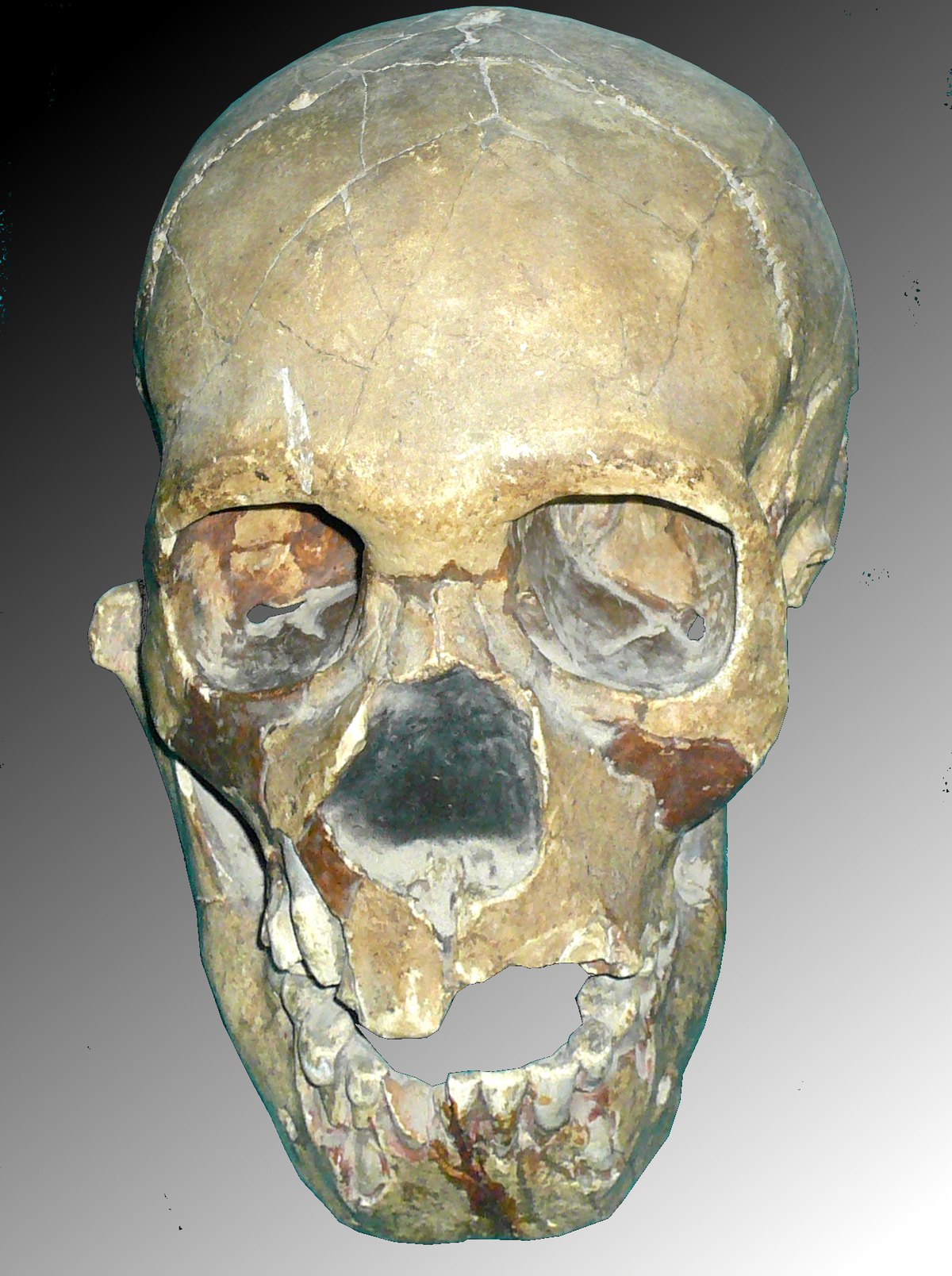
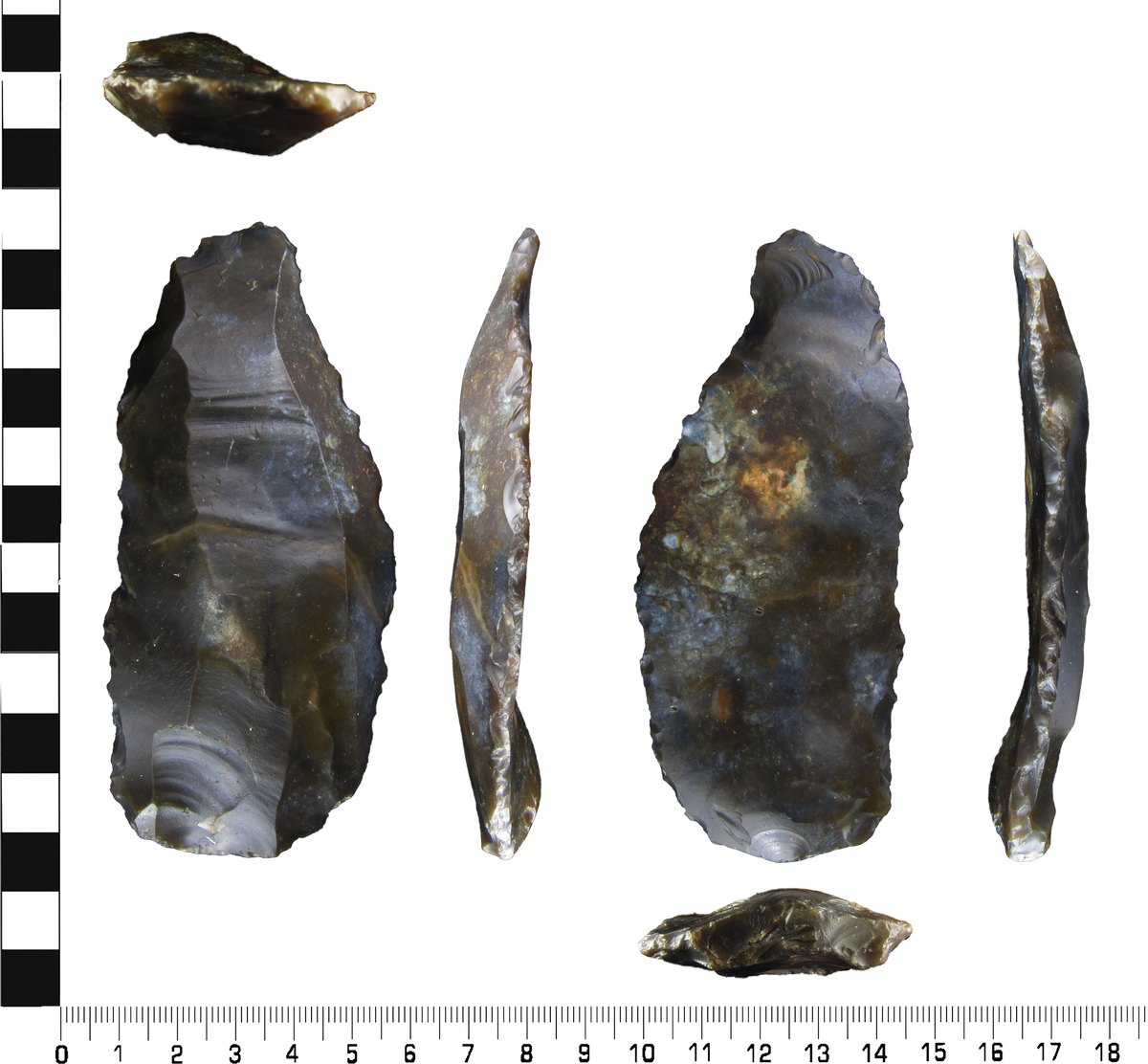
It is in these levels that 37 flintFlintA hard, brittle siliceous rock, knapped by prehistoric people to produce blades, points and sharp tools.→ points were found with a particular morphology: a base thinned by bifacial retouching, facilitating hafting onto a wooden or bone shaft, and very regular cutting edges indicating meticulous shaping. Traceological analysis under microscope revealed characteristic impact fractures on the distal face of the points, consistent with their use as thrown projectiles rather than hand-held tools2.
Neanderthals or Homo sapiens? The debate remains open
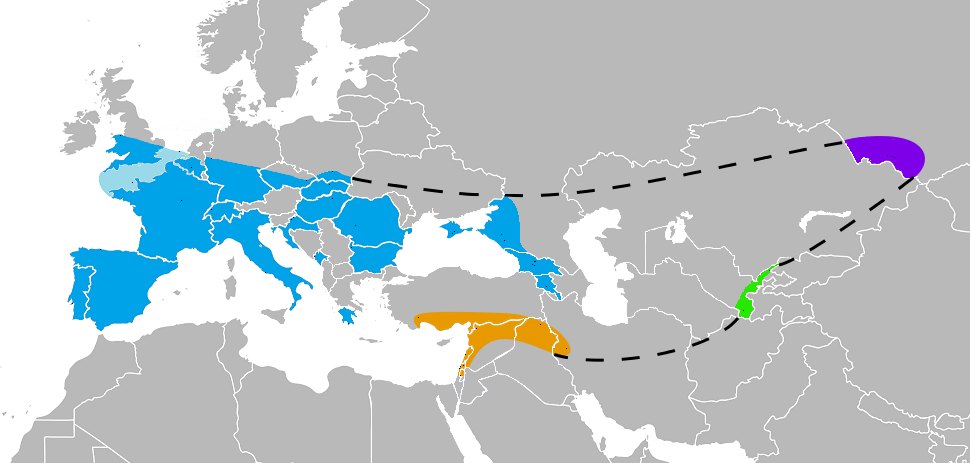
Attributing these points to a specific homininHomininMember of the subtribe Hominina, comprising the human lineage (Homo, Australopithecus, Paranthropus…) but excluding orangutans and gibbons. The term progressively replaces "hominid" in its narrow sense.→ species is the central issue of the discovery. At 80,000 years, the chronology is ambiguous: in Central Asia, this period corresponds to the end of a long Neanderthal occupation episode, but early Homo sapiens migrationsMigrationsLong-distance movements of populations; a major driver of human history (the exit from Africa, the peopling of continents, Neolithic and steppe expansions).→ out of AfricaOut of AfricaThe dispersals of Homo sapiens out of Africa, including a major expansion c. 70,000 to 60,000 years ago and earlier exits.→ are also documented in the Near East region from 120,000 years ago. The study's authors favour a Neanderthal attribution, based on the technological continuity observed with earlier Mousterian levels and the absence of Homo sapiens anatomical markers in the corresponding levels.
If this attribution is confirmed, it implies that Central Asian Neanderthals had independently developed the hafted projectile technique, hitherto considered a characteristic innovation of Homo sapiens in sub-Saharan AfricaSub-Saharan AfricaThe part of Africa south of the Sahara; cradle of Homo sapiens, long thought hostile to ancient-DNA preservation because of heat.→ and the Near East. Hafted points attributed to Neanderthals are already known in Europe - notably in late Levallois - but their dating is generally more recent and their use as projectiles remains debated. The Kulbulak points would thus be among the oldest worldwide examples of this technology, across all species3.
Complex cognitive behaviour documented in Central Asia
Beyond the taxonomic question, the discovery at Kulbulak contributes to redefining the behavioural complexity of hominins during the 80,000-90,000 year period. Manufacturing a point intended to be hafted and thrown involves several distinct cognitive steps: anticipating the final tool form from the outset of knapping, mastering bifacial retouching techniques to obtain a suitable hafting base, preparing the plant or bone shaft and fixing the point to it, and finally conceiving the tool-projectile assembly as a composite system whose components are produced and assembled separately. This long, planned operational chain is considered one of the markers of so-called modern human behaviour.
Excavations at Kulbulak are ongoing and researchers hope to discover human bone remains associated with the points, which would definitively confirm the manufacturing species. In the meantime, the discovery adds to a growing body of evidence showing that the Central Asian Middle Palaeolithic was far from being culturally poor or technologically behind Europe or the Near East. The prehistoric Silk Road was perhaps generating its own innovations4.
No comments yet. Be the first.