For nearly a hundred years a question had haunted Egyptologists: were the hundreds of bodies lined up around the royal tombs of AbydosAbydosA sacred site in Upper Egypt, necropolisNecropolisA large organised burial ground, a "city of the dead", often spanning several periods.→ of the earliest kings (Umm el-Qaab) and a major centre of the cult of Osiris.→ those of servants sacrificed at their king's death, or simply the dead buried there over time? A study by Roselyn Campbell, an anthropologist at Purdue University in Indiana, published on 5 October 2026 in the journal Frontiers in Environmental Archaeology, offers at last a material answer. By re-examining a collection of skulls forgotten for a century with modern forensic methods, the researcher identified fractures that owe nothing to chance or to the passage of time, but to blows struck around the moment of death.1
A century of doubt over Abydos
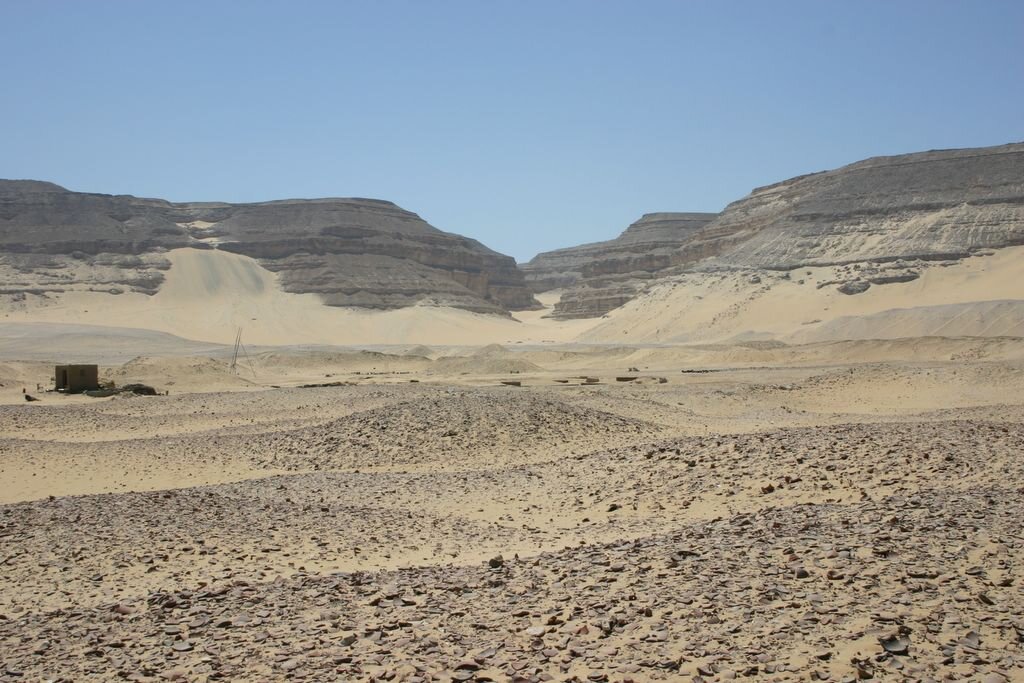
In the 1920s the British archaeologist Flinders Petrie excavated the funerary complexes of Egypt's earliest pharaohs at Abydos, in Upper Egypt. Around the royal tombs of the First DynastyFirst DynastyFirst line of kings of unified Egypt, around 3100 to 2900 BCE, which practised servant sacrifice.→ he uncovered hundreds of humbler graves, carefully laid out in regular rows. That unusual number and orderly arrangement struck him at once: it looked less like a cemetery that had filled up little by little than like an ensemble created all at once, as if all these people had been buried at the same time as the sovereign.2
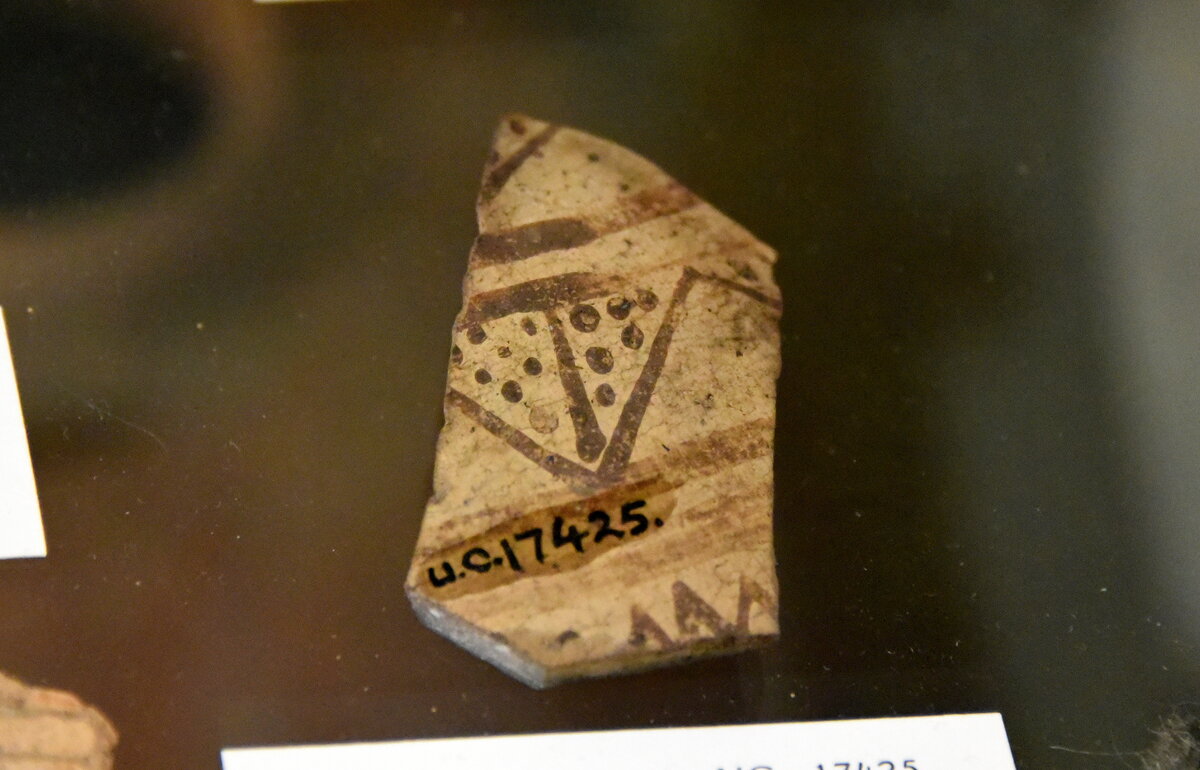
Petrie noticed that several of these dead were accompanied by stelae bearing titles such as sealSealA small engraved object (often steatite) used to stamp a mark in clay; the Indus seals, bearing animals and signs, attest to administration and trade, though their script remains undeciphered.→-bearer, a sign that they had served the king in life. The hypothesis of servant sacrifice came to him naturally: when the pharaohPharaohThe title of the ruler of ancient Egypt, regarded as a living god guaranteeing cosmic order (Maat), supreme head of state, army and worship.→ died, his entourage would have followed him into the tomb to go on serving him in the afterlife. But the archaeologist ran into a major obstacle. On the bones he found no clear mark of violence, no obvious fatal wound. For want of proof, the idea remained an intuition, and the question of human sacrifice in ancient Egypt has fuelled an endless debate ever since.
The exhumed bodies then met various fates. Petrie reburied most of them on the spot, leaving them to the desert from which he had drawn them. A few dozen skulls, however, made their way to England and joined the Duckworth Collections at the University of Cambridge. There, stored in boxes, they slept for almost a century without anyone truly studying them, mute witnesses to an enigma left unresolved.
The debate, however, had never died down. Some specialists held servant sacrifice to be an established fact; others saw in it a modern interpretation imposed on tombs that were poorly understood, or even a mere family or court cemetery that had filled up with natural deaths. The alignment of the graves, their apparently simultaneous closing and the carved titles argued for sacrifice; the absence of wounds contradicted it. For want of bones to re-examine, the discussion had gone round in circles for decades, each side holding firm. It was precisely this deadlock that the rediscovery of the Cambridge skulls could break.
Reopening a case left closed at Cambridge
It is this forgotten collection that Roselyn Campbell set out to reopen. In all, she was able to examine 46 individuals, the fraction of the Abydos graves whose remains had been preserved. The researcher applied to these skulls the toolkit of contemporary forensic anthropology: close observation of the lesions, imaging and analysis of the bone structure, in order to tellTellAn artificial mound formed by the accumulation of successive layers of settlement remains at the same spot, typical of the Near East. Each destruction-rebuilding event adds a stratum.→ apart a wound inflicted in life from a break that occurred after burialBurialThe intentional deposition of a body, sometimes with offerings; a marker of symbolic behaviour.→, under the weight of sediment or during the excavation.3
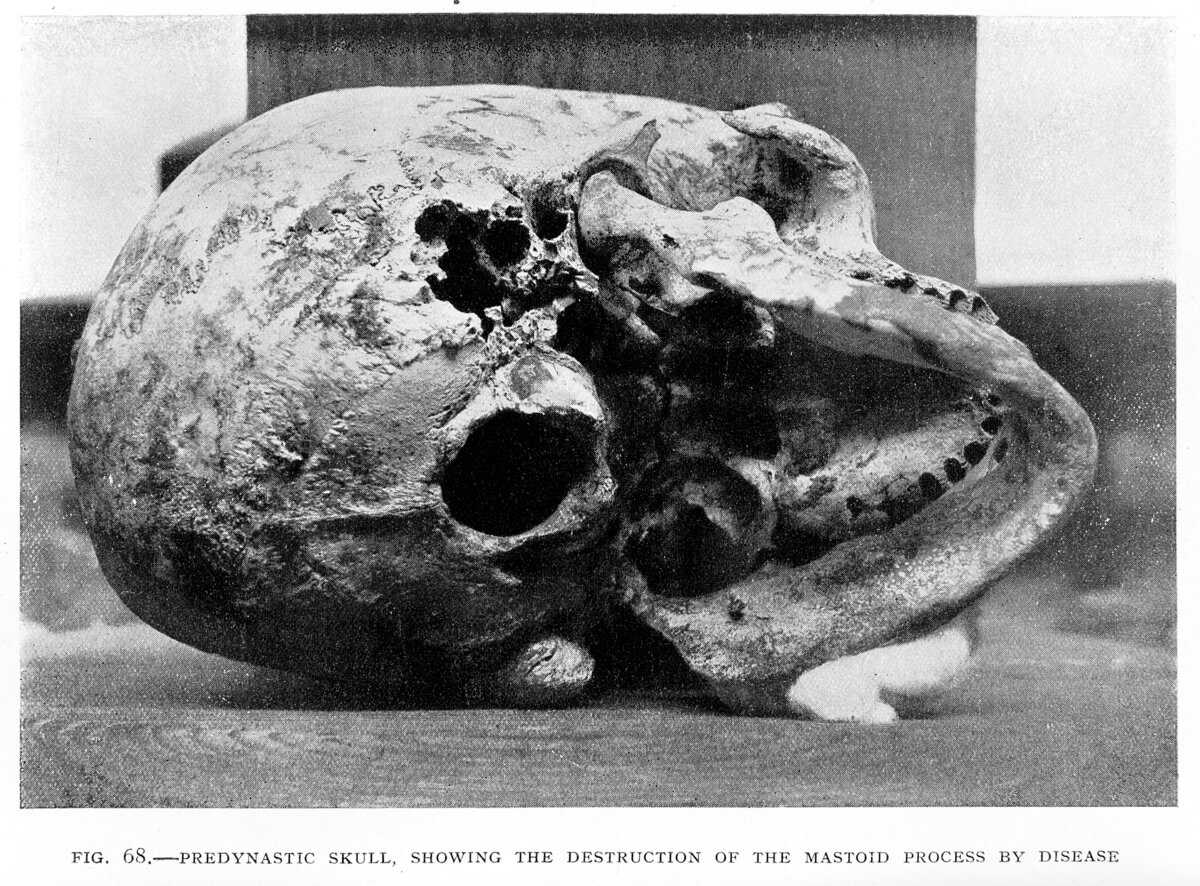
The result is clear. Of the 46 skulls, 18 show lesions that Campbell reinterprets as perimortemPerimortemOccurring around the time of death, as opposed to lesions produced long after burial.→ trauma, that is, occurring around the time of death and not after burial. Yet these same marks had once been attributed to natural causes or to later degradation. By changing both her gaze and her tools, the researcher thus draws from old material an information her predecessors had failed to read. Eighteen cases out of forty-six is close to four skulls in ten bearing the trace of a violent death.
The distinction between perimortem injury and later damage lies at the heart of the demonstration. A living bone, or one freshly dead, does not break in the same way as a dry bone buried for millennia: the shape of the fractures, the state of their edges, the reaction of the bone matter each tell a different story. It is precisely this fine reading that recent techniques allow and that the examination of the 1920s could not. What Petrie had taken for mere accidental breaks becomes again, under the eye of forensic science, the signature of struck blows.
This reversal illustrates a deep trend in present-day archaeology, that of reopening old collections with new tools rather than multiplying excavations. Thousands of bones, exhumed a century ago and sleeping in museum stores, can thus yield fresh data without disturbing the sites any further. The Abydos case shows that material deemed exhausted by one generation of researchers can become, for the next, a first-rate source. It still took the right questions and the right instruments.
Fractures that tell of death
What form do these wounds take? For the most part they are linear fractures, long fissures running across the vault of the skull. According to Campbell, this type of lesion occurs when the cranium is struck by a relatively large object with moderate force: because of the rounded shape of the braincase, the impact disperses across the vault instead of concentrating at a single point. Such fractures, she writes, often cause rapid loss of consciousness, internal haemorrhage and death, unless surgery is performed to relieve the pressure.1
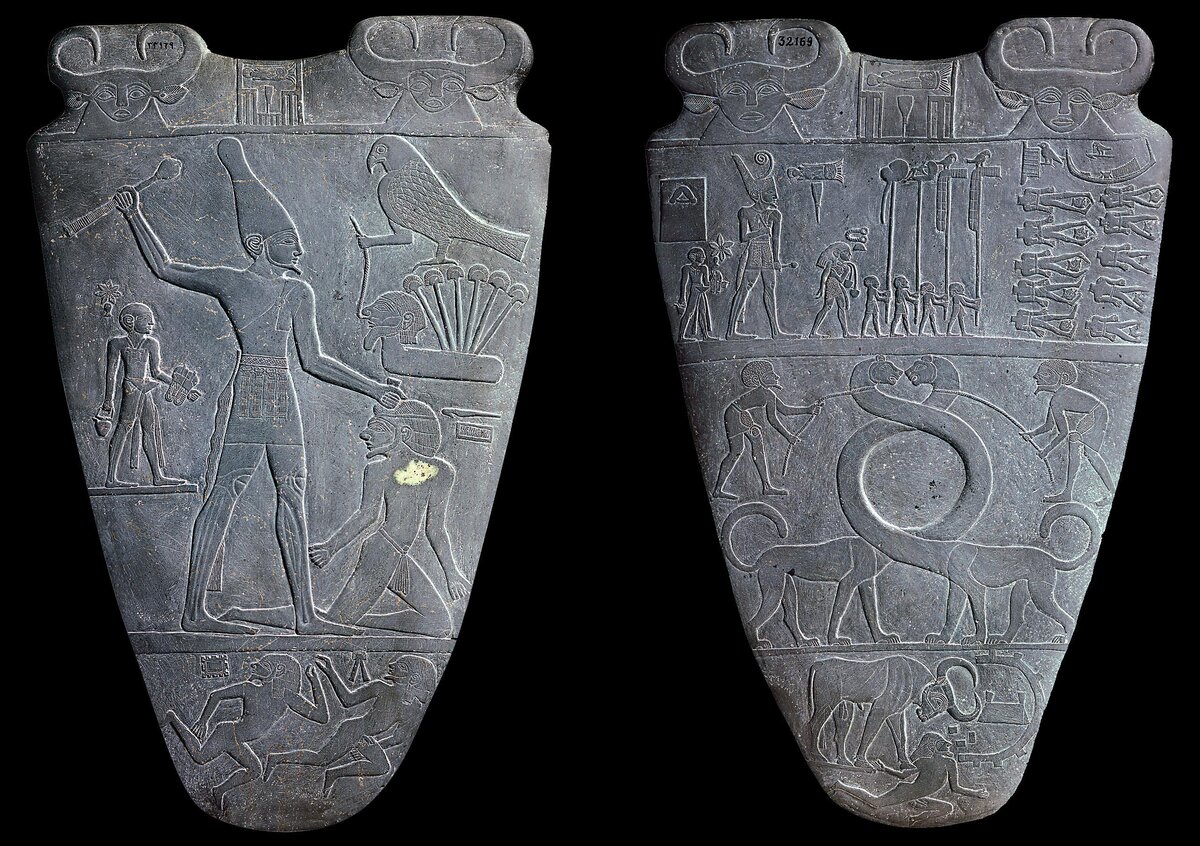
A few skulls bear other traces, sharp-force lesions, including one above the orbit that suggests a blow struck near the eye. The instrument, however, remains a puzzle. Egyptian royal iconography readily shows the pharaoh striking down his enemies with a mace, a codified gesture of victory and domination. Yet the wounds observed do not match a mace. According to Campbell, the most likely object would have been flat, straight-edged and relatively light, probably made of a material such as wood rather than stone. No weapon of this kind has been found in the cemeteries, and the researcher refrains from any definitive claim about the exact method of execution.
A specialist outside the study, the Egyptologist Jacobus van Dijk of the University of Groningen, welcomes the work while admitting his surprise. The rare ancient depictions of ritual killing in fact show a kneeling victim, hands tied behind the back, stabbed in the chest: a scenario far removed from the blows to the head revealed by the Abydos skulls. The gap between the official image and the reality of the bones is a reminder of how figured sources do not always say what the bodies themselves underwent.
The twenty-eight silent ones
That leaves the other twenty-eight skulls, those showing no visible trace of violence. Should we conclude that these people died naturally? Caution is in order, for the absence of a mark on the bone does not mean the absence of a provoked death.2
Several means of killing in fact leave no imprint on the skeleton. Poisoning, strangulation or suffocation can kill without breaking a single bone. Nothing rules out, then, that some of these twenty-eight individuals were sacrificed by means archaeology can no longer detect. To this is added the context, which is decisive: the arrangement in rows, the immediate proximity of the royal tomb, the servants' titles carved on the stelae. Everything points to the whole group having been buried at the same time as the king, and therefore sacrificed, even if only a part of it bears the bony proof today.
The limits of the sample must also be kept in mind. The surviving skulls represent only a small fraction, of the order of 5 to 15 percent, of the people once buried around each enclosure. The vast majority of bodies have vanished, reburied by Petrie or lost. The eighteen cases of trauma are thus only a partial glimpse of a phenomenon that was surely far wider. The Abydos subsidiary graveSecondary burialThe burial of bones moved after an initial decomposition, rather than of a whole body.→ yields what it can still yield: enough to establish the reality of sacrifice, too little to measure its exact scale.
A retinue for eternity
Beyond the skulls, a whole chapter of the history of early EgyptAncient EgyptA civilisation that developed along the Nile for almost three millennia, from unification around 3100 BC to the Greco-Roman era; it bequeathed the pyramids, temples and hieroglyphic writingWritingA system of conventional signs used to fix language or information durably; its appearance (c. 3300 BC) marks, by convention, the end of prehistory.→.→ takes shape. Between roughly 3100 and 2900 BCE, in the aftermath of the unification of Upper and Lower Egypt, at least five First Dynasty rulers had themselves accompanied into death by subjects who were killed. The Abydos tombs re-examined by Campbell are those of the kings Djer and Djet, as well as Meretneith, a woman who most likely wielded power.1
Why kill dozens of servants in this way? Researchers see in it the meeting of two logics. The first is religious: to provide the dead king with a complete entourage, servants, craftsmen, close attendants, so that he might go on reigning and being served in the afterlife as he was in life. The second is political: nothing demonstrates a sovereign's power better than his ability to order the death of his entourage and take it with him into the tomb. Human sacrifice then becomes a staging of royal authority, a spectacular assertion of the absolute power the first pharaohs were in the process of building.
This practice belongs to a very particular moment, that in which Egyptian kingship was still finding and imposing itself. The state had only just been born, the pharaoh had to secure his legitimacy, and funerary splendour, down to its cruelty, was part of that demonstration. Far from an immemorial rite, servant sacrifice appears as a dated phenomenon, concentrated on the very first generations of unifying kings.
Egypt, moreover, is not an isolated case. Other ancient societies, at comparable moments in the building of royal power, knew similar practices in which the sovereign's death brought on that of his entourage. This parallel invites us to read the Abydos phenomenon less as an Egyptian singularity than as a possible stage in the formation of the earliest states, when a nascent authority seeks to inscribe itself in bodies as much as in stone. Campbell's work, which is to lead to a forthcoming book, gives the supporters of this reading the material argument they had been missing.
The end of a practice
For what is perhaps most striking is the brevity of the phenomenon. Servant sacrifice seems to disappear as early as the end of the First Dynasty, after lasting at most two centuries, perhaps less. As kingship consolidated and found other ways to assert its power, it gave up this bloody demonstration.4
A substitute then took over. Servants of flesh and blood gave way to votive figurines, small statuettes placed in the tomb and meant to serve the king in the afterlife in place of the living. The belief remained, that of a sovereign surrounded by his staff for eternity, but its expression changed radically: one no longer kills, one represents. This shift from the real body to the effigy no doubt signals a deep change in power, now secure enough to no longer need to prove its strength through blood.
Many cases, nonetheless, remain open. Because Petrie reburied most of the bodies, the bulk of the remains still escapes analysis. Roselyn Campbell says so herself: with unlimited resources, she would seek to find these skeletons and study them. The eighteen skulls examined close a few century-old enigmas, but leave dozens of others unresolved. At Abydos, beneath the sand of Upper Egypt, a large part of the history of Egypt's earliest royal sacrifices still sleeps, waiting for the day when new hands and new methods come to question it once more.5
No comments yet. Be the first.