More than three million years ago, on the bank of a tree-lined river, a female the size of a chimpanzee stepped toward the water to drink. We call her Lucy, and her species, Australopithecus afarensis, is among the best known of the entire human lineage. What is less often told is that beneath the murky surface the most formidable predator of that vanished world may have been waiting. In March 2026, a team led by palaeontologist Christopher Brochu of the University of Iowa gave that threat a name: Crocodylus lucivenator, described in the Journal of Systematic Palaeontology under a blunt title, "Lucy's Peril".1
The animal's name is a learned pun. It joins the Latin luci-, light or dawn, with venator, hunter, while echoing the nickname of the most famous of all australopithecines. "Dawn hunter", or "Lucy's hunter": both readings coexist, and both say the same thing. In the Afar DepressionAfar DepressionA vast tectonic basin in northeastern Ethiopia, formed by the spreading of three plates, where sediment accumulation has preserved many homininHomininMember of the subtribe Hominina, comprising the human lineage (Homo, Australopithecus, Paranthropus…) but excluding orangutans and gibbons. The term progressively replaces "hominid" in its narrow sense.→ fossils.→, at the heart of what is often called the cradle of humanity, crocodiles were not mere scenery. They were leading actors in the story of our origins.
Afar, a wide window onto our origins
The Afar Depression is one of the most singular places on Earth. It is here, in northeastern Ethiopia, that three tectonic plates are slowly pulling apart, tearing the crust and hollowing out a vast basin where sediments laid down by lakes and rivers accumulate, layer upon layer. This slow subsidence has made the region an exceptional geological archive, recording for millions of years the life that unfolded there. The Lower Awash Valley, which drains part of this depression, was inscribed on the UNESCO World Heritage List as early as 1980, in recognition of its importance for understanding human evolution.
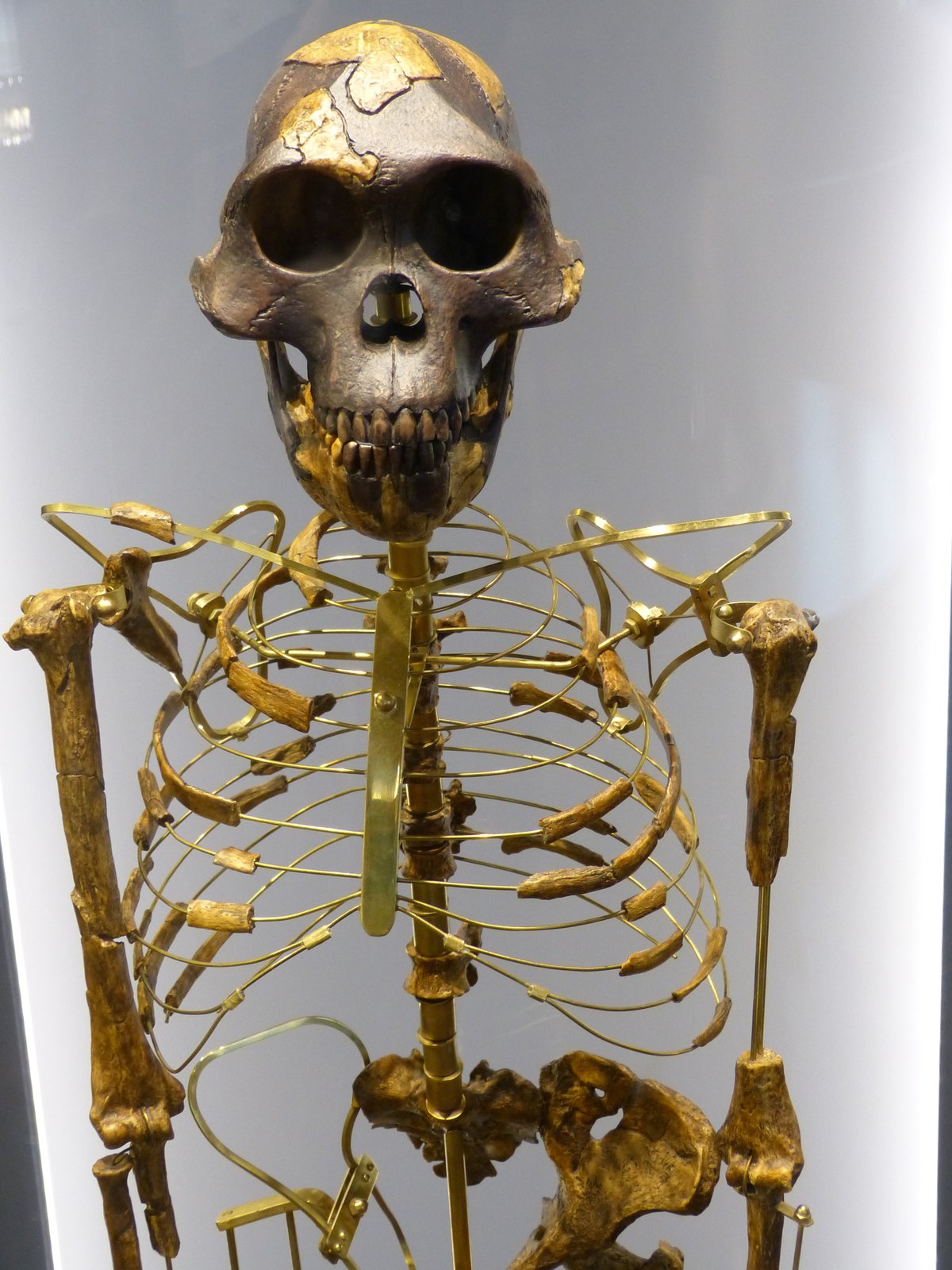
The Hadar site is the jewel of this archive. It was here, in 1974, that the team of Donald Johanson and Maurice Taieb uncovered Lucy, a partial skeleton of Australopithecus afarensis roughly 3.2 million years old, which would become the global ambassador of human palaeontologyPalaeontologyThe science that studies past life from fossils, in order to reconstruct the history of life and ecosystems.→. The Hadar FormationHadar FormationA sequence of river and lake sediments in the Lower Awash Valley, dated to the Pliocene, which yielded Lucy and many Australopithecus afarensis.→, a thick pile of river and lake sediments, has since yielded hundreds of remains of this species, including the famous group nicknamed "the First Family". But Hadar does not stand alone. A few dozen kilometres away, the Ledi-Geraru area produced in 2015 a jaw assigned to the oldest known representative of the genus Homo, dated to 2.8 million years, which bridges part of the gap between the australopithecines and ourselves.5 Further south, the Woranso-Mille area yielded in 2019 a nearly complete skull of Australopithecus anamensis, 3.8 million years old, a probable ancestor of Lucy's species.6
Within a few dozen kilometres and a few hundred thousand years, Afar has thus recorded several decisive chapters of our evolutionary history. Nowhere else is the continuity of the hominin fossil record so dense. It is this richness that earns the region its nickname, and it is in this same setting that giant crocodiles left their bones, mingled with those of our ancestors.
A world of lakes, rivers and predators
To understand Lucy's life, one must set aside the image of an arid, uniform savanna. Reconstructions based on the sediments and fauna of Hadar sketch a far wetter and more varied landscape. During the PliocenePlioceneA geological epoch spanning roughly 5.3 to 2.6 million years ago, the last subdivision of the Neogene. It was during the Pliocene, in an East AfricaAfricaThe cradle of humankind: the continent where the first hominins appeared, then Homo sapiens around 300,000 years ago, before the expansion to the rest of the world.→ undergoing cooling and forest fragmentation, that the first fully bipedal australopithecines such as Lucy (~3.2 Ma) evolved.→, the region was a mosaic of habitats that succeeded one another in time and space: shallow lakes, floodplains, watercourses lined with gallery forests, wet grasslands, open woodlands and thorn scrub.2 Water was everywhere, and with it an abundant aquatic fauna.
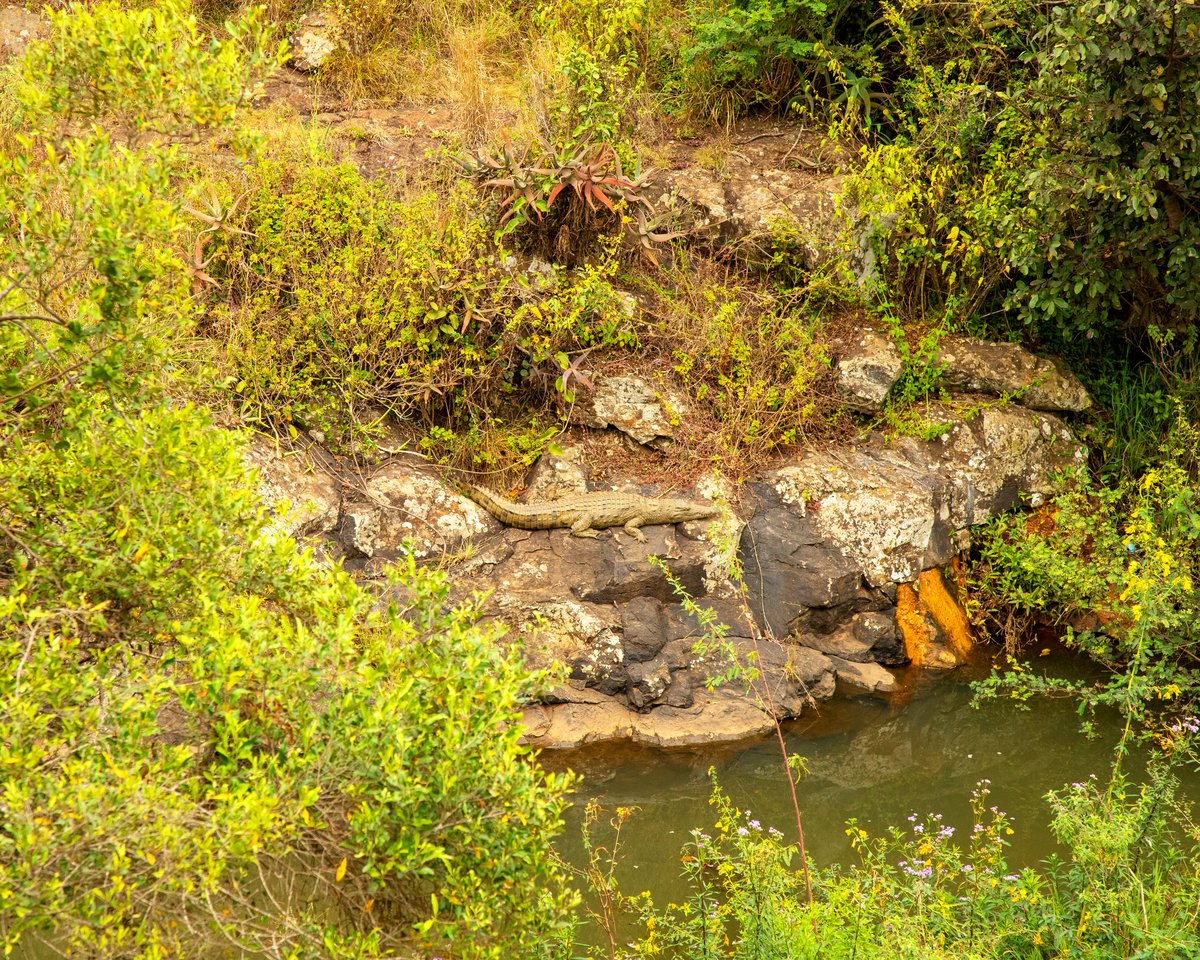
This abundance of water had a corollary: the presence of large reptiles. The East African RiftEast African RiftA great fracture in the crust running north to south through East Africa, lined with lakes and volcanoes, the setting of much of human evolution.→ was at that time a string of lakes and rivers where crocodiles thrived, some of them of considerable size. The hominins who came to drink, to fish or to cross a ford therefore shared their territory with animals perfectly able to kill them. Palaeontology shows that this coexistence was no mere theory: the remains of australopithecines and crocodiles are found in the same beds, witnesses to an ecosystem in which humans were not at the top of the food chain.
The scene is worth picturing from the prey's point of view. An australopithecineAustralopithecineA genus of bipedal hominins from Africa (c. 4.2–1.9 Ma) with a brain still close to that of great apes (400–550 cm³) but walking upright. Lucy (<em>Au. afarensis</em>) is the most famous specimen.→ edging toward the water could not know whether the river was empty or whether a motionless shape, barely distinct from a floating log, was watching from the shore. The crocodile is an ambush hunter: it lies submerged, then lunges in a fraction of a second. For small-bodied hominins, without claws or fangs, obliged to expose themselves regularly on the banks, this danger was constant. To understand the world of our ancestors therefore means taking their predators seriously, and first among them these freshwater reptiles.
Crocodylus lucivenator, Lucy's hunter
This is where the discovery published in 2026 comes in. Examining 121 catalogued remains, mostly skulls, teeth and fragments of jaws representing dozens of individuals, Christopher Brochu's team recognised a species that had never been described.1 The researcher, who has studied fossil crocodiles for thirty-five years, first examined these specimens in 2016, during a visit to a museum in Addis Ababa. It would take him nearly a decade to draw a formal description from them, working alongside specialists in geology and taphonomy to place each bone in its environmental context.
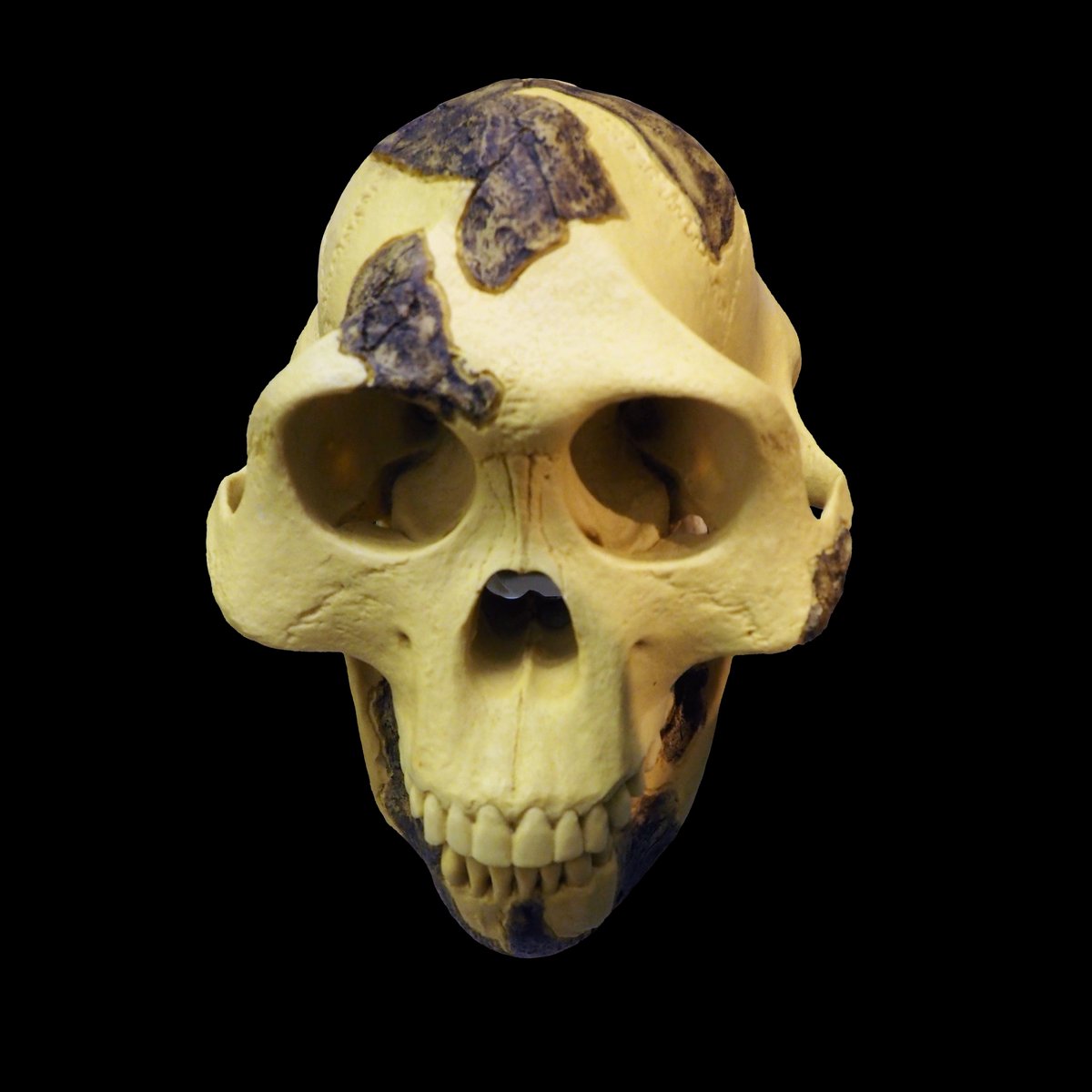
Crocodylus lucivenator was not an outsized monster, but a powerful and perfectly adapted animal. Adults reached from 3.6 to 4.6 metres in length, with an estimated weight of between 270 and 590 kilograms, about the size of a small car.2 It was, by far, the largest predator of the Hadar ecosystem, far more imposing than the lions or hyenas that prowled there at the time. "It is a near certainty that this crocodile would have hunted Lucy's species", Brochu sums up. One anatomical detail set it apart from its living African cousins: a pronounced bony hump in the middle of the snout, similar to the one borne by the American crocodile but absent in the Nile crocodile. The authors think this protuberance served the males to attract females, in a display where the animal lowers its head slightly to show it off. Its rostrum, moreover, was longer than in the crocodiles of its time, foreshadowing the profile of modern species.
Remarkably, Crocodylus lucivenator appears to have been the only crocodilian of the Hadar Formation, the undisputed master of its domain.1 The situation contrasts with that of the Lake Turkana basin, further south, where three to four crocodile species coexisted at the same period. One of the specimens bears on its lower jaw the traces of partially healed injuries, consistent with combat between members of the same species, those face-to-face clashes still seen in living crocodiles. Whether the animal won or lost, the healing proves it survived the struggle. In terms of relationships, the analysis places the species among the palaeo-African Crocodylus of East Africa, a group whose history remains partly to be written and which this discovery helps to clarify.
When crocodiles ate our ancestors
The idea that large crocodiles might have attacked hominins is not a mere inference drawn from coexistence. It rests on tangible evidence, inscribed in the bone itself. Over the past twenty years, a field of research has developed around recognising the traces left by predators on fossil skeletons, a speciality of taphonomyTaphonomyThe study of the processes affecting organic remains between death and fossilisation, including the marks left by predators.→, the science of what happens to organic remains between death and fossilisation.
The reference works are those of Jackson Njau and Robert Blumenschine, published in 2006 in the Journal of Human Evolution.3 From controlled observations of Nile crocodiles feeding on large carcasses, the two researchers drew up a list of diagnostic signatures allowing crocodile bites to be distinguished from those of mammalian carnivores: deep punctures, so-called bisected marks, hook-shaped scores, an absence of the characteristic gnawing, and whole bones left intact. These criteria gave prehistorians a key for identifying, in fossil assemblages, the hand, or rather the jaws, of the crocodile.
The most spectacular demonstration came from Tanzania. In 2010, Christopher Brochu, Jackson Njau, Robert Blumenschine and Llewellyn Densmore described another extinct crocodile, Crocodylus anthropophagus, whose name means literally "the man-eating crocodile".4 Found in the Olduvai Gorge, in the same Plio-PleistocenePleistoceneThe geological epoch of the great ice ages (c. 2.6 Ma–11,700 BP), spanning most of human prehistory.→ beds as remains of Homo habilis and ParanthropusParanthropusA genus of fossil hominins known as robust australopithecines, with a powerful chewing apparatus, that lived in Africa about two to one million years ago.→, this reptile also bore a pair of horns above the eyes. Above all, hominin bones from these sites, including a foot and a leg, show tooth marks attributable beyond reasonable doubt to a crocodilian. The direct proof was there: at least some of our distant relatives ended up in the stomachs of these animals. Whether the crocodile had killed them or merely consumed their carcasses remains another question, one that bones alone cannot always settle.
Crocodylus lucivenator fits into this picture. No bite mark on a fossil of Lucy has been published to date, and one must be careful not to turn an ecological probability into a certainty. But the species occupied exactly the niche of the large aquatic predator at Hadar, in contact with a dense population of australopithecines. The analogy with Olduvai, where predation is demonstrated, makes the scenario highly plausible. It is worth adding that the interpretation of such marks is not without debate: later neotaphonomic studies have questioned whether specific Olduvai specimens were truly taken by crocodiles rather than by other agents, a reminder that each fossil must be read on its own terms. What is no longer in doubt, however, is the general fact that crocodiles and early hominins shared these waters, and that the former sometimes fed on the latter.
What crocodiles teach us about the ecosystem
One might think that a fossil crocodile is of interest only to reptile specialists. The opposite is true. Every new species described in these deposits adds a piece to the portrait of the environment in which our ancestors evolved, and that environment shaped what we became. A large ambush predator lurking at the water holes is no minor detail of the setting: it is a selective pressure. Vigilance, group living, the choice of where and when to approach the water, so many behaviours that may have been favoured by the constant presence of such a danger.
The presence of a large crocodile also tells us about climateClimateThe long-term average atmospheric conditions of a region; its variations (glaciations, aridifications) shaped migrations, agriculture and the collapse of prehistoric societies.→ and hydrology. These animals need permanent water and abundant prey; their abundance confirms that Hadar had durable lakes and rivers, not ephemeral water holes. The fact that Crocodylus lucivenator was, according to the authors, one of the few species to persist throughout the Hadar sequence, despite the shifting habitats, also makes it an indicator of the relative stability of these aquatic ecosystems over long spans of time. In a landscape that otherwise shifted between woodland, grassland and scrub, the enduring presence of a top aquatic predator suggests that the rivers and lakes themselves formed a comparatively constant backbone, around which both animals and hominins organised their movements.
Finally, this discovery is a reminder of something often forgotten: human history did not play out in a vacuum. Our ancestors were one species among others, embedded in a web of relationships in which they were by turns hunters and hunted. Reconstructing their world means describing not only the hominins, but the whole retinue of animals that shared their territory, from hippos to big cats, from antelopes to crocodiles. By naming "Lucy's hunter", palaeontologists have not merely added a species to the catalogue of vanished life. They have brought a little more into focus the face of the world in which humanity first took flight, a world of shimmering lakes and dangerous banks, where every mouthful of water could be the last.
J'avais vu un truc là-dessus sur YouTube mais votre article donne vraiment plus de détails.
Je reviens souvent ici avant de traiter un sujet scientifique. Fiable et bien écrit.
Je l'ai projeté en cours et les élèves ont posé beaucoup de questions. Très bon support.