Almost 150 years ago, an eight-year-old girl named Maria de Sautuola was exploring the family cave in Cantabria, Spain, with her father. Looking up at the low ceiling of a side gallery, she saw what no one before her - or at least no one willing to believe - had noticed: a herd of bison painted in polychrome, curled to fit the natural bumps of the rock, so alive, so precise, so magical that she cried out, according to legend: "Mira, papa, bueyes!" (Look, papa, oxen!). That moment in 1879 marks the discovery of Altamira, one of the world's greatest decorated caves and what has since been called the "Sistine Chapel of prehistoryPrehistoryThe span of human history before the invention of writing, from the Palaeolithic to the Metal Ages, known mainly through material remains.→." But the road to recognition was long, tortuous, and humiliating for the man who made it.
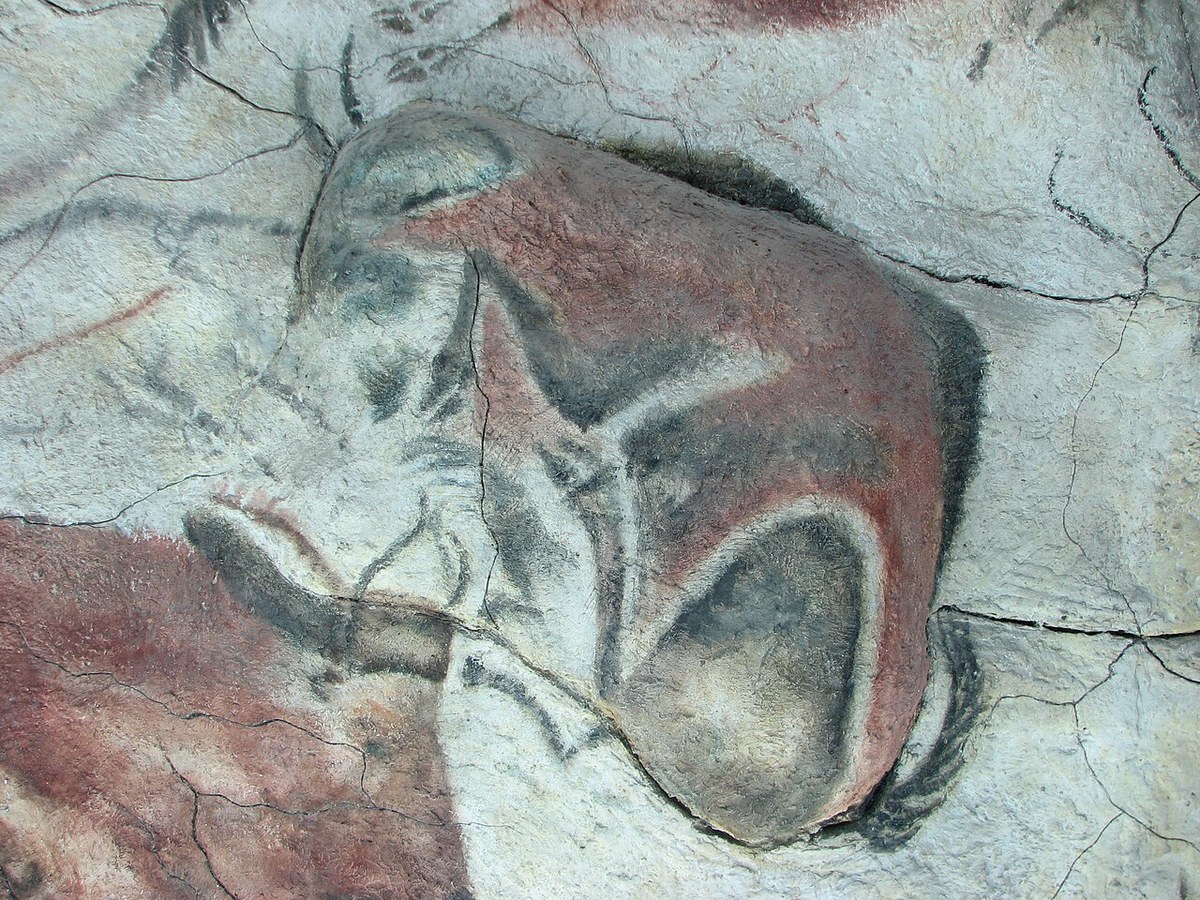
Altamira cave lies near Santillana del Mar, in Cantabria (northern Spain). It extends nearly 300 metres and divides into several galleries. The main chamber, 18 metres long and 9 metres wide, has a ceiling whose natural limestone bumps were exploited by the artists to sculpt in hollow and paint in relief the silhouettes of twenty-two large mammals: bison, deer, boars, and a horse. The paintings, dated between 18,500 and 14,000 years BCE, belong to the MagdalenianMagdalenianThe last great Upper Palaeolithic culture (c. 17,000–12,000 BC), the peak of cave art (Lascaux).→ period[1].
Marcelino Sanz de Sautuola and the scientific rejection
It was Marcelino Sanz de Sautuola, an aristocrat and amateur archaeologist, who discovered the paintings during a visit to the cave in 1879 with his daughter Maria. He had seen animal engravings at the 1878 Paris Universal Exposition, which had made him alert to such remains. In 1880 he published a memoir attributing the paintings to the PalaeolithicPalaeolithicThe oldest and longest period of prehistory (c. 3.3 Ma–12,000 BC), defined by chipped stone tools and a hunter-gatherer way of life.→ period. The scientific community's reception was icy, then hostile. The most virulent critic was Emile Cartailhac, then a professor at the Sorbonne and the dominant figure in European prehistory: he held that the paintings were too beautiful, too well preserved, too sophisticated to be Palaeolithic, and attributed them to a modern fraud. The implicit accusation gnawed at Sautuola's reputation until his death in 1888, unrehabilitated[2].
Rehabilitation: from La Mouthe to Cartailhac himself
Other discoveries opened the scientific community's eyes. In 1895, La Mouthe cave in the Dordogne was found to contain animal engravings beneath an intact layer of sediment - irrefutable proof they were Palaeolithic. Then Les Combarelles, Font-de-Gaume and Pair-non-Pair confirmed the existence of ancient cave art. In 1902, Cartailhac himself visited Altamira with Abbe Henri Breuil and spent several days studying the paintings. He then published a celebrated article entitled "Mea culpa of a sceptic," publicly acknowledging his error and rehabilitating Sautuola's memory[3]. It was too late: the discoverer of Altamira had been dead for fourteen years.
The techniques of the Magdalenian artists
Modern chemical and physical analyses have revealed the sophistication of the techniques used at Altamira. The artists worked with several pigments: manganese oxide (black), haematite and ochreOchreA red or yellow mineral pigment (iron oxides), used from prehistory for adornment, funerary rites and art.→ (red, yellow, brown), mixed with organic binders and applied with animal-hair pads, fingers, or blowpipes. The use of the cave's natural relief is what most distinguishes Altamira from other contemporary caves: natural protuberances become a curled bison's rump, hollows form the space between flanks. The result is a three-dimensional polychrome whose sophistication rivals that of many Renaissance painters. The Altamira bison are shown resting, alert, fleeing or fighting, with precise anatomical detail and a sense of movement that still strikes the contemporary visitor.
Altamira today: replica and restricted access
After discovery, Altamira was opened to the public and attracted thousands of visitors throughout the twentieth century. But human presence produced carbon dioxide, heat and humidity that promoted the growth of algae and moulds on the paintings. Deterioration was observed from the 1960s. The cave was closed in 1977, partially reopened in 1982, then closed again in 2002[4]. Since 2001, an adjacent museum, the Museo de Altamira, has offered an exact replica of the bison ceiling, produced to the millimetre with the same materials and pigments as the original. Since 2014, highly restricted access to the real cave has been restored by lottery: five visitors per week, accompanied by conservators. Thousands apply each year for this unique cultural lottery. Altamira has been a UNESCO World Heritage Site since 1985. It remains the most celebrated symbol of the capacity of Upper PalaeolithicUpper PalaeolithicThe final phase of the Palaeolithic (c. 45,000 to 10,000 years ago), marked by Homo sapiens in Europe, art, ornaments and a succession of cultures (Aurignacian, Gravettian, Solutrean, Magdalenian).→ Homo sapiensHomo sapiensThe present-day human species, which emerged in Africa around 300,000 years ago, the only surviving human lineage after the extinction of Neanderthals and Denisovans.→ to create beauty, observe nature with precision, and transcribe it onto a sacred wall. The cognitive and artistic capacity it demonstrates is entirely comparable to our own.
No comments yet. Be the first.