Eight thousand years ago, on the banks of a river in western Siberia, hunter-gatherersHunter-gatherersA way of life based on hunting, fishing and gathering wild resources, without farming or herding; it dominated almost the whole of human history.→ were building what is now considered the world's oldest known fortified site.1 The Amnya site, perched on a promontory overlooking the eponymous river deep in the Siberian taiga, featured wooden palisades, ditches, and earthen ramparts -- structures that traditional archaeology had reserved for sedentary agricultural societies. This discovery overturns one of the founding paradigms of prehistoryPrehistoryThe span of human history before the invention of writing, from the Palaeolithic to the Metal Ages, known mainly through material remains.→ and invites us to rethink the social complexity of northern peoples.
A fortified promontory at the heart of the taiga
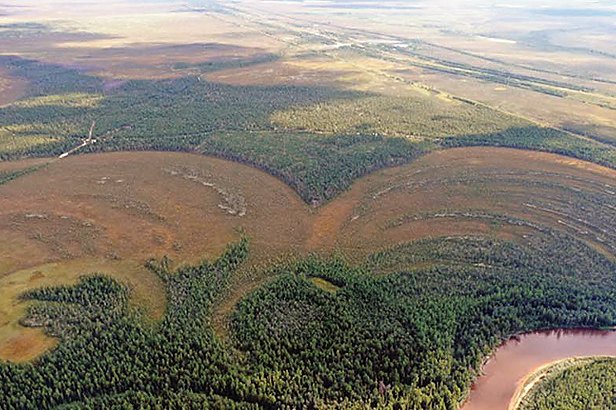
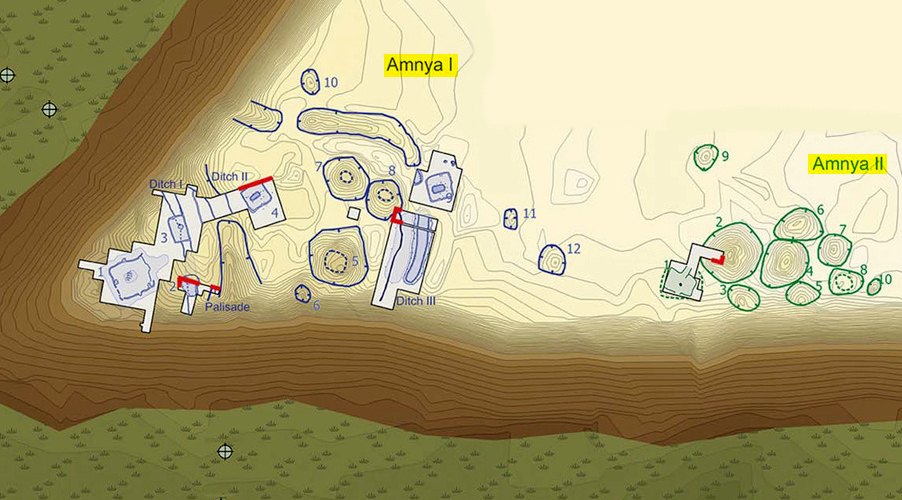
The Amnya site spans a natural promontory in western Siberia, in the present-day Khanty-Mansiysk Autonomous Okrug, several hundred kilometers east of the Ural Mountains. The Amnya River, which gives the site its name, borders it on several sides, creating a natural defense that its inhabitants reinforced with artificial works.2 Excavations uncovered the remains of wooden palisades, ditches dug into the ground, and earthen banks -- a coherent defensive ensemble that leaves little doubt about the site's primary function.
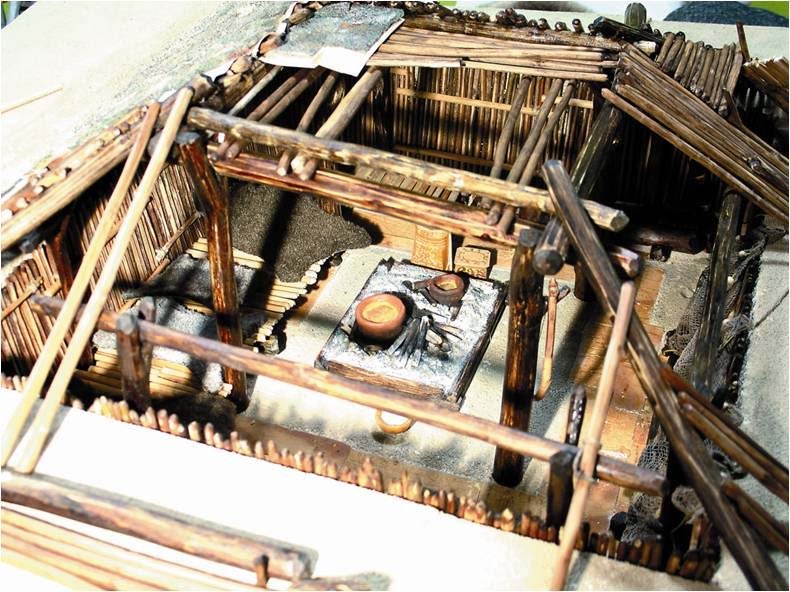
The site actually comprises two distinct complexes, Amnya I and Amnya II, located a few hundred meters apart along the river. Amnya I is the best preserved and most studied; it is here that the clearest architectural traces have been identified. Semi-subterranean houses -- pits covered with a wooden frame and earth -- formed the core of this settlement, characteristic of populations in the Siberian taiga during the MesolithicMesolithicThe period between the PalaeolithicPalaeolithicThe oldest and longest period of prehistory (c. 3.3 Ma–12,000 BC), defined by chipped stone tools and a hunter-gatherer way of life.→ and the Neolithic (c. 10,000–6,000 BC in Europe), still based on hunting and gathering.→ and NeolithicNeolithicThe "New Stone Age": a period marked by farming, herding, settlement and pottery, from around 10,000 BC.→ periods.
The first fieldwork on this site dates back to the Soviet era, but it was only in 2019 that a team from Freie Universität Berlin undertook systematic excavations and rigorous radiocarbon dating. The results, published in 2023 in the journal Antiquity, stunned the archaeological community.
A dating that reverses 8,000 years of history
Radiocarbon dates obtained from charcoal and bone fragments taken from the oldest layers of Amnya I place the first occupations of the site at around 8,000 years before the present, approximately 6,000 BCE.1 To put this figure in global perspective: it predates the Egyptian pyramids by more than 2,500 years, and is contemporary with the first Neolithic cultures of western Europe -- at a time when the future inhabitants of Brittany were only just beginning to build the first megalithic monuments.
This result exceeded researchers' most optimistic estimates. Earlier work on the site, conducted during the Soviet era, had not enabled such a precise chronology to be established. The new dating positions Amnya not only as the northernmost fortified site in Eurasia for this period, but as the oldest known fortification in the world -- pushing back the previous record by several centuries.
The sedimentary layers also reveal that the site underwent several fire destructions throughout its occupation. These fire episodes -- identifiable by lenses of charcoal and calcined structures -- suggest repeated violent conflicts, a dynamic observed at other contemporary sites in the region. Who attacked? Who defended? The data do not yet allow an answer, but the hypothesis of territorial rivalries between groups of hunter-gatherers is being seriously considered.
Organized hunter-gatherers, not farmers
The most unsettling revelation concerns less the antiquity of the site than the identity of its builders. According to the long-dominant archaeological dogma, the construction of permanent fortifications was the prerogative of agricultural societies: only agricultureAgricultureThe cultivation of plants and production of food by working the soil, which emerged in the Neolithic in the Near East and independently elsewhere; it radically transformed human societies.→ allowed the accumulation of food surpluses, lasting sedentismSedentismThe shift from a nomadic life to lasting settlement in one place, a precondition for the rise of villages.→ and, consequently, the labor force and motivation needed to erect collective defenses.3
Yet the inhabitants of Amnya were not farmers. All archaeological analyses agree: they lived by hunting, fishing, and gathering. The Siberian taiga abounded in resources -- fish in the rivers, game in the forests, edible berries and plants -- that permitted relative abundance without tilling the soil. The tools found at the site confirm this lifestyle: flintFlintA hard, brittle siliceous rock, knapped by prehistoric people to produce blades, points and sharp tools.→ arrowheads, bone harpoons, stone-knapped knives. No trace of cultivated cereals, domesticated animals (except the dog), or tillage tools.
How did these groups mobilize the collective workforce needed to build and maintain such an elaborate defensive system? Researchers advance several complementary hypotheses. The wealth of natural resources in the region -- particularly the migratory fish that ascended the river in mass at certain seasons -- could have generated sufficient surpluses to support task specialization, including that of builder. Intensive fishing, practiced on a large scale with nets and weirs, can generate considerable food stocks, freeing part of the population for other activities.
Competition for control of these fish resources -- and perhaps also for the best hunting grounds -- would have provided the primary motivation for building fortifications. In an environment with concentrated but seasonal resources, controlling a strategic access point could make the difference between survival and famine. Amnya, with its promontory dominating the river, was a natural lock on a vital artery of the taiga.
An overturned archaeological paradigm
The discovery of Amnya is not an isolated case. Other sites in the Ob and Irtysh region, two great rivers of western Siberia, present similar characteristics dating from the same period. The study published in Antiquity places them within a coherent regional dynamic: western Siberia in the early MesolithicMesolithicThe period between the Palaeolithic and the Neolithic (c. 10,000–6,000 BC in Europe), still based on hunting and gathering.→ and NeolithicNeolithicThe "New Stone Age": a period marked by farming, herding, settlement and pottery, from around 10,000 BC.→ would have been the scene of a genuine "acceleration" of social and technological diversification among hunter-gatherer populations, independent of the agricultural processes developing simultaneously further south and west.
This conclusion has profound implications for our understanding of human social evolution. It suggests that organizational complexity -- the capacity to coordinate large-scale collective projects, to defend territory, to maintain stable social structures over the long term -- is not a monopoly of agricultural societies. It can emerge independently in favorable ecologies, carried by hunter-gatherer groups that are sufficiently stable and organized.
This perspective aligns with other recent discoveries that complicate the linear narrative of a prehistory progressing from "primitive barbarism" to "agricultural civilization." The megalithic monuments of Gobekli Tepe in Turkey also predate agriculture in their region and testify to a comparable capacity for collective mobilization. Hunter-gatherer societies, long confined to the role of simple nomadic predecessors to the civilizations to come, are revealing an unsuspected social and architectural creativity. Amnya is a striking Siberian illustration of this.
No comments yet. Be the first.