On the arid highlands of the Four CornersFour CornersRegion of the American Southwest where Colorado, Utah, Arizona and New Mexico meet, the cradle of Ancestral Puebloan culture.→, where Colorado, Utah, Arizona and New Mexico meet, stone ruins cling to cliff faces and rise from the floors of the canyons. These remains belong to the Ancestral Puebloans, long known as the Anasazi, a Native American culture whose roots reach far deeper than the famous cliff dwellings. Before they raised four-story towers, these people were desert hunters and basket makers who, as early as the second millennium before our era, slowly learned to grow maize. It is this long trajectory, from earthen huts to grand ceremonial centers, that this documentary retraces.1
A name, a region, a long history
The word "Anasazi" comes from a Navajo term, roughly transcribed into English, meaning something like "the ancient ones" or "the ancient enemies". Today's Pueblo tribes do not recognize themselves in this label, and archaeologists now prefer Ancestral Puebloans, "the ancestors of the Pueblos".2 Behind the name lies a precise geography, the Colorado Plateau and the Four Corners area, a country of mesas, canyons and intermittent rivers where rain is scarce and farming always uncertain.
To order this history, researchers use the Pecos Classification, defined in 1927 at a conference held in Pecos, New Mexico, under the guidance of archaeologist Alfred V. Kidder. It divides the sequence into major phases, from the BasketmakerBasketmakerThe earliest phases of Ancestral Puebloan culture (from about 1500 BC), marked by basketry, spear-thrower hunting and the gradual adoption of maize.→ periods to the Pueblo periods, based on changes observed in architecture, pottery and toolmaking.3 This chronological framework, still in use, reminds us that Ancestral Puebloan culture was never a fixed block, but a story stretching across nearly three thousand years.
The Basketmakers: hunters, weavers and first maize farmers
At the origins of this civilization stand the Basketmakers, so named because they excelled at weaving long before they knew pottery. From around 1500 before our era, during the so-called Basketmaker II period, semi-nomadic groups of the Colorado Plateau began cultivating maize and squash while still hunting and gathering wild plants.3 They wove baskets of remarkable fineness, fiber sandals and storage bags, and hunted with the spear-thrower, the atlatlatlatlA spear-thrower, a hooked stick that extends the hunter's arm and increases a dart's range, used before the adoption of the bow.→, which gave the dart far greater range.
Gradually these communities settled and built their first durable dwellings, the semi-buried pit houses. Dug into the ground and covered with a wood-and-earth superstructure, these homes offered good thermal inertia in a climateClimateThe long-term average atmospheric conditions of a region; its variations (glaciations, aridifications) shaped migrations, agriculture and the collapse of prehistoric societies.→ of extremes. The Basketmaker III period, from about 400 of our era, marked a turning point, with the appearance of pottery, the cultivation of beans, the domestication of the turkey and the replacement of the atlatl with the bow and arrow.3 Maize, squash and beans, the famous agricultural triad of the Southwest, now formed the foundation of the diet.
Farming in such an environment was a feat in itself. On a plateau where rainfall rarely exceeds three hundred millimeters a year, the Basketmakers developed a subtle mastery of water and soil, using micro-relief, valley-bottom deposits and runoff to plant where moisture gathered. Carefully insulated storage pits and granaries let them keep grain from one season to the next and cushion the lean years, a caution that would remain at the very heart of Pueblo culture for centuries.
The birth of the Pueblos
Around the eighth century, villages changed shape. Above-ground dwellings of stone and earth, arranged in rows, took over from the pit houses, which in turn evolved into half-buried ceremonial chambers. These clusters of adjoining rooms gave rise to the puebloPuebloSpanish word for "village", used for the adjoined stone-room dwellings of the Southwest and, by extension, the peoples who live in them.→, a Spanish word meaning "village" that would come to designate both the settlements and their inhabitants.2
The Pueblo I and then Pueblo II periods saw communities grow, pottery become more refined and architecture grow more ambitious. Multi-story houses went up, plazas were laid out, and storage rooms multiplied to hoardHoardA set of deliberately buried objects: a metal reserve, hoarding or offering; common in the Bronze Age.→ harvests against the lean years. This accumulation of skill set the stage for the culture's golden age, that of the great regional centers which, between the tenth and thirteenth centuries, would radiate across the entire Southwest.
Chaco Canyon, the heart of a world
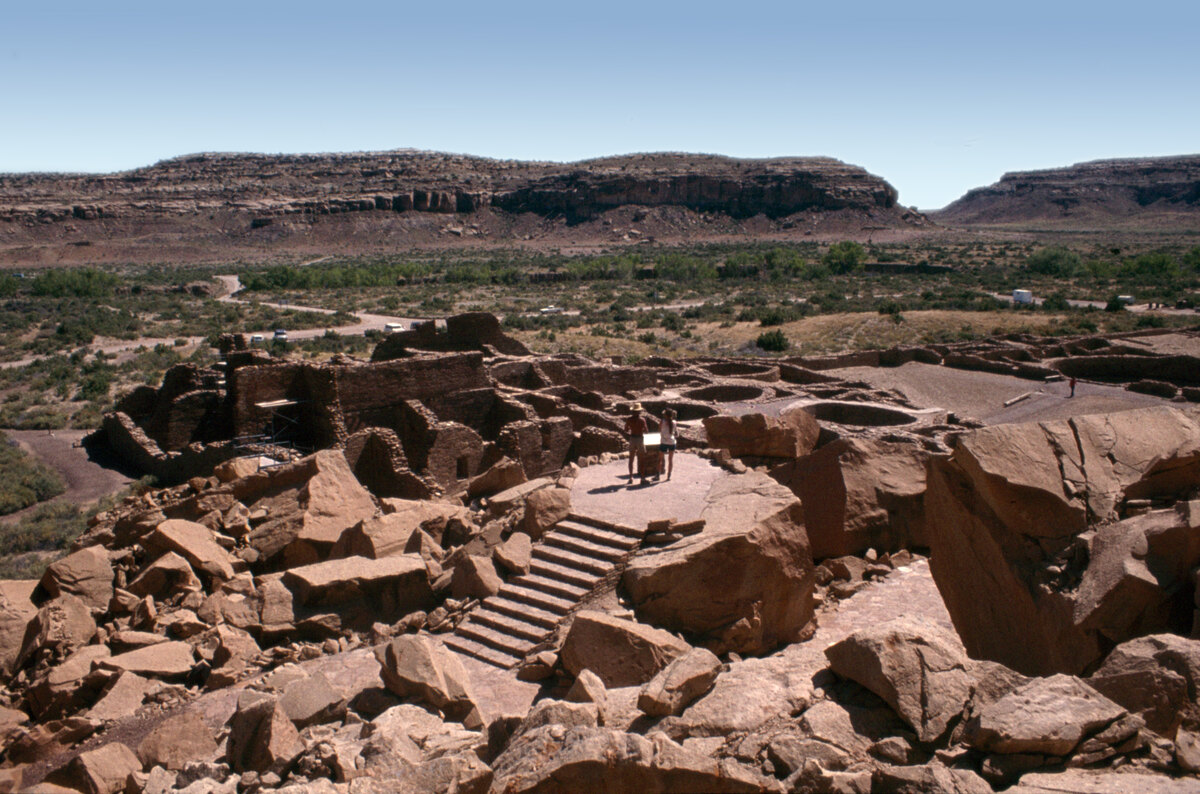
At the bottom of an arid canyon in northwestern New Mexico, Chaco Canyon was, between roughly 850 and 1150, the ceremonial and economic center of Ancestral Puebloan culture. Here people built great houses, or great housesgreat houseA large multi-story monumental complex, such as Pueblo Bonito, typical of the Chaco Canyon ceremonial center.→, monumental complexes of careful masonry made of a rubble core faced with finely fitted stone.1 The largest, Pueblo Bonito, spreads out in a semicircle and once held up to eight hundred rooms across four levels.
Chaco was not merely a town but the hub of a vast network. A system of roads, sometimes nine meters wide and remarkably straight, linked the canyon to dozens of outlying communities spread over thousands of square kilometers. These routes did not answer only to practical needs, some, like the Great North Road, appear to have carried symbolic meaning, oriented toward celestial north rather than any useful destination.2 Turquoise, seashells from the Pacific and even traces of cacao imported from Mexico attest to the reach of the exchanges of which Chaco was the pivot.
The building effort is staggering. It is estimated that the great houses of the canyon required the felling and transport of hundreds of thousands of timber beams, cut in mountain forests sometimes eighty kilometers away and carried on human backs, without draft animals or the wheel. This mobilization of labor, combined with the precision of the masonry and the careful planning of whole complexes, reveals a society able to coordinate vast construction projects and to gather, during the great festivals, populations drawn from across the entire network.
Mesa Verde and the cliff cities
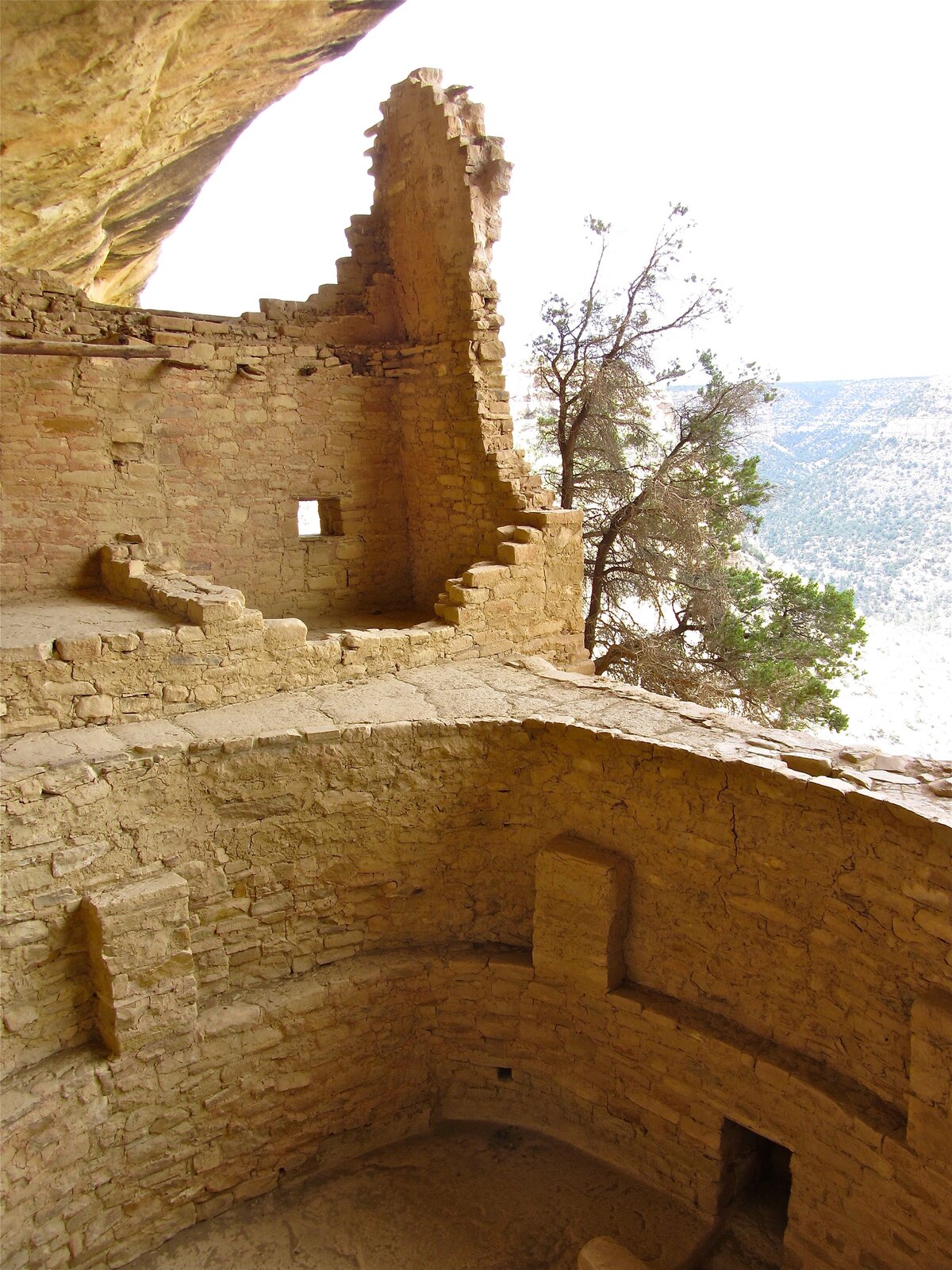
On the Colorado side of the Four Corners, Mesa Verde offers the other great face of this civilization, that of the cliff dwellings. From the late twelfth century, people left the mesa tops to shelter in the vast natural alcoves carved into the canyon walls, where they built true villages of stone.4 Several hundred sites have been counted there, some two dozen of them reaching the size of small towns.
The most spectacular, Cliff Palace, aligns some one hundred and fifty rooms and around twenty kivas beneath an immense sandstone vault. Built and occupied between roughly 1200 and 1280, it illustrates the height of a vertical urbanism perfectly suited to the cliff. This retreat toward defensive, hard-to-reach sites, barely more than a century before the general abandonment, still fuels scholarly debate about the tensions that ran through the region at the time.4
The alcoves offered real advantages beyond shelter, keeping the dwellings cool in summer and warm in winter, and shielding stores of grain from rain and raiders. Yet the fields still lay on the mesa tops above, so every day people climbed the sheer rock by hand and toe holds cut into the sandstone, carrying water, wood and the harvest up and down the cliff. That daily effort, sustained across generations, measures both the ingenuity of these communities and the growing pressures that pushed them into such demanding refuges.
Kivas, pottery and daily life
At the heart of every village beat the kivakivaA circular, half-buried ceremonial chamber entered from the roof, used for rituals and gatherings in Pueblo communities.→, a circular, half-buried chamber entered by a ladder through the roof. Fitted with benches, a central hearth and often a small ritual hole, the sipapu, symbol of the ancestors' emergence, it served for religious ceremonies and community gatherings.2 The great kivas of Chaco, more than fifteen meters across, could bring together entire populations during the major ritual festivals.
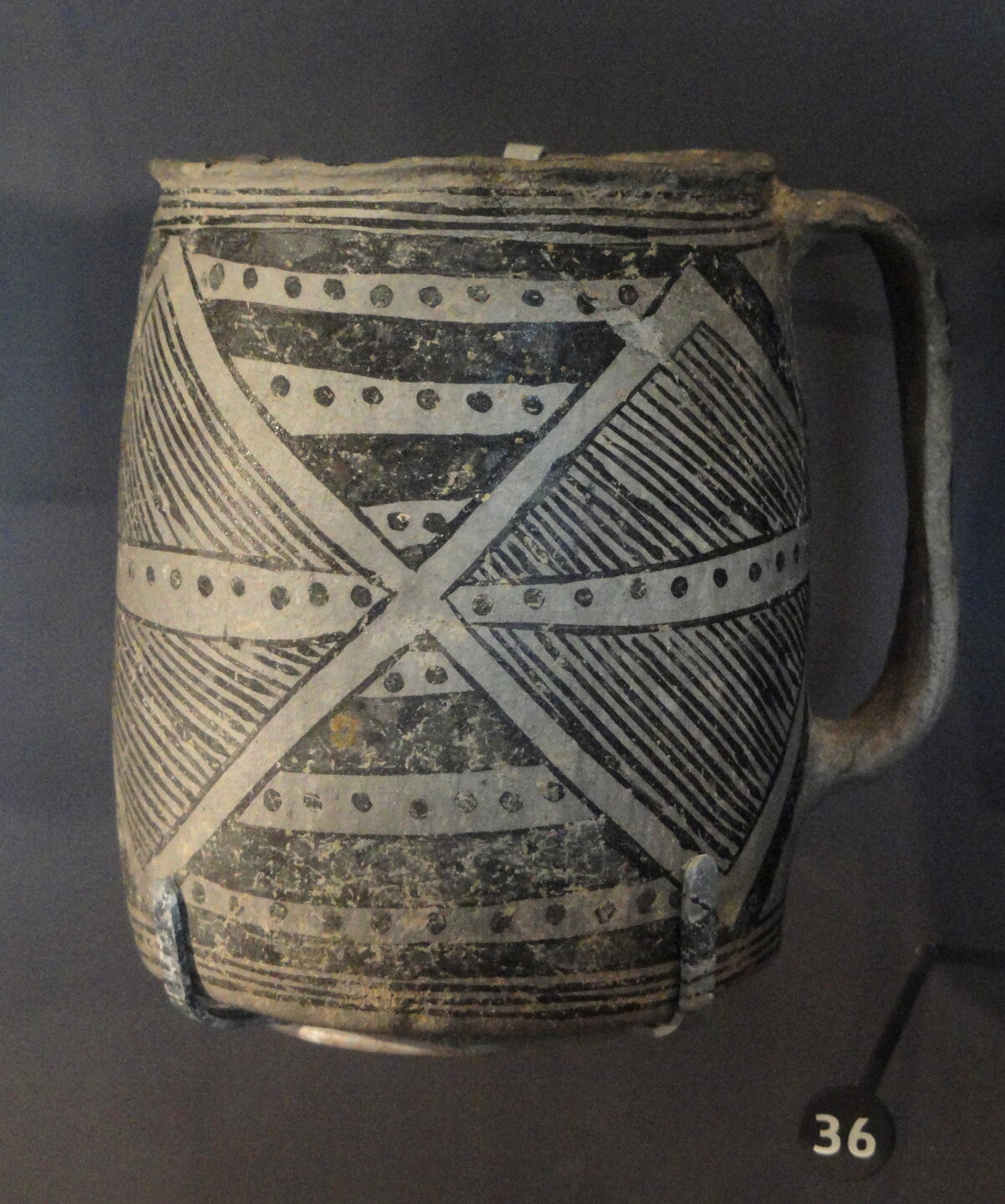
Pottery, which appeared in the Basketmaker III period, reached heights of refinement over the centuries. Craftspeople shaped bowls, jars, mugs and canteens, and covered their pale surfaces with geometric patterns painted in black, a style archaeologists call "Mesa Verde black-on-white".4 These objects, at once useful and beautiful, are today precious chronological markers that help date the sites. Daily life rested on the cultivation of maize, the grinding stone for meal, the weaving of cotton and the raising of turkeys.
Grinding grain took up a large share of women's time, kneeling for long hours before the flat metate and its handstone, as the characteristic wear on excavated bones bears witness. The turkey, domesticated as early as the Basketmaker III period, provided meat, feathers for blankets and bone for tools. Nothing was wasted, in a world where every resource counted, and yet this economy of frugality still left room for art, as the turquoise ornaments and the petroglyphs pecked into the rock faces make clear.
Astronomers of the desert
The builders of Chaco were also keen observers of the sky. Many of their structures are oriented according to the cycles of the Sun and the Moon, turning the landscape into a vast calendar of stone.2 The facade of Pueblo Bonito follows an almost perfect east-west axis, and several great houses open onto the sunrises of the solstices.
The most famous witness of this astronomy is the "sun dagger" of Fajada Butte. At the top of this butte, three upright stone slabs cast, through the gaps between them, blades of light onto two spirals carved into the rock. At the summer solstice, a single blade of light pierces the center of the large spiral, while at the winter solstice two blades frame it exactly.2 This device, together with the alignments of the great houses and roads, reveals a science of the calendar in the service of farming and ritual life.
Abandonment and Pueblo continuity
Around 1300, the great sites of the Four Corners emptied out. Long reduced to a "mysterious disappearance", this abandonment in fact resulted from a cluster of causes. The Great Drought of 1276 to 1299, documented by tree rings, struck hard at an already fragile agricultureAgricultureThe cultivation of plants and production of food by working the soil, which emerged in the Neolithic in the Near East and independently elsewhere; it radically transformed human societies.→, causing crop failures and water shortages.2 To these climatic pressures were added population strain, the depletion of soils and woodlands, competition for scarce resources and, it seems, a rise in violence and in social and religious tensions.
But the Ancestral Puebloans did not vanish, they moved. Between roughly 1150 and 1300, populations migrated south and east, toward the Rio Grande Valley, the Zuni region, the Little Colorado valley and the Hopi mesas, where they founded vast pueblos organized around plazas.1 The Hopi, the Zuni and the other Pueblo peoples of today are the direct heirs of this culture. Their languages, their kivas, their pottery and their origin stories carry into the present the story begun nearly three thousand five hundred years ago by the basket makers of the desert.
For today's Pueblo peoples, indeed, there was no break. Their oral traditions describe not a disappearance but a long series of deliberate migrationsMigrationsLong-distance movements of populations; a major driver of human history (the exit from Africa, the peopling of continents, Neolithic and steppe expansions).→, a journey of the ancestors across the landscape to the villages of the present. The ruins of Chaco and Mesa Verde are not dead cities to them but living places of origin, where the old ones rest and where the bond with the land is renewed. It is this continuity, as much as the stone remains, that the documentary invites us to see.
J'ai commencé à noter les sites mentionnés dans vos articles pour les visiter. La liste s'allonge !
Depuis que j'ai découvert ce site, je prépare mes voyages patrimoniaux différemment.