In the heart of Burgundy, in the French department of the Yonne, the river Cure has carved over the ages a limestone gorge pierced by numerous cavities. It is here, on the territory of the commune of Arcy-sur-Cure, that one of the major sites of European prehistoryPrehistoryThe span of human history before the invention of writing, from the Palaeolithic to the Metal Ages, known mainly through material remains.→ opens up. For the general public, the name Arcy long evoked nothing more than a network of show caves with spectacular concretions. Yet behind the calcite columns and the mineral draperies lay an unsuspected treasure: among the oldest known cave paintings in France, around twenty-eight thousand years old, long hidden beneath the soot of torches and veils of calcite, and rediscovered only in 19901. A few dozen metres away, another cave, that of the Reindeer, had been yielding since the mid-twentieth century decisive remains concerning the last NeanderthalsNeanderthalsA fossil humanity of Eurasia, robust and cold-adapted, extinct around 40,000 years before present.→ of Europe and their surprising material culture.
Arcy-sur-Cure thus brings together, on a single site, two of the greatest enigmas of prehistory: the flourishing of cave art at the dawn of the Upper PalaeolithicPalaeolithicThe oldest and longest period of prehistory (c. 3.3 Ma–12,000 BC), defined by chipped stone tools and a hunter-gatherer way of life.→, and the burning question of the symbolic capacity of Neanderthals. On one side, mammoths, a feline, a bird and negative hands blown in ochreOchreA red or yellow mineral pigment (iron oxides), used from prehistory for adornment, funerary rites and art.→ onto the wall by Homo sapiensHomo sapiensThe present-day human species, which emerged in Africa around 300,000 years ago, the only surviving human lineage after the extinction of Neanderthals and Denisovans.→ of the GravettianGravettianAn Upper Palaeolithic culture (c. 33,000–21,000 BC) spanning from the Atlantic to Siberia, famous for its ivory female figurines ("Venuses") and, at Dolní Věstonice, the oldest fired ceramics.→GravettianAn Upper PalaeolithicUpper PalaeolithicThe final phase of the Palaeolithic (c. 45,000 to 10,000 years ago), marked by Homo sapiens in Europe, art, ornaments and a succession of cultures (Aurignacian, Gravettian, Solutrean, Magdalenian).→ culture (c. 33,000–21,000 BC) famous for its female figurines, the "Venuses".→. On the other, ornaments, bone tools and pigments associated with a culture called the ChâtelperronianChâtelperronianA transitional material culture (c. 45,000-40,000 years ago) straddling the Middle and Upper Palaeolithic in France and northern Spain; curved-backed knives and, at the Grotte du Renne at Arcy, ornaments and bone tools attributed to Neanderthals.→, which many attribute to the last NeanderthalsHomininHomininMember of the subtribe Hominina, comprising the human lineage (Homo, Australopithecus, Paranthropus…) but excluding orangutans and gibbons. The term progressively replaces "hominid" in its narrow sense.→A member of the human lineage in the broad sense, including modern humans, their ancestors and related great apesgreat apesThe family of great apes (Hominidae) comprising orangutans, gorillas, chimpanzees, bonobos and humans.→.→. Few places concentrate so many debates about what it means to "be human" and about the birth of symbolic thought.
This article sets out to survey this whole history. We shall first present the Arcy cave complex as an exceptional archaeological ensemble, then the Great Cave and its paintings. We shall return to the rediscovery of 1990, beneath soot and calcite, which revealed an unsuspected decorated sanctuary; to the singular bestiary of mammoths, feline and bird, and to the negative hands; to the Gravettian dating that makes it a milestone of European parietal artCave (parietal) artArt made on the walls of caves and shelters (paintings, engravings), as opposed to portable artPortable artTransportable art objects (figurines, engravings on bone or ivory), such as the Palaeolithic Venuses.→.→. We shall then explore the Cave of the Reindeer and the Neanderthal Châtelperronian, the debate on Neanderthal symbolism, questions of conservation and the site's historical vandalism, before considering what one can see and understand at Arcy today.
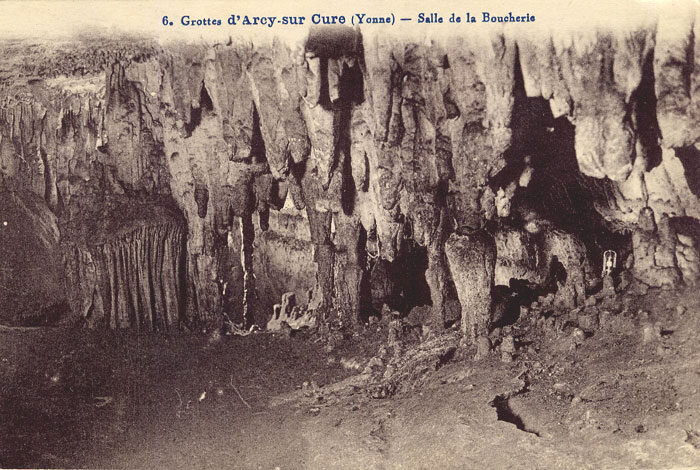
Arcy, a major cave complex
The site of Arcy-sur-Cure is not an isolated cave but a veritable string of cavities hollowed out of the limestone cliff that borders the left bank of the Cure, on the territory of the communes of Arcy-sur-Cure and Saint-Moré. The river, a tributary of the Yonne, has cut over the millennia into a massif of Jurassic limestone, and infiltrating water has shaped within it a complex karstic network. There are some ten caves here, whose names, Cave of the Horse, Cave of the Hyena, Cave of the Reindeer, Cave of the Bison, Cave of the Wolf, Great Cave, speak both of the imagination of their explorers and of the richness of the Palaeolithic fauna that frequented their surroundings.
This concentration of cavities makes it one of the most important prehistoric ensembles in France. The location of the site is no accident: the valley of the Cure formed a natural corridor of movement for humans as much as for large herbivores, and the caves offered at once shelter, a vantage point over the valley and access to water. During the long glacial periods of the PleistocenePleistoceneThe geological epoch of the great ice ages (c. 2.6 Ma–11,700 BP), spanning most of human prehistory.→, these shelters were occupied, abandoned and reoccupied according to the swings of climateClimateThe long-term average atmospheric conditions of a region; its variations (glaciations, aridifications) shaped migrations, agriculture and the collapse of prehistoric societies.→, by successive human groups, from Neanderthals of the Middle PalaeolithicMiddle PalaeolithicA Palaeolithic period (c. 300,000 to 40,000 years ago) associated mainly with Neanderthals and early Homo sapiens, marked by Levallois tools.→ to the hunter-gatherersHunter-gatherersA way of life based on hunting, fishing and gathering wild resources, without farming or herding; it dominated almost the whole of human history.→ of the Upper Palaeolithic.
Archaeological research at Arcy goes back to the nineteenth century, but it took on a new scientific scale in the mid-twentieth century, notably under the impetus of André Leroi-Gourhan, one of the major figures of French prehistory, who led important excavations there from the 1940s and 1950s onward3. The stratigraphic layers of Arcy, particularly thick and well preserved, have made it possible to read a succession of occupations spanning tens of thousands of years. The Cave of the Hyena and the Cave of the Reindeer, in particular, have yielded reference sequences for understanding the passage from the Middle to the Upper Palaeolithic in western Europe.
It is worth stressing how precious these sequences are for research. In prehistory, the thickness and continuity of a stratigraphyStratigraphyThe study of the superimposed layers (strata) of an archaeological site; each layer corresponds to a phase of occupation and yields a relative chronology.→ determine the fineness with which one can reconstruct the unfolding of time. At Arcy, the layers accumulated over a long span without major gaps in certain cavities, offering researchers a kind of sedimentary calendar in which each level corresponds to a phase of occupation. One reads there the alternation of material cultures, the changes in stone-knappingknappingThe set of operations for fracturing a stone block to extract flakes or blades.→ techniques, the variations in the hunted fauna across climatic oscillations. This documentary quality makes Arcy a reference site, cited in every textbook dealing with the transition between the Middle and the Upper Palaeolithic.
The Arcy complex thus presents a double face. On the one hand, it is a site of dwelling and encampment, where hearths, knapped-stone tools and the remains of hunted and consumed fauna have been found, witnesses to the daily life of human groups. On the other hand, one of the cavities, the Great Cave, was taken over as a decorated place, a sanctuary to which people came to paint the wall. This duality, dwelling and art, makes the whole singularity of the site and explains why it occupies a leading place in the manuals of prehistory.
It must also be recalled that the caves of Arcy have long been a tourist site. Part of the network, known as the Great Caves, was developed for visiting as early as the nineteenth century, drawing walkers who came to admire the concretions, the rimstone pools, the calcite columns and an underground lake. This ancient attendance, as we shall see, was not without consequence for the conservation of the paintings, and explains in part why they so long escaped attention.
The Great Cave and its paintings
Among all the cavities of Arcy, it is the Great Cave that holds the parietal treasure. A vast cavity whose galleries extend over several hundred metres, adorned with magnificent concretions, it had long been known and visited for its natural qualities. No one suspected that its walls bore, beneath a crust of calcite and lamp-black, dozens of painted and engraved figures dating back to the dawn of the Upper Palaeolithic.
The paintings are concentrated in certain galleries of the cave, where the wall offered surfaces favourable to drawing. The Palaeolithic artists used essentially two techniques: painting, with red pigments (iron oxides, ochres) and black pigments (manganese oxide, charcoal), and engraving, by incising the soft rock or the film of clay. Many figures in fact combine the two processes, the painted line underscoring or completing an engraved outline. The ensemble today comprises more than a hundred recorded representations, which makes Arcy one of the principal decorated ensembles of the Palaeolithic in France.
The pigments used deserve a moment's attention. The red came from ochres and iron oxides, abundant in nature, which were ground and diluted with a binder to obtain a colouring matter. The black could be drawn from charcoal or from manganese oxide, the latter offering deep and lasting hues. The preparation of these pigments already presupposes a complex chain of operations: locating the deposit of raw material, extracting it, grinding it, sometimes heating it to alter its tint, mixing it with a binder, then applying it to the wall with the fingers, a pad or by blowing. Behind each painted figure, then, lies a genuine technical know-how, handed down from generation to generation, which bears witness to an already accomplished mastery of the materials and gestures of painting.
What strikes one at once is the antiquity of this art. The paintings of Arcy are among the oldest known on French soil, in a restricted group that includes the Chauvet cave, in the Ardèche, and a few other major sanctuaries. Where MagdalenianMagdalenianThe last great Upper Palaeolithic culture (c. 17,000–12,000 BC), the peak of cave art (Lascaux).→ art, later and more famous, that of Lascaux or Niaux, deploys frescoes of great virtuosity, the art of Arcy belongs to an earlier phase, in which the very conventions of parietal representation were being invented. It is an art of origins, in which each figure documents the birth of a visual language.
The Great Cave functioned, evidently, as a symbolic space distinct from the domestic space. People did not live in the deep galleries where the paintings are found; they went there, torch in hand, to perform a gesture that had nothing utilitarian about it. The arrangement of the figures, their location in sometimes hard-to-reach recesses, the care given to certain compositions, everything indicates that these decorated walls had a function that largely escapes us, but that belonged to the sacred, to ritual or to the transmission of knowledge. As in most decorated caves, it is the animal that dominates and the human that fades away, reduced most often to the imprint of a hand.
To grasp the importance of Arcy, one must recall the context of its revelation. For decades, thousands of visitors walked through these galleries without seeing anything of the paintings, so concealed were they. It took a trained eye, and particular circumstances, for the sanctuary to emerge, in 1990, from beneath the calcite and the soot. This late rediscovery is one of the most striking episodes in the recent history of parietal art.
The rediscovery of 1990, beneath the soot
The story of the rediscovery of the Arcy paintings has something of a coup de théâtre about it. The Great Cave was, as we have said, a place of visit since the nineteenth century, frequented by generations of tourists. Yet throughout that time its paintings remained invisible, covered by two superimposed screens: on the one hand the veils of calcite that infiltrating water slowly deposits on the walls, forming a translucent but opacifying film; on the other a layer of soot and lamp-black, accumulated over centuries by the torches, lamps and flares of the successive explorers and visitors.
It was in 1990 that everything changed. A team of researchers, led notably by the prehistorians Dominique Baffier and Michel Girard, undertook a careful examination of the walls of the Great Cave1. By cautiously scraping or cleaning certain surfaces, by observing the rock under raking light and with the help of modern techniques, they brought to light, beneath the black crust, painted figures that had remained invisible for millennia. The news caused a sensation: in the very heart of an extremely busy tourist site, one of the oldest decorated ensembles in France had been discovered.
The layer of soot, paradoxically, played a double role. On the one hand, it long masked the paintings and harmed their legibility; on the other, by settling over them, it sometimes helped to protect them, sealing the pigments beneath a film that shielded them from certain forms of deterioration. Calcite, in the same way, covers and alters, but also protects while dating: the fine films of carbonate that form above or below a painting can be analysed to bracket chronologically the moment at which the figure was traced.
The work of revelation was, and remains, delicate. It is not a matter of stripping the wall brutally, which would destroy both the calcite, precious for dating, and the fragile pigments. Specialists proceed by meticulous observation, by survey drawings, by imaging, sometimes by localised micro-cleaning, with constant concern to preserve the integrity of the work. The rediscovery of Arcy is therefore not an isolated event but the start of a long programme of study that continued through the 1990s and beyond, as new figures emerged from the shadows.
This late rediscovery invites a broader reflection. How many decorated caves still sleep, unrecognised, beneath veils of calcite or deposits of soot, in cavities believed to have been long explored? Arcy reminds us that the inventory of parietal art is never closed, and that the gaze brought to bear on the walls, refined by new methods of observation and analysis, can bring forth masterpieces where one saw only blackened stone. The sanctuary of Arcy passed, for decades, before the eyes of thousands of visitors; it had to be learned to be seen.
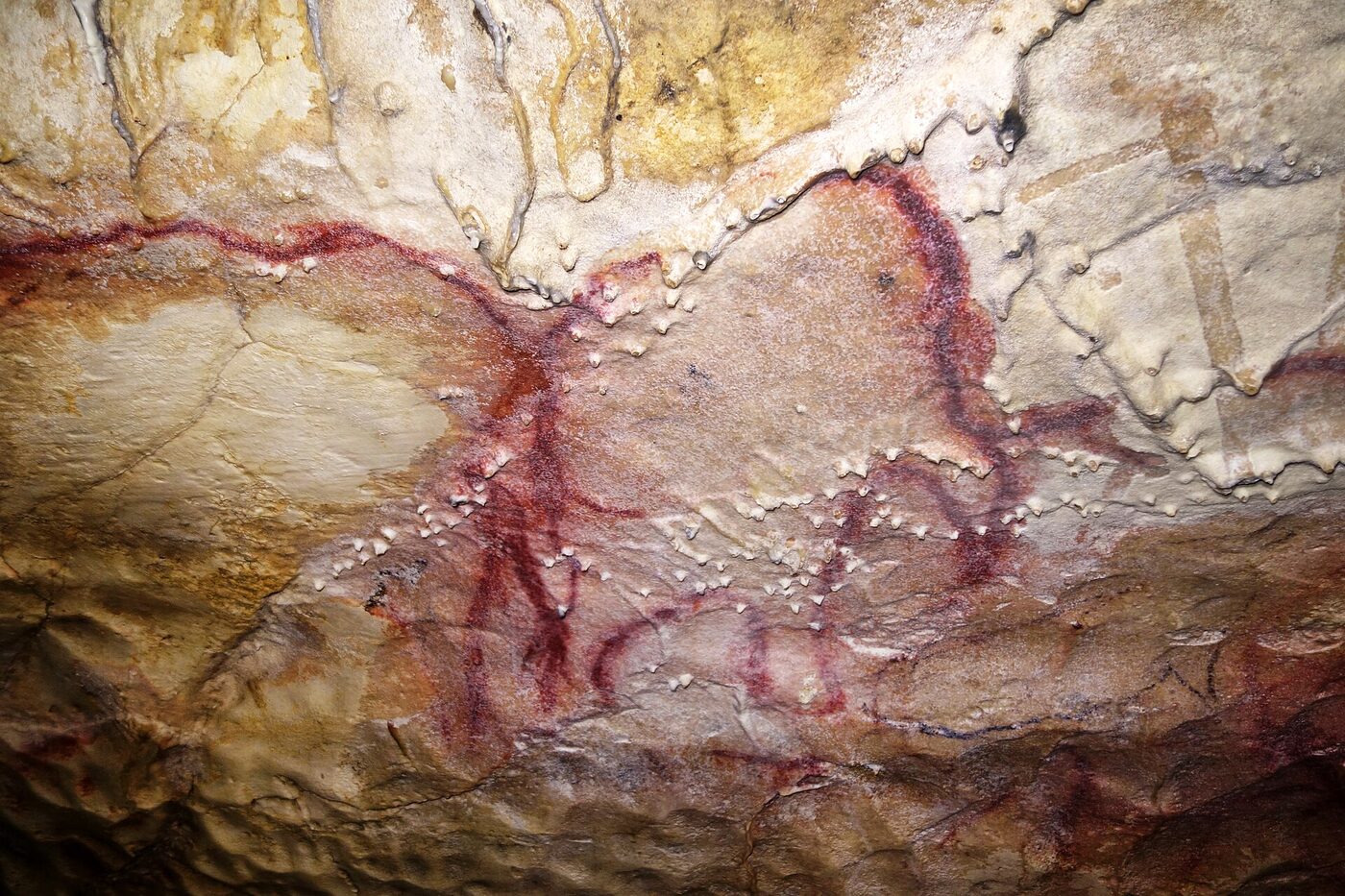
The bestiary: mammoths, feline, bird, and the hands
The bestiary of Arcy presents a singular physiognomy that distinguishes it from many other decorated caves. The most frequent figure there is the mammoth. This emblematic animal of the glacial steppes, with its massive silhouette, its arched back, its domed head and its curved tusks, occupies a central place in the repertoire of the Arcy artists. Yet the mammoth is relatively rare in French parietal art taken as a whole: its pre-eminence at Arcy makes the site a remarkable case, sometimes compared on this point to the cave of Rouffignac, in the Dordogne, nicknamed "the cave of a hundred mammoths".
Alongside the mammoths, one recognises other animals characteristic of the cold fauna of the Upper Palaeolithic: horses, ibexes, deer, bovids, sometimes sketched with a single line, sometimes more fully realised. But two figures particularly draw attention through their rarity. The first is that of a feline, an exceptional animal in parietal art and always charged with a particular intensity, as the famous lions of the Chauvet cave attest. The second, more unexpected still, is a representation of a bird, a motif of great rarity in cave art, where the figured animal world is almost always limited to the large mammals that were hunted or feared.
The presence of these unusual motifs, feline, bird, broadens the iconographic repertoire known for this early period and feeds the idea that Palaeolithic art, far from being fixed, varied from one group to another, from one sanctuary to another. Each decorated cave seems to obey a logic of its own, favouring certain animals and neglecting others, according to choices that largely escape us but that must have had a precise meaning for those who painted them.
The pre-eminence of the mammoth at Arcy has nourished many hypotheses. Should one see in it the reflection of a fauna particularly present in the valley of the Cure at the time when the paintings were made? A symbolic preference specific to the human group that frequented the sanctuary? A mythological or totemic significance attached to this great pachyderm of the steppes? Specialists guard against any hasty interpretation, for parietal art cannot be reduced to a simple inventory of what people saw or hunted. The choice of the animals figured doubtless belonged to a symbolic grammar whose key we have lost, in which each species occupied a determined place within a vision of the world that remains largely opaque to us. The mammoth of Arcy, like the horse of Lascaux or the lion of Chauvet, keeps its mystery.
Alongside the animals, the other great category of figures at Arcy is that of the negative hands. These imprints are among the most moving manifestations of prehistoric art. To make them, the artist placed a hand flat against the wall, then projected pigment all around it, blowing it from the mouth or by means of a tube, so that the silhouette of the hand stood out in reserve, light against the coloured ground. The result is striking: the hand is not painted, it is drawn in hollow by the absence of pigment, and it is precisely this void that makes it such a disquieting presence. At Arcy, these negative hands, blown in ochre, signal the direct presence of human beings who stood there some twenty-eight thousand years ago.
Negative hands pose fascinating questions. To whom did these hands belong, men, women, children? What gesture, what rite accompanied their application? Were they a signature, an offering, a mark of passage, an act of symbolic appropriation of the place? No definitive answer exists, but their universality, similar ones are found across the world, from Europe to Patagonia by way of Indonesia, suggests a deep need, common to humanity, to leave on stone the trace of one's own hand. At Arcy, these imprints stand alongside the mammoths, the feline and the bird, composing an ensemble in which animal and human converse on the wall.
The Gravettian dating
One of the essential questions, for any parietal art, is that of its age. At Arcy, the research conducted since the rediscovery has made it possible to attribute the paintings to a range situated around twenty-eight thousand years before the present1. This age places the sanctuary of Arcy in the early phase of the Upper Palaeolithic, and more precisely in the so-called GravettianGravettianAn Upper Palaeolithic culture (c. 33,000–21,000 BC) famous for its female figurines, the "Venuses".→ culture, which developed in Europe between roughly thirty-one thousand and twenty-two thousand years before our era.
How does one date rock paintings? Several methods are combined. The most direct consists in dating by radiocarbon the black pigments when they contain charcoal, that is to say organic matter resulting from combustion. The measurement of residual carbon-14 then gives an age for the very act of painting. But this method is applicable only to carbon-based pigments and requires the removal of a little matter, which is not always possible on fragile works. Another, indirect approach rests on the analysis of the films of calcite that formed above or below the painting: by the uranium-thorium method, one can date these concretions and thus bracket the figure between a minimum and a maximum age.
The attribution to the Gravettian situates Arcy in a decisive moment of European prehistory. The Gravettian is the culture of the great hunters of mammoths and reindeer of the glacial steppes, and also that of the famous Palaeolithic "Venuses", those female statuettes with amplified forms found from France to Siberia. It is a period of expansion of Homo sapiens across Europe, marked by great mobility, extensive networks of exchange and a rich symbolic life. The paintings of Arcy are one of the parietal expressions of this Gravettian world.
This early dating confers a particular value on Arcy. The site belongs to the very restricted club of French decorated caves older than twenty-five thousand years, alongside Chauvet, older still, around thirty-six thousand years, and a few others. Far from the image of a parietal art that would culminate with the Magdalenian of Lascaux, the sequence of Arcy reminds us that humans painted the walls of caves from the very beginnings of the Upper Palaeolithic, and that the conventions of this art were established very early, on already sophisticated foundations.
The precision of these datings remains, as always in prehistory, subject to margins of uncertainty and to revisions in step with methodological progress. But the order of magnitude, some twenty-eight millennia, is solidly established and makes Arcy a chronological reference point. When one contemplates a mammoth of the Great Cave, one is looking at an image traced by a human hand nearly three hundred centuries before us, at a time when Europe was a glacial tundra crossed by herds of large herbivores.
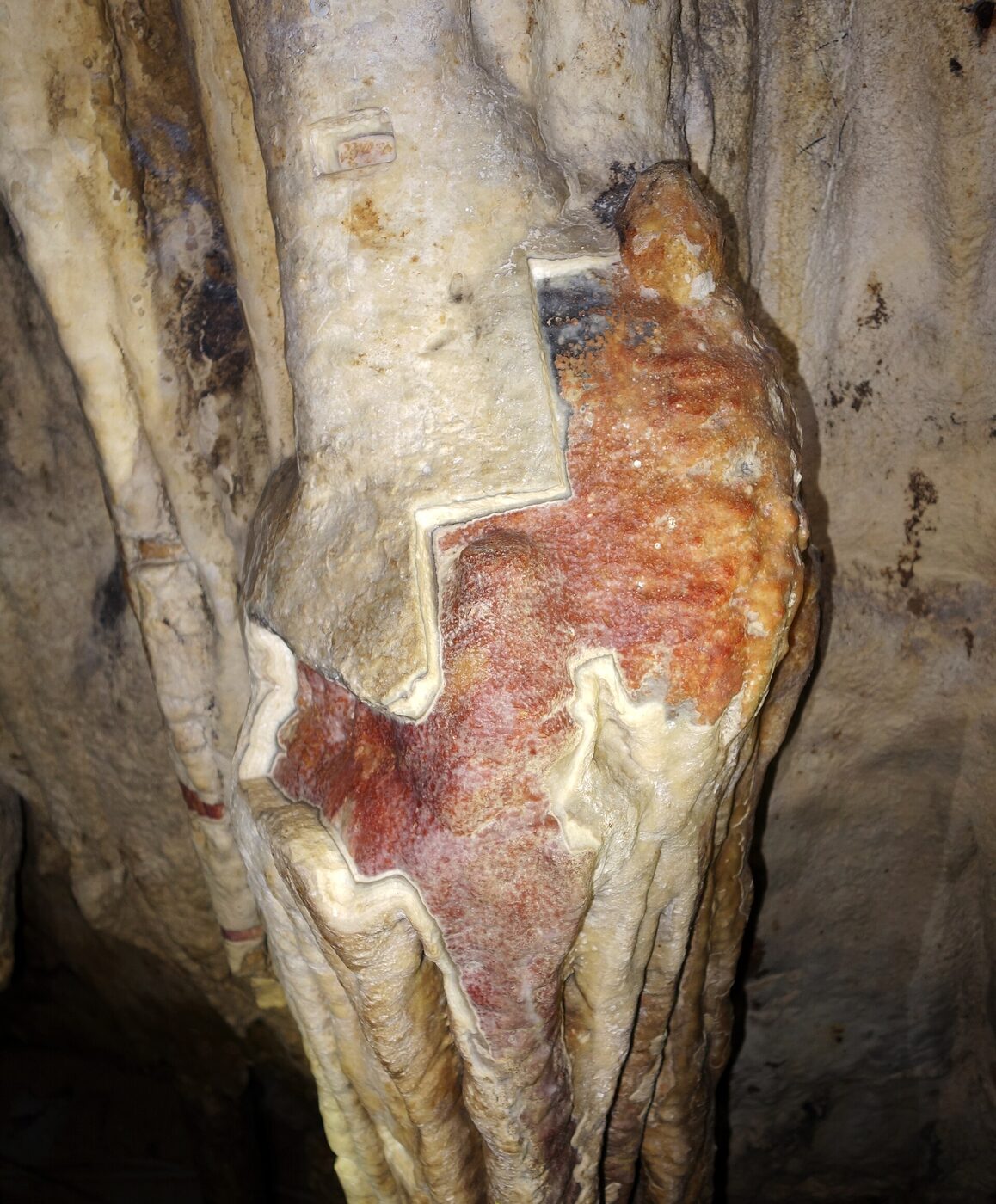
The Cave of the Reindeer and Neanderthals
If the Great Cave makes Arcy famous among lovers of parietal art, it is another cavity of the site, the Cave of the Reindeer (Grotte du Renne), that has profoundly marked research on Neanderthals. Excavated principally by André Leroi-Gourhan from the 1940s onward, this cave has yielded a stratigraphy of exceptional richness, in which layers of occupation succeed one another from the Middle to the Upper Palaeolithic2.
The level that made the Cave of the Reindeer world-famous is the one corresponding to the ChâtelperronianChâtelperronianA transitional material culture (c. 45,000-40,000 years ago) straddling the Middle and Upper Palaeolithic in France and northern Spain; curved-backed knives and, at the Grotte du Renne at Arcy, ornaments and bone tools attributed to Neanderthals.→. This culture, dated to roughly forty-five thousand to forty thousand years before the present, occupies a pivotal position: it lies at the transition between the Middle Palaeolithic, associated with Neanderthals, and the Upper Palaeolithic, associated with the arrival of Homo sapiens in Europe. The Châtelperronian owes its name to the site of Châtelperron, in the Allier, and is characterised notably by curved-backed knives, known as Châtelperron points.
But what makes the Châtelperronian layer of the Cave of the Reindeer so extraordinary is the objects it yielded. Alongside the stone tools, the excavators brought to light ornaments, pierced animal teeth, rings and beads of ivory, objects shaped to be suspended or worn, worked bone tools, as well as pigments. These elements belong typically to what prehistorians associate with "modern" behaviour: the concern for adornment, the manufacture of symbolic objects, the transformation of matter for ends that are not strictly utilitarian.
Now, crucially, several human remains discovered in these levels have been attributed to Homo neanderthalensis. If one accepts that it was indeed Neanderthals who produced the Châtelperronian of the Cave of the Reindeer, then one must conclude that these homininsHomininA member of the human lineage in the broad sense, including modern humans, their ancestors and related great apes.→, long caricatured as brutes incapable of abstraction, also made ornaments, worked bone and used pigments. The Cave of the Reindeer thus becomes one of the cornerstones of the dossier on the symbolic intelligence of Neanderthals, and one of the most discussed sites in all of European prehistory.
The importance of the Cave of the Reindeer also rests on the quality of its stratigraphy. The layers there are numerous, thick, and make it possible to follow, level by level, the evolution of material cultures at a decisive moment in human history: the moment when Neanderthals and Homo sapiens coexisted in Europe, before the former disappeared, some forty thousand years ago. To understand what was at play in these levels of Arcy is to attempt to grasp the nature of that encounter and the reasons for the extinction of the Neanderthals.
The Cave of the Reindeer yielded, beyond the ornaments, an abundant assemblage that illuminates the daily life of its occupants. Hearths, bone remains of consumed animals, tools of stone and bone sketch the picture of a camp repeatedly inhabited. The reindeer, which gave the cave its name, figures among the most represented species in the faunal remains, a sign of a cold steppeSteppeA vast semi-arid, treeless grassland of Eurasia, suited to nomadic herding and the horse; a corridor for the movement of peoples and technologies in later prehistory.→-type environment and of a hunting economy turned toward the great herds. This domestic dimension of the site complements the symbolic dimension of the ornaments: one finds there not only objects of prestige, but the whole material fabric of an existence, which makes the reading of these layers all the more precious for reconstructing the way of life of the last Neanderthals.
The debate on Neanderthal symbolism
The Châtelperronian layer of the Cave of the Reindeer lies at the heart of one of the liveliest controversies of contemporary prehistory. The question can be put simply: are the ornaments and symbolic objects of this layer really the work of the Neanderthals, or do they result from a mixing, accidental or later, with the productions of Homo sapiens?
Two major positions confront each other. For some, the association between the Neanderthal remains and the ornaments is solid: it was indeed the last Neanderthals who made these adornments, whether on their own initiative or by imitation of the Homo sapiens who were then arriving in Europe. This interpretation makes Neanderthals beings endowed with a real symbolic capacity, capable of innovation and abstract thought, and joins other clues accumulated in recent years: use of pigments, burials, perhaps graphic manifestations in certain Iberian caves.
For others, caution is required. They stress that the layers of a cave excavated over long periods can undergo disturbances, animal burrows, trampling, reworking, infiltrations, liable to mix remains of different ages and origins. According to this reading, the ornaments of the Cave of the Reindeer might come from upper, later levels attributable to Homo sapiens, and have migrated into the Châtelperronian layer. The debate then bears on the stratigraphic integrity of the deposit and on the reliability of the associations between objects and human remains.
To settle the matter, researchers have mobilised a wide arsenal of methods: increasingly precise radiocarbon datings, chemical analyses of bone collagens, detailed taphonomic studies of the layers, examinations of possible disturbances. The direct datings of the objects and bones have occupied a central place in the discussion, without always producing unanimity. The Arcy dossier illustrates wonderfully the difficulty of proof in prehistory, where every clue must be weighed, cross-checked, subjected to criticism, and where a solid conclusion often requires decades of work and debate.
Beyond the technical quarrel, the stakes are considerable. They touch on the very definition of what would make the specificity of our species. If Neanderthals made ornaments, buried their dead, used pigments and ordered their world through symbols, then the boundary that people long wished to draw between them and us blurs. Symbolic thought, the aesthetic sense, culture would cease to be the exclusive prerogative of Homo sapiens to become a more ancient heritage, shared by other human forms. The Cave of the Reindeer at Arcy stands, on this terrain, in the front line, and that is what makes it such a decisive and disputed site.
Conservation and historical vandalism
The history of Arcy is also, in its way, a history of fragility. The fact that the paintings of the Great Cave were masked by the soot of torches reminds us that this tourist site was, for centuries, exposed to the deterioration linked to human attendance. The visitors of the nineteenth and twentieth centuries, lighting their way with flares and flame lamps, deposited on the walls that lamp-black which, accumulating, obscured the painted figures. To this were added, over time, acts of vandalism: graffiti, removal of concretions, various forms of damage, common in show caves developed long ago and insufficiently protected.
This prolonged attendance poses an acute conservation problem. A decorated cave is a highly sensitive environment: the air exhaled by visitors, their body heat, the variations of temperature and humidity they cause, the introduction of micro-organisms, all of this can durably alter the paintings and favour the development of moulds or bacterial veils. The example of Lascaux, whose paintings were threatened by the proliferation of algae and then fungi after it was opened to the public, has shown how vulnerable parietal art is and how much human presence, even well-intentioned, can harm it.
At Arcy, the situation is rendered particularly delicate by the coexistence, on a single site, of a tourist sector open to the public and decorated galleries of inestimable scientific value. The management of the site must therefore reconcile two sometimes contradictory requirements: openness, which allows the transmission and valorisation of the heritage, and protection, which imposes the limitation of access to the most sensitive areas. Since the rediscovery of 1990, awareness of the value of the paintings has led to a strengthening of preservation measures and to a stricter regulation of the approach to the decorated walls.
Calcite, paradoxically, holds an ambivalent place in this history of conservation. By covering the paintings, it masks them and may, in the long run, efface them; but by settling, it also seals them and protects them from certain aggressions, while offering researchers a precious dating tool. The work of conservation therefore consists in finding a subtle balance: preserving the ancient pigments without destroying the concretions that cover them, slowing deterioration without artificially freezing a living environment in perpetual evolution.
The eventful history of Arcy, between past deterioration and present preservation, also serves as a lesson. It reminds us that parietal heritage is a non-renewable inheritance, which has crossed tens of thousands of years but which a few generations of neglect could efface. Every decorated cave lost, damaged or poorly protected is a page of humanity that disappears forever. The vigilance now devoted to Arcy is commensurate with the value of what the site nearly let vanish beneath the soot.
Visiting Arcy today
What can one see and understand at Arcy-sur-Cure today? The site remains a major tourist destination in Burgundy. The Great Caves of Arcy, developed for visiting, welcome the public and allow the discovery of a spectacular underground world: galleries adorned with concretions, draperies of calcite, columns and stalactites, rimstone pools and an underground lake compose a mineral landscape of great beauty, shaped by water over the millennia.
For obvious conservation reasons, access to the parietal paintings of the Great Cave is closely controlled. As in most major decorated caves, one could not allow streams of visitors to approach freely figures twenty-eight thousand years old, on pain of repeating the mistakes of the past. Attendance of the decorated galleries is therefore reserved for scientists and subject to strict protocols, while the public discovers the archaeological richness of the site through other mediations: reproductions, explanatory panels, documentation.
The valley of the Cure offers, moreover, a remarkable natural and heritage setting. The limestone cliffs that overhang the river, the vegetation that clings to them, the gorge cut by the waters compose a landscape that helps one imagine what this territory may have been in the Palaeolithic: a corridor of movement for the great herds, a vantage point and shelter for human groups, a place where nature offered both protection and resources. To understand Arcy is also to read the landscape and to place mentally within it the hunter-gatherers who roamed it.
The visit to Arcy finally invites a kind of meditation on time. Walking through these galleries where men of the Gravettian came to paint mammoths, where others, millennia earlier, left ornaments in the Cave of the Reindeer, one touches with the eye the depth of the human adventure. The site condenses, over a few hundred metres of cliff, tens of thousands of years of history, from the last Neanderthals to the artists of Homo sapiens. Few places give so strongly the sense of the continuity and depth of the past.
For the attentive visitor, Arcy is therefore not merely a beautiful cave of concretions, but an open book on the origins. Each gallery, each layer of sediment, each painted figure tells a fragment of the history of our species and of those that preceded it. It is this density, this superimposition of narratives, that makes Arcy-sur-Cure one of the most precious sites of the European prehistoric heritage.
Ultimately, what Arcy offers the visitor of today is an experience of deep time. Where our daily life is measured in hours and days, the site is measured in millennia: between the tools of the first Neanderthal occupants and the Gravettian paintings of the Great Cave, tens of thousands of years elapsed, and yet everything is held within a single landscape, beneath a single cliff. This compression of time, this possibility of holding so vast a duration in a single gaze, is precisely what makes the great prehistoric caves so overwhelming. Arcy-sur-Cure, through the diversity of what it preserves, offers one of the most complete and most moving examples of it.
Conclusion
Arcy-sur-Cure gathers, in a single limestone gorge of the Yonne, an essential part of the great history of human origins. The Great Cave preserves there one of the oldest ensembles of parietal art in France: mammoths, a feline, a bird and negative hands blown in ochre, traced some twenty-eight thousand years ago by Gravettian hunters, and long concealed beneath the soot of torches and veils of calcite before their spectacular rediscovery in 1990. The Cave of the Reindeer, for its part, has yielded one of the most discussed dossiers in prehistory: that Châtelperronian with its ornaments and bone tools, associated with the last Neanderthals, which unsettles the idea that symbolic thought would be the exclusive prerogative of Homo sapiens.
The site illustrates, better than many others, the way in which prehistory advances: through the attention given to walls believed to be mute, through the patient and rigorous debate on the origin of the remains, through the concern to preserve for future generations a fragile and non-renewable heritage. Arcy reminds us that the inventory of our past is never closed, and that the caves of the valley of the Cure perhaps still keep, beneath the calcite and the passage of time, secrets that we have not finished deciphering.
Je n'ai pas de formation historique mais j'aime apprendre. Ce site est parfait pour moi.
Je galère à relier toutes les périodes en cours. Cet article m'aide vraiment à y voir plus clair.
J'ai recommandé ce site à trois collègues. On en parle maintenant pendant les pauses.
Arcy-sur-Cure est au coeur du débat sur les comportements symboliques des Néandertaliens. Les parures de la couche Châtelperronienne montrent que les Néandertaliens utilisaient des dents percées comme ornements, ce qui est traditionnellement associé à Homo sapiens. Que cela soit le résultat d'une invention indépendante ou d'un échange avec les Homo sapiens, c'est fascinant dans les deux cas.
Les grottes d'Arcy-sur-Cure en Bourgogne sont un site absolument exceptionnel pour la compréhension de la transition entre Paléolithique moyen et supérieur. Les parures découvertes dans des couches associées à l'industrie Châtelperronienne ont alimenté le débat sur les capacités symboliques des Néandertaliens. Ces objets ont-ils été fabriqués par des Néandertaliens ou acquis par contact avec des Homo sapiens ?