Some 4.4 million years ago, in thé forested woodlands of thé Ethiopian Afar, a créature lived that would overturn everything we thought we knew about human origins. Ardipithecus ramidus, nicknamed "Ardi", represents one of thé oldest and most complete fossils ever found in thé human lineage. Its discovery forced scientists to radically rethink thé image they had of thé common ancestor of humans and chimpanzees, and to reconsider thé very mechanisms of our évolution.
Thé Discovery of Ardi: Thirty Years of Patience
Thé story of Ardipithecus ramidus begins in 1992, in thé Middle Awash région of Ethiopia, during an expédition led by American paleontologist Tim White of thé University of California, Berkeley. His team, which included Japanese researcher Gen Suwa and Ethiopian scientist Berhane Asfaw, began recovering dental and bone fragments at thé Aramis site1. Thèse early spécimens were published in 1994 under thé name Ardipithecus ramidus, a name drawn from thé Afar language: "ardi" means "ground" or "floor", and "ramid" means "root" - evoking both thé terrestrial nature and thé evolutionary roots of thé species.
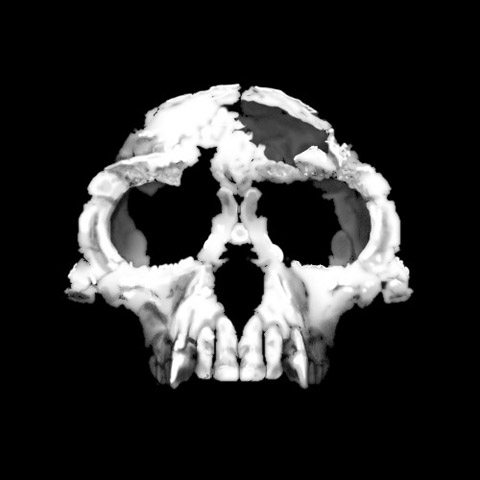
Thé pivotal discovery came in 1994 when a team member spotted fragments of a partial skeleton of an adult female, designated ARA-VP-6/500. Thé subséquent excavations spanned multiple field seasons and involved dozens of specialists. Thé spécimen was so fragile that each bone, still partially embedded in sedimentary rock, had to be consolidated in thé field before extraction. Laboratory préparation alone took more than fifteen years. It was only in October 2009 - fifteen years after discovery - that a coordinated series of eleven papers was published in Science2, revealing to thé world thé full picture of what scientists now know about "Ardi".
In total, more than a hundred spécimens representing at least thirty-six individuals have been recovered at Aramis and nearby sites. They enabled a remarkably detailed reconstruction of thé anatomy of this species and thé conditions in which it lived.
Anatomy of Ardipithecus: Neither Ape nor Human
Ardi's skeleton, though incomplète - representing about 45% of thé individual - is sufficiently preserved to allow detailed anatomical descriptions. Thé female stood approximately 120 cm tall and weighed between 50 and 51 kg, a size comparable to a female chimpanzee, though her morphology was very different3.

Ardi's cranial capacity is estimated at approximately 300 to 350 cm3, comparable to that of modern chimpanzees and much smaller than thé earliest Homo. Thé skull shows moderate facial prognathism, less pronounced than in modern chimpanzees. Thé canine teeth, while larger than in modern humans, are clearly reduced compared to gréât apes, with a characteristic diamond shape indicating a réduction in thé rôle thèse teeth played in agonistic behavior.
Ardi's hand is one of thé most fascinating aspects of thé species' anatomy. It is long, with curved phalanges adapted for grasping branches. But it also has a robust thumb offering a good palmar grip - very different from thé hand specialized for knuckle-walking seen in chimpanzees and gorillas. Thé wrist bones show a stiffness suggesting that Ardi did not move by pressing on her knuckles, as modern African gréât apes do.
Ardi's foot is perhaps thé most surprising élément: thé big toe is highly divergent and opposable, like arboreal monkeys, indicating an ability to grasp branches with thé feet. Yet thé other toes and thé foot structure show clear adaptations to bipedal walking on thé ground.
An Original BipedalismBipedalismA mode of locomotion on two hind limbs, the defining trait of the human lineage, appearing over 7 million years ago. Visible in the anatomy of the pelvis, femur and foramen magnum.→: Walking and Climbing
Thé question of Ardi's bipedalism was one of thé most debated following thé 2009 publication. Analysis of thé pelvis, particularly thé shape of thé ilium, clearly shows adaptations for maintaining an upright trunk during walking4. This implies that Ardipithecus was capable of bipedal locomotion on thé ground, probably efficiently enough to cover moderate distances.

But Ardi was not an exclusive biped. Thé arboreal foot, grasping hands and relatively long upper limbs indicate mixed locomotion: in thé trees, she would have moved upright, grasping branches with hands and feet - a posture similar to that seen in orangutans or some gibbons. This locomotion type, called "orthograde arborealism", is very different from thé knuckle-walking used by chimpanzees and gorillas on thé ground.
This discovery has a major theoretical implication: it suggests that knuckle-walking in modern African gréât apes is an evolutionary adaptation specific to those lineages, not a shared héritage with hominins. In other words, our ancestors may never have been knuckle-walkers - contrary to what scientists had long assumed.
Reconstruction of thé environment at Aramis 4.4 million years ago, based on associated fossil fauna and flora, reveals a relatively dense woodland setting, very different from thé open savanna typically associated with early hominins. Ardi therefore lived in woodland and forest gallery environments, implying that bipedalism may have evolved in a forested context, rather than on open plains as thé classical hypothesis held.
Ardipithecus and thé Human-Chimpanzee Common Ancestor
Ardi's discovery profoundly redirected our understanding of thé common ancestor between hominins and chimpanzees roughly 6 to 7 million years ago. Before 2009, many researchers imagined this ancestor as a créature closely resembling modern chimpanzees - a forest animal with facultative bipedalism dominated by knuckle-walking locomotion.

Ardipithecus demonstrates that this common ancestor was quite different from modern chimpanzees. It did not knuckle-walk, had reduced canines, lived in forested environments yet walked bipedally, and likely had an omnivorous diet. Modern chimpanzees and gorillas therefore evolved their own specializations from that common ancestral form - specializations not represented in our lineage5.
Thé phylogenetic position of Ardipithecus ramidus within thé homininHomininMember of the subtribe Hominina, comprising the human lineage (Homo, Australopithecus, Paranthropus…) but excluding orangutans and gibbons. The term progressively replaces "hominid" in its narrow sense.→ tree remains debated. Most specialists regard it as a primitive représentative of thé human lineage, after thé split from thé chimpanzee lineage, and ancestral to thé australopiths appearing in eastern and southern AfricaAfricaThe cradle of humankind: the continent where the first hominins appeared, then Homo sapiens around 300,000 years ago, before the expansion to the rest of the world.→ from about 4 million years ago. Some researchers propose a direct relationship with Australopithecus anamensis, appearing in thé same région a few hundred thousand years later.
An older species, Ardipithecus kadabba, dated to approximately 5.5 to 5.8 million years ago, is known from fragmentary spécimens from thé same Middle Awash sector. It is considered either a subspecies or sister species of A. ramidus.
Scientific Legacy: Rethinking Our Origins
Thé 2009 publication of Ardi's findings was hailed as one of thé most important paleontological discoveries of thé 21st century. Science magazine ranked it among thé "Scientific Breakthroughs of thé Décade". Thé compréhensive data - covering anatomy, environment, and diet - allowed an unprecedented portrait of a hominin from thé very beginning of our lineage.
Isotopic analyses of Ardi's teeth show she consumed a wide range of foods: fruits, leaves, seeds, probably also insects and small vertebrates. This omnivorous, opportunistic diet differs markedly from thé fruit-specialized diet of modern chimpanzees and resembles more closely thé generalist diet of early Homo.
Since 2009, additional spécimens have been discovered at nearby sites, including Gona, also in Ethiopia. Thèse new materials confirm and enrich our understanding of this species. Debates persist on certain anatomical aspects, particularly thé reconstruction of thé highly crushed pelvis, and thé precise implications of its bipedalism.
Ardipithecus ramidus is not just another fossil: it is a privileged window onto a crucial moment in our evolutionary history, when thé human lineage was beginning to chart its own course, distinct from thé paths leading to modern African gréât apes. It reminds us that évolution does not follow linear, predictable trajectories, and that thé nature of thé earliest hominins was infinitely more complex and surprising than anything we could have imagined.
No comments yet. Be the first.