In the summer of 1987, in the valley of the Bolshaya Karaganka river in the southern Urals, a team of archaeologists led by Gennady Zdanovich was sent out in haste. A dam was soon to turn the plain into an irrigation reservoir, and the mission was in principle little more than confirming that nothing important needed saving. Instead, the researchers uncovered the concentric rings of a fortified town roughly four thousand years old. The news, carried by the press, triggered an unexpected mobilisation in a crumbling Soviet Union, and the flooding plans were finally abandoned. The site, named Arkaim, became one of the archaeological symbols of contemporary Russia.1
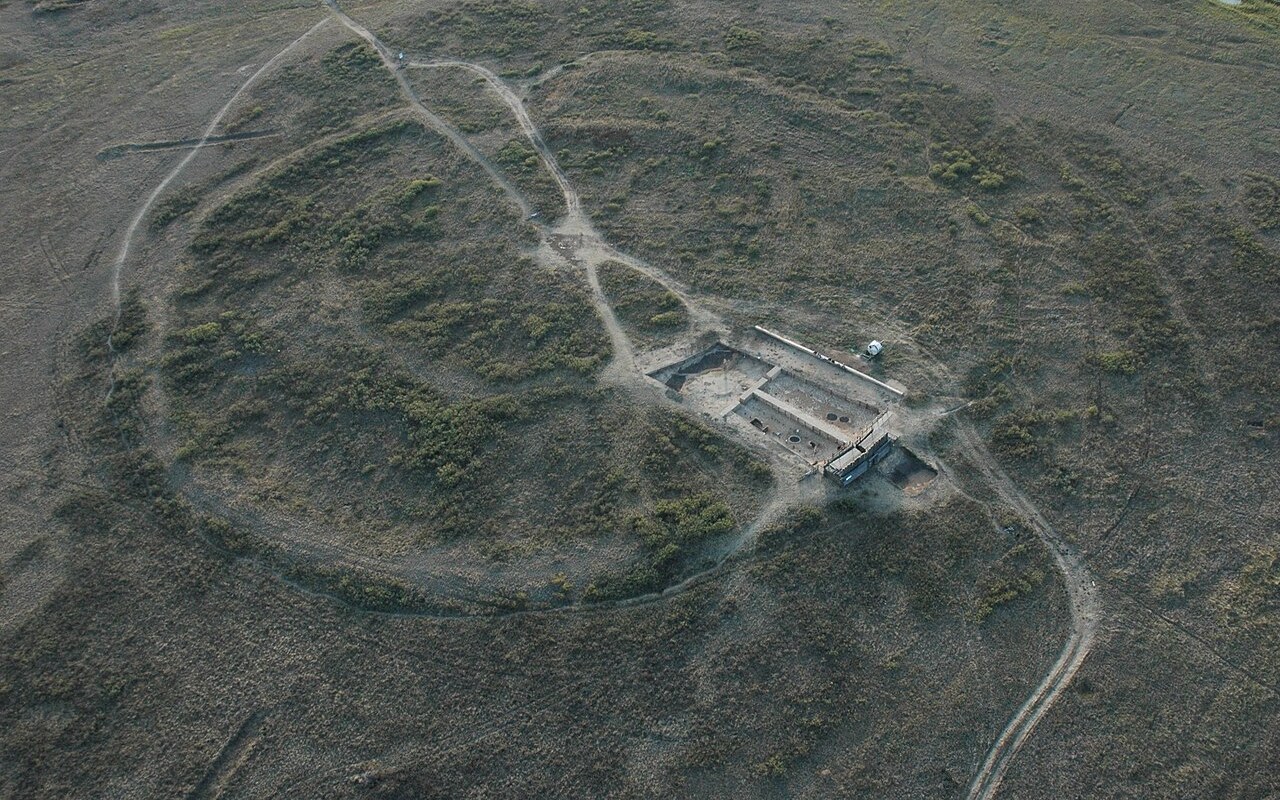
Arkaim is no isolated accident. It belongs to the Sintashta culture, named after another site in the region, and forms part of a group of around twenty fortified settlements scattered across the trans-Ural steppe. By a quirk of history, the first traces of these circles had been spotted as early as 1952 on aerial photographs, though no one then understood what they showed. Only the excavation of Arkaim revealed the scale of the phenomenon and allowed these occupations to be dated seriously, today placed at roughly 2100 to 1800 BCE.1
The very name of Arkaim comes from a nearby hill, whose Turkic-rooted name passed to the site. Around it, the Karaganka valley has yielded only part of the town: the river, shifting its bed over the millennia, carried away one sector of the rampart, so that archaeologists had to reconstruct the full plan by symmetry. Turned into a protected natural and cultural reserve, the site now has an open-air museum and reconstructed dwellings that make it a place of study as much as a destination for visitors. This dual vocation, scientific and heritage-related, deeply shaped the fate of Arkaim, for better and for worse.
A circular plan and the Country of Towns
What strikes a visitor to Arkaim first is the geometric rigour of its plan. The town traces two concentric circular walls, made of rammed earth poured into timber frames and reinforced with unbaked clay brick, enclosing a space about one hundred and fifty metres across. Between and against the two ramparts stand rectangular dwellings arranged like the spokes of a wheel, or the slices of a cake, all opening onto a single circular street and then a central square. Protected by a ditch and gate towers, the whole could house several hundred people.1
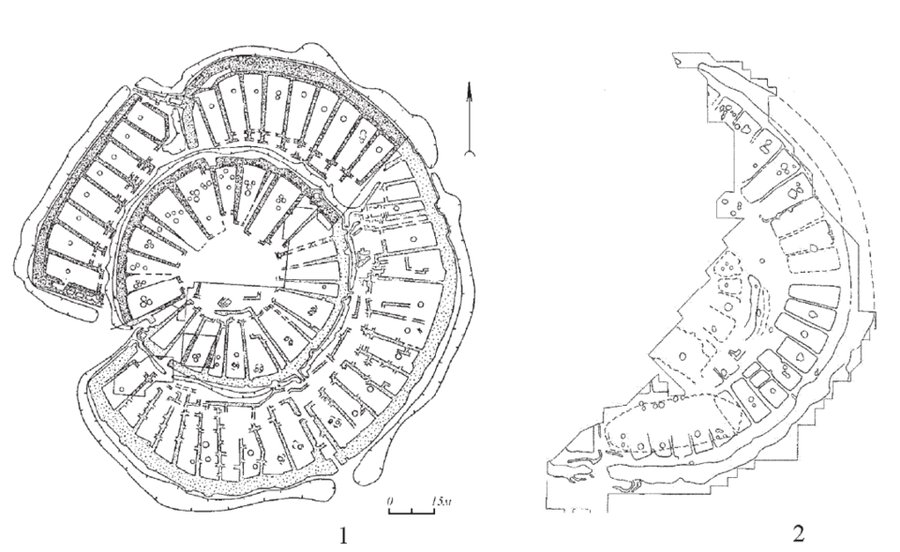
This design reveals overall planning: the town did not grow by accretion but was conceived as a single whole, following a repeated module. To describe this network of closely related sites, Zdanovich coined the phrase Country of TownsCountry of TownsA network of some twenty related fortified settlements of the Sintashta culture in the trans-Ural steppes, a phrase coined by G. Zdanovich.→ (in Russian Strana Gorodov). The formula was hugely successful but also drew criticism: some archaeologists find it too grandiose for settlements that, measured against the contemporary Near EastNear EastA region of western Asia (Levant, Mesopotamia, Anatolia, Iran), cradle of the Neolithic revolution, agriculture, the first cities and writing.→, remained modest villages. Recent fieldwork nonetheless extends the map of this network from the Urals to the Ishim basin, confirming that it was a genuine regional web rather than a scattering of isolated structures.1 The same rigorous plan has fed bolder interpretations, to which we will return, but above all it testifies to a society able to muster labour and coordinate a complex building project.
The detail of the arrangements reinforces this impression of collective mastery. Each dwelling had its hearthhearthA combustion structure set on the ground, evidence of the mastery of fire and a marker of how a prehistoric dwelling was organised.→, storage areas and, often, a well dug down to the water table, around which part of domestic life was organised. A system of gutters and drains carried water out to the outer ditch, managing rain and snowmelt in a harsh continental climateClimateThe long-term average atmospheric conditions of a region; its variations (glaciations, aridifications) shaped migrations, agriculture and the collapse of prehistoric societies.→. The function of these ramparts is still debated: fortresses meant to repel attackers, enclosures protecting people and livestock, or symbols of status as much as of defence. The considerable investment they represented suggests, at any rate, that security, whether military or economic, held a central place in these communities.
The first war chariots and the domestic horse
The most resounding contribution of the Sintashta culture to human history is read not in the walls of Arkaim but in its cemeteries. The necropolises linked to these sites have yielded the oldest known spoke-wheeled vehicles in the world: genuine light, two-wheeled chariots, laid in graves beside sacrificed horses. These are commonly called spoke-wheeled chariotsSpoke-wheeled chariotA light two-wheeled vehicle with spoked wheels, drawn by horses, whose oldest known examples come from Sintashta graves.→, as opposed to the heavy solid-wheeled wagons already known earlier. The imprints of the wheels, preserved in the bottom of the pits, show hubs and spokes, an innovation that radically lightened the vehicle and made it fit for speed.3
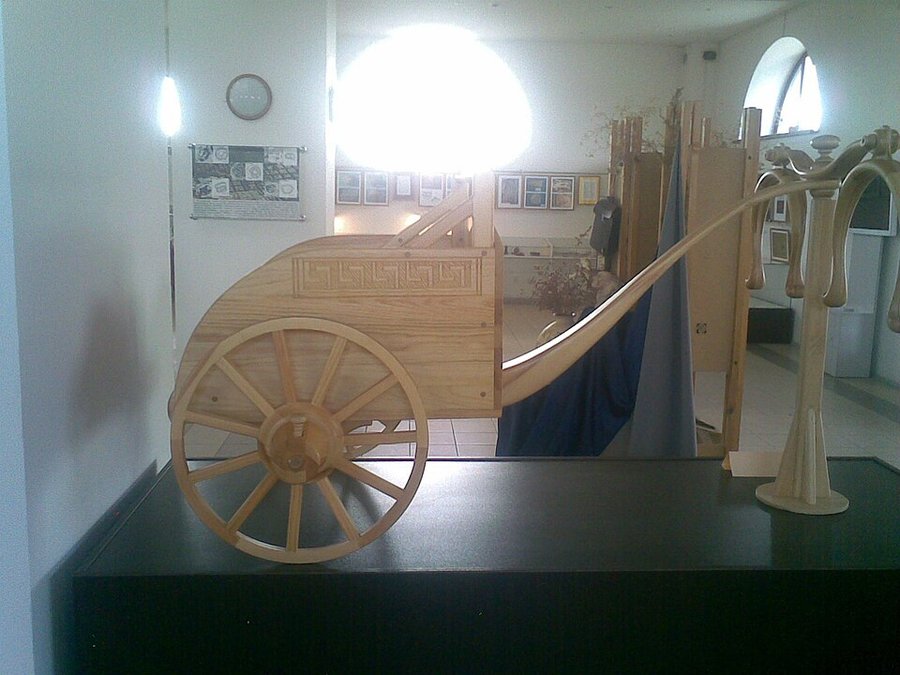
These graves also contain cheekpiecesCheekpieceThe side element of a bit, made of bone or antlerantlerThe mass of solid bony material that male deer grow on their heads and renew each year, a sought-after raw material for tools and weapons.→, used to hold and control the harnessed horse.→, the side elements of a bit, made of bone or antler, that gripped the horse's mouth and ensured precise control of the team. Study of the burials has shown that the great majority of graves with cheekpieces also held horse bones, a sign of the ritual and social importance of the animal.7 Dating these assemblages has been fiercely debated. The archaeologist David Anthony argued, on the basis of radiocarbon dates, that these chariots went back to around 2000 BCE, far earlier than the old stylistic estimates that placed them near 1600.3 A more recent Bayesian analysis of the radiocarbon dates, carried out by Stephan Lindner, places the use of these two-wheeled spoked vehicles in the south Ural piedmont at the latest between 1950 and 1888 BCE, within an overall range of chariot graves from 2100 to 1800.2
These chariots would have been nothing without the horse. Recent genetic work has sharpened this link considerably. The study by Ludovic Librado and colleagues, published in 2021, showed that modern domestic horses descend from a lineage that appeared in the western Eurasian steppes, around the lower Volga and Don, and not from the older horses of Botai in Kazakhstan. This lineage spread very quickly across Eurasia from about 2000 BCE, in step with equestrian material culture, including the Sintashta spoke-wheeled chariots.5 In other words, the revolution of the harnessed horse and that of the chariot are one and the same movement, of which Sintashta is one of the decisive centres.
The question of the chariot's origin nonetheless remains disputed. Some scholars point out that depictions of spoke-wheeled vehicles appear in the Near East at a close period, around the nineteenth and eighteenth centuries BCE, for example on sealSealA small engraved object (often steatite) used to stamp a mark in clay; the Indus seals, bearing animals and signs, attest to administration and trade, though their script remains undeciphered.→ impressions. For these authors, the idea could have travelled from south to steppe, or the reverse, across a zone of intense contact. The difficulty is that the radiocarbon dates of the Sintashta graves often give ranges older than the markers provided by Near Eastern written sources. As things stand, most specialists accept that the oldest materially preserved chariots, with their spoked wheels imprinted in the ground, do come from the steppe, even if the debate over the priority of the invention is not settled.2
Smiths of the steppes
Behind the chariot warrior stands the smith. The Sintashta culture was above all a society of metallurgists, so much so that Arkaim and its neighbours have been described as fortified industrial centres. In almost every house excavated, archaeologists have found traces of a furnace and of ore reduction: metal production was not reserved for a few specialised workshops but woven into the domestic life of the community.8
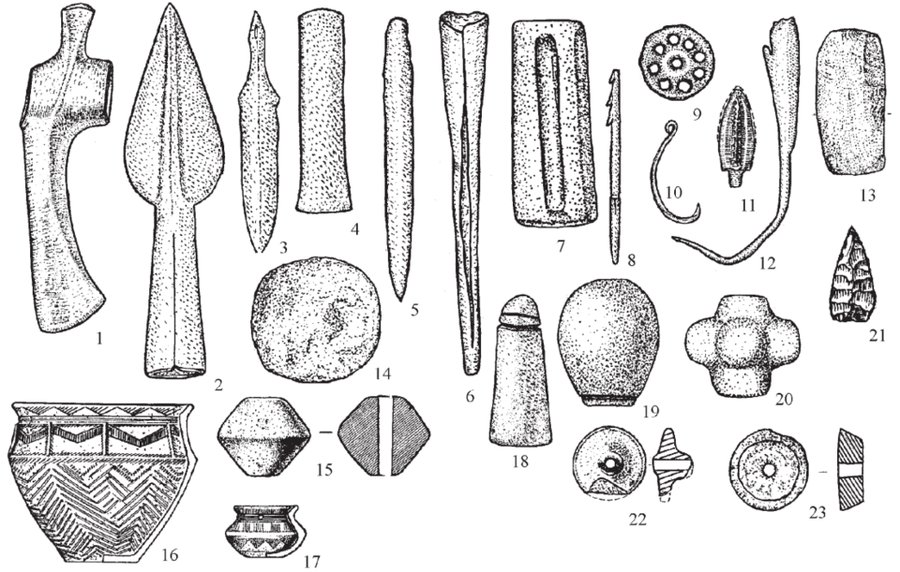
Copper ore, mined from nearby deposits, was turned on site into copper and arsenical bronzeArsenical bronzeAn alloy of copper and arsenic, used at Sintashta in the absence of tin, whose fumes were toxic to the craftsmen.→, an alloy in which arsenic replaced the tin that was then hard to obtain in the region. That choice came at a price: the arsenic fumes released during metalworking were toxic for the craftsmen. Mastery of these processes gave Sintashta a considerable advantage, since it fed both the making of weapons and tools and the exchange networks with neighbouring regions. Control of metal, of the horse and of the chariot thus formed a single technical and social complex, at once economic and military, which explains why these communities radiated far beyond their original territory.8
Archaeologists have also noted that the domestic wells were sometimes connected to the metallurgical hearths by ducts, which led to the hypothesis of an air draught exploiting the coolness of the well to fan combustion and reach the temperatures needed to reduce copper. True or not in its detail, this interpretation illustrates the degree of technical ingenuity attributed to these communities. The demand for fuel, ore and labour that such production implied doubtless helped to structure the territory, to organise the movement of herds and to weave long-distance exchange relations, from ore to finished goods.
Andronovo, Indo-Iranian languages and ancient DNAAncient DNAGenetic material preserved in old remains, often degraded, sequenced with cutting-edge techniques.→
The Sintashta culture did not simply vanish: it gave rise to, or at least largely contributed to, the vast AndronovoAndronovo cultureA vast Bronze AgeBronze AgePeriod of late prehistory marked by bronze metallurgy and the rise of maritime trade, beginning in the Near East around 3300 BCE.→ cultural complex of Central Asia, partly derived from Sintashta, that spread during the second millennium BCE.→ complex that spread across the Central Asian steppes during the second millennium BCE. This cultural continuity, legible in pottery, metallurgyMetallurgyThe techniques of extracting and working metals (copper, bronze, gold); its rise in the Eneolithic and Bronze Age transformed tools, weapons and social hierarchies.→ and funerary practices, gave Sintashta an importance far exceeding the few hectares of Arkaim.3
Over the following centuries, Andronovo groups spread across a huge area of the Central Asian steppes, from the Urals toward the Yenisei and down to the margins of the irrigated oases of the south. Carrying their herds, their chariots and their metallurgical know-how, these pastoralists came into contact with the sedentary civilisations of Central Asia, such as the Bactria-Margiana complex, in exchanges that were sometimes peaceful and sometimes not. It is against this backdrop of mobility and contact, rather than through any single mass invasion, that researchers now tend to picture the gradual spread of peoples, techniques and perhaps languages out of the world that Sintashta had helped to create.
Here arises one of the great questions of Eurasian prehistoryPrehistoryThe span of human history before the invention of writing, from the Palaeolithic to the Metal Ages, known mainly through material remains.→: the spread of the Indo-IranianIndo-IranianThe eastern branch of the Indo-European language family, including Sanskrit and Old Persian among others.→ languages, the eastern branch of the Indo-European family that includes Sanskrit and Old Persian. Many linguists and archaeologists see the Sintashta-Andronovo world as the setting in which these languages formed and from which they spread, carried by steppe pastoralist populations. Sintashta ritual traditions, and in particular horse sacrifices, offer striking parallels with the oldest Indo-Iranian texts, such as the Rig Veda and the Avesta.3
Ancient population genetics has brought spectacular evidence to this file. The study by Vagheesh Narasimhan and colleagues, published in Science in 2019 from genomic data on several hundred ancient individuals, links the population transformations of South and Central Asia to the Sintashta and Bactria-Margiana complexes. It shows that a steppe-related ancestry reached South Asia about four thousand years ago, via Central Asia, with a genetic profile comparable to that of Bronze Age Eastern Europe.4 The authors suggest that this movement probably spread features shared by the Indo-Iranian and Balto-Slavic languages. Caution remains in order, however: the link between genes and languages is an inference, not a demonstration, since populations can move without their language following, or the reverse.4
Astronomical mirages and scientific caution
The popular success of Arkaim came at a cost: the site quickly became a magnet for the most fanciful interpretations. It was nicknamed the Russian Stonehenge, credited with the function of an astronomical observatory of unrivalled precision, supposedly able to measure celestial positions to the arc-minute, far better than Stonehenge. Such claims circulate mainly in popular literature and rest on no solid archaeoastronomical study: the interpretation of Arkaim as an observatory is accepted neither universally nor, in fact, by mainstream research.1
More troubling still, Arkaim has been co-opted by nationalist and neo-pagan currents. Presented by some as a capital of the Aryans, or as the most ancient Slavic-Aryan town, the site has drawn New Age pilgrimages and identity-based rhetoric. The anthropologist Victor Shnirelman has analysed this instrumentalisation in detail: the discovery, coinciding with the Soviet collapse, allowed an identity anchoring to be reasserted through a supposed Aryan-ness of the territories.6 Shnirelman rightly recalls that the standardised plan of the Sintashta towns points to a very real social and technical organisation, not to some cosmic mystery.6
Perhaps that is the most lasting lesson of Arkaim. The site needs no esoteric mysteries to be exceptional: a Bronze Age society that planned its towns, mastered copper metallurgy, domesticated and harnessed the horse, invented the spoke-wheeled chariot and took part in one of the vastest linguistic diffusions in history is more than enough to justify the fascination it inspires. Rigorous archaeology, far from impoverishing the story, restores its true grandeur.
Ce site est la meilleure chose que mes enfants m'aient recommandée depuis longtemps.