In the spring of 1987, a team of Soviet archaeologists was conducting rescue excavations in the steppeSteppeA vast semi-arid, treeless grassland of Eurasia, suited to nomadic herding and the horse; a corridor for the movement of peoples and technologies in later prehistory.→ of the Chelyabinsk region in the southern Urals. A hydroelectric dam was soon to flood the valley of the Bolshaya Karaganka River, and the researchers had little expectation of finding anything significant. What they uncovered left them speechless: beneath a few centimetres of earth and dry grass, the foundations of a fortified city dating from the Bronze AgeBronze AgeA protohistoric period following the Neolithic, defined by bronze metallurgy (a copper-tin alloy) and the rise of the first cities and states; in Egypt it corresponds to the age of the first pyramids.→, built according to a geometrically precise plan. They named this city Arkaim, after a nearby mountain.
The Discovery of Arkaim: A Narrow Archaeological Escape
The 1987 excavations were led by Gennady Zdanovich, a professor at Chelyabinsk State University. The first soundings revealed exceptional remains, and the Soviet scientific community began to grasp the magnitude of the discovery.1 The archaeologists found themselves in a race against time: if the dam were built, the site would disappear beneath the waters.
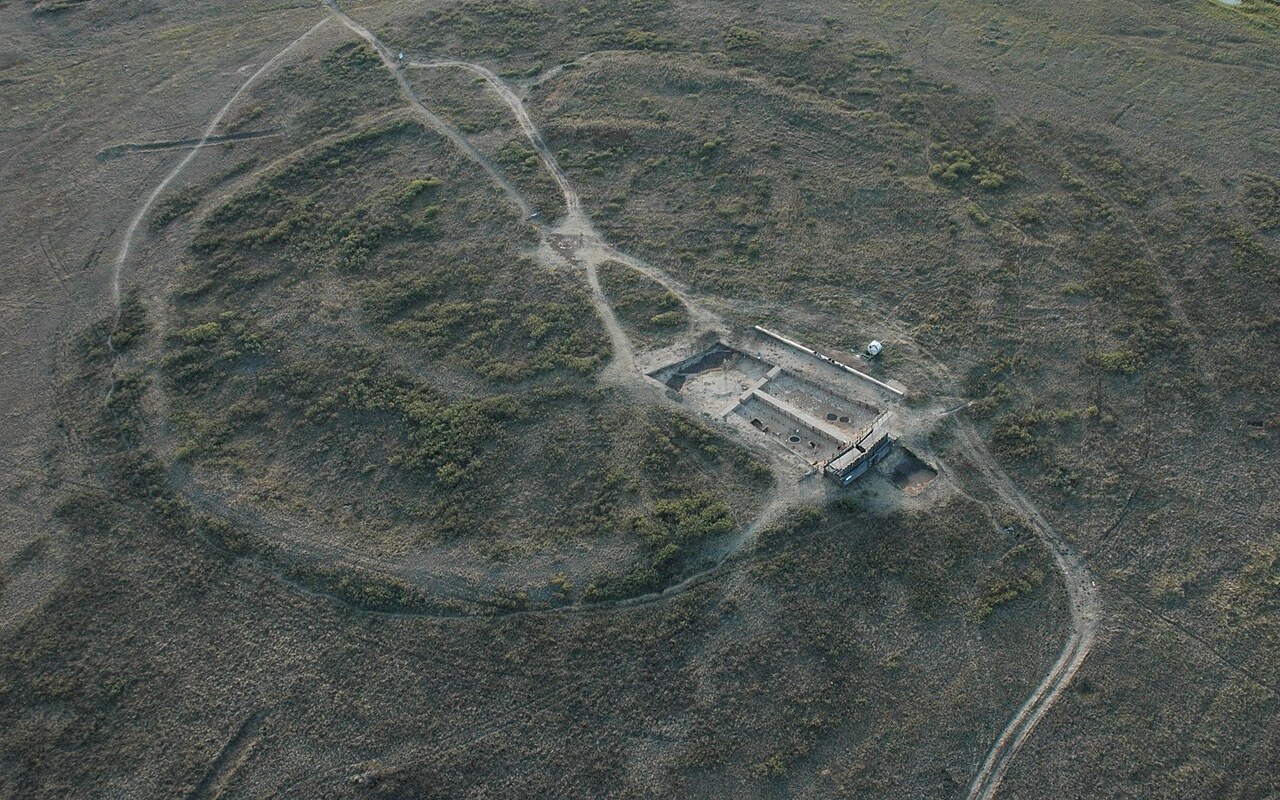
An unprecedented mobilisation took shape in Soviet academic circles. Petitions circulated and letters were sent to the highest levels of government. In 1991, after lengthy negotiations, the dam construction was definitively abandoned. Arkaim was preserved and designated a natural and historical reserve. The discovery coincided with glasnost and perestroika, which facilitated widespread media coverage and considerable popular interest, sometimes tinged with mystical nationalism.
The systematic excavations that followed progressively uncovered the entire site. Archaeologists revealed a city with a planned layout of remarkable rigour: log-paved streets, a network of canals and drainage channels, and dwellings built to a standardised plan. The complex covers approximately 20,000 square metres and was protected by two concentric circular enclosures.
Radiocarbon and dendrochronological dating places the construction of Arkaim between approximately 2100 and 1800 BCE, in the middle Bronze Age. The site belongs to what archaeologists call the Sintashta culture, named after a nearby river where another major site had been identified a few years earlier. This culture is part of a larger complex sometimes called the "Land of Towns," which groups together more than twenty similar agglomerations within a 300-kilometre radius.
Arkaim's Architecture: A Geometric City of the Steppe
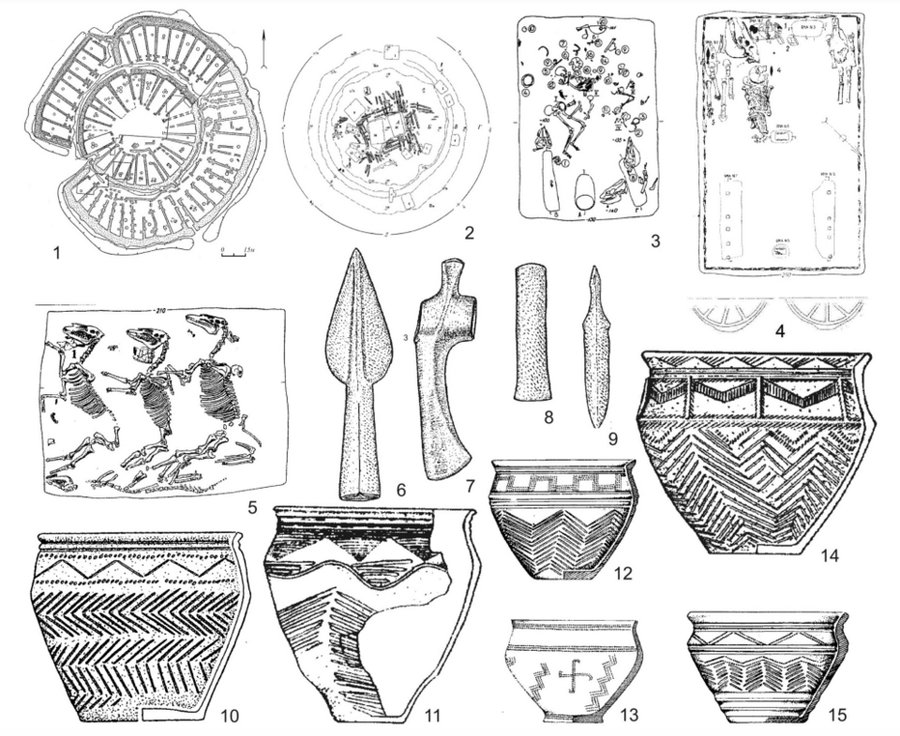
Arkaim is distinguished above all by the sophistication and coherence of its layout. The site consists of two concentric rings of buildings, separated by a circular lane, surrounded by an outer ditch. The overall form evokes a chariot wheel or a mandala, which has fuelled speculation about a possible cosmological or astronomical significance.
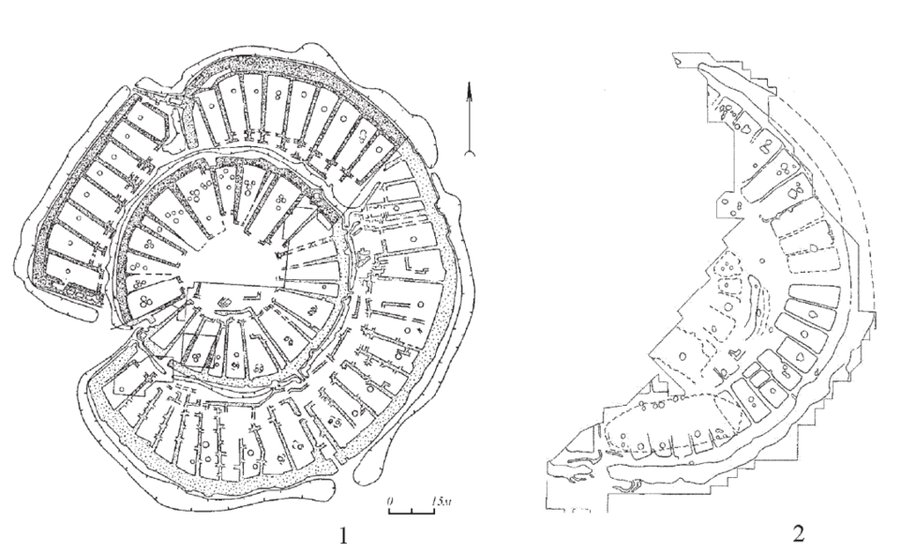
The outer ring comprises between 35 and 40 houses arranged radially, each occupying a wedge-shaped segment and opening onto a radial lane. The inner ring contains about twenty smaller dwellings. At the centre lies a rectangular open square. The enclosure walls, built of timber and mud brick, could reach five metres in height and two metres in thickness. Watchtowers flanked the access gates, one of which was oriented along a solar axis.2
Each house follows a nearly identical plan: an entrance corridor, a main room with a central hearth, a well, and lateral annexes. Some houses contain metallurgical installations: bellows, casting moulds, crucibles. Bronze-working was practised directly within the dwellings, making Arkaim a city of specialist craftsmen as much as of warriors.
The hydraulic network is particularly impressive for the period. Channels ran along the lanes allowing waste water to drain into a peripheral ditch. Domestic wells provided an independent water supply for each family. This technical sophistication testifies to a social organisation and engineering mastery far superior to what was generally attributed to steppe societies of this age.
Archaeologists estimate that the city could have housed between 1,500 and 2,500 inhabitants. Its period of occupation seems to have been relatively brief, perhaps one or two centuries, before the inhabitants abandoned it and, remarkably, deliberately burned it down. The controlled fire that destroyed Arkaim at abandonment carbonised the structural timbers, allowing their excellent preservation and precise dating.
The "Land of Towns": A Network of Steppe Cities
Arkaim is not an isolated anomaly. Since its discovery, archaeologists have identified more than twenty similar sites within a 300-kilometre radius, forming what Zdanovich dubbed the "Strana Gorodov" or "Land of Towns."3 These sites, all dated between approximately 2100 and 1700 BCE, share common architectural and cultural characteristics.
Among the best-excavated sites, Sintashta itself yields spectacular data, notably burials in which complete two-wheeled chariots were found alongside warriors interred with their horses. Arkaim is the best-preserved site in the network, but some sites exceed 30,000 square metres and may have housed several thousand inhabitants.
The geographical distribution of these "towns" is not random: they are all located along watercourses in the steppes and semi-steppes of the southern Urals and northern Kazakhstan. Bronze composition analyses show ore supply networks extending hundreds of kilometres. Copper came from local Ural mines, tin from more distant sources, sometimes as far as Central Asia.
The coordinated abandonment of these cities around 1700 BCE remains an enigma. Several hypotheses have been advanced: exhaustion of local resources, climatic destabilisation, pressure from neighbouring populations, or an internal evolution toward more accentuated pastoral nomadism. The Sintashta populations seem to have dispersed eastward, southward and westward, leaving behind daughter cultures that perpetuated their traditions and, above all, their language.
The Sintashta Culture and the Invention of the War ChariotWar chariotA light two-wheeled spoke-wheeled vehicle drawn by horses, built for combat or prestige; the oldest attested (c. 2000 BC) come from Sintashta graves in the Ural steppe.→
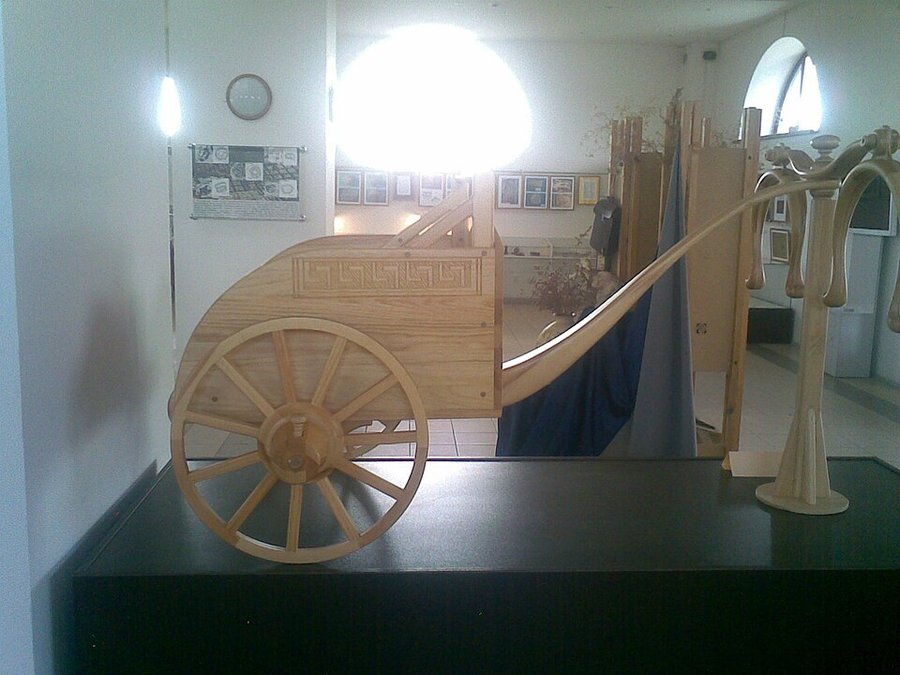
One of the Sintashta culture's most important contributions to human history is the invention, or at least the wide dissemination, of the two-wheeled spoked chariot. Elite Sintashta burials yield the oldest known examples of this type of vehicle, dated to approximately 2000 to 1800 BCE, several centuries before Egyptian or Mycenaean chariots.4
The spoked wheels found in Sintashta tombs display advanced technical characteristics: curved rims, lightweight wooden spokes, hubs adapted for a rotating axle. These innovations allowed construction of a vehicle far faster and more manoeuvrable than the solid-wheeled carts that had previously existed in Mesopotamia. Combined with trained draft horses and sophisticated harnessing, this new type of chariot constituted a formidable military weapon.
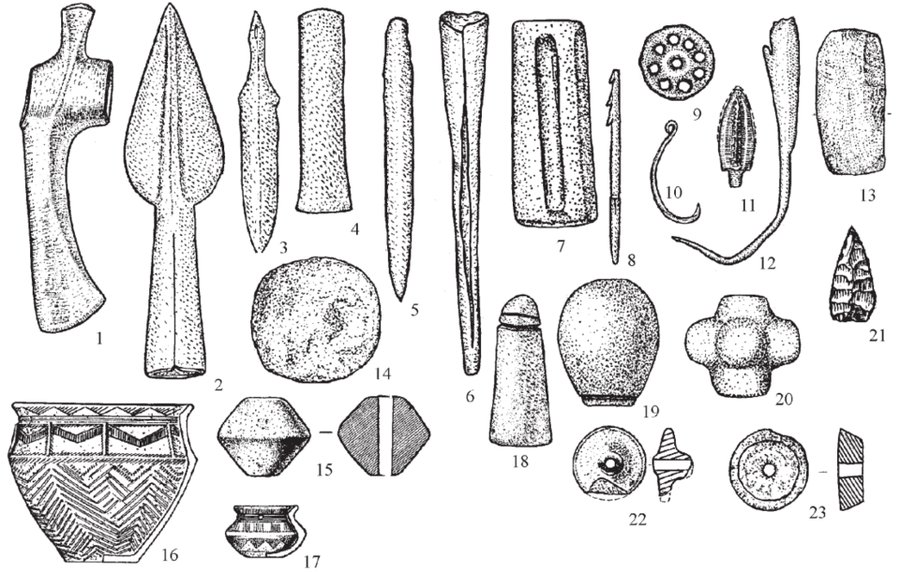
The tombs of Sintashta warriors reveal a complete and diverse arsenal: composite bows, bronze arrowheads, spears, battle axes. The systematic presence of weapons in certain male burials suggests the existence of a distinct warrior class whose social status was closely tied to mastery of mounted combat and chariot warfare. These warriors were buried with their horses according to complex rites involving animal sacrifices.5
The impact of this technological development on Eurasian history is difficult to overestimate. Wherever steppe populations moved, they took with them their equestrian expertise and chariot-fighting techniques. The genetic and linguistic connections woven across Eurasia from the Bronze Age onward were largely the result of these migrationsMigrationsLong-distance movements of populations; a major driver of human history (the exit from Africa, the peopling of continents, Neolithic and steppe expansions).→ linked to the military superiority of the steppe peoples.
The Indo-European Connection: Arkaim and the Origins of a Language Family
The question that has most fascinated researchers since Arkaim's discovery is its link with the origins of the Indo-European peoples. Since the nineteenth century, linguists have known that hundreds of languages, from the Celtic languages to Hindi via Greek, Latin, Russian and Persian, descend from a common ancestral language: Proto-Indo-European. But where and when was this language first spoken?
The "KurganKurganA burial mound of the Eurasian steppes, of earth and stone over a timber chamber holding a high-status individual and grave goods.→ hypothesis," developed by Lithuanian-American linguist Marija Gimbutas in the 1950s-1970s, placed the Proto-Indo-European homeland in the Pontic-Caspian steppes. The populations of these steppes, characterised by their tumulusTumulusA mound of earth or stones covering one or more burials; it often capped a dolmen's chamber in the Neolithic.→ burials, would have gradually diffused their language as they moved toward Europe, Anatolia, Iran and India. The Sintashta culture represents one of the later links in this chain of diffusion.6
The Sintashta culture is now identified as the probable ancestor of the Indo-Iranian cultures. The texts of the Rigveda (between 1500 and 1200 BCE), the oldest Vedic Indian text, describe ritual practices, horse sacrifices and chariot battles that correspond precisely to the archaeological remains found in Sintashta tombs. Linguist Asko Parpola has developed this argument extensively, demonstrating striking parallels between Vedic terminology and the funerary practices of the southern Urals.7
Genetics has recently provided decisive evidence. Ancient DNAAncient DNAGenetic material preserved in old remains, often degraded, sequenced with cutting-edge techniques.→ studies carried out on Sintashta individuals and their cultural descendants show they display a genetic profile found in South Asian and Iranian Bronze Age populations. An "Aryan migration" from the Eurasian steppes now appears to have taken place and to have contributed significantly to the genetic composition of modern Indian populations.8
Funerary Practices and Social Organisation
The cemeteries associated with Sintashta towns constitute an irreplaceable source of information on the social organisation of these communities. The tombs, often grouped beneath small tumuli, reveal a strongly hierarchical society in which access to wealth and prestige symbols was unequally distributed.
The richest burials contain complete chariots, teams of two to four horses, bronze and bone weapons, ceramic vessels and ornaments. These tombs belong almost exclusively to adult men, suggesting a patriarchal society in which male status was associated with mastery of combat, herding and metallurgy. Women and children were buried with more modest offerings, although some female burials reveal notable wealth.
Funerary rituals systematically involve animal sacrifices. Bones of cattle, sheep, goats and horses are found in most tombs. These sacrifices presumably had a dual function: providing sustenance for the deceased and demonstrating the wealth of the surviving family. The very structure of these rituals presents striking parallels with ceremonies described in the Vedic and Avestan texts, the oldest religious texts of the Indo-Iranian peoples.
Analyses of human bones reveal traces of interpersonal violence and combat wounds on some male individuals, confirming the central role of warfare in this society. Isotopic analysis shows that some individuals, probably captives or wives from distant regions, had grown up far from their burial site.
Bronze Metallurgy: Technology and Exchange Networks
Mastery of bronze metallurgy is one of the most distinctive features of Sintashta civilisation. Compositional analyses of bronze objects found at Arkaim and neighbouring sites reveal remarkable technical expertise: mastery of alloy composition, bivalve mould casting, and cold-working to harden surfaces. Metallurgical production far exceeded local needs, suggesting an export-oriented economy.
Raw material sources lay at considerable distances. Copper came primarily from mines in the southern Urals. Tin, necessary to produce bronze, had to be imported from sources still only partially identified, perhaps in central Kazakhstan or Central Asia. These supply networks implied regular long-distance exchanges, probably organised through itinerant specialists or extended kinship networks.
The diffusion of Sintashta metallurgical technologies toward Europe, Central Asia and South Asia constitutes one of the most important technological transfers of protohistoryProtohistoryThe transitional period between prehistory and history, covering societies without their own writing but known through external texts.→. Tools and weapons of Sintashta type are found in archaeological contexts spanning a remarkable geographic range, from the Danube basin to northern India, attesting to the far-reaching influence of this steppe civilisation.
Arkaim in Contemporary Culture: Between Science and Mysticism
Since its discovery, Arkaim has become far more than an archaeological site. In Russia, it quickly became a place of pilgrimage for neo-pagan movements, adherents of deep Russian nationalism, and seekers of alternative spirituality. Thousands of visitors arrive each year, some for scientific reasons, others for esoteric or nationalist motives.9
This popularity has generated radically unscientific interpretations. Some groups have claimed that Arkaim was the "ancestral homeland" of the Russian "Aryans," mixing archaeology and nationalist ideology in a problematic way. Others have seen in the site's geometry evidence of advanced astronomical knowledge. These interpretations, widely relayed in popular Russian media, sometimes complicated the work of archaeologists by generating distorted readings of the site.
Professional archaeologists had to navigate this charged environment. Zdanovich himself sometimes appeared to play both sides, using the "Arkaim" name as a regional identity marker while maintaining rigorous scientific standards in his publications. The Arkaim natural and historical reserve today houses a museum, a research centre and educational programmes, while managing the substantial flow of visitors with varied motivations.
Arkaim's Legacy in Current Research
Thirty-five years after its discovery, Arkaim continues to stimulate archaeological and linguistic research. New exploration technologies, notably satellite remote sensing, LiDARLiDARLaser-based remote sensing (from "Light Detection And Ranging"): a sensor fires light pulses and measures the echo's return time to map a surface in three dimensions. Mounted on a plane or a drone, it slips through gaps in the canopy and reconstructs the bare-earth relief, revealing structures invisible beneath vegetation.→ and drones, have allowed the identification of new Sintashta network sites, some still unexcavated.10
Ancient DNA studies have transformed our understanding of the migrations that followed the decline of Sintashta civilisation. Large-scale genomic analyses allow the trajectories of populations that left the southern Urals to be traced with increasing precision toward India, Iran, central Europe and Siberia. Arkaim emerges as a nodal point in one of the greatest migratory events in human history.
The question of the causes of Sintashta towns' abandonment around 1700 BCE remains open. Palaeoclimatic analyses suggest a period of increased steppe aridification that would have made it difficult to maintain large herds near the towns. But other factors may have played a role: exhaustion of forest resources needed for construction, pressure from neighbouring populations, or adaptation to a more mobile lifestyle better suited to steppe realities.
What is certain is that Arkaim and its sister sites constitute one of the most important archaeological phenomena of the twentieth century. Their discovery forced researchers to radically revise their image of Bronze Age Eurasian steppe societies: far from being simple nomads without urban culture, these peoples were able to build planned cities, master metallurgy, invent revolutionary military technologies, and diffuse their language and culture across a significant portion of the globe.
Ce site est la meilleure chose que mes enfants m'aient recommandée depuis longtemps.