In June 1987, in the arid steppes of southern Chelyabinsk Oblast, less than 3 km from the border with Kazakhstan, high school students working with an archaeological team reported unusual embankments on the plain. That same evening, archaeologist Gennady Zdanovich announced the discovery of an extraordinary site. It was Arkaim -- a circular fortified city dating from the second millennium BCE, so well preserved that its walls, streets, houses, and drainage system are still visible. The discovery came at the worst possible moment: the location was scheduled to be flooded under an irrigation reservoir under construction. A race against time began, mobilizing the entire Soviet scientific community -- and concluding with the victory of archaeology over concrete.[1]
Arkaim is today one of the most important Bronze AgeBronze AgeA protohistoric period following the Neolithic, defined by bronze metallurgy (a copper-tin alloy) and the rise of the first cities and states; in Egypt it corresponds to the age of the first pyramids.→ sites in Eurasia. It belongs to the Sintashta culture (or Sintashta-Petrovka), which developed in the southern Urals between approximately 2200 and 1800 BCE, and which constitutes one of the most fascinating and debated cultures of Eurasian archaeology: it is associated with the world's first known two-wheeled chariots, the first systematic horse breeders, and according to many specialists, the ancestors of Proto-Indo-Iranian speakers -- the peoples who would give rise to Vedic and ancient Iranian cultures.
Arkaim's Architecture: A City in the Steppes
Arkaim covers approximately 2 hectares. Its overall plan is circular and concentric: two rings of adobe (unfired brick) fortifications reinforced with wooden beams, two circular streets, and an open central space. The outer wall, with a diameter reaching 160 metres, is 4 to 5 metres thick and 5.5 metres high. Around it runs a 2-metre-deep moat. The inner wall, even thicker (3 metres), delimits a second enclosure. The site has four entrances oriented to the cardinal points, the main one to the west.[2]
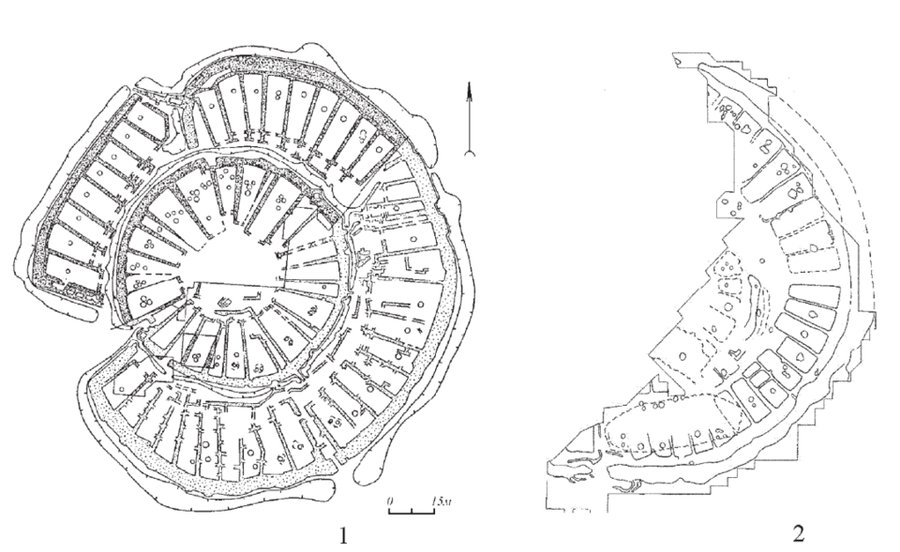
The outer enclosure comprises 39 to 40 houses, whose doors open onto the circular wood-paved street. The inner enclosure has 27, smaller ones, whose doors open onto the rectangular central square of approximately 25 x 27 metres. Each house has a hearth, a well, a storage cellar, and -- crucially -- a metallurgical hearth with air ducts blown by the wells to achieve temperatures sufficient to smelt copper and bronze. The circular street is equipped with a covered drainage gutter with rainwater collection pits -- a drainage system of remarkable sophistication for this period. Zdanovich estimates that the city housed between 1,500 and 2,500 people. Around the walls were irrigated fields via canals, 130 to 140 metres long by 45 metres wide.[2]
The Sintashta Culture: Warriors, Horses, and Chariots
Arkaim is not an isolated city. It belongs to a complex of more than 20 similar fortified settlements, distributed over an area of approximately 400 km north to south and 150 km east to west in the southern Urals, which archaeologists call the "Country of Towns" (strana gorodov in Russian). All these settlements -- including Sintashta, which gave its name to the culture, located 30 km north of Arkaim -- display the same concentric architecture, the same house plans with metallurgical workshops, and the same funerary rituals.[3]
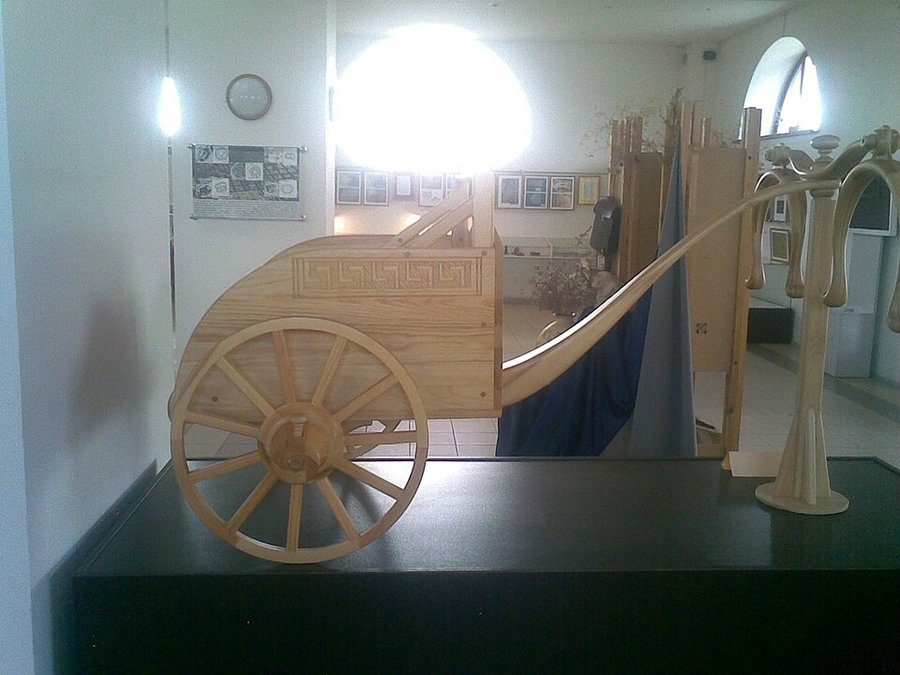
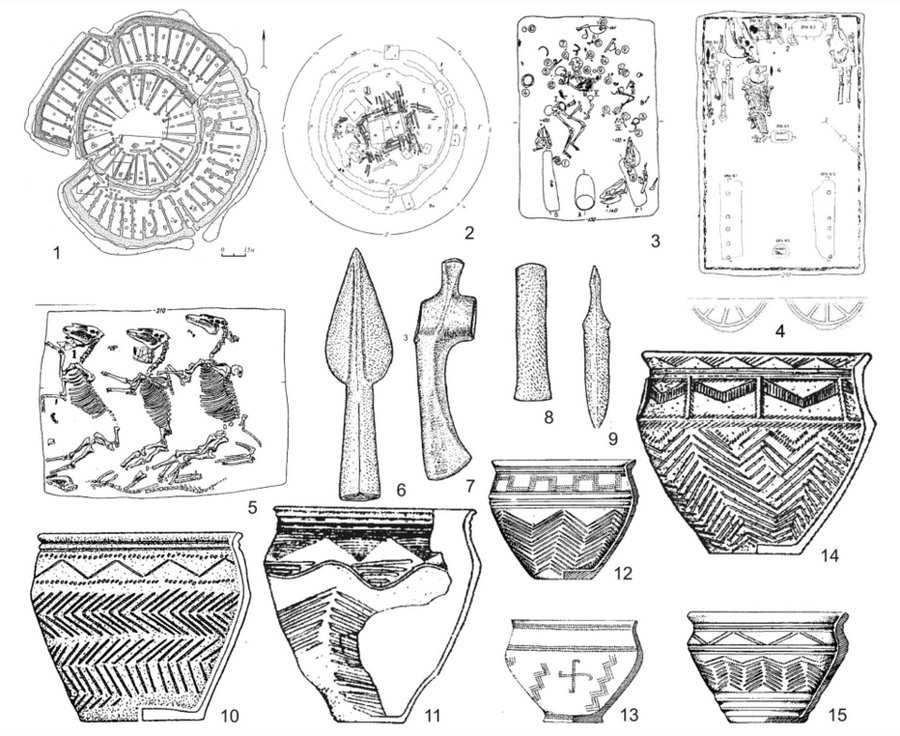
These funerary rituals are particularly revealing. The Sintashta culture necropolises contain barrow (kurganKurganA burial mound of the Eurasian steppes, of earth and stone over a timber chamber holding a high-status individual and grave goods.→) graves with burials of humans accompanied by horses, two-wheeled chariots, and bronze weapons. The Sintashta chariots, dated to 2100-1800 BCE, are the oldest known spoke-wheeled chariots in the world -- earlier than Egyptian and Mycenaean chariots by several centuries. They are harnessed to horses and appear to have been used for warfare, funerary rituals, and competitions alike. The discovery of these chariots in male graves led archaeologists to identify the Sintashta culture as a warlike, aristocratic society, probably led by warlords.[4]
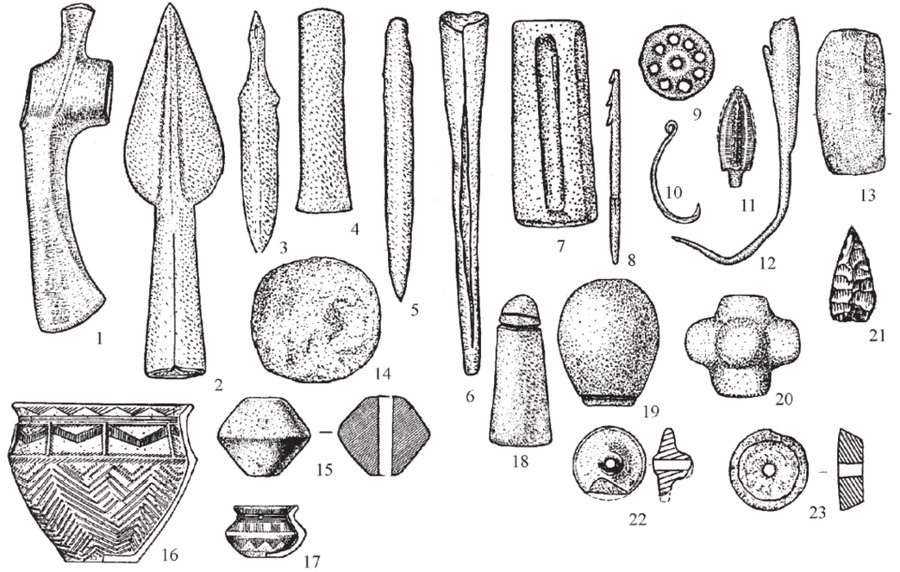
The Sintashta economy rested on three pillars. First, horse husbandry, systematic and intensive, providing slaughter animals, draught horses, and war mounts -- a combination that would give the steppeSteppeA vast semi-arid, treeless grassland of Eurasia, suited to nomadic herding and the horse; a corridor for the movement of peoples and technologies in later prehistory.→ peoples their strength for millennia to come. Second, bronze metallurgy: analysis of the smelting hearths in each Arkaim dwelling shows organized production, each family participating in the casting and working of metal. Third, long-distance exchange: tin from Central Asia, copper from the Ural mountains, shells from the Caspian Sea, and ornaments from Europe are found in Sintashta graves, testifying to an active commercial network covering thousands of kilometers.
Arkaim and the Indo-European Question
The discovery of Arkaim reinvigorated a major scientific debate: that of the origin and ancestral homeland of the Indo-EuropeansIndo-EuropeansA set of populations linked by a language family (Indo-European) from which most languages of Europe and part of Asia derive; their spread is associated with Bronze Age steppe societies.→. The Sintashta culture is generally considered one of the clearest expressions of the Proto-Indo-Iranian phase -- that is, the common ancestor of Indo-Aryan (Sanskrit, Vedism) and Iranian (Avesta, Zoroastrianism) languages and cultures. The parallels between Sintashta funerary rituals and those described in the Rigveda (horse sacrifice, warrior retinue, kurgan burials) are so striking that many researchers consider the bearers of this culture to be the direct ancestors of the Vedic Aryans and archaicArchaicRefers to an ancient, now-extinct human population or form (Neanderthals, Denisovans, ghost lineages), as opposed to anatomically modern humans.→ Iranians.[5]
Recent genetic analyses have substantially confirmed this hypothesis. Sintashta culture populations carry a genetic signature that appears in large proportions in current South Asian (notably Indian), Iranian, and European populations, consistent with massive migrationsMigrationsLong-distance movements of populations; a major driver of human history (the exit from Africa, the peopling of continents, Neolithic and steppe expansions).→ from the Pontic-Caspian steppes into these regions during the second millennium. The "kurgan hypothesis" proposed by linguist Marija Gimbutas from the 1950s -- which located the Proto-Indo-European homeland in the Ural and Black Sea steppes -- is thus strengthened, even if the geographic and chronological details remain debated.[6]
Myths, Nationalist Drifts, and Political Stakes
The discovery of Arkaim has not been without generating unscientific interpretations, sometimes frankly nationalist. Russian neo-pagan groups (Rodnovers), Zoroastrians, Roerichians, and other spiritual movements have made the site a "holy place" or a "cradle of Aryan civilization." Some have even identified Arkaim with the Asgard of Odin of Germanic mythology, or the birthplace of Zoroaster. These interpretations, vigorously contested by professional archaeologists, have nonetheless influenced cultural policy: in 2005, Vladimir Putin personally visited the site and met Zdanovich, who reportedly presented Arkaim as a "possible national idea for Russia." These drifts show how an archaeological site can become an identity and political issue far beyond its historical reality.[1]
Despite these controversies, Arkaim remains one of the most fascinating sites in Eurasian archaeology. Its exceptional preservation, sophisticated urban structure, metallurgical workshops, and complex funerary rituals make it a unique witness to the birth of complex societies in the Ural steppes, at the dawn of the Bronze Age. More than 20,000 visitors come each year, testifying to a popular interest that far exceeds the world of prehistoric research alone.
No comments yet. Be the first.