Deep within the limestone caves of western Europe, the men and women of the Upper PalaeolithicPalaeolithicThe oldest and longest period of prehistoryPrehistoryThe span of human history before the invention of writing, from the Palaeolithic to the Metal Ages, known mainly through material remains.→ (c. 3.3 Ma–12,000 BC), defined by chipped stone tools and a hunter-gatherer way of life.→ left behind, tens of thousands of years ago, images of a power that defies time. Horses caught in mid-gallop, herds of bison, wary cave lions, hands pressed like signatures onto the damp stone: what we call parietal artCave (parietal) artArt made on the walls of caves and shelters (paintings, engravings), as opposed to portable art.→ constitutes one of the oldest testimonies to the symbolic thought of our species. Far from being the clumsy scrawls of primitive ancestors, these works reveal a technical mastery, a sense of animal observation and an aesthetic intention that command admiration. From the discovery of Altamira at the end of the nineteenth century to the spectacular datings of the Chauvet cave, cave art has never ceased to overturn our understanding of prehistory and to push back the boundaries of what we thought we knew about the cognitive capacities of the earliest human societies.
This article offers a reasoned journey through the great decorated sanctuaries of the European Palaeolithic. We will encounter the horses of Chauvet, the bulls of Lascaux, the hands of Cosquer swallowed by the Mediterranean and the polychrome bison of Altamira. Beyond description, the aim is to understand how these images were made, what they might have meant to their authors, and why they continue to speak to us with undiminished force. For parietal art is not merely an object of admiration: it is a fragile and precious archive of the ways in which our distant predecessors inhabited the world, thought about it and represented it to themselves.
What is parietal art?
The term parietal art refers to the whole body of graphic representations made on the walls, vaults and floors of caves, rock shelters and, more rarely, open-air blocks. It is distinct from portable artPortable artTransportable art objects (figurines, engravings on bone or ivory), such as the Palaeolithic Venuses.→, which gathers together transportable decorated or carved objects: statuettes, engraved plaquettes, decorated spear-throwers, ornaments. This apparently technical distinction conceals profoundly different realities. Portable art accompanied human groups in their movements; parietal art, by contrast, is fixed, inseparable from the place that bears it. It transforms a natural cavity into a developed space, sometimes into a true sanctuary, where the rock itself participates in the image.
The techniques used are varied. Engraving, obtained by incising the wall with a flintFlintA hard, brittle siliceous rock, knapped by prehistoric people to produce blades, points and sharp tools.→ or a pointed tool, is undoubtedly the most widespread, even if it is also the least spectacular to the modern eye. Painting, made with mineral pigments, strikes the viewer with its chromatic richness and its sometimes exceptional preservation. Charcoal drawing, clay modelling and carved bas-relief complete this repertoire. Often several techniques combine on a single wall: an engraved contour may be enhanced with black, a painted silhouette may exploit a natural relief of the rock to suggest the volume of a back or a thigh.
Chronologically, European parietal art spans an immense duration, from the AurignacianAurignacianThe earliest culture of the European Upper PalaeolithicUpper PalaeolithicThe final phase of the Palaeolithic (c. 45,000 to 10,000 years ago), marked by Homo sapiens in Europe, art, ornaments and a succession of cultures (Aurignacian, Gravettian, Solutrean, Magdalenian).→ (c. 43,000–33,000 BC), tied to the arrival of Homo sapiensHomo sapiensThe present-day human species, which emerged in Africa around 300,000 years ago, the only surviving human lineage after the extinction of Neanderthals and Denisovans.→ and the first artworks.→ (around 40,000 years before present) to the end of the MagdalenianMagdalenianThe last great Upper Palaeolithic culture (c. 17,000–12,000 BC), the peak of cave art (Lascaux).→ (about 12,000 years ago). This permanence over nearly thirty millennia makes it one of the longest artistic traditions in human history, far more extended in time than the entire sequence running from pharaonic Egypt to our own day. Within this span, styles, themes and techniques evolve, without this implying a linear progression from the simple to the complex: from the very beginning, as Chauvet shows, mastery is already present.
Chauvet: the dawn of art, 36,000 years ago
Discovered on 18 December 1994 in the gorges of the Ardeche by Jean-Marie Chauvet, Eliette Brunel and Christian Hillaire, the Chauvet-Pont-d'Arc cave literally overturned the accepted chronology of parietal art. Before its discovery, it was readily assumed that cave art had undergone a slow maturation, from the schematic to the naturalistic, culminating at Lascaux. The radiocarbonRadiocarbon (carbon-14)A dating method based on the decay of carbon-14, usable back to about 50,000 years.→ datings obtained from the charcoal pigments and from associated remains revealed an astounding age: the oldest figures date back to around 36,000 years, in the heart of the AurignacianAurignacianThe earliest culture of the European Upper Palaeolithic (c. 43,000–33,000 BC), tied to the arrival of Homo sapiens and the first artworks.→.2 In other words, some of the finest works of prehistory are also among the oldest.
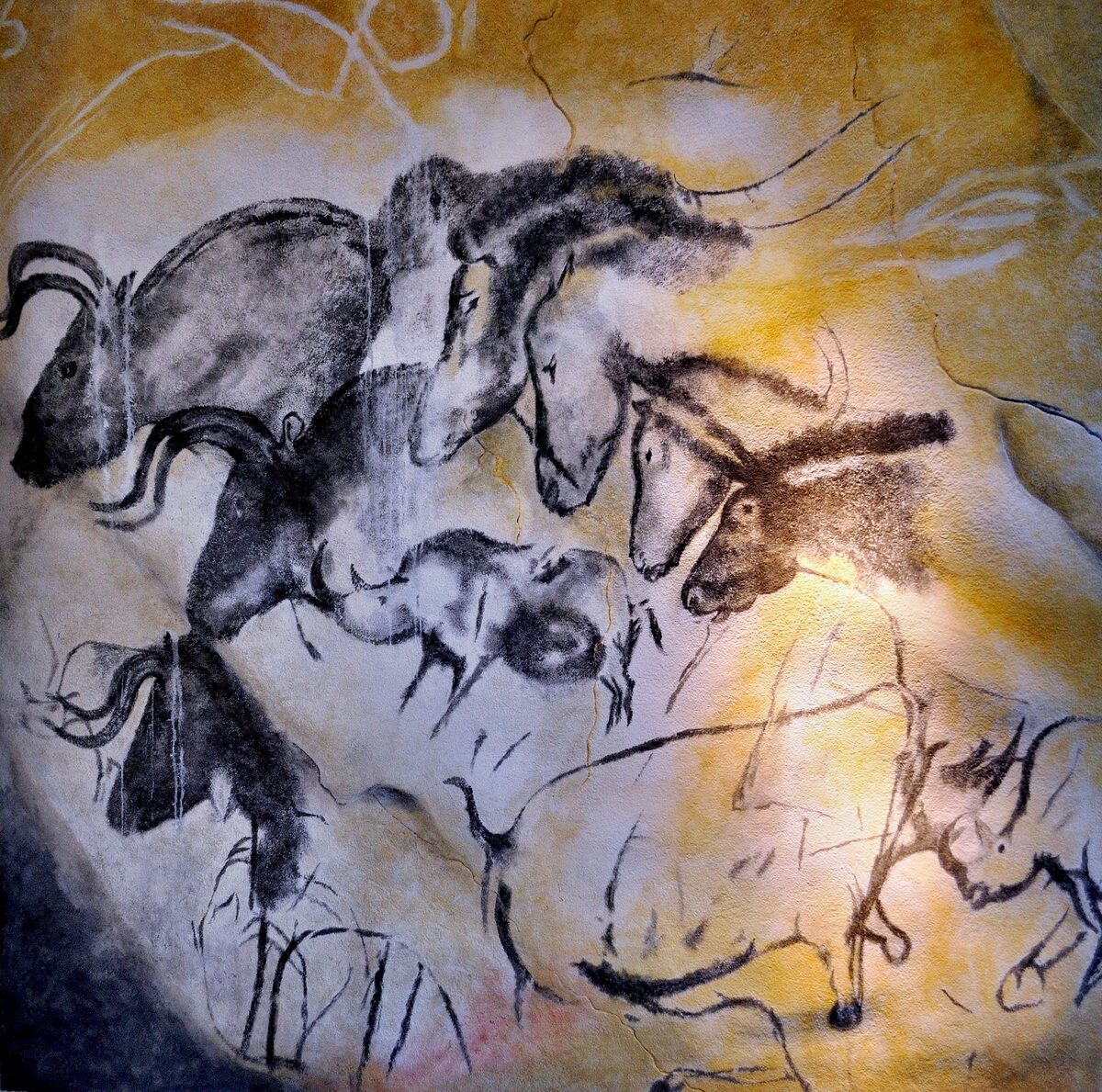
The bestiary of Chauvet is singular. Whereas most decorated caves favour hunted herbivores, horses, bison, aurochs, deer, Chauvet grants an exceptional place to dangerous and powerful animals: cave lions, woolly rhinoceroses, mammoths, bears, a panther, a hyena. These predators and formidable large herbivores account for a far higher proportion than in any other known sanctuary. The famous Panel of the Lions shows a pride of felines on the hunt, rendered with a striking economy of means and anatomical accuracy. The Panel of the Horses, where four equine heads overlap in a gradation of blacks, demonstrates a mastery of modelling and shading once thought reserved for much later periods.1
The artists of Chauvet employed sophisticated procedures: preparation of the wall by scraping to make the figures stand out against a light background, finger-stumping to suggest volume, use of natural reliefs, and even a form of perspective. Certain compositions suggest movement through the staggered repetition of legs or horns, like a distant intuition of animation. This precocity forced prehistorians to abandon the idea of a simple, progressive evolution: art appeared, it seems, already fully accomplished.
The cave was sealed by a rockfall around 21,000 years ago, which preserved the walls intact and even the traces on the floor: bear prints, hearths, charcoal. This exceptional preservation makes Chauvet a time capsule. Inscribed on the UNESCO World Heritage List in 2014, it remains closed to the public for conservation reasons, a faithful replica, the Grotte Chauvet 2, having been built nearby to welcome visitors.
Lascaux: the Sistine Chapel of prehistory
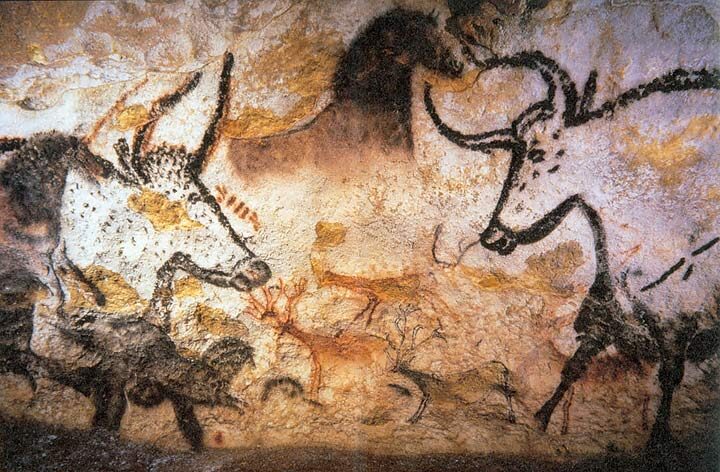
If one cave embodies the splendour of parietal art in the collective imagination, it is surely Lascaux. Discovered on 12 September 1940 by four teenagers and their dog on a hill in the Vezere valley, in the Dordogne, it revealed an ensemble of unforgettable scale and pictorial quality. The paintings belong to the early MagdalenianMagdalenianThe last great Upper Palaeolithic culture (c. 17,000–12,000 BC), the peak of cave art (Lascaux).→ and are generally dated to around 17,000 to 19,000 years ago.3 Abbe Henri Breuil, who studied it among the first, nicknamed it the Sistine Chapel of prehistory, a phrase that has remained famous, so well does it convey the sense of awe feltFeltA non-woven fabric made by pressing and matting wool fibres; steppe nomads used it for rugs, saddles and appliqués, remarkably preserved in the frozen Pazyryk tombs.→ by the visitor.
The centrepiece is the Hall of the Bulls, or rotunda, a vast chamber whose pale walls host immense aurochs, one of which exceeds five metres in length, making it the largest known animal figure in parietal art. Around them gallop horses, run deer, and appears a strange animal with two straight horns nicknamed the unicorn. The Magdalenian artists played with scale, superimposition and rhythm to create a true frescoFrescoA term used by extension for large painted compositions on the walls of decorated caves, although the technique differs from the classical mural fresco.→ in motion. Further on, the Axial Gallery extends this display with the frieze of the small horses and the famous leaping cow, of remarkable elegance of line.
Lascaux is also famous for the Scene of the Shaft, one of the rare narrative representations in all of Palaeolithic art. It shows a schematic, bird-headed man, apparently falling backwards before a disembowelled bison whose entrails hang out; a rhinoceros moves away, and a bird perched on a staff completes the scene. This enigmatic composition has prompted countless interpretations, from a hunting accident to a mythical narrative, without any one of them prevailing definitively. It reminds us that these images are not mere animal inventories but carry a symbolic charge that largely escapes us.
Opened to the public after the war, Lascaux enjoyed such success that the influx of visitors caused serious damage: the green disease of algae, then the white disease of calcite, endangered the paintings. The cave was closed in 1963. To meet public demand without sacrificing the original, Lascaux II, a facsimile, was inaugurated in 1983, followed by Lascaux IV, an international centre for cave art opened in 2016. Lascaux thus became the symbol of a fundamental dilemma: how can a heritage be shared when the very act of visiting it threatens to destroy it?
Cosquer: a submerged sanctuary
Off the coast of Marseille, among the calanques, opens one of the most singular decorated caves: the Cosquer cave. Discovered in 1985 by the diver Henri Cosquer, its entrance now lies 37 metres below sea level. During the PalaeolithicPalaeolithicThe oldest and longest period of prehistory (c. 3.3 Ma–12,000 BC), defined by chipped stone tools and a hunter-gatherer way of life.→, when hunter-gatherersHunter-gatherersA way of life based on hunting, fishing and gathering wild resources, without farming or herding; it dominated almost the whole of human history.→ frequented it, the sea level was much lower, the Mediterranean coastline retreated by several kilometres, and the cavity accessible on foot. The rise of the waters at the end of the last glaciation flooded the porch and part of the works, leaving only the upper portion of the cave emerged.
The decorations of Cosquer fall into two great phases. The earliest, around 27,000 years ago (GravettianGravettianAn Upper Palaeolithic culture (c. 33,000–21,000 BC) spanning from the Atlantic to Siberia, famous for its ivory female figurines ("Venuses") and, at Dolní Věstonice, the oldest fired ceramics.→GravettianAn Upper Palaeolithic culture (c. 33,000–21,000 BC) famous for its female figurines, the "Venuses".→), is dominated by negative hands, those imprints obtained by blowing pigment around a hand pressed against the wall. The second, around 19,000 years ago, includes numerous animals: horses, ibex, bison, aurochs, but also, remarkably, marine and coastal species, seals, auks (the now-extinct great auk), fish and jellyfish. This presence of a marine bestiary, unique in parietal art, recalls that the cave then opened onto a coastal plain.
The threat to Cosquer is twofold: marine erosion and the continuing rise of the waters linked to climateClimateThe long-term average atmospheric conditions of a region; its variations (glaciations, aridifications) shaped migrations, agriculture and the collapse of prehistoric societies.→ warming relentlessly eat away at the lower walls. To safeguard the memory of this doomed sanctuary, a replica, the Grotte Cosquer Mediterranee, was inaugurated in Marseille in 2022. Cosquer poignantly illustrates the fragility of this heritage, and the way in which environmental upheavals, yesterday as today, redraw the relationship between human beings and their sacred places.
Altamira and the recognition of prehistoric art
The story of the scientific recognition of parietal art begins in pain and scepticism. In 1879, in the cave of Altamira, in Spanish Cantabria, the young Maria, daughter of the amateur archaeologist Marcelino Sanz de Sautuola, looked up at the ceiling and cried out, so the legend goes, look, papa, oxen! Her father then discovered the fabulous ceiling of the bison, a concentration of polychrome figures of astonishing realism, where the Magdalenian artists exploited the bulges of the rock to give volume to the bodies of the animals curled upon themselves.
When Sautuola published his discovery and asserted the antiquity of these paintings, the scholarly community refused to believe him. How could prehistoric people, supposedly crude, have produced such masterpieces? He was even accused of fraud, or of having had the cave painted by a contemporary artist. Sautuola died in 1888 without seeing his honour restored. It was only at the turn of the century, with the multiplication of discoveries in France, notably at La Mouthe, Les Combarelles and Font-de-Gaume, that the authenticity of Palaeolithic parietal art was finally admitted. In 1902, Abbe Breuil and Emile Cartailhac, the latter having been among the sceptics, published a resounding Mea culpa of a sceptic that rehabilitated Altamira and Sautuola posthumously.
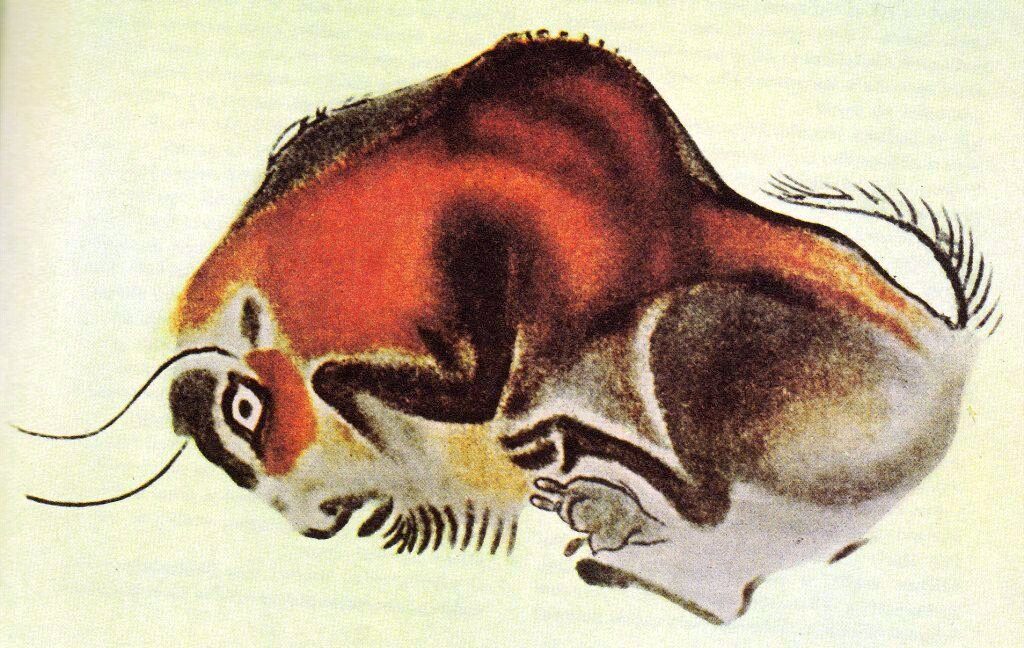
After the long disputes that accompanied the discovery of Altamira, one must acknowledge that these images, by their accuracy and their force, abolish the distance we believed insurmountable between prehistoric humans and ourselves: they are the works of artists in the fullest sense.
Techniques and pigments: the making of the image
Understanding parietal art means entering the workshop of the Palaeolithic artists. The colours used come almost exclusively from minerals: ochres, hydrated iron oxides, provide the whole range of yellows, oranges, reds and browns; manganese dioxide and charcoal yield the blacks. White, rarer, could be obtained from clays or calcite. These raw materials were ground, sometimes heated to alter their hue, then mixed with binders and fillers, water, animal fat, even saliva or plant matter, to obtain a paste adhering to the wall.
Application was carried out in many ways: with the finger, with a pad of fur or moss, with a plant or hair brush, by direct projection from the mouth or with a hollow tube. The stencil technique, used for negative hands, consisted in blowing pigment around a template, here the hand itself. To reach the high walls, the artists had to erect scaffolding, traces of whose sockets have been found at Lascaux. And since these caves are plunged in total darkness, all the work was carried out by the flickering light of fat lamps and torches, whose combustion residues have sometimes been dated.
The physico-chemical analysis of pigments, through spectrometry and microscopy, has revealed genuine recipes, specific to certain caves or periods, suggesting a transmission of know-how. The gesture itself testifies to learning: the ease of the line, the management of proportions on an irregular surface and in semi-darkness presuppose long practice. Far from the image of a spontaneous outpouring, parietal art appears as a deliberate, organised and transmitted technical activity.
Themes and meanings: what did they want to say?
The question of the meaning of parietal art has haunted researchers for more than a century, and no single answer has prevailed. The first interpretations, at the start of the twentieth century, invoked hunting magic: painting the animal, even piercing it with depicted arrows, was supposed to ensure symbolic control over the game. This seductive thesis, however, runs up against awkward facts: the most painted species are not always those most hunted and eaten, as comparisons between wall art and the bones found in dwellings show.
Andre Leroi-Gourhan proposed, in the 1960s, a structural reading: the decorated cave would form an organised system, where the figures were distributed according to a logic of opposition, notably between masculine and feminine principles, the horse and the bison playing complementary roles. This approach, which broke with the idea of a fortuitous assemblage, deeply marked the discipline, even if its presuppositions have since been qualified.
More recently, the hypothesis of shamanismShamanismA set of beliefs and ritual practices based on communication between the living and a spirit world, mediated by a practitioner (the shaman) entering a trance state. The shamanic hypothesis has been proposed to interpret part of Palaeolithic parietal art.→ has enjoyed great popularity. According to this reading, defended notably by David Lewis-Williams, certain images, in particular the geometric signs and the composite half-human half-animal figures, would translate visions experienced during altered states of consciousness, within shamanic practices. The cave, a space of passage between worlds, would have served as the setting for these experiences. This stimulating hypothesis remains debated: it risks projecting recent ethnographic models onto the Palaeolithic. It is likely that no single explanation accounts for thirty millennia of images produced by diverse societies.
Negative hands: signatures of humanity
Among all the motifs of parietal art, negative hands exert a particular fascination. Obtained by projecting pigment around a hand pressed against the wall, they leave in reserve the pale silhouette of the fingers and palm. They are found at Cosquer, at Pech Merle, at Gargas in the Pyrenees, and as far afield as the caves of Patagonia or Indonesia, where recent datings have revealed ages comparable to those of the European caves. This worldwide phenomenon underlines the universality of a gesture: to place one's hand on the rock is to inscribe one's presence, to say I was here.
At Gargas, some hands show apparently incomplete or folded fingers, which has nourished varied hypotheses: ritual mutilations, diseases, frostbite, or more simply deliberate finger positions within a gestural code. The diversity of hand sizes, children, women, men, indicates that these imprints were not the work of a single category of individuals. Through these negative silhouettes, it is the most direct, the most carnal humanity that touches us: no longer the observed animal, but the very body of the artist set against the stone.
Portable art and parietal art: two faces of one world
Parietal art must not be isolated from portable artPortable artTransportable art objects (figurines, engravings on bone or ivory), such as the Palaeolithic Venuses.→, with which it forms a continuum. The same societies that decorated the caves carved Venuses with generous forms, engraved stone plaquettes, decorated spear-throwers and perforated batons, and sculpted contours cut from bone. Often, the same themes and stylistic conventions recur on the walls and on the objects, a sign of a shared visual culture. Some engraved plaquettes found in dwellings seem to have served as sketches or exercises, bridging domestic production and the monumental work of the sanctuary.
This continuity invites us to move beyond the opposition between an everyday art and a sacred art. The image circulated, on the wall as in the hand, in the dwelling as in the depths of the cave. Understanding one illuminates the other: portable art, better dated by its stratigraphic context, helps to situate chronologically styles that recur on walls more difficult to date directly.
Conservation and replicas: preserving the irreplaceable
The discovery of parietal art has almost always been accompanied by an awareness of its fragility. The equilibrium of decorated caves, maintained for millennia by the stability of the underground atmosphere, is broken as soon as they are opened: human presence alters the temperature, humidity and carbon dioxide level, favouring the development of micro-organisms, algae, fungi and bacteria that can invade the walls. Lascaux gave the tragic demonstration of this, followed by delicate and sometimes controversial treatment campaigns.
Faced with this dilemma, the favoured solution has been the closure of the originals to the public, combined with the creation of very high-fidelity replicas: Lascaux II and IV, the Grotte Chauvet 2, the Grotte Cosquer Mediterranee. Far from being mere stage sets, these facsimiles mobilise cutting-edge technologies, laser surveys, photogrammetry, pigment restitution, to reproduce the visual experience of the cave down to the millimetre. They raise a profound question about authenticity: can the emotion of a work be transmitted through its copy? Experience shows that it largely can, and that the replica is undoubtedly the very condition of the survival of the originals.3
Conclusion: a dialogue across the millennia
Palaeolithic parietal art is not merely a chapter in the history of art: it is a window opening onto the birth of symbolic thought, onto our species' capacity to transform the world into images and to charge those images with meaning. From Chauvet to Lascaux, from Altamira to Cosquer, these caves show us men and women who observed animals with extreme acuity, mastered complex techniques and conferred upon the depths of the caves a spiritual dimension that we can only glimpse.
Each new discovery, each advance in dating methods, refines and sometimes overturns our understanding. What remains is the raw emotion before these horses, these bison, these hands reaching out to us across tens of thousands of years. In contemplating these walls, we do not merely look at vanished animals: we meet the gaze of our distant predecessors, and we recognise ourselves in them. Therein perhaps lies the greatest power of cave art: to remind us, across the abyss of time, that we belong to one and the same creative humanity.
Geography of a European phenomenon
If Chauvet, Lascaux, Cosquer and Altamira concentrate attention, they are only the most visible peaks of a vast ensemble. Several hundred decorated caves are now counted in western Europe, distributed mainly across two great clusters: the Perigord and the Pyrenees in France, the Cantabrian coast in Spain. The Vezere valley alone shelters an exceptional density of sites, which earned it World Heritage status: Font-de-Gaume, one of the last polychrome caves still open to the public, Les Combarelles, rich in thousands of engravings, Rouffignac, nicknamed the cave of the hundred mammoths, or Cap Blanc with its sculpted frieze of horses.
In the Pyrenees, caves such as Niaux, with its striking Salon Noir peopled with bison, or Les Trois-Freres and its enigmatic figure of the Sorcerer, half-human half-beast, complete this panorama. Further east, the Pech Merle cave, in the Lot, preserves its famous spotted horses surrounded by negative hands, while in Cantabria, El Castillo has yielded some of the oldest known datings for painted discs, pushing the origin of parietal art beyond 40,000 years. This geographical distribution is no accident: it follows the territories where limestone rock offered suitable cavities and where human groups, in a cold steppeSteppeA vast semi-arid, treeless grassland of Eurasia, suited to nomadic herding and the horse; a corridor for the movement of peoples and technologies in later prehistory.→ environment rich in game, had the resources and the time necessary for such symbolic activity.
Beyond this Franco-Cantabrian core, more scattered testimonies exist: decorated caves in Italy, in Romania with Coliboaia, in the Russian Urals with Kapova. And above all, recent discoveries outside Europe, in Indonesia in particular, where figurative representations and hands have been dated to more than 40,000 years, suggest that the artistic impulse is not the monopoly of glacial Europe, but a trait widely shared by populations of Homo sapiens across the world.
The animal at the centre of everything
One observation strikes anyone who walks through the decorated caves: the animal reigns supreme. Human figures are rare there, often schematic, sometimes caricatural, whereas the smallest horse, the smallest bison is treated with remarkable care and anatomical accuracy. This disproportion is heavy with meaning. The Palaeolithic artists knew intimately the fauna that surrounded them: they knew how to render the silhouette of a mammoth, the neck of a horse, the posture of a charging or ruminating bison, the lightness of an ibex on a ledge. Their gaze was that of hunters, but also of observers sensitive to postures, to seasonal coats, to behaviours.
The choice of represented species varies according to regions and periods, drawing a kind of symbolic geography. The horse and the bison dominate the entire corpus; then come the aurochs, the deer, the ibex, the mammoth, the woolly rhinoceros, the reindeer, more rarely the bear, the lion or the fish. Some species nonetheless abundant in the diet, such as reindeer at many sites, are curiously little painted, while others, dangerous or spectacular, are over-represented. This selection proves that parietal art is not a faithful mirror of the environment, but a cultural construction, in which certain animals carried a particular charge, perhaps mythological, totemic or ritual.
The signs: an abstract vocabulary
Alongside the animal figures, the walls bear a multitude of geometric signs whose meaning remains one of the great enigmas of prehistory. Aligned dots, lines, strokes, grids, arrow-shaped, key-shaped, club-shaped or comb-shaped signs, ovals and circles: this abstract repertoire, long neglected in favour of the spectacular animals, is today the object of sustained attention. Some researchers see in it the first milestones of a notation system, without going so far as to speak of writingWritingA system of conventional signs used to fix language or information durably; its appearance (c. 3300 BC) marks, by convention, the end of prehistory.→, others territorial or identity markers, still others representations linked to particular states of consciousness.
What is striking is the recurrence of certain signs across sometimes distant sites, as if a single visual code circulated within vast human networks. The fact that these signs are sometimes systematically associated with certain animals or placed at precise locations in the cave, entrance, deep zones, suggests that they participated fully in the symbolic organisation of the sanctuary. Far from being mere ornaments, they constitute an abstract language whose key is missing, but whose coherence betrays a structured mind.
Dating the invisible: the advances of science
One of the greatest challenges in the study of parietal art is its dating. An engraving in stone contains in itself no directly datable matter; an ochreOchreA red or yellow mineral pigment (iron oxides), used from prehistory for adornment, funerary rites and art.→ painting, a purely mineral pigment, also escapes radiocarbonRadiocarbon (carbon-14)A dating method based on the decay of carbon-14, usable back to about 50,000 years.→ dating. This is why charcoal paintings have played a decisive role: charcoal, of organic origin, can be radiocarbon-dated, provided micro-samples are taken without damaging the work. It was thus that Chauvet could be attributed its astounding age, by directly dating the pigment of certain figures.2
Other methods complete the arsenal. Uranium-series dating, applied to the thin films of calcite that deposit on the paintings, makes it possible to bracket their age: a calcite covering a figure gives a minimum age, an underlying calcite a maximum age. It is this technique that pushed the origin of certain signs back beyond 40,000 years in Spain. Thermoluminescence, the study of concretions, and comparative stylistic analysis refine the estimates. Each method has its limits and uncertainties, and the datings are the object of sometimes lively debate, but their convergence draws an increasingly solid chronology.
The experience of the decorated cave
One cannot understand parietal art by reducing it to a collection of images on walls. One must imagine the lived experience: the descent into darkness, the thick silence, the cold, the flickering light of fat lamps casting moving shadows, the echo of footsteps and voices beneath the vaults. In these conditions, the painted animals seemed to come alive, to surge forth and vanish with the play of the flame. The very choice of locations, some figures placed in hard-to-reach recesses, others exploiting a natural relief already evoking the animal, reveals a deliberate staging.
Some caves present features that suggest a ritual or collective use: vast chambers able to accommodate a group, narrow passages imposing an initiatory route, decorated zones located in the deepest parts, far from any dwelling. The acoustic dimension has also been studied: it has been noticed that figures sometimes concentrate in the zones where resonance is strongest, as if sound participated in the ritual. Everything indicates that the decorated cave was not a museum but a living place, the theatre of gestures, words and perhaps ceremonies of which the painted images are only the silent trace.
Legacy and contemporary perspectives
The revelation of parietal art has profoundly marked modern culture. In the twentieth century, artists such as Picasso, who is said to have declared after a visit to Lascaux that we have invented nothing, saw in these paintings a source of inspiration and a lesson in humility. Cave art has nourished reflection on the origin of creation, on the place of the image in human societies, on what, ultimately, makes us symbolic beings. It has also fed the popular imagination, from textbook illustrations to fictions about prehistory.
Today, parietal art stands at the crossroads of several issues: scientific, with the constant progress of analysis and dating; heritage-related, with the need to conserve threatened sites; ethical, with the questions raised by the commodification of heritage and the place of replicas; and even environmental, since climate warming directly threatens caves such as Cosquer. To study these works is therefore also to reflect on the way in which a society chooses to transmit, or to lose, the memory of its origins.
Beyond the scholarly debates, one fact remains self-evident: before the Panel of the Horses at Chauvet, before the bulls of Lascaux or the bison of Altamira, the visitor feels an emotion that transcends the millennia. These images tellTellAn artificial mound formed by the accumulation of successive layers of settlement remains at the same spot, typical of the Near East. Each destruction-rebuilding event adds a stratum.→ us that, long before the first cities, the first writings, the first organised religions, men and women felt the need to represent the world, to think it in images, to leave a trace. In this, parietal art is not only the oldest of the arts: it is the first sign, brilliant and fragile, of our humanity.
The people behind the images
Who were the authors of these masterpieces? The question remains open, but several clues allow us to sketch a portrait. The artists belonged to societies of nomadic hunter-gatherers, living in small mobile groups in a cold steppe environment, to the rhythm of the seasons and animal migrationsMigrationsLong-distance movements of populations; a major driver of human history (the exit from Africa, the peopling of continents, Neolithic and steppe expansions).→. Far from the wretched image long conveyed, these populations possessed a sophisticated material culture, finely knapped flint tools, eyed needles to sew fitted garments, elaborate hunting techniques, and enough social time to develop a rich symbolic life.
The study of hand and foot prints preserved in some caves provides precious information. At Chauvet as at Pech Merle, it has been possible to identify the presence of children and adolescents alongside adults, which suggests that the frequenting of decorated caves was not reserved for a narrow elite of initiates, at least not in all cases. The diversity of negative hand sizes confirms this mix. It is likely that the making of the works themselves was the province of specialised persons, holders of a transmitted know-how, while the frequenting of the sanctuary could involve a wider public on particular occasions.
The question of the artist's status in these societies remains speculative. Were there recognised specialists, a form of mastery transmitted from generation to generation? The constancy of certain styles over long periods, the sophistication of the techniques, the existence of probable sketches on plaquettes argue for an organised transmission of know-how. But parietal art may never have been an activity separate from the rest of social and ritual life: the artist was probably also a hunter, a storyteller, perhaps an officiant, and the work was woven into a fabric of practices of which it was only one thread.
Fragility and the future of a heritage
The recent history of parietal art is also that of a race against degradation. Each decorated cave is a delicate ecosystem, whose balance rests on invisible parameters: humidity level, constant temperature, air circulation, the chemistry of the water seeping through the rock. The slightest disturbance can trigger chain reactions, calcite crystallisation covering the paintings, proliferation of micro-organisms, corrosive condensation. The managers of these sites must constantly monitor these balances, sometimes with the help of probes and climatic models, to anticipate threats.3
Three-dimensional digitisation, through laser survey and high-resolution photogrammetry, today constitutes a form of life insurance for this heritage. Even if a cave were to disappear, its detailed memory, to the nearest millimetre, would be preserved and could be studied, or even reconstructed. These digital archives also open new research possibilities: a wall can be analysed from every angle, different lightings simulated, superimpositions measured, without ever entering the fragile cavity. Technology, which made it possible to reveal the antiquity of these works, thus becomes the tool of their survival.
From discovery to interpretation: a changing science
The study of parietal art has itself a history, one that mirrors the evolution of prehistoric science as a whole. In its early decades, the discipline was dominated by a small number of charismatic figures, foremost among them Abbe Henri Breuil, nicknamed the pope of prehistory, who spent years copying the wall figures by hand and proposed the first great chronological frameworks. His tracings, though sometimes interpretative, remain invaluable records of figures that have since faded. Breuil read the caves above all through the lens of hunting magic, an approach that long held sway.
The second half of the twentieth century brought a methodological revolution. The structural analyses of Leroi-Gourhan and Annette Laming-Emperaire sought statistical regularities in the placement and association of figures, treating the cave as a coherent whole rather than a random accumulation. Later still, the development of physico-chemical analysis, direct radiocarbon dating and uranium-series methods transformed a discipline once founded largely on stylistic intuition into a rigorous experimental science. Today, the use of digital imaging, three-dimensional modelling and statistical processing of the signs continues to renew the questions asked of these ancient walls.
Each generation, in truth, has projected its own preoccupations onto the painted caves, reading them as hunting shrines, as structured cosmologies, as theatres of shamanic trance. This succession of interpretations should inspire humility rather than discouragement: it reminds us that the images remain, stable and silent, while our readings of them shift. The honest researcher accepts that a part of their meaning is irretrievably lost, and that the greatness of these works lies precisely in their capacity to resist any final explanation, to keep open the dialogue between the Palaeolithic mind and our own.
It is worth emphasising, finally, that the great decorated caves were not isolated artistic accidents but the visible apex of a way of life in which image-making was woven into the daily and ceremonial rhythms of whole communities. The hunters who tracked reindeer across the cold plains, the women who sewed and gathered, the children who learned by watching, all moved within a world saturated with signs, stories and remembered animals. The painted walls are the durable residue of that immaterial culture, the one fragment of an otherwise vanished mental universe that has survived the erosion of forty thousand years. To stand before them is to receive, almost intact, a message sent by people who shared our minds if not our world, and who chose, against the darkness, to make light and meaning out of pigment and stone.
L'approche est exactement ce qu'on demande en histoire : chronologie, sources, contexte. Bravo.
Ces formes géométriques préhistoriques reviennent régulièrement dans mon travail graphique. Ce site les documente parfaitement.
Je ne savais rien de ce sujet avant cet article. Maintenant j'ai envie d'aller encore plus loin.
La recherche sur l'art pariétal paléolithique a connu une révolution avec l'introduction des datations U/Th sur les calcites qui recouvrent les parois. Ces datations, plus fiables que le radiocarbone pour les temps longs, ont permis de confirmer l'ancienneté de sites comme Chauvet et d'en réévaluer d'autres. Le dialogue entre archéologues et géochimistes est productif.
L'art pariétal paléolithique est l'un des sujets les plus visuellement frappants pour la production documentaire. Ces images vieilles de 15 000 à 40 000 ans ont une force esthétique qui touche les spectateurs d'aujourd'hui sans médiation culturelle. Ce dossier couvre bien les principaux enjeux de la recherche actuelle, en particulier les questions de datation et de signification.