For five centuries, between roughly 2700 and 2200 BCE, Egypt invented a kind of grandeur the world had never seen. Along the Nile, a state arose capable of mobilising tens of thousands of hands, of carving mountains of limestone and of turning the desert into eternal necropolises. This was the Old Kingdom, the age of the pyramids, the era when the pharaohPharaohThe title of the ruler of ancient Egypt, regarded as a living god guaranteeing cosmic order (Maat), supreme head of state, army and worship.→ became a god on earth and when the administration learned to count, to classify and to govern. Arte's documentary "Egypt, the Fall of the Old Kingdom" devotes its first part to this apogee: it shows a civilisation at the height of its power, just before the first cracks appeared. This companion article extends that account and sheds light on its inner workings.
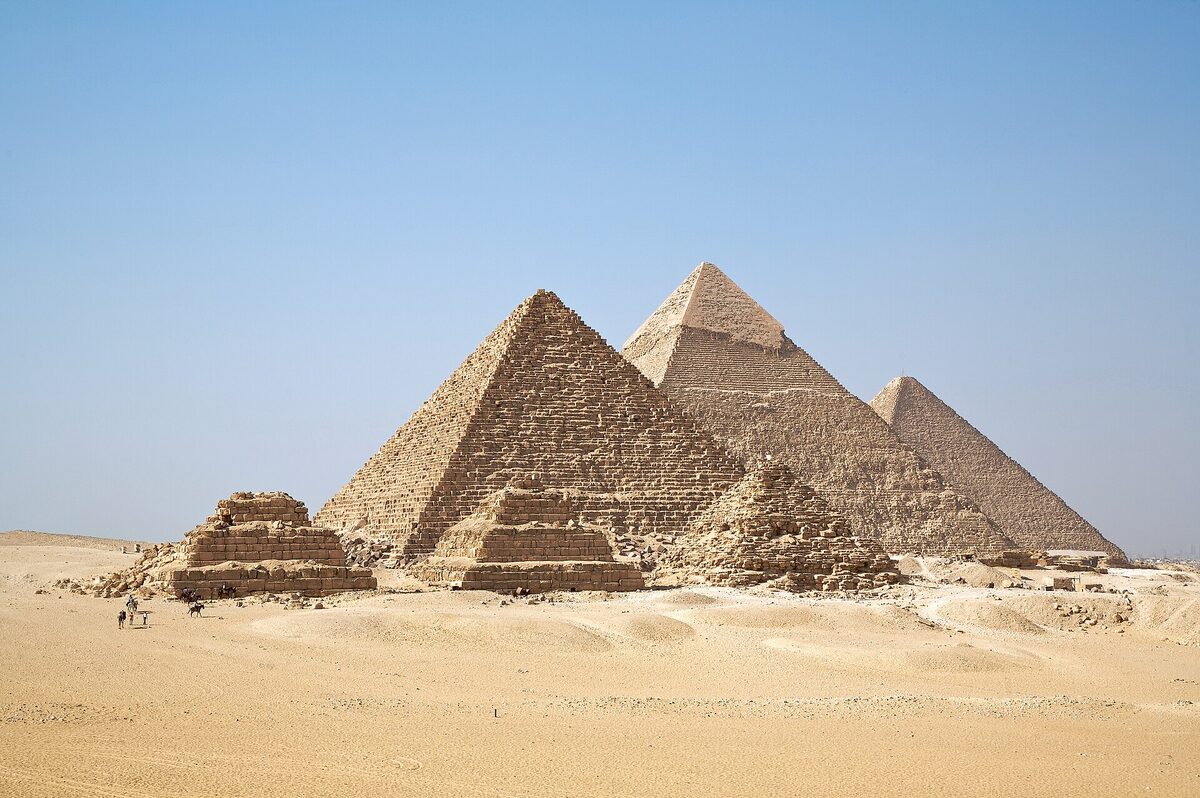
One clarification is needed at the outset. When we speak of "the pyramids", we almost always think of the three giants of Giza, made famous by postcards and films. But Egypt has more than a hundred of them, scattered over nearly a hundred kilometres along the western bank of the Nile, from Abu Rawash in the north to the Fayoum region in the south. Almost all belong to the Old and Middle Kingdoms. To contemplate them as a whole, rather than stopping at the Giza stars alone, allows us to grasp an evolution, hesitations, successes and failures, in short a genuine technical and political history unfolding over several generations of builders.
We will trace the origins of this golden age, from the first monumental tombs to the giants of Giza, in order to understand what made the Old Kingdom so solid, and why that very solidity already carried within it a few weaknesses. People often speak of the pyramids as pure technical feats; they are first of all the expression of a political, religious and social order of astonishing coherence. To grasp the rest of the story, the fall recounted in the second part, one must first measure the height of the summit. That is the subject of this first episode and of this analysis, which sets the documentary's images alongside what archaeology and Egyptology now tellTellAn artificial mound formed by the accumulation of successive layers of settlement remains at the same spot, typical of the Near East. Each destruction-rebuilding event adds a stratum.→ us about this founding period.
The word "pyramid" itself is not Egyptian: it comes to us from Greek, and its exact origin remains debated. The ancient Egyptians designated these monuments by other terms connected to their function of the king's ascent toward the sky. This simple shift of vocabulary reminds us how far our view of Egypt is filtered through the civilisations that took an interest in it before us, from the Greeks to the scholars of the Egyptian expedition. To restore the Egyptians' own point of view, from their texts and their images, is one of the great challenges of Egyptology, and one of the strengths of serious documentaries devoted to this period.
What is the Old Kingdom?
Egyptology has divided the long history of pharaonic Egypt into great periods, and the first of these, after the unification of the Two Lands, bears the name of the Old KingdomOld KingdomThe first great period of unified pharaonic Egypt (c. 2700-2200 BC, 3rd-6th Dynasties), the golden age of the great pyramids and of a strongly centralised state.→. It covers approximately the Third, Fourth, Fifth and Sixth Dynasties, that is roughly the years 2700 to 2200 BCE. This is a scholars' convention, for the Egyptians themselves did not think of their past in such terms; but it corresponds to a strong historical reality: over these five centuries the country enjoyed a stability, a centralisation and a monumental creativity without precedent.
Before the Old Kingdom came the so-called Thinite period, that of the first two dynasties, during which the very idea of a unified kingdom took shape, governed from the north by a single sovereign. The capital, Memphis, was founded at the hinge between the Delta and the valley, a strategic point from which both Lower and Upper Egypt could be watched. It was from Memphis that the whole Old Kingdom radiated, and it was on the desert plateaus bordering it, from Saqqara to Giza, that the pharaohs had their gigantic tombs built.
What distinguishes the Old Kingdom is the extraordinary concentration of power in the hands of the king. The pharaoh was not merely a political leader: he was the guarantor of cosmic order, Maat, without which the world would return to chaos. This ideology was anything but abstract: it governed the organisation of the entire state, justified taxation, mobilised the workforce and explains the colossal effort devoted to building the pyramids. To understand the Old Kingdom is to understand this knot where religion, politics and economy meet around the sacred person of the sovereign.
We must also set aside a few preconceptions. The Old Kingdom was not a frozen block: it evolved, its dynasties each had their own character, and the balance of power between the king and his entourage shifted over the reigns. At the start, the monarchy crushed everything with its power; by the end, high officials and provincial governors gradually nibbled away at central authority. It is precisely this slow erosion that prepared the fall recounted in the documentary's second part. But for now, let us dwell on the moment when everything seemed possible.
A word more on chronology. The dates given for the Old Kingdom remain approximate, for Egypt had no continuous era like our calendar: years were counted from the accession of each king. Egyptologists reconstruct the succession of reigns by cross-checking ancient king lists, such as the one carved at AbydosAbydosA sacred site in Upper Egypt, necropolis of the earliest kings (Umm el-Qaab) and a major centre of the cult of Osiris.→, fragmentary annals like the famous Palermo Stone, and archaeological correlations. These commonly accepted date ranges result from that patient work, and one must bear in mind that they can vary by several decades from one specialist to another.
The pyramid revolution: Djoser, Sneferu, Khufu
If a single object were to embody the Old Kingdom, it would be the pyramid. Yet the pyramid was not born all at once: it is the culmination of a long evolution of Egyptian funerary practices, inherited from late prehistoryPrehistoryThe span of human history before the invention of writingWritingA system of conventional signs used to fix language or information durably; its appearance (c. 3300 BC) marks, by convention, the end of prehistory.→, from the PalaeolithicPalaeolithicThe oldest and longest period of prehistory (c. 3.3 Ma–12,000 BC), defined by chipped stone tools and a hunter-gatherer way of life.→ to the Metal Ages, known mainly through material remains.→ and the Thinite period. In predynasticPredynasticThe period of Egypt before unification (c. 3100 BCE) and the First Dynasty, marked by the Naqada cultures and the gradual emergence of the state.→ times the dead were buried in simple pits dug into the sand. Then the elites had more elaborate tombs built, capped with a rectangular superstructure with a flat roof and sloping sides: the mastabaMastabaAn early Egyptian flat-roofed tomb with sloping sides, the architectural ancestor of the pyramid.→. Beneath this mass of mud brick, a shaft descended to the burialBurialThe intentional deposition of a body, sometimes with offerings; a marker of symbolic behaviour.→ chamber. The mastaba already contains the fundamental idea of the pyramid: a massive volume protecting and glorifying a burial.
It was at Saqqara, under the reign of pharaoh Djoser, the first great sovereign of the Third Dynasty, that the founding act took place. Around 2700 BCE, his architect Imhotep conceived a revolutionary idea: to stack mastabas one upon another in decreasing tiers. Six superimposed mastabas thus rose to some sixty metres. The step pyramidStep pyramidEgypt's first great stone monument, raised for King Djoser at Saqqara by Imhotep (Third Dynasty), by stacking diminishing mastabas.→ of Djoser was born. For the first time, a monument built entirely of dressed stone reached such a height. Imhotep, later deified, remains one of the few architects of antiquity whose name has come down to us, and his work marks the true starting point of the pyramid adventure.
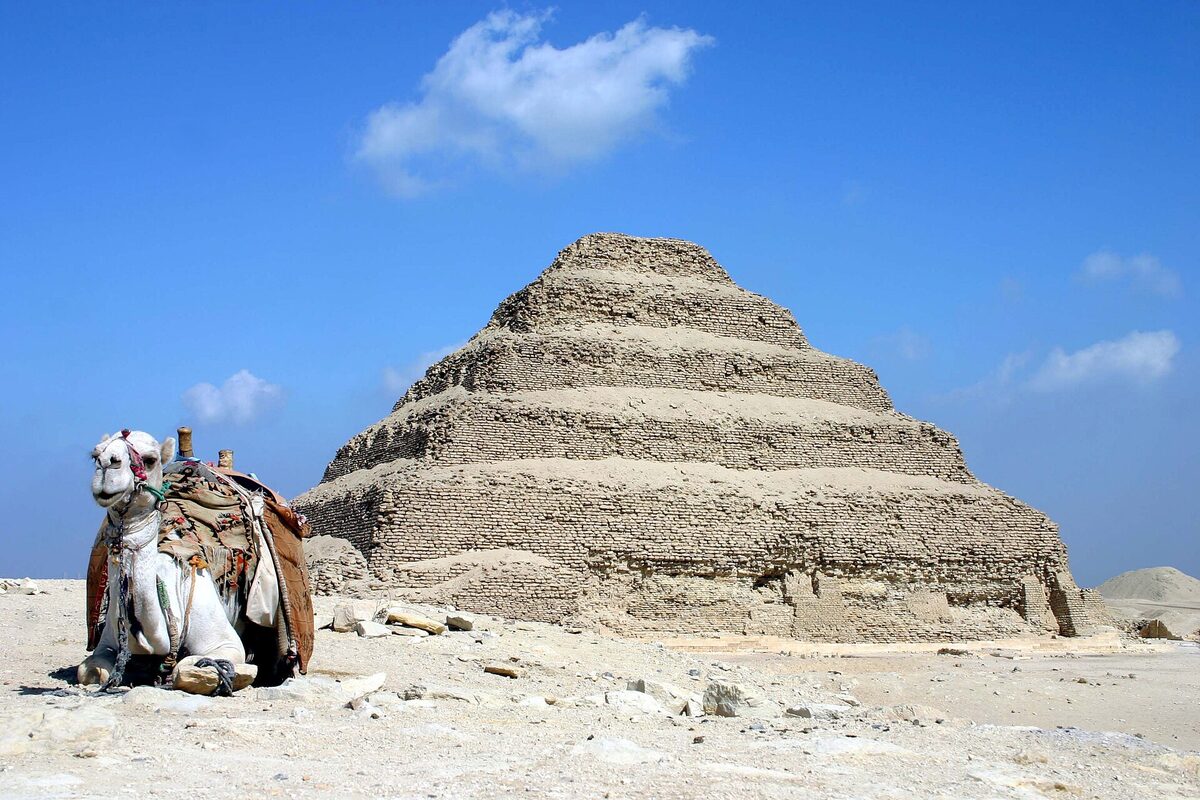
Djoser's complex is not limited to the pyramid. All around it stretches a vast enclosure of white limestone, with courts, temples, chapels and false doors intended for the funerary cult. The whole reflects an already highly elaborate organisation: quarries were needed, as were stone-cutters, transporters, architects and scribes to keep the accounts. The step pyramid is not only a technical feat, it is the sign of a state capable of mobilising considerable human and material resources and of planning a building site over years.
After Djoser, the pharaohs sought to perfect the form. It was the reign of Sneferu, founder of the Fourth Dynasty, that marked the transition from the step pyramid to the smooth-sided pyramid. This sovereign, one of the greatest builders in all Egyptian history, had not one but three pyramids erected. At Meidum, an attempt was made to smooth the steps into flat faces, with a partially collapsed result. At Dahshur, Sneferu had the Bent Pyramid built, whose angle changes abruptly at mid-height, probably out of fear of collapse. Finally, also at Dahshur, the Red Pyramid became the first monument with perfectly smooth faces, a true dress rehearsal before Giza.
The volume of stone moved under Sneferu's reign alone exceeds that mobilised for the Great Pyramid. This accumulation of trial and error shows that the Egyptians had no ready-made blueprint: they learned by building, correcting angles, adjusting slopes, passing their knowledge from one site to the next. It was this collective apprenticeship, as much as the genius of a few architects, that made the following masterpiece possible.
For it was Sneferu's son, Khufu, who brought the form to absolute perfection. On the Giza plateau he had the Great Pyramid raised, originally nearly one hundred and forty-six metres high and composed of more than two million blocks. For almost four thousand years it remained the tallest human construction ever built. Its astronomical orientation, the precision of its angles and the regularity of its courses still command the admiration of modern engineers. Beside it would soon rise the pyramid of his successor Khafre and that of Menkaure, forming the famous Giza alignment. The technical questions, how to move and lift such blocks, how to raise the ramps, how to house and feed the thousands of workers, continue to fuel research, but the fundamental answer is clear: these monuments were built neither by anonymous slaves nor by supernatural forces, but by a remarkably organised society.
It is worth dwelling on what the construction of the Great Pyramid actually represents. Modern estimates suggest a project carried out over some twenty years, mobilising at its peak several tens of thousands of people, not permanently but on a rotation system. Stone-cutters, haulers, masons, carpenters, water-carriers, bakers, brewers and scribes formed an organisation comparable to that of a small moving town. The limestone blocks most often came from nearby quarries, while the fine facing limestone came from Tura, on the opposite bank, and the granite of the inner chambers from Aswan, more than eight hundred kilometres upstream.
Debates about lifting methods remain open. Straight ramp, spiral ramp wrapping around the monument, internal ramp, lever systems: each hypothesis has its supporters and runs up against objections. What is certain is that the Egyptians knew neither the pulley nor iron, and that they accomplished this feat with copper tools, wooden sledges, ropes and a perfect command of work organisation. It is precisely this absence of technologies we would deem indispensable that makes their achievement so fascinating.
The pharaonic state and administration
Behind the stone there is the state. A pyramid is not only an engineering feat: it is the visible product of an administrative machine of formidable efficiency. To gather, feed, house and coordinate tens of thousands of workers, to bring limestone from nearby quarries, granite from Aswan hundreds of kilometres away and timber imported from Lebanon, an organisation was needed that could plan over the long term, keep precise accounts and transmit orders across the whole country.
At the summit of this human pyramid sat the king, a living god. But the pharaoh did not govern alone. At his side stood the vizierVizierThe highest official of the Egyptian state after the pharaoh (Egyptian "tjaty"): effectively a prime minister directing administration, justice, the treasury and public works in the king's name.→, a kind of prime minister who directed the central administration, oversaw justice, public works, granaries and the treasury. Below the vizier rose a hierarchy of officials, scribes and provincial governors called nomarchs. It is this nascent bureaucracy, one of the oldest in the world, that formed the true backbone of the Old Kingdom.
The instrument of this administration was writing. Hieroglyphs served for monumental and religious inscriptions, while a cursive script, hieratic, allowed accounts, inventories and correspondence to be quickly written on papyrus. The scribe held an envied position: knowing how to read, write and count opened the doors to a career and exempted one from the harshest forced labour. Whole statues celebrate the image of the seated scribe, tablet on his knees, attentive and lettered. Through him, the state saw, counted and levied.
For to govern is first of all to count. The Egyptian administration regularly organised censuses of cattle, land and people, the basis of the fiscal system. Tax was levied in kind, grain, cattle, craft products, and stored in vast state granaries. This centralised redistribution made it possible to feed the building sites, maintain the temples and guard against bad harvests. Pharaonic power thus rested on a formidable capacity to concentrate resources and then redirect them toward the great royal projects.
Arte's documentary rightly stresses this point: the grandeur of Egypt lay not only in the size of its monuments but in the sophistication of its administration. A pyramid is, in a sense, a petrified balance sheet. Each block implies a quarry worked, a team assigned, a ration distributed, a transport organised. Behind the frozen image of mineral eternity hides an anthill of managers, foremen and scribes without whom nothing would have been possible.
This administration did not stop at the palace gates. It covered the whole country, divided into districts called nomes, each with its officials, granaries and workshops. Messengers and itinerant officials ensured the circulation of orders and accounts between the capital and the provinces. Carved in stone or preserved on papyrus, royal decrees, personnel lists, building-site accounts and even registers of workers' presence and absence have been found. These documents, among the oldest administrative records of humanity, reveal a concern for the written trace that would never cease to characterise Egyptian civilisation.
Economy and society
The economy of the Old Kingdom rested almost entirely on the agricultureAgricultureThe cultivation of plants and production of food by working the soil, which emerged in the Neolithic in the Near East and independently elsewhere; it radically transformed human societies.→ of the Nile. Each summer the flood deposited a black, fertile silt on the land, allowing abundant harvests of wheat and barley. This almost miraculous regularity, compared with the capricious rains of other regions, provided the indispensable food surpluses. Without these surpluses of grain, the state could never have diverted so many hands from agricultural production toward the royal building sites. The pyramid, paradoxically, is a daughter of the silt.
Old Kingdom Egyptian society was strongly hierarchical, but this hierarchy was not a system of rigid castes. At the summit, the royal family and the high administration. Below them, the priests, the scribes, the skilled craftsmen, then the immense mass of peasants. The pyramid workforce was largely made up of these peasants, mobilised by rotation, particularly during the flood season when the fields were under water and hands were freed. This system, closer to organised corvée than to slavery, regularly supplied fresh teams.
The excavations carried out near the pyramids, in particular the discovery of workers' villages and labourers' cemeteries, have profoundly renewed our view. The skeletons tell of a life of toil, compressed vertebrae, worn joints, fractures, but also of medical care, healed bones, treatments that imply a society attentive to its workforce. Traces of bakeries, breweries and slaughterhouses meant to feed these teams have been found. Far from the cliché of the whipped slave, it is the image of a rational, almost industrial organisation that emerges from these remains.
Trade, for its part, crossed borders. Egypt imported cedar wood from Lebanon, incense and gold from Nubia, exotic products from the land of Punt, copper and turquoise from the Sinai. Expeditions were organised by the state, sometimes protected by the army, toward these distant regions. This openness, already perceptible in the nascent Bronze AgeBronze AgeA protohistoric period following the NeolithicNeolithicThe "New Stone Age": a period marked by farming, herding, settlement and pottery, from around 10,000 BC.→, defined by bronze metallurgyMetallurgyThe techniques of extracting and working metals (copper, bronze, gold); its rise in the Eneolithic and Bronze Age transformed tools, weapons and social hierarchies.→ (a copper-tin alloy) and the rise of the first cities and states; in Egypt it corresponds to the age of the first pyramids.→, shows that the Old Kingdom was not a world closed in on itself but an actor connected to a vast network of regional exchanges.
Family and property structured daily life. The tombs of private individuals, adorned with painted or carved scenes, show us the Egyptians ploughing, fishing, harvesting, feasting and playing music. These carefully codified images are not mere decoration: by their very presence they were meant to assure the deceased of the eternal renewal of the goods and pleasures of existence. Through these representations, a whole art of living of the Old Kingdom has come down to us.
The condition of women deserves mention. While the major public offices remained male, the women of the Old Kingdom enjoyed rights that many ancient societies denied them: they could own property, inherit it, pass it on, go to law and conclude contracts. Queens and princesses held a prominent place in royal ideology and the funerary cult. The tombs also show us women at work, at the millstone, at the loom, in the markets. This deeply hierarchical society nonetheless recognised a certain legal autonomy for individuals, men and women alike.
Craftsmen, finally, occupy a place apart in this picture. Stone-cutters, goldsmiths, cabinet-makers, sculptors, painters and potters reached a level of mastery attested by the objects found in the tombs: hard-stone vases with walls of extreme fineness, jewellery of gold and semi-precious stones, statues of striking realism. These skills, passed on within workshops often attached to the palace or the temples, constituted a technical treasure as precious as material resources. The artistic excellence of the Old Kingdom is not an incidental luxury: it fully participates in the affirmation of the pharaonic state's power.
Solar religion and funerary cult
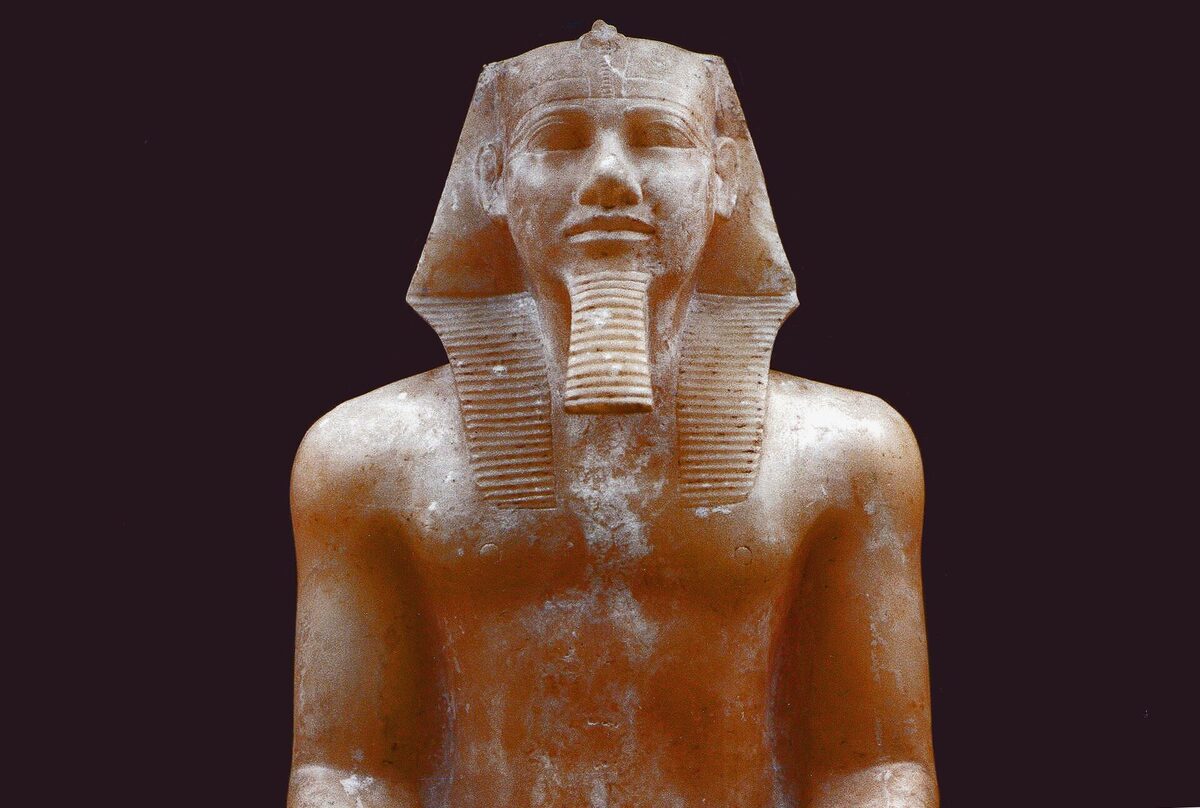
One understands nothing of the Old Kingdom if one neglects its religion. The pyramid itself is a religious object before being a technical challenge. Its form, pointed toward the sky, evokes the rays of the sun or the primordial mound that emerged from chaos at the origins of the world. The deceased pharaoh was, according to belief, to join the gods and continue to watch over the country from the beyond. To build an eternal tomb was to guarantee this survival and, through it, the permanence of the entire cosmic order.
Over the course of the Old Kingdom, the solar god Ra took on growing importance. His great sanctuary at Heliopolis became a major theological centre, and the pharaohs multiplied their marks of devotion toward the daytime star. From the Fifth Dynasty, the kings adopted in their titulary the title "son of Ra", thus inscribing their kingship in a directly solar lineage. The sun, which rises, dies and is reborn each day, offered a perfect model for thinking about the death and resurrection of the king.
The funerary cult did not end with burial. Around each royal pyramid was organised a complex comprising a valley temple linked by a causeway to a high temple, where priests ensured in perpetuity the offerings intended for the deceased king. Whole agricultural estates were assigned to the upkeep of this cult, whose revenues escaped in part the central administration. This seemingly trivial detail would have, as we shall see, heavy consequences: the multiplication of these pious foundations immobilised considerable resources.
Toward the end of the Old Kingdom the Pyramid Texts appeared, carved on the walls of the royal burial chambers from the Fifth Dynasty onward. These are the oldest monumental religious texts of humanity. Formulae, incantations and prayers guide the king on his journey toward the stars and the sun. These texts offer us rare access to the religious thought of the time, to its fears and its hopes in the face of death, and bear witness to a theological elaboration of great richness.
It is worth recalling that these texts were, at first, a strictly royal privilege. Only the king could hope, by means of these formulae, to navigate the dangers of the afterlife and join the imperishable stars. This monopoly on eternity is itself revealing of the political order: at the height of the Old Kingdom, even the beyond was structured around the singular destiny of the pharaoh. It is only later, well after the period that concerns us here, that comparable funerary texts would spread to officials and then, gradually, to a far broader segment of society, in a kind of slow democratisation of access to the hereafter.
Religion thus structured the whole of society, from top to bottom. It legitimised the king's power, justified the effort of the building sites, ordered the calendar of festivals and offerings. It also gave meaning to the immense human and material expenditure devoted to the tombs: pyramids were built not out of vanity but because the king's survival in the beyond conditioned, it was believed, the prosperity of the entire country, the regularity of the floods and the fertility of the land. To touch this edifice of beliefs was to risk undermining the entire order.
Mummification, whose techniques were perfected in the Old Kingdom, flowed directly from these beliefs. For the individual to survive in the beyond, his body had to be preserved, for it remained the support of his identity and the receptacle of the vital principles that the Egyptians distinguished under several names. So they learned to dry out the flesh, to remove the viscera, to wrap the body in bandages and to protect it with amulets. This extreme care given to the corpse makes sense only in relation to the conviction that another life awaited the deceased, provided everything was carried out according to the rites.
The apogee: the Fifth Dynasty
If the Fourth Dynasty is that of the greatest pyramids, the Fifth Dynasty represents in many ways the refined apogee of the Old Kingdom. Its pyramids are more modest, often less well built, but art reached a peak of finesse and culture enjoyed a remarkable flowering. The tomb reliefs became more delicate, more narrative, more lively. It was also at this time that the solar temples developed, vast complexes dedicated to the god Ra, which reflect the rise of the sun cult.
The shift of effort, from pyramidal mass toward decorative quality and the solar cult, is not insignificant. It reveals a kingship that no longer sought only to overwhelm through giganticism, but to radiate through sophistication. The high officials, for their part, had increasingly beautiful and autonomous tombs built, a sign that the administrative elite was gaining wealth and prestige. This movement, brilliant in appearance, already heralded a rebalancing of forces.
The Fifth Dynasty is also the era of great viziers and high dignitaries whose mastabas at Saqqara count among the masterpieces of Egyptian art. The scenes of daily life there reach an unequalled vividness: marshes teeming with birds, fishing scenes, markets, craftsmen at work, herds driven through the water. This artistic flowering bears witness to a society sure of itself, prosperous, whose elite had the means and the taste to afford a richly decorated eternity.
It is also under the Fifth Dynasty that the first Pyramid Texts appeared and that the solar titulary of the kings became fixed. Everything converges toward the image of a mature, balanced state at the height of its cultural and religious power. Arte's documentary captures this moment of plenitude well, when Egypt seems to have found a perfect formula: a divine king, an efficient administration, a powerful religion and a prosperous economy, all in the service of a single project of grandeur.
One may pause for a moment on the solar temples of the Fifth Dynasty, for they alone sum up the spirit of the age. Built not for a deceased king but for the god Ra himself, they were organised around a great massive obelisk set on a base, a symbol of the primordial mound and of the solar rays. An open-air altar there received the offerings in full daylight. For the first time, the cult of a cosmic deity rivalled, in investment and prestige, the funerary cult of the king. This theological shift, from honours paid to the king toward those paid to the sun, sketches in outline a kingship that henceforth thought of itself as the instrument of a god greater than itself.
But it is often at the summit that difficulties begin. Behind the brilliance of the Fifth Dynasty, deep-seated developments were silently at work in Egyptian society. The power that seemed absolute had to reckon with new forces. To understand the fall to come, we must now look more closely at these first cracks, still discreet but already perceptible to the historian's eye.
First cracks
No civilisation collapses overnight. The causes of the end of the Old Kingdom, which the documentary's second part will develop, have their roots in the golden age itself. The first of these fragilities lay in the gradual enrichment of the administrative elite. To reward its faithful, the king distributed land, titles and tax exemptions. Yet each domain granted, each funerary foundation exempted from tax, correspondingly reduced the resources directly controlled by the crown. Little by little, wealth slipped from the palace toward the great houses.
A second development, more political, concerns the provincial governors, the nomarchs. Originally simple officials appointed by the king and removable at his will, they tended over time to make their offices hereditary and to put down local roots. Their tombs, once grouped around the royal pyramid as if to remain in the protective shadow of the sovereign, began to flourish in the provinces, a sign of a growing attachment to the land and of an increasing autonomy. A true provincial aristocracy was being born.
To this is added the economic weight of the funerary cult. The multiplication of temples, pious foundations and estates assigned to the upkeep of the royal dead immobilised land and revenues in circuits that escaped in part the central administration. The older the Old Kingdom grew, the more these perpetual charges accumulated, like a religious debt that the living had constantly to honour toward the dead. The state found itself gradually burdened by its own piety.
The decrees of immunity found at certain sites illustrate this mechanism perfectly. By these acts, the king exempted a temple or a funerary foundation from taxes and corvées, thereby withdrawing its land and its dependants from the ordinary levies. Taken in isolation, each decree was merely a favour; accumulated over generations, they transferred a growing share of the country's wealth beyond the direct control of the crown. Royal generosity, which aimed to secure loyalties, ended up eroding the very foundations of the power it was meant to serve.
Finally, the very length of certain reigns may have played a role. The end of the Old Kingdom is marked by the exceptionally long reign of Pepi II, who is said to have ruled for many decades. So stretched-out a reign poses succession problems, weakens the renewal of the elites and gives time for centrifugal forces to settle in. When central power slackens, if only through weariness or ageing, the local counter-powers take advantage of it to assert themselves.
To these political and economic factors will be added, according to many researchers, an environmental cause: an episode of prolonged aridity, linked to regional climatic variations, which is thought to have reduced the Nile floods and provoked famines and disorders. But this disruption would only have precipitated a crisis already prepared by internal fragilities. Therein lies the whole interest of the diptych offered by Arte: to show first the apparent solidity of the system, the better to make us understand afterward how it could come undone. The first part sets the scene of grandeur; the second will recount its twilight.
What the documentary shows
The first part of "Egypt, the Fall of the Old Kingdom" succeeds in making tangible the grandeur of an era often reduced to its pyramids alone. Drawing on the major sites, Saqqara, Dahshur, Giza, and on the work of archaeologists, the film reconstructs the concrete functioning of this pharaonic state. The computer-generated images recreate the building sites, the ramps, the teams at work, giving flesh to processes that the ruins alone struggle to evoke.
The documentary takes care to demolish the most tenacious preconceptions. No, the pyramids were not built by enslaved people chained under the whip, but by an organised workforce, fed and housed. No, their construction does not stemstemThe narrowed base of a point, used to haft it onto a shaft or handle.→ from any supernatural mystery, but from patiently accumulated know-how and remarkable logistics. By refocusing the narrative on human organisation, the film restores to the Egyptians the authorship of their own genius, which a certain literature had sought to take from them.
Another merit of the documentary is to link architecture to politics. Each pyramid appears in it as the expression of a state of power: the step pyramid of Djoser marks the assertion of a new kingship; the giants of Giza celebrate the apogee of an all-powerful monarchy; the more modest pyramids of the Fifth and Sixth Dynasties reflect a subtle shift in the balances. Through the stone, it is the political history of the Old Kingdom that can be read.
The film gives a deserved place to the researchers and excavators themselves. One sees the patient work of field archaeology, the recording of inscriptions, the analysis of bones, the study of the graffiti left by the work teams. This dimension is precious: it reminds us that our knowledge of the Old Kingdom is not a fixed body of learning but a construction still in progress, fed by recent discoveries. Each season of excavation may qualify, complete or overturn what was thought to be settled, and it is this living inquiry that the documentary shows.
The film finally, in its closing sequences, begins the shift that will be the subject of the second part. It poses the questions that haunt historians: how could so powerful a civilisation sink? What share falls to men, what share to the climateClimateThe long-term average atmospheric conditions of a region; its variations (glaciations, aridifications) shaped migrations, agriculture and the collapse of prehistoric societies.→? By closing this first episode on the summit of the curve, the documentary installs an effective dramatic tension: we now know what will be lost, and we are eager to understand how. To explore the subject as a whole, one may consult our complete dossier on the Egyptian Old Kingdom.
Conclusion: before the fall
The Old Kingdom will remain in history as one of the summits of human civilisation. In five centuries, Egypt invented the monumental state, written administration, large-scale stone architecture and a royal theology of striking coherence. The pyramids are only the visible part of this edifice: behind them hide scribes, governors, priests, peasants and craftsmen, all caught in a single order willed by the pharaoh and guaranteed, it was believed, by the gods.
What strikes us, in hindsight, is the unity of this whole. Religion, politics, economy, art and architecture did not form separate domains but the faces of a single project of civilisation, ordered around the king and his survival. The pyramid condenses all this: it is at once tomb, religious symbol, economic enterprise and political manifesto. In it meet faith in the beyond, the power of the state and the technical genius of a people. It is no surprise that it became, for posterity, the very symbol of ancient Egypt.
This apogee was not, however, eternal. At the very moment when Egypt seemed to have reached a perfect balance, the forces that would undo it were already at work in silence: the enrichment of the elites, the rise of provincial powers, the weight of the funerary cults, the length of the reigns, and soon a less clement climate. The first part of Arte's documentary shows us the grandeur; it also prepares us, by small touches, to understand its end.
The rest of this story, the disintegration of royal authority, the fragmentation of the country, what Egyptologists call the First Intermediate PeriodFirst Intermediate PeriodA phase of political fragmentation in Egypt (c. 2181-2055 BC) between the Old and Middle Kingdoms: eclipse of royal power, autonomy of nomarchs, Herakleopolis-Thebes rivalry.→, is the subject of the second episode. We will analyse it in our companion article devoted to the fall of the Old Kingdom. For now, let us keep the essential in mind: before it fell, the Egypt of the Old Kingdom shone with a brilliance that four thousand five hundred years have not sufficed to extinguish, and of which the pyramids of Giza remain, on the desert horizon, the most dazzling testimony.
Le côté gestion de ressources et déplacements de la préhistoire m'intéresse particulièrement.
J'ai partagé cet article avec mes amies du club de lecture. Nous en avons débattu deux heures.
J'ai regardé le documentaire Arte correspondant et ce premier épisode m'a passionné. Je ne savais pas que des changements climatiques avaient pu jouer un rôle dans la chute de l'Ancien Empire. Ca me fait penser aux questions qu'on se pose aujourd'hui sur notre propre civilisation face aux dérèglements climatiques. L'histoire se répète ?
Ce premier volet sur la chute de l'Ancien Empire aborde la question du rôle du changement climatique, notamment une sécheresse prolongée qui aurait fragilisé l'agriculture et donc le pouvoir royal. La connexion entre le Nil et le pouvoir du pharaon est fondamentale : sans crues régulières, pas de récoltes, pas d'impots, pas de pyramides. L'environnement est toujours au coeur de l'histoire.