How could a state that had raised the pyramids, levied armies, organised expeditions to Sinai and Nubia, and administered a territory stretching a thousand kilometres along a river, fall apart within a few decades? The first instalment of this Arte documentary series1, which we discussed in our article on the political dimension of the collapse, asked the question of power: the wearing-out of institutions, the interminable reign of Pepi II, the entrenchment of the provincial governors. This second instalment shifts the gaze. It leaves the corridors of the palaces to venture into sediment cores, flood levels carved on stone, isotopic analyses of distant stalagmites. It poses a question of an entirely different nature: what if the sky, more than men, sealed the fate of the Old KingdomOld KingdomThe first great period of unified pharaonic Egypt (c. 2700-2200 BC, 3rd-6th Dynasties), the golden age of the great pyramids and of a strongly centralised state.→?
At the heart of this account lies an event geologists eventually gave an almost technical name: the 4.2-kiloyear climateClimateThe long-term average atmospheric conditions of a region; its variations (glaciations, aridifications) shaped migrations, agriculture and the collapse of prehistoric societies.→ event, that is, the great aridification that occurred about 4,200 years ago, around 2200 BC. This episode, long suspected and then gradually documented, coincides in a disturbing way with a series of upheavals across the ancient world: the collapse of the Akkadian Empire in Mesopotamia, the crisis of the cities of the Indus Valley, disruptions in NeolithicNeolithicThe "New Stone Age": a period marked by farming, herding, settlement and pottery, from around 10,000 BC.→ China, and, in Egypt, the end of the Old Kingdom and the opening of a long parenthesis of disorder that Egyptologists call the First Intermediate Period. This documentary tells how Egypt, that gift of the Nile in Herodotus's phrase, saw its life-giving river falter, its granaries empty and its cosmic order overturned: a maat, the harmony willed by the gods, suddenly inverted into chaos.
What follows is not a mere summary of the film. It is a companion article, conceived to extend the viewing: to set the images in their scientific context, cite the sources, and distinguish established fact from what remains debated. For the climate thesis, attractive in its simplicity, is no dogma. It stands against, or rather combines with, a political and social reading that is just as solid. Our guiding thread will therefore be twofold: to understand the mechanics of the collapse, and to understand how researchers themselves debate its causes.
Before getting to the heart of the matter, a word is needed on the very nature of what we are studying. To speak of "collapse" assumes agreement on the word. For some scholars, collapse means the rapid and lasting disappearance of a level of social complexity: less administration, less hierarchy, less long-distance exchange, fewer monuments. For others, the term is too dramatic and masks continuities: the population did not vanish, villages persisted, language and religion endured. Egypt at the end of the third millennium illustrates this ambiguity perfectly: the central state did disintegrate, but Egyptian civilisation itself survived and even renewed itself. Keeping this distinction in mind avoids many misunderstandings.
The documentary, by its very form, blends reconstructions, expert interviews and shots of present-day desert and Nile landscapes. These images have an obvious pedagogical virtue, but they can also mislead if one forgets that they illustrate hypotheses, not certainties. Our role in this article is precisely to sort things out: to flag what the film asserts, what it suggests, and what current research can actually support. Only at this price does the pleasure of viewing combine with a critical understanding.
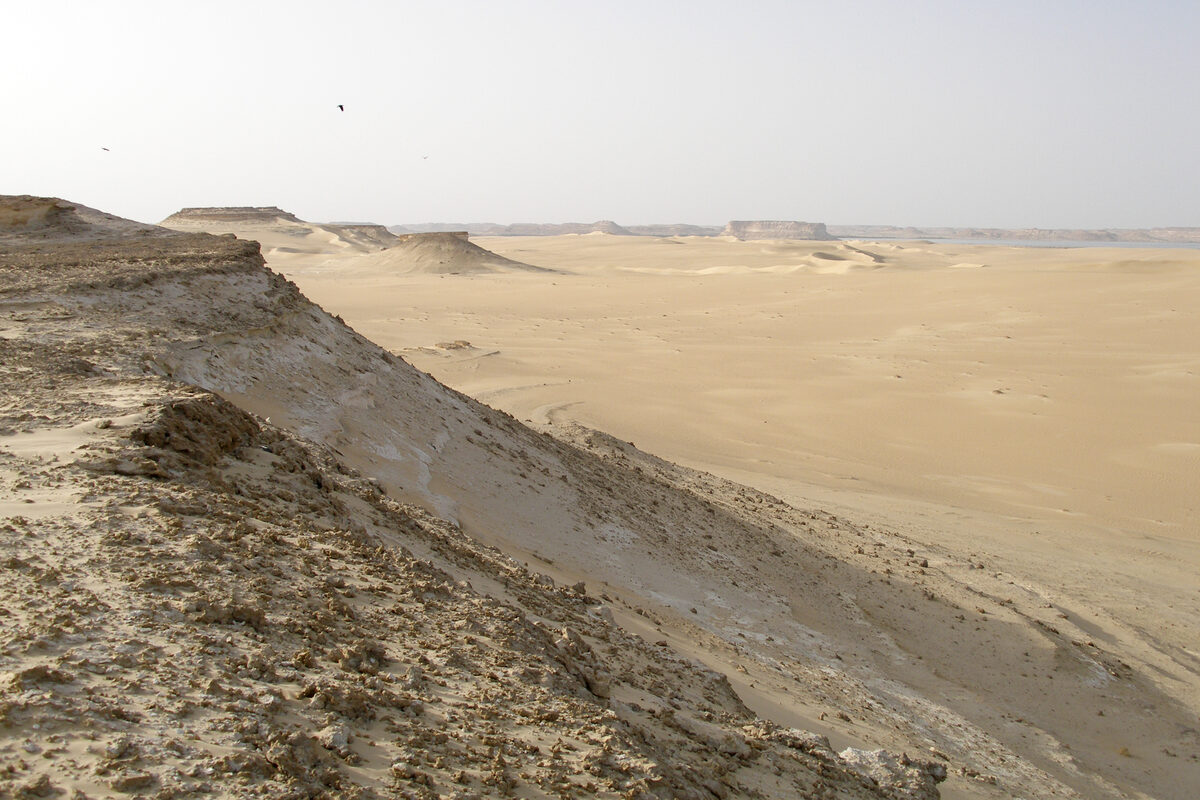
Egypt on the brink of collapse
To grasp the scale of the fall, one must first measure the height from which Egypt fell. The Old Kingdom, running roughly from the Third to the Sixth Dynasty (c. 2700 to 2180 BC), is one of the summits of human civilisation in the third millennium. It is the age of the great pyramids of Giza, raised under the Fourth Dynasty; the age of the refined funerary complexes of Saqqara; the age of a centralised administration able to mobilise tens of thousands of workers, keep records, redistribute harvests and impose the pharaohPharaohThe title of the ruler of ancient Egypt, regarded as a living god guaranteeing cosmic order (Maat), supreme head of state, army and worship.→'s will from Memphis to the far reaches of Upper Egypt.
This power rested on an implicit pact: the pharaoh, son of the gods, guaranteed the regularity of the world. By his mere presence and his rites, he ensured that the sun would rise, that maat would reign and, above all, that the Nile would rise each summer. For everything in Egypt depended on the flood. Each year, around the month of June, the monsoon rains falling on the high plateaus of Ethiopia swelled the Blue Nile; the river overflowed, covered the plains with a black, fertile silt, then withdrew, leaving a soil saturated with water and nutrients. A good flood meant abundance; too weak a flood foretold famine; too strong a flood swept away dykes and villages. Egyptian agricultureAgricultureThe cultivation of plants and production of food by working the soil, which emerged in the Neolithic in the Near East and independently elsewhere; it radically transformed human societies.→, and therefore society as a whole, hung on this hydraulic thread.
One must fully measure what this dependence on the river represented. Unlike Mesopotamia, where irrigation relied on a complex network of canals to maintain constantly, Egypt enjoyed a natural irrigation of almost miraculous simplicity: the flood came on its own, each year, to deposit its silt. This hydraulic comfort had a flip side: Egyptian society had been built entirely on trust in the regularity of the Nile. It had little room for manoeuvre should that regularity break. Granaries could cushion one or two bad years, in keeping with the late biblical tale of the seven fat cows and the seven lean cows; but a prolonged succession of deficient floods exceeded any storage capacity. The system was optimised for abundance, not for lasting scarcity.
To this hydraulic vulnerability was added a geographical peculiarity. Habitable Egypt was only a long green ribbon squeezed between two deserts, sometimes barely a few kilometres wide. There was no agricultural hinterland to fall back on in case of a bad harvest: beyond the cultivation limit the sterile desert began at once. This extreme concentration of life on a narrow river strip, which made Egypt's strength in normal times, became a trap in time of crisis. When the flood receded, it was not a margin that was lost, but the very heart of the food-producing land.
Now, at the end of the Sixth Dynasty, several faults converged. The interminable reign of Pepi II, said by ancient sources to have lasted nearly ninety-four years, had let central power weaken and the provincial governors, the nomarchs, take local root. Offices became hereditary; the provinces, the nomes, acquired their own militias, their own granaries, their own prestige. The grandeur of the Old Kingdom thus rested on an increasingly unbalanced edifice: a sumptuous royal façade, but provincial foundations that gradually captured the resources and the loyalty of men.
It is upon this already precarious balance that, according to the thesis defended in the documentary, a shock from the climate would fall. A robust society might perhaps have absorbed a few bad years; a society whose institutions were already undermined by decentralisation and routine was, by contrast, particularly vulnerable. A collapse is never the product of a single cause: it is the meeting of a fragility and a trigger. The documentary sets out precisely to show this point of junction.
The 4.2-kiloyear climate event
The term may seem dry, but it designates one of the best-studied climatic episodes of the HoloceneHoloceneThe current geological epoch, begun about 11,700 years ago at the end of the last ice age; the setting of all post-glacial history.→, the interglacial period in which we have lived since the end of the last ice age. The 4.2-kiloyear event4.2-kiloyear eventAn abrupt climatic aridification around 2200 BC (~4,200 years ago), marked by prolonged droughts; it marks the start of the Meghalayan Age of the Holocene.→ refers to a phase of abrupt and global aridification that occurred about 4,200 years ago, that is, around 2200 BC. Its importance is such that the International Commission on StratigraphyStratigraphyThe study of the superimposed layers (strata) of an archaeological site; each layer corresponds to a phase of occupation and yields a relative chronology.→ adopted it, in 2018, as the geological marker for the start of a new age of the Holocene, named the Meghalayan, after an Indian stalagmiteStalagmiteA calcite formation rising from a cave floor by drip-by-drip deposition; its slow growth allows precise dating.→ whose layers record this shift (see [2]).
What does this mean concretely? A change in atmospheric circulation that, over several centuries but with a core of intensity around 2200 BC, weakened the monsoon rains and dried out vast regions in a band running from the Mediterranean basin through the Near EastNear EastA region of western Asia (Levant, Mesopotamia, Anatolia, Iran), cradle of the Neolithic revolution, agriculture, the first cities and writing.→ to South Asia. The evidence is plentiful. Sediment cores taken from lake beds show falling water levels; pollen analyses reveal a retreat of vegetation; cave formations, stalagmites and stalactites, record in their successive layers the isotopic signature of drier years. In the Gulf of Oman, marine cores have yielded wind-borne dust attesting to increased aridity over the Arabian Peninsula and Mesopotamia. This bundle of evidence, accumulated since the 1990s, has turned an intuition into a substantiated hypothesis.
What is striking is the apparent synchrony of the crises. In the same period, the Akkadian Empire, the first empire in Mesopotamian history, collapses; an Akkadian text, the Curse of Akkad, describes fields that no longer yield, famine and divine punishment. The cities of the Indus civilisationIndus CivilisationA major Bronze Age urban civilisation (c. 2600-1900 BC) across present-day Pakistan and north-west India: planned cities (Harappa, Mohenjo-daro), standardised bricks, undeciphered script, no monumental palaces.→ decline. In Egypt, the Old Kingdom topples. This concordance has fed the idea of a mega-climatic event with planetary consequences, a kind of tipping point of the third millennium. The Arte documentary aligns with this reading: it proposes to see, behind the Egyptian fall, the same invisible hand that struck Akkad and the Indus.
How do palaeoclimatologists manage to read a climate four thousand years old? The tools are remarkably ingenious. Stalagmites, which grow drop by drop in caves, trap in their calcite variations in oxygen isotopes that reflect rainfall: one layer corresponds to a season, almost to a mineral calendar. Lake cores, taken from sediments accumulated at the bottom of lakes, preserve pollen, micro-organisms and particles that trace the history of regional vegetation and humidity. Marine cores, finally, record the dust carried by wind from dried-out lands. By cross-checking these archives, researchers reconstruct, year by year or decade by decade, the climatic pulse of the past.
The case of the Mawmluh stalagmite, in north-eastern India, has become emblematic. It is in its layers that the geological community chose to fix the official marker of the Meghalayan Age. This decision, taken in 2018, does not mean that everything changed overnight everywhere on the planet: it simply recognises that an aridification signal is clear and widespread enough to serve as a marker in the geological timescale. It is a scientific convention, grounded in data, but also a choice that simplifies a more nuanced reality. The climate knows no boundaries as sharp as our classifications.
One nuance must nevertheless be introduced here, to which we shall return. The 4.2-kiloyear event was neither everywhere simultaneous nor of equal intensity. Its precise dating, its regional extent and even its exact nature are still debated among palaeoclimatologists. Some see in it a clear global signal; others stress that local archives tellTellAn artificial mound formed by the accumulation of successive layers of settlement remains at the same spot, typical of the Near East. Each destruction-rebuilding event adds a stratum.→ divergent stories, and that one must beware of imposing a single scheme on contrasting realities. This caution does not ruin the climate thesis: it forces it to become more refined.
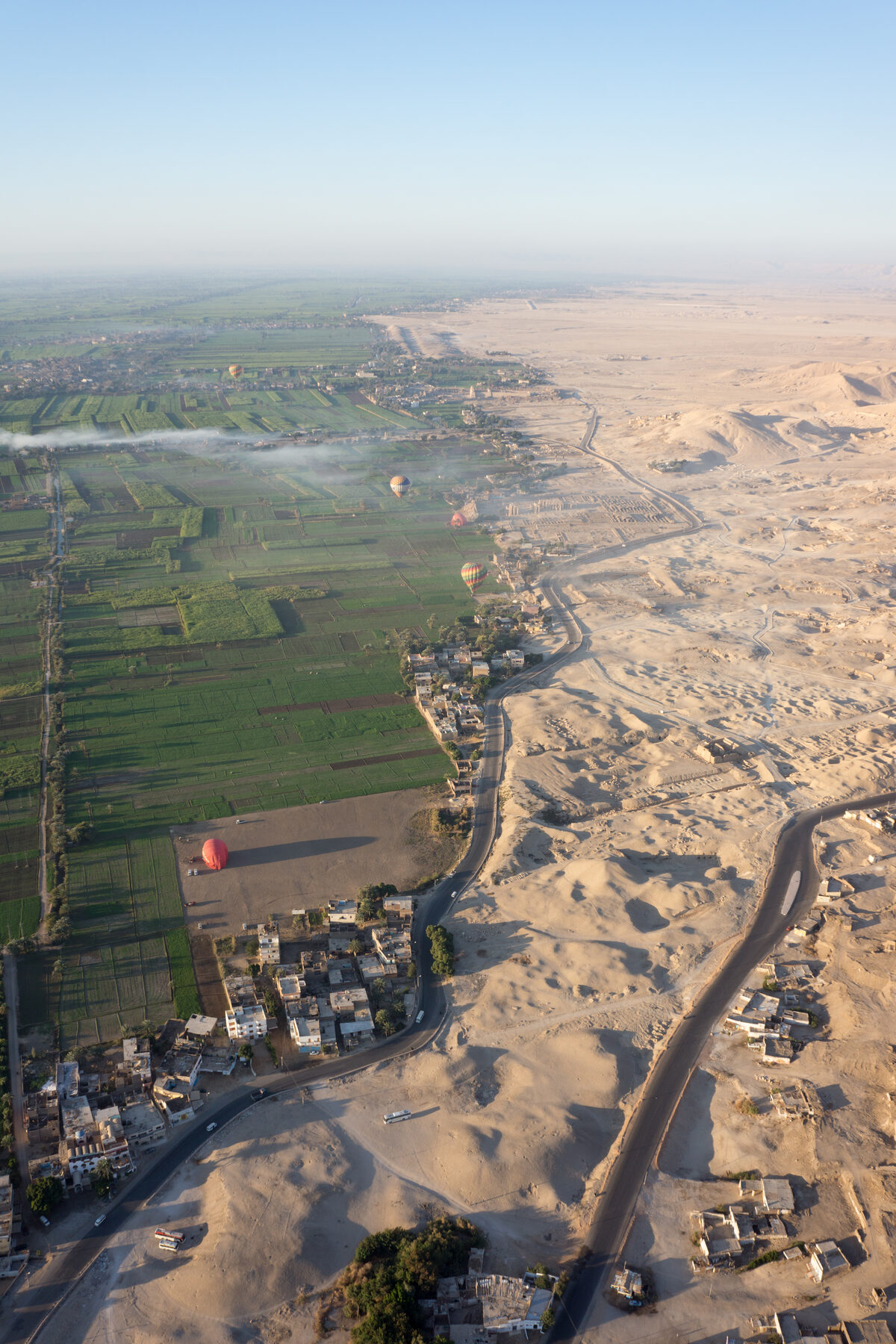
Drought, famine and a faltering Nile
In Egypt, the climate event translated into a phenomenon whose consequences were immediately legible: the weakening of the Nile floods. The Egyptian river draws most of its summer flow from the monsoon rains that fall on the Ethiopian highlands. If the monsoon weakens, the Blue Nile fills less, and the great annual flood, on which all agriculture rested, becomes mediocre. Several years of low floods in a row, and the spectre of famine rises over the valley.
The proofs of this hydraulic failure are both geological and textual. On the side of the natural archives, researchers have studied the sediments of the delta and the levels of lakes such as the Faiyum, which record variations in the river regime. Further upstream, analyses of Nile sediments and wind-borne deposits confirm a phase of increased aridity at the turn of the third millennium. On the side of Egyptian sources, it is the autobiographical inscriptions of provincial notables that speak. Several governors of the late Old Kingdom and the early First Intermediate Period boast, in their tombs, of having fed their people during the years of scarcity, of having opened their granaries, of having dug canals to save the harvests. One reads, for example, formulas such as "I gave bread to the hungry" or "no one died of hunger in my nome".
These protestations are precious, but they must be handled with care. Boasting of one's generosity in the face of famine was a convention of funerary autobiography, a way of presenting oneself as a good administrator, true to maat. The very fact that this theme becomes recurrent at this period nonetheless suggests that scarcity was a tangible reality, and not a mere rhetorical ornament: one glorifies oneself for having defeated hunger only if hunger truly threatens. The frequency of these formulas, their insistence, sketch in negative the portrait of a valley where granaries were emptying and where survival became the central stake of local power.
Famine, in ancient Egypt, was not only a material catastrophe: it was an ideological earthquake. If the Nile no longer rose, it was because maat was broken, and therefore the pharaoh was no longer fulfilling his cosmic function. The king drew his legitimacy from his capacity to guarantee the order of the world; a faltering river was, in a sense, an indictment of the throne itself. One then understands how a climate crisis could turn into a political crisis: by sapping the flood, the climate sapped the very foundation of royal authority. The pharaoh, guarantor of abundance, became, in the eyes of the starving, the one responsible for the shortage.
One can sketch the chain of mechanisms linking climate to crisis. A weakened monsoon caused low floods; low floods reduced the inundated areas, and thus the cultivable areas; meagre harvests emptied the granaries; empty granaries starved the population; a starving population fled, revolted or died; demographic decline and social disorder deprived the state of hands and resources; the weakened state could no longer maintain the dykes or redistribute food, which further worsened the agricultural crisis. This chain, which specialists sometimes call a negative feedback loop, turned a passing climatic hazard into a spiral of collapse. Once set in motion, the dynamic fed on itself.
A major difficulty remains for the historian: Egyptian sources never date their famines with the precision of a modern hydrological reading. The inscriptions evoke "years of misery" without always specifying which ones, and the absolute chronology of the end of the Old Kingdom remains uncertain by several decades. It is therefore awkward to make a drought peak identified in a sediment core coincide exactly with a famine episode mentioned in a tomb. This chronological imprecision is one of the knots of the debate: it leaves a margin of interpretation into which competing hypotheses rush.
The Papyrus Ipuwer
No document embodies this overturning of the world better than the famous Papyrus IpuwerFirst Intermediate PeriodA phase of political fragmentation in Egypt (c. 2181-2055 BC) between the Old and Middle Kingdoms: eclipseEclipseThe passing of one celestial body into the shadow of another, for instance the Moon hiding the Sun or the Earth casting its shadow on the Moon.→ of royal power, autonomy of nomarchs, Herakleopolis-Thebes rivalry.→, more exactly the Admonitions of Ipuwer, which the documentary makes one of its high points. This literary text, preserved on a papyrus called Papyrus Leiden I 344, has reached us in a New Kingdom copy, but its composition is generally dated to an earlier time, and many commentators see in it the echo of the First Intermediate Period or of the disorder that followed the Old Kingdom (see [3]).
The papyrus stages a sage named Ipuwer who deplores, in a long lamentation, the collapse of the established order. The world there is described as turned upside down. The rich have become poor and the poor have seized the goods of the rich; servants command and masters obey; the river is blood, or rather it no longer brings the expected water; the dead no longer receive a worthy burialBurialThe intentional deposition of a body, sometimes with offerings; a marker of symbolic behaviour.→; the archives are scattered, the laws trampled. "Behold, that which had never been seen has come to pass," the text repeats. It is the vision of a total social collapse, in which all hierarchies have been inverted and chaos has replaced maat.
One must resist the temptation to read the Papyrus Ipuwer as a report. It is not a chronicle of events, but a literary work, belonging to a genre Egyptologists call the literature of lamentations or of pessimism. This genre cultivated the picture of disorder, often the better to exalt, by contrast, the return of order guaranteed by a strong king. The description of chaos is therefore partly rhetorical, conventional, deliberately exaggerated. One cannot mechanically deduce from it that this or that scene actually took place.
For all that, the text is not pure invention detached from reality. It draws its force from a collective memory of disaster. For an Egyptian audience to understand and dread this picture, the idea of a world overturned by famine and civil war had to be anchored in experience. The Papyrus Ipuwer thus works as a cultural seismograph: it records, in a stylised form, the trauma of an era when the state had collapsed, when the Nile had betrayed and when survival had prevailed over order. The documentary rightly uses it as a voice from the past, provided one recalls that it is a literary voice, and not a transcript. It is precisely this ambiguity that makes it a fascinating document: between testimony and fiction, it tells the truth of an anguish more than the precision of a fact.
The eclipse of central power
While the climate dried out the valley, royal power itself was diluting. After the death of Pepi II, Egypt experienced a succession of brief and obscure reigns, grouped by tradition under the Seventh and Eighth Dynasties. The famous priest-historian Manetho, who much later compiled a list of the dynasties, summed up this period in a phrase that has remained famous: seventy kings in seventy days. The phrase is doubtless exaggerated, but it conveys the idea of extreme instability at the top of the state, of a waltz of sovereigns incapable of holding the country together.
Several factors contributed to this eclipse. First, the administrative machine that made the strength of the Old Kingdom had seized up. Centralisation rested on the capacity of the palace of Memphis to collect resources, redistribute them, appoint and control officials. When the harvests collapse, this system of redistribution breaks down: there is no longer enough to redistribute, and each province has an interest in keeping for itself what it produces. The centre, deprived of its food-providing function, loses its usefulness and its authority.
Next, offices had become hereditary. The governors no longer really depended on the king for their position; they passed it on to their sons, forming genuine local dynasties. The personal bond of loyalty that once tied the official to his sovereign had loosened in favour of an attachment to the land and the lineage. Finally, the very legitimacy of the pharaoh, as we have seen, was undermined by the failure of the flood. A king unable to guarantee abundance was a king weakened in his sacred essence.
The result was a slow evaporation of central power. Memphis did not disappear overnight, but it gradually ceased to truly command the country. Royal orders carried less and less far; the great royal works were interrupted; the pyramids, those gigantic affirmations of the throne's power, were no longer built, or only in a stunted form. The pharaonic state, without crumbling in a spectacular crash, was being drained of its substance. This is one of the subtlest lessons of the documentary: a collapse is not always a sudden fall; it can be a silent erosion, a disintegration by which institutions lose their capacity to act even before they cease to exist.
The rise of the nomarchs
As the centre faded, the provinces rose. The nomarchsNomarchThe governor of a province (nome) of ancient Egypt; first appointed by the pharaoh, the nomarch became a hereditary, autonomous dignitary rivalling central power at the end of the Old Kingdom.→, those governors of nomes once mere relays of the royal will, became the true masters of the real country. The phenomenon was not new: as early as the Sixth Dynasty, under Pepi II, provincial autonomy had increased. But the crisis at the end of the Old Kingdom gave it decisive scope. Deprived of the arbitration and support of the centre, the provinces turned in on themselves and organised to survive.
This rise to power is admirably documented by the funerary inscriptions of the nomarchs themselves. In their tombs, dug no longer in the shadow of the royal pyramids but in the cliffs of their own province, these dignitaries had themselves commemorated for their own merits. They present themselves as protectors of their people, organisers of irrigation, builders of granaries, sometimes war chiefs leading their troops against neighbouring nomes. The tone changes: it is no longer the service of the king that makes a man's glory, but his capacity to ensure the survival and prosperity of his community. A nomarch of Asyut, another of Mo'alla, boast of having fed the hungry of neighbouring provinces, a sign both of a regional famine and of a rivalry between local poles.
We thus witness a genuine feudalisation of Egypt, if one accepts to use that term with caution. The territory fragments into de facto principalities, each endowed with its resources, its militia, its administration, its cult. The nomarchs maintain complex relations made of alliances, marriages, and open conflicts over the control of water and land. Far from being mere anarchy, this period sees the emergence of a new, decentralised order, in which real power lodges in the provinces. Some nomes even prosper, taking advantage of their autonomy to develop an original local art, workshops, regional styles that break with the rigid perfection of Memphite art.
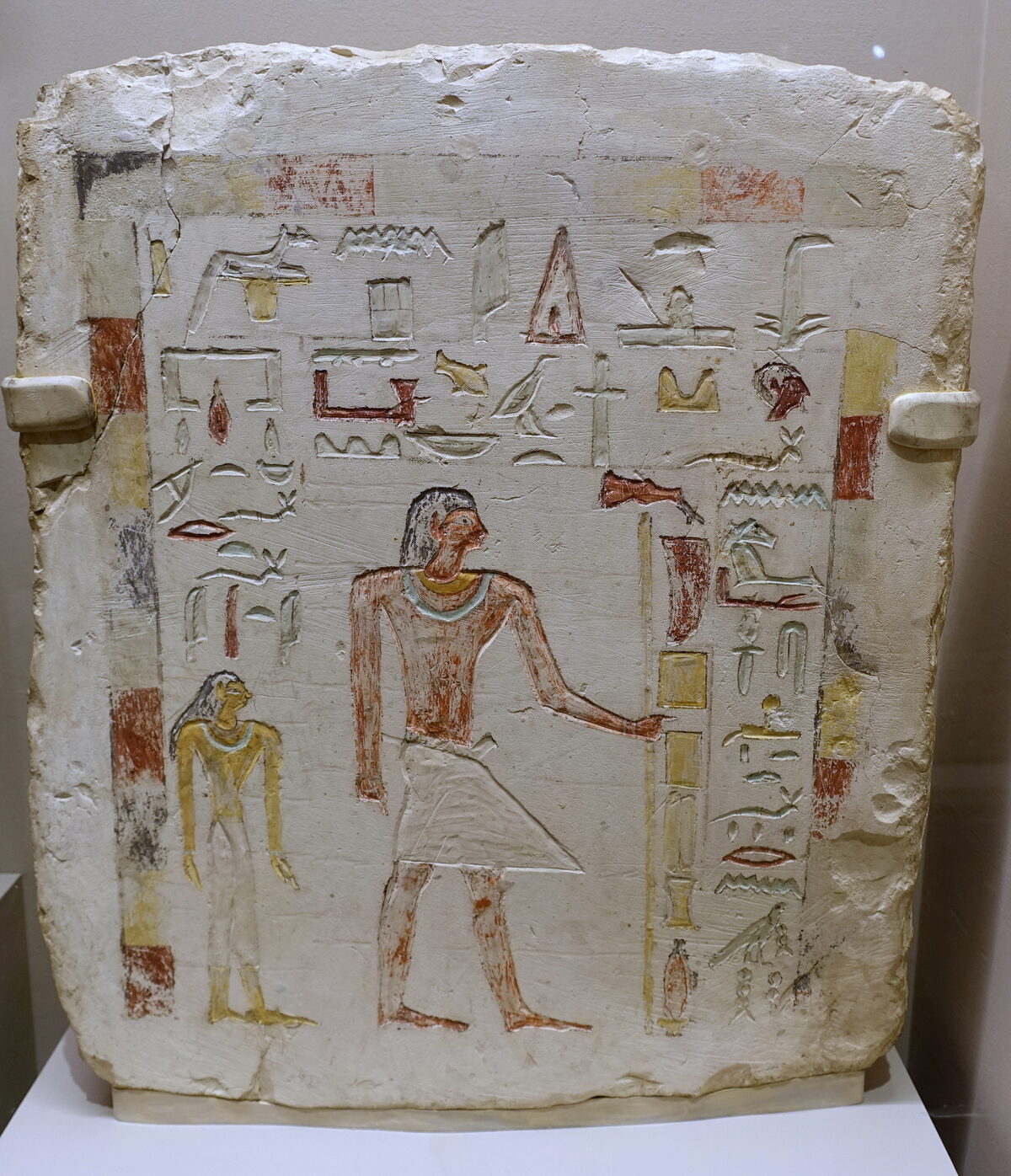
Archaeology confirms and nuances this picture. In several provinces of Upper and Middle Egypt, the provincial necropolises develop considerably at this time. The necropolisesNecropolisA large organised burial ground, a "city of the dead", often spanning several periods.→ of local notables, once discreet against the overwhelming centrality of the royal cemeteries of Memphis, gain in size, in richness, in originality. There one finds rock-cut tombs adorned with scenes of daily life, painted stelae, scale models of granaries, boats and workshops, deposited as offerings. These objects inform us both about the growing status of the nomarchs and about the concerns of a society turned towards subsistence and security.
The artistic style itself transforms. Far from the rigorous and perfectly mastered canons of Memphite art, the provincial workshops develop freer manners, sometimes judged clumsy by classical eyes, but which attest to a local vitality and an emancipation from the royal model. Proportions lengthen, colours assert themselves, inscriptions become more personal. This stylistic diversification is, in its way, a political clue: it signals that power and prestige no longer radiated from a single centre, but took root in a mosaic of regional hearths.
This decentralisation is therefore not only a loss: it is also a recomposition. The faltering flood and the eclipse of the king released provincial energies that centralisation had contained. It is in these local hearths that the unity of Egypt would, in time, be rebuilt. For among all these rival poles, two finally come to dominate: in the north, Herakleopolis, which claims to embody royal continuity; in the south, Thebes, a hitherto secondary town that rises to the rank of an emerging power. Their confrontation would structure the First Intermediate Period.
The First Intermediate Period
Egyptologists call First Intermediate PeriodFirst Intermediate PeriodA phase of political fragmentation in Egypt (c. 2181-2055 BC) between the Old and Middle Kingdoms: eclipse of royal power, autonomy of nomarchs, Herakleopolis-Thebes rivalry.→ the phase of political fragmentation that separates the Old Kingdom from the Middle Kingdom, that is, roughly from 2181 to 2055 BC. The term "intermediate" reflects the retrospective gaze of historians: these periods are defined by contrast with the great unified empires that frame them. They correspond to moments when Egypt is no longer governed by a single central power, but split among several rival authorities.
Concretely, after the exhaustion of the ephemeral Seventh and Eighth Memphite Dynasties, two competing royal houses impose themselves. At Herakleopolis, in Middle Egypt, a line establishes itself that tradition groups under the Ninth and Tenth Dynasties; it claims the Memphite heritage and controls the north of the country. At Thebes, in Upper Egypt, another line emerges, the Eleventh Dynasty, which gradually extends its grip over the south. Between these two poles opens a long period of tensions, punctuated by clashes for control of the pivotal zone of Middle Egypt, notably around the province of Asyut, which swings now to one side, now to the other.
It would be wrong, however, to reduce this period to mere chaos. If political power is fragmented, life goes on: people cultivate, trade, bury their dead, produce works. Better still, some historians see in it a period of creativity and relative democratisation. Funerary culture, once reserved for the highest dignitaries gravitating around the king, spreads to broader layers of society. Men of modest condition now have stelae and tombs erected for themselves, appropriating formulas once royal. The Coffin Texts, which democratise the older Pyramid Texts once reserved for the pharaoh, attest to this spread of the sacred towards private individuals. The idea of an afterlife accessible to all, and no longer to the king alone, takes root during these troubled centuries.
The First Intermediate Period ends when the Theban house prevails. Around 2055 BC, the pharaoh Mentuhotep II, of the Eleventh Dynasty, manages to defeat Herakleopolis and reunify Egypt under his authority. This victory inaugurates the Middle Kingdom, a new era of centralisation and prosperity. But the Egypt that is reborn is no longer quite the same: the experience of collapse has left traces, in institutions as in mentalities. The kings of the Middle Kingdom would prove anxious to control the nomarchs, and the literature of this era would long meditate on the fragility of order, on the duty of the king and on the memory of past chaos. The collapse did not only destroy: it also forged a new awareness.
Climate or politics: the debate
Here we are at the heart of the controversy that this documentary does not conceal. Should the fall of the Old Kingdom be attributed to drought, hence to the climate, or to the internal dynamics of Egyptian power, hence to politics? The question divides specialists, and it is worth setting out honestly the arguments of each camp.
The proponents of the climate thesis, often from the Earth sciences, emphasise the concordance of the natural archives and the synchrony of crises across the ancient world. If Egypt, Akkad and the Indus collapse at roughly the same time, around 2200 BC, it is tempting to see in it the mark of a common factor: the climate. The 4.2-kiloyear event offers a plausible mechanism: the weakening of the monsoons, the fall of the floods, famine, then social and political collapse. This reading has the merit of coherence and rests on measurable, quantifiable data, independent of written sources always suspect of bias.
Historians and Egyptologists, for their part, raise several objections. The first concerns chronology: the datings of the climate archives are sometimes imprecise, and the exact coincidence between the aridity peak and the precise moment of the Egyptian collapse is not always rigorously established. The second concerns causality: even if the drought occurred, it does not suffice to explain why society toppled. Other civilisations weathered droughts without collapsing; what matters is the resilience of institutions in the face of the shock. Now the Old Kingdom was already politically weakened, undermined by decentralisation and the wearing-out of power, even before the climate crisis. The climate would then have played the role of trigger, not of sole cause.
The third objection is more radical: some researchers contest the very scale of the 4.2-kiloyear event in Egypt. The Nilotic archives are less clear than one would wish, and the narrative of a catastrophic aridity would rest in part on too literal a reading of literary sources such as the Papyrus Ipuwer. By dint of seeking a great drought to explain the fall, one risks over-interpreting tenuous clues. The debate therefore remains open, and therein lies its richness.
A further argument deserves to be weighed: that of comparison. If the 4.2-kiloyear event had been a sufficient cause, one would expect all the societies exposed to aridification to have collapsed in the same way. Yet the trajectories diverge. Some regions experienced migrationsMigrationsLong-distance movements of populations; a major driver of human history (the exit from Africa, the peopling of continents, Neolithic and steppe expansions).→ and reorganisations rather than a collapse; others seem to have crossed the period without major rupture. This variability argues against a strict climatic determinism: the climate sets the frame, but it is societies, through their institutions, their choices and their capacity to adapt, that determine the outcome. Egypt did not passively undergo the climate; it reacted according to its own springs, and it is the weakness of those springs at the moment of the shock that explains the gravity of the crisis.
The most widely shared position today is a synthesis: neither all-climate nor all-politics, but a combination. The collapse of the Old Kingdom would result from the meeting of a structural vulnerability, of political and social origin, with an environmental stress of climatic origin. The climate did not create Egypt's fragility; it revealed and precipitated it. This is what is sometimes called a multifactorial causality: an already strained system, which gives way under the effect of a shock it might, in other circumstances, have absorbed. The documentary, by giving voice to diverse perspectives, honestly restores this complexity, and invites the viewer to beware of single explanations.
Lessons of a collapse
Why, more than four thousand years after the events, does the collapse of the Old Kingdom continue to speak to us? Because it raises questions that remain ours. It interrogates the resilience of complex societies in the face of environmental shocks, the fragility of centralised systems, the role of climate in human history. At a time when our own societies worry about climate disruption, the Egyptian example offers a disturbing precedent, to be handled, however, with caution.
The first lesson is that no civilisation, however powerful, is safe. Old Kingdom Egypt seemed eternal; its pyramids still defy time. Yet the political edifice that had raised them collapsed within a few decades. Monumental grandeur does not guarantee institutional solidity: a state can shine with all its lights while carrying within it the seeds of its own disintegration.
The second lesson concerns the role of slow and invisible factors. The decentralisation of the nomarchs, the heredity of offices, the erosion of royal legitimacy: so many underground processes that worked the Old Kingdom from within, long before the final crisis. Collapses do not fall from the sky; they ripen in structures, and the drought merely revealed a weakness already in place. To understand a crisis therefore requires looking beyond the triggering event, towards the accumulated fragilities.
The third lesson, perhaps the most precious, is a lesson of method. The history of the Old Kingdom shows how the natural sciences and the human sciences must converse to reconstruct the past. Sediment cores without texts, or texts without cores, give only a partial truth. It is the crossing of natural and written archives, of isotopic data and funerary inscriptions, that allows one to approach reality. The archaeology of climate, a young discipline, illustrates this fruitfulness of interdisciplinary dialogue, which extends to other terrains the methods of prehistoryPrehistoryThe span of human history before the invention of writingWritingA system of conventional signs used to fix language or information durably; its appearance (c. 3300 BC) marks, by convention, the end of prehistory.→, from the PalaeolithicPalaeolithicThe oldest and longest period of prehistory (c. 3.3 Ma–12,000 BC), defined by chipped stone tools and a hunter-gatherer way of life.→ to the Metal Ages, known mainly through material remains.→ and the archaeology of ancient societies.
Finally, the collapse of the Old Kingdom reminds us that endings are also beginnings. The First Intermediate Period, long described as a dark age, was also a period of recomposition, of creativity, of cultural diffusion. From its rubble was born a renewed Egypt, that of the Middle Kingdom. History is not a succession of peaks separated by voids; periods of crisis are themselves moments of transformation, in which the future is prepared.
Conclusion
The second instalment of this Arte series accomplishes a salutary shift: it brings the climate into the account of the fall of the Old Kingdom, without however making it the sole culprit. The 4.2-kiloyear event, that great aridification of the third millennium, did indeed weigh on Egypt's fate, by weakening the Nile floods, emptying the granaries, undermining the legitimacy of a pharaoh meant to guarantee abundance. But this climatic stress struck a society already weakened by decentralisation, the heredity of offices and the wearing-out of central power. The drought was the trigger; the institutional fragility, the ground. It is from their meeting that the catastrophe was born.
The Papyrus Ipuwer bequeathed us the anguished voice of an overturned world, where the rich became poor and the river betrayed. The inscriptions of the nomarchs showed us how, in the void left by the king, the provinces took their survival in hand. The First Intermediate Period, finally, taught us that a collapse is never an absolute end, but a passage: after the chaos came reunification, and Egypt was reborn, instructed by the ordeal.
For the curious viewer, this documentary is an invitation to think about complexity. It refuses simplistic explanations, whether climatic or political, preferring the crossing of causes and the plurality of perspectives. This is, at bottom, what science has most precious to offer us: not definitive certainties, but a method for honestly interrogating the past. And the collapse of the Old Kingdom, seen from this angle, ceases to be a mere antique curiosity to become a mirror held up to all societies that, like ours, wonder what makes them strong and what makes them fragile.
Le lien entre site, contexte géographique et époque est exactement ce que je cherche avant une visite.
La Première Période Intermédiaire qui suit l'Ancien Empire est une période souvent négligée dans la vulgarisation mais très riche pour comprendre la résilience des sociétés égyptiennes. Malgré les troubles politiques, la culture matérielle et les pratiques funéraires se poursuivent avec des adaptations locales intéressantes. La capacité de l'Egypte à se réunifier après ces crises est remarquable.
La chute de l'Ancien Empire reste l'une des grandes énigmes de l'histoire égyptienne. La deuxième partie de ce dossier Arte approfondit les facteurs politiques et économiques qui ont fragilisé le pouvoir central après la VI ème dynastique. La décentralisation progressive vers les nomarques locaux est un phénomène bien documenté dans les textes et l'archéologie.