Beneath the sands of Saqqara, in the shadow of the world's first stone pyramid, sleeps a figure the Egyptians placed just below the pharaohPharaohThe title of the ruler of ancient Egypt, regarded as a living god guaranteeing cosmic order (Maat), supreme head of state, army and worship.→ in the hierarchy of power: the vizier, the tjatyVizierThe highest official of the Egyptian state after the pharaoh (Egyptian "tjaty"): effectively a prime minister directing administration, justice, the treasury and public works in the king's name.→. The Arte documentary Egypt: The Mystery of the Vizier's Tomb follows, step by step, the opening and study of one of these monumental tombs, a mastaba whose walls recount, scene after scene, the intimate workings of one of the best-organised states of antiquity. Far from the gold of kings and spectacular mummies, what is laid out here is the administration of the Old KingdomOld KingdomThe first great period of unified pharaonic Egypt (c. 2700-2200 BC, 3rd-6th Dynasties), the golden age of the great pyramids and of a strongly centralised state.→, written in the detail of harvests, accounts, herds and official titles.
The film is no adventure story. It dwells on a quieter, more enduring substance: the gestures of a senior official, his functions, his subordinates, his relationship to the king and to the afterlife. By following the archaeologists who clear, photograph and decipher the walls, the viewer comes to understand that a vizier's tomb is not merely a house of eternity: it is a stone archive, a concentrate of administration frozen for the millennia. This companion article looks in depth at what the documentary shows and at what archaeology has learned, over more than a century, from the tombs of the great servants of the Egyptian state [1].
To grasp the stakes, one must first set the scene. We are at Saqqara, the vast necropolis of the ancient capital Memphis, and we go back to the Old Kingdom, that founding moment when Egypt invented the pharaonic state as we imagine it: a god-king, a pyramidal bureaucracy, colossal building sites, and a script placed at the service of power. The vizier is the keystone of this system. Without him, the administrative machine does not turn.
Saqqara, the necropolis of Memphis
Saqqara stretches along the west bank of the Nile, where the sun sets, in the direction the Egyptians associated with the realm of the dead. For more than three thousand years this desert plateau served as the cemetery of the neighbouring city of Memphis, Egypt's political capital for much of its history. It is one of the largest necropolisesNecropolisA large organised burialBurialThe intentional deposition of a body, sometimes with offerings; a marker of symbolic behaviour.→ ground, a "city of the dead", often spanning several periods.→ of the ancient world, and surely the most continuously used: people were buried here from the First Dynasty down to the Coptic period, through every great phase of pharaonic civilisation [3].
The monument that dominates the site is the Step PyramidStep pyramidEgypt's first great stone monument, raised for King Djoser at Saqqara by Imhotep (Third Dynasty), by stacking diminishing mastabas.→ of Djoser, raised around 2650 BCE by the architect Imhotep. It is the first great building of dressed stone in the history of humanity, the matrix from which the smooth pyramids of Giza would be born. Around it, for kilometres, stand the tombs of the courtiers, priests, scribes and high dignitaries who wished to rest in the protective shadow of their king. For at Saqqara, proximity to the royal pyramid is a privilege: to be buried near the sovereign is to prolong into death the bond of service that united the official to the throne during his life [1].
The Arte documentary recalls this spatial logic. The tombs of viziers are not scattered at random: they cluster in precise sectors, often as close as possible to the royal funerary complexes. This topography is itself a source for the historian. It maps power, where the distance to the king is measured in metres of sand and where the location of a mastaba betrays the rank of its owner. For archaeologists, to read Saqqara is to read the organisation chart of a vanished state.
The site has never ceased to yield finds. In the nineteenth century, the pioneers of Egyptology uncovered spectacular mastabas there, whose painted reliefs amazed Europe. Auguste Mariette identified the Serapeum, a vast catacomb where the Apis bulls were interred. More recently, missions continue to bring to light intact chambers, brightly coloured coffins and embalming workshops. Saqqara is not an exhausted site: it is a palimpsest, where each layer of sand covers another era, and where the ground surely still holds untouched tombs [3].
It is in this context that the film's inquiry must be placed. A vizier's tomb takes on a particular value here, because it belongs to that narrow elite that governed in the king's name. To understand this mastaba is to enter the workings of the Old Kingdom through its highest door.
The very name Saqqara probably derives from Sokar, the ancient funerary god of the Memphite region, deity of necropolises and of the subterranean darkness. This lineage is no trifle: it inscribes the site, from its origins, within a sacred geography. The plateau is not a mere empty plot chosen for convenience; it is a consecrated space, placed under the protection of the gods of the afterlife, where one comes to lay one's dead in order to bring them closer to the divine. The viziers who had themselves buried here sought both the proximity of the king and that of the powers of the beyond.
The documentary also recalls the extraordinary density of Saqqara's soil. Within a few square kilometres are superimposed thousands of tombs, galleries of sacred animals, temples and processional causeways. To dig at Saqqara is to excavate a matter saturated with history, where every stroke of the trowel risks touching an unknown burial. This saturation explains why the site continues, year after year, to deliver discoveries: it has never been, and never will be, entirely explored.
What is a vizier (tjaty)?
The word "vizier" comes to us from medieval Eastern languages, but by convention we use it to translate the Egyptian title tjaty. The tjaty is the highest official of the state after the pharaoh: a kind of prime minister, head of administration and chief justice rolled into one person. He concentrates powers that modern societies distribute among several ministries. To him fell the supervision of the Treasury, the granaries, the building sites, justice, the archives and, more broadly, everything that kept the machine of state running [2].
In Egyptian royal theology, the pharaoh is a living god, guarantor of the cosmic order, Maat. But a god cannot personally administer every granary of every province. The vizier is therefore the human relay of the royal will, the one through whom orders descend and reports rise. The texts describe him as "the eyes and ears of the king". He receives petitioners, arbitrates disputes, appoints and supervises officials, sets taxes, orders works. Nothing of importance is decided without his being informed [2].
The documentary stresses the breadth of these powers. A famous text, the "Installation of the Vizier", preserved in tombs of the New Kingdom but reflecting a far older tradition, enumerates his duties: to judge with equity, not to let himself be corrupted, to treat the weak as the powerful, to keep a record of everything. It is an idealised portrait of the servant of the state, but it says something real: the office demanded exemplary integrity, because it placed a single man at the summit of an immense human pyramid.
Under the Old Kingdom, the office of vizier is at first often entrusted to princes of the blood, sons or close relatives of the king. It is a way of keeping power within the royal family and of ensuring the loyalty of the second figure of the state. Then, across the dynasties, the office tends to open to men of more modest birth, whose careers rest on competence and loyalty rather than on blood. This evolution is itself a political indicator: it signals the gradual professionalisation of the administration, and sometimes too the emancipation of the great servants from the crown [2].
For the vizier embodies a permanent tension. He is the instrument of the king, but his power can become a threat. The more complex the state becomes, the more the tjaty weighs, and the blurrier the boundary between service and autonomy. At the end of the Old Kingdom, the weakening of central power was accompanied by a rise of the great officials and the provincial governors, who had themselves buried in their own domains with a splendour once reserved for the court. The vizier's tomb, by its magnificence, also tells that story: that of an administrative elite which, little by little, appropriates the signs of kingship.
The office of vizier also underwent, at certain periods, a telling duplication. As the country expanded and the administration grew more complex, power sometimes appointed one vizier for the South, Upper Egypt, and another for the North, Lower Egypt. This partition reflects the fundamental duality of Egypt, that double country born of the union of two kingdoms, and the concrete difficulty of governing from a single capital a territory stretched over nearly a thousand kilometres along the Nile. The vizier was no abstraction: he was the man who made possible, day after day, the unity of a geographically scattered land.
To grasp this office in its full scope, the best approach is to set it back within the whole system. The curious reader will find a complete panorama of this founding period in our feature on Old Kingdom Egypt, which places the vizierate within the long history of the pharaonic state.
The tomb and its architecture: the mastaba
The word mastabaMastabaAn early Egyptian flat-roofed tomb with sloping sides, the architectural ancestor of the pyramid.→ comes from Arabic and means "bench": it is the massive, low, trapezoidal shape that these tombs present when seen from outside. Originally, under the first dynasties, the mastaba is a simple mud-brick superstructure covering a pit. But under the Old Kingdom, for the great dignitaries, it becomes a carefully dressed stone building, fitted with chapels, corridors and decorated chambers. The vizier's tomb belongs to this elite category [1].
The architecture of a mastaba meets a twofold requirement: to protect the body and to nourish the spirit of the deceased. Two ensembles can therefore be distinguished. Deep below, under the mass, a vertical shaft descends to the burial chamber proper, where the sarcophagus rests. This part is sealed after the burial, meant to remain inviolate for eternity. At the surface and at the heart of the superstructure unfolds, by contrast, an accessible space: the chapels, where the family and the priests come to lay offerings and celebrate the funerary cult.
The heart of this arrangement is the "false door". Carved in stone, it depicts a door that no living person crosses, but through which the soul of the dead, the ka, is supposed to pass to come and consume the offerings placed before it. Around this false door are concentrated the most important inscriptions and reliefs: the name of the deceased, his titles, the list of provisions that must be brought to him. It is the point of contact between the world of the living and that of the dead, the place where the administrative machine that was the vizier's life prolongs itself into a kind of administration of the afterlife [2].
The Arte documentary highlights the patient work needed to understand this plan. The archaeologists record the orientation of the corridors, the position of the shafts, the layout of the chapels. Every detail has meaning. The orientation towards the west evokes the realm of the dead; the depth of the shaft protects the sarcophagus from plunderers; the arrangement of the rooms guides the circulation of priests and offerings. To read the architecture is already to read the funerary religion of the Old Kingdom.
The construction of such a monument mobilised considerable resources: quarrymen, stonecutters, draughtsmen, sculptors, painters. A vizier's mastaba is not the work of an isolated craftsman, but of an organised building site, a miniature reflection of the great royal works. The very fact that an official could command such a workforce tells his rank: he has access to the quarries, the workshops, the trades that only the state can set in motion. The tomb is thus, from its raw stone, a marker of power.
The decoration itself obeyed a telling economy of means. The areas most visited by the living, the entrance, the main chapel, the surroundings of the false door, received the most carefully worked reliefs, cut in sunk or low relief and then painted in vivid colours. More remote parts could make do with painting applied directly onto plaster, faster and cheaper. This hierarchy of decoration, which archaeologists can read, shows how the patron and his craftsmen concentrated effort where it mattered most, that is, where the eye and the cult would settle.
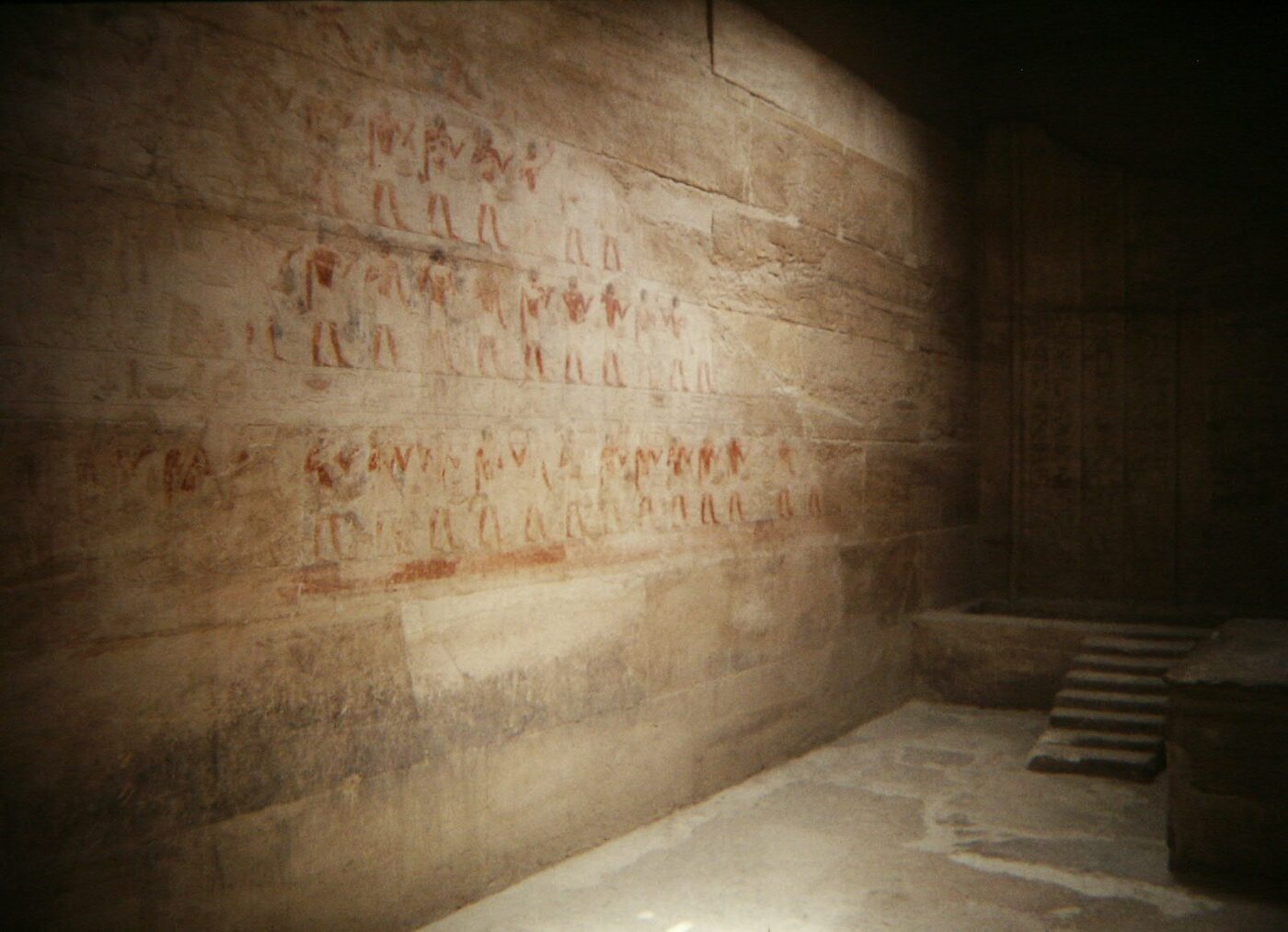
Inside, the walls are never left bare. They are entirely covered with reliefs below and paintings, organised in superimposed registers like stone comic strips. It is there, in these images, that the tomb delivers its most precious treasure for the historian: not gold, but information.
The scenes of daily life
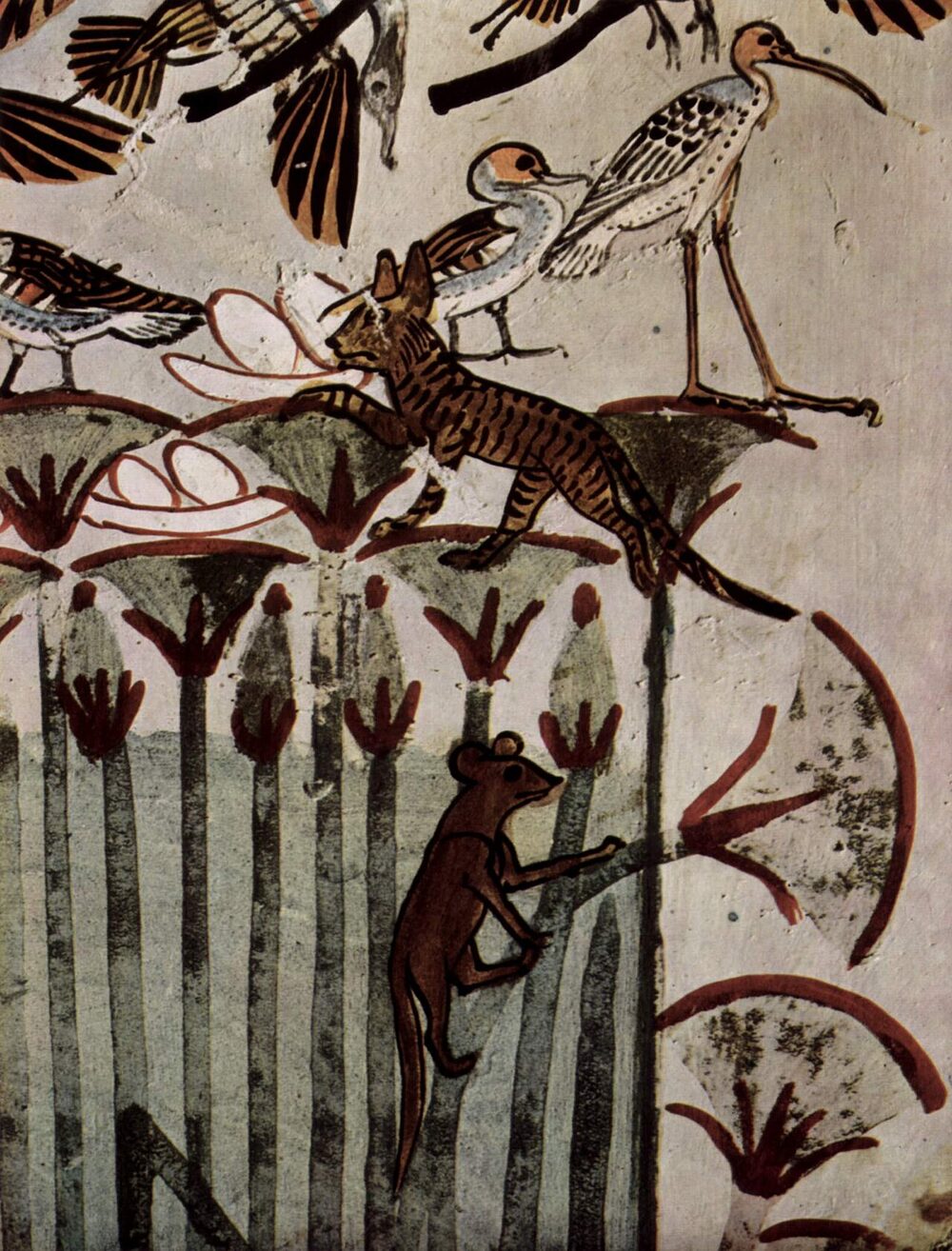
One might expect, in the tomb of so powerful a man, scenes of battle or of personal glory. Yet the walls of an Old Kingdom mastaba show something quite different: daily life, and more precisely the productive life of the estate. We see ploughing, sowing, harvesting, threshing the grain, measuring it and storing it. We see herds being tended, cows being milked, beasts being driven across fords. We see fishing with nets in the marshes, fowling with the throwing stick, pressing the grapes, brewing beer, kneading bread [1].
These images are not mere decorations. They have a magical function: by the virtue of representation, they guarantee the deceased the eternal abundance of the goods depicted. The dead man will never lack bread or beer, because the painted scenes produce them endlessly. But in fulfilling this religious function, they also draw up, unintentionally, an inventory of unequalled precision of the material life of Egypt in the third millennium. No text informs us as finely about the gestures of work as these chapel walls.
The documentary lingers over these tableaux. It details the agricultural techniques: the plough drawn by oxen, the threshing sledge treading the ears, the baskets of grain carried on the head. It follows the complete cycle of food, from field to table, like a production line meticulously broken down. The Egyptian artists do not seek the picturesque; they document a system, that of an estate which must produce, store and redistribute in order to feed the household of the great official and to supply, through tax, the granaries of the state.
The craft scenes are just as rich. We see carpenters sawing and assembling, goldsmiths weighing and casting metal, potters turning, weavers working the linen, sculptors roughing out the stone. Each trade is represented in action, often accompanied by hieroglyphic captions that name the operation or report the words of the workers. These brief inscriptions, a foreman urging on the men, a worker complaining, give a strikingly lively flavour to these images four and a half thousand years old.
Among the most precious scenes are those of the market, where goods are exchanged before the invention of money: a man holds out a vase for onions, a woman offers cloth for fish. These tableaux give us a rare glimpse of the barter economy that structured everyday transactions. The great official, in his tomb, thus makes room for the humblest life, because it is from that life that, in the last analysis, the wealth of his estate and of the kingdom flows.
The master of the tomb, for his part, is always represented on a far larger scale than the peasants and craftsmen around him. This "hierarchical perspective" is a fundamental convention of Egyptian art: size renders rank, not distance. The vizier dominates his scenes as he dominates his estate, seated, standing or carried in a chair, supervising with a sovereign eye the works that secure his eternal sustenance. The image speaks power as much as the words.
It also happens that the family of the deceased appears at his side: the wife, sometimes seated against his leg in a codified gesture of tenderness, the children depicted smaller, the servants named individually. These presences are not merely a matter of affection; they inscribe the vizier within a lineage and a household, for status, in Egypt, is transmitted and surrounded. The tomb thus becomes the portrait of a complete social cell, from the master down to the last of the day-labourers, ranged around him in an immutable order.
Inscriptions and titles: reading a curriculum in stone
If the scenes paint a world, the inscriptions name it. On the walls of a vizier's mastaba, the hieroglyphsHieroglyphA sign of the sacred Egyptian script, at once figurative and phonetic, carved or painted on monuments and in tombs.→ run everywhere: they caption the images, identify the figures, list the offerings and, above all, set out the long titulary of the deceased. For a senior Egyptian official defines himself above all by his titles, those official formulas that state his exact place in the organisation chart of the state [2].
These titles are of extraordinary richness for the historian. Besides the title of tjaty itself, dozens of others are found, detailing the man's precise competencies: "overseer of the granaries", "overseer of the Treasury", "director of the king's works", "chief of the scribes of the royal documents", "lector priest", "director of the two houses of gold", and so on. Each of these titles corresponds to a real administration, to a department of the state of which the vizier had charge or control. By compiling them, Egyptologists gradually reconstruct the entire structure of the pharaonic bureaucracy [2].
Some of these titles are purely honorific, inherited from an ancient era when they designated real charges attached to the person of the king. Others cover effective and weighty responsibilities. Distinguishing the two is not always easy, and it is one of the permanent tasks of research: to disentangle, in the titulary of a great personage, the share of real function from that of court dignity. This very ambiguity is instructive, for it reveals an administration in which prestige and effective power intertwined, where honours were accumulated as offices are accumulated today.
The documentary shows how these titularies read like a curriculum in stone. The order of the titles, their accumulation, the appearance of honorific functions alongside effective ones, all of this sketches a career. One can sometimes follow the rise of a man, from junior scribe to grand vizier, through the progression of the titles engraved on the successive monuments that punctuate his life. The tomb then becomes the culmination of an administrative trajectory, fixed for eternity.
To the titles are added the offering formulas and the autobiographical texts. The offering formula, engraved near the false door, invokes the king and the god of the dead to grant the deceased bread, beer, oxen, fowl, alabaster and cloth, the ritual list of goods needed for eternity. The autobiography, rarer and more personal, makes the dead man speak in the first person: he boasts of his loyalty to the king, his justice, his generosity towards the poor, his irreproachable conduct. These texts, formulaic in appearance, sometimes contain precious historical information, allusions to expeditions, to functions exercised, to favours received.
The deciphering of these inscriptions is the work of a goldsmith. The hieroglyphs of the Old Kingdom have their peculiarities, their script, their fixed formulas. Epigraphers must record each sign, restore damaged passages, compare with other tombs to fill the gaps. The Arte documentary pays tribute to this patient philology, without which the images would remain mute. For it is the conjunction of scenes and texts that makes the mastaba a historical source of the first order: the image shows, the inscription explains.
One detail often strikes visitors: the name of the deceased, either hammered out or, on the contrary, piously repeated. Repeated, it ensures the survival of the dead, for in Egypt the one whose name is spoken continues to exist. Hammered out, it signals a posthumous vengeance, a will to erase a man from memory, a practice reserved for the disgraced. The presence or absence of the name, its integrity or its mutilation, tellTellAn artificial mound formed by the accumulation of successive layers of settlement remains at the same spot, typical of the Near East. Each destruction-rebuilding event adds a stratum.→ on their own of political dramas of which we would otherwise have no trace.
What the administration of the Old Kingdom reveals
By cross-referencing scenes and inscriptions, the vizier's tomb delivers a veritable X-ray of the pharaonic state. What one discovers is an administration of remarkable sophistication for the third millennium BCE. Old Kingdom Egypt is a centralised, hierarchical state, capable of counting its resources, levying taxes, redistributing goods and mobilising an immense workforce for the royal building sites [2].
At the summit of this human pyramid sits the king, a living god. Just below, the vizier coordinates the whole. Beneath him is tiered a multitude of officials: directors of granaries, stewards of estates, scribes of the fields, tax collectors, judges, priests. WritingWritingA system of conventional signs used to fix language or information durably; its appearance (c. 3300 BC) marks, by convention, the end of prehistory.→ is the central tool of this apparatus. Without it, no accounting, no archives, no transmission of orders. The scribe, able to read and write, is the basic agent of the state, and the vizier is, in a sense, the chief scribe of the kingdom.
The system rests on counting and measurement. Cattle are counted, fields are measured, harvests are assessed, the floods of the Nile on which the abundance of the crops depends are recorded. The counting scenes one sees on the walls of the mastaba, scribes seated, palette in hand, counting the beasts that file past, are not anecdotal: they represent the founding act of administration, the transformation of reality into figures, and of figures into tax. It is this capacity to quantify the world that makes the strength of the Egyptian state.
This bureaucracy of numbers also produced a culture of written proof. A transaction, a delivery, a quota of labour: nothing was deemed valid unless it had been set down, sealed and archived. The scribe's palette, so often shown in the reliefs, is therefore more than a tool; it is the emblem of a state that trusted the written sign over the spoken word, and that built its permanence on documents as much as on monuments.
Redistribution is the other pillar. The state takes a share of production, stores it in its granaries, and redistributes it: to officials as remuneration, to building sites as rations, to temples as offerings. It is a centralised redistributive economy, in which money does not yet exist and where everything is measured in quantities of grain, bread, beer and cloth. The vizier is the supreme manager of this flow. The granaries he supervises are the beating heart of the royal economy.
The documentary underlines how fragile this organisation was as well. It rested on the regularity of the flood, on the cohesion of the elite, on the authority of the king. Let one of these conditions fail, and the machine seizes up. The end of the Old Kingdom, marked by a series of poor floods, by the weakening of central power and by the rise of provincial potentates, shows the vulnerability of a system so dependent on its summit. The growing splendour of officials' tombs, at that time, is the symptom of this shift: when servants have themselves buried like kings, it is because the king no longer reigns quite alone.
There is here a lesson of history that the vizier's tomb makes visible better than any treatise. Administration is not a neutral backdrop: it is the very skeleton of civilisation. It is through it that the pharaonic edifice holds together, and it is through its cracks that it collapses. The mastaba, by freezing the workings of this machine, allows us to understand both its grandeur and its fragility.
The documentary's inquiry
The Arte film takes the form of an inquiry. It does not content itself with filming fine walls: it follows the reasoning of the researchers, their hypotheses, their doubts, their verifications. It is this investigative dimension that makes its interest. The viewer does not merely attend a tour of a tomb; he takes part in the reconstruction of a life and a system from stone clues [1].
The inquiry begins with identification. Who was the owner of this tomb? The titles engraved on the walls, the name repeated near the false door, the stylistic and architectural clues make it possible to situate him in time and in the hierarchy. To date a mastaba is to cross several strands: the form of the hieroglyphic signs, the style of the reliefs, the layout of the chapels, sometimes the mention of a king. Each element tightens the chronological bracket.
Then comes the reading of the walls. The epigraphers record the inscriptions, translate them, compare them. Specialists in iconography analyse the scenes, identify the activities depicted, spot the conventions and the departures from them. The documentary shows this dialogue between disciplines: the archaeologist who clears, the epigrapher who reads, the historian who interprets, the conservator who consolidates. Knowledge is born of this collaboration, where each gaze completes the others.
One of the threads running through the film is the question of meaning. Why this scene in this place? Why this accumulation of titles? What does the choice of images tell us about the personality of the deceased, about his ambitions, about the idea he had of the afterlife? The mastaba is not a random assemblage: it is a programme, a deliberate composition meant to assure the dead an eternity in keeping with his rank. To decode this programme is to enter into the thought of the ancient Egyptians, into their conception of power and of death.
The documentary does not evade the grey areas. Many questions remain open: about the exact biography of the vizier, about the circumstances of his career, about the fate of his tomb over the centuries. Archaeology proceeds by cautious hypotheses, never by definitive certainties. This methodological honesty is one of the film's qualities: it shows science in the making, with its advances and its limits, rather than a fully constituted body of knowledge.
Running through it is also a reflection on time. Four and a half thousand years separate us from this man, and yet his walls still speak to us. Through the harvest scenes and the lists of titles, a human presence resurfaces, that of an individual who wished, through stone and image, to outwit oblivion. The archaeological inquiry grants, in its way, this wish for eternity: by giving back a name and a story to the vizier, it brings him back to life.
Conservation and plundering
An Old Kingdom tomb that reaches us is a survivor. For four and a half millennia it has faced plunderers, erosion, reuse, oblivion. Most of these monuments were violated as early as antiquity, their burial chamber forced, their sarcophagus emptied of its gold and jewels. The researchers who open a tomb rarely find an intact treasure: they find the traces of an ancient plundering, and that is already historical information in itself [1].
Plundering is as old as the tombs themselves. As early as the Old Kingdom, the builders took precautions against thieves: deep shafts, sealed chambers, stone portcullises, false galleries. But none of these protections withstood human greed for long. The most precious goods, gold and stones, attracted plunderers sometimes only a few generations after the burial. Paradoxically, it is often the least "profitable" parts of the tomb, the decorated chapels, without precious metal, that have best crossed the centuries, and it is they that inform us the most.
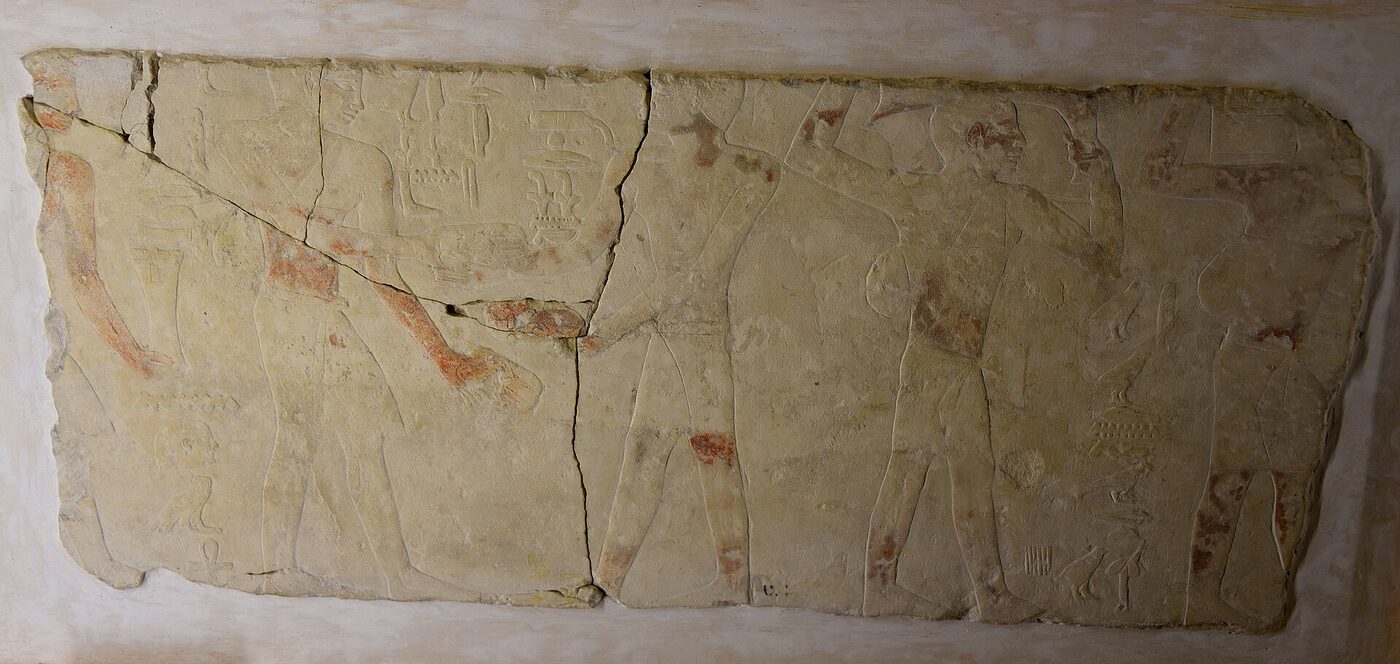
In modern times, other threats have been added. The stone of the mastabas was sometimes reused as building material. Reliefs were cut out and torn away to feed the antiquities market, scattering across the world's museums fragments once joined within a single wall. The market relief held at the Petrie Museum in London illustrates this fate: detached from its original mastaba at Saqqara, it survives today far from Egypt, an eloquent but uprooted witness [3].
Conservation poses considerable challenges. Once cleared, the reliefs and paintings are exposed to the air, to light, to variations in humidity, to the salt that rises from the stone and makes the colours flake. Tourist traffic adds its share of damage. Archaeological missions must therefore reconcile two contradictory demands: to study and to show, but also to protect and sometimes to close back up. The documentary evokes this dilemma, which runs through all of contemporary Egyptology.
Modern techniques offer new tools. Photogrammetry, three-dimensional digital recording, multispectral imaging make it possible to document a tomb in its smallest details without touching it, and to preserve a virtual copy even if the original were to deteriorate. The film shows these methods at work: contemporary science comes to the aid of a fragile heritage, multiplying the immaterial safeguards of a threatened legacy of stone.
At bottom, every tomb is a race against time. What the plunderers did not destroy, erosion attacks; what erosion spares, tourism weakens. The work of archaeologists and conservators consists in wresting from this twofold threat the maximum of information, before it disappears. To study a vizier's tomb is also to wage a patient battle for memory, against the oblivion that lies in wait.
Conclusion
A vizier's tomb does not have the lustre of royal treasures. It offers neither golden mask nor spectacular mummyMummyA body preserved from decay, naturally (cold, aridity, peat) or artificially; the frozen Pazyryk kurgans yielded natural mummies with tattooed skin.→. And yet it is perhaps one of the richest sources that Old Kingdom Egypt has bequeathed to us. For where a king's tomb celebrates a god, that of a senior official documents a world: an estate, an administration, a system of production and redistribution, an entire society captured in the detail of its everyday gestures [2].
The Arte documentary has the merit of making this richness palpable. By following the inquiry of the archaeologists, it transforms a heap of engraved stones into a living narrative: that of a man who governed in the king's name, and that of the state he served. Through the harvest scenes, the lists of titles, the offering formulas, it is the invisible mechanics of pharaonic power that are made visible, in all their sophistication and all their fragility.
What remains of this immersion is a lasting impression: that of a civilisation which had managed, as early as the third millennium BCE, to invent the workings of a complex state, and to entrust to a single man, the tjaty, the heavy task of keeping them turning. The mastaba of Saqqara, by freezing this servant and his world for eternity, holds up a distant mirror to us. It reminds us that every civilisation depends on the invisible architecture of its administration, and that it is often in the tombs of the servants, more than in those of the kings, that the truth of a state can be read.
Cet exemple sera parfait pour illustrer une notion difficile à transmettre en visite guidée.
Fascinant. Je travaille justement sur ce thème pour mon mémoire et cet article m'apporte un éclairage nouveau.
Les documentaires Arte sur l'Egypte ancienne atteignent un niveau de qualité visuelle et scientifique exceptionnel. La restitution 3D des tombeaux permet de montrer les couleurs et les compositions originales que la dégradation a souvent effacées. Ce type de production est essentiel pour redonner vie à un patrimoine qui risque de disparaitre en raison du tourisme de masse et des conditions climatiques.
Les tombeaux des vizirs de l'Ancien Empire sont parmi les plus beaux exemples de l'art funéraire égyptien. Les scènes de la vie quotidienne peintes sur les parois, avec leurs représentations de métiers, de festivités et de chasse, sont des documents historiques d'une valeur inestimable. Le tombeau de Mereruka à Saqqarah reste pour moi l'un des chefs-d'oeuvre de cet art.