Around 45,000 to 40,000 years ago, Ice Age Europe reached a decisive turning point. Small groups of Homo sapiensHomo sapiensThe present-day human species, which emerged in Africa around 300,000 years ago, the only surviving human lineage after the extinction of Neanderthals and Denisovans.→, arriving from the Near EastNear EastA region of western Asia (Levant, Mesopotamia, Anatolia, Iran), cradle of the Neolithic revolution, agriculture, the first cities and writing.→, pushed into a continent until then inhabited by NeanderthalsNeanderthalsA fossil humanity of Eurasia, robust and cold-adapted, extinct around 40,000 years before present.→. With them came an entirely new material culture, which prehistorians call the AurignacianAurignacianThe earliest culture of the European Upper PalaeolithicUpper PalaeolithicThe final phase of the Palaeolithic (c. 45,000 to 10,000 years ago), marked by Homo sapiens in Europe, art, ornaments and a succession of cultures (Aurignacian, Gravettian, Solutrean, Magdalenian).→ (c. 43,000–33,000 BC), tied to the arrival of Homo sapiens and the first artworks.→: the earliest culture of the European Upper PalaeolithicPalaeolithicThe oldest and longest period of prehistoryPrehistoryThe span of human history before the invention of writing, from the Palaeolithic to the Metal Ages, known mainly through material remains.→ (c. 3.3 Ma–12,000 BC), defined by chipped stone tools and a hunter-gatherer way of life.→. Within a few millennia, ivory figurines, bone flutes, ornaments of shell and pierced teeth, and stone tools of unprecedented refinement all appeared. For many, this is the moment when modern humanity "takes the stage" with, for the first time on a massive and undeniable scale, figurative art and a symbolic life1.
This dossier tells the story of that cultural dawn: who the Cro-Magnon people were, how they arrived in Europe and coexisted with Neanderthals, and above all why the Swabian Jura, in southern Germany, became the recognised cradle of the world's oldest figurative artworks and oldest musical instruments, so much so that it was inscribed on the UNESCO World Heritage List in 20173.
Who were the Cro-Magnon people?
The name "Cro-Magnon" comes from a small rock shelterRock shelterA shallow cavity at the foot of a cliff or under a rocky overhang, offering natural shelter; a favoured site of prehistoric habitation and rock art.→ in the village of Les Eyzies-de-Tayac, in the Dordogne. In 1868, during railway works, several skeletons of anatomically modern humans were found there, together with pierced shells and flintFlintA hard, brittle siliceous rock, knapped by prehistoric people to produce blades, points and sharp tools.→ tools. The geologist Louis Lartet named them after the site, and the term came to designate the first Homo sapiens of Europe1. They are not a separate species: the Cro-Magnon people are fully modern humans, anatomically identical to us. Tall and robust, with high foreheads and prominent chins, they had a brain of comparable size to our own.
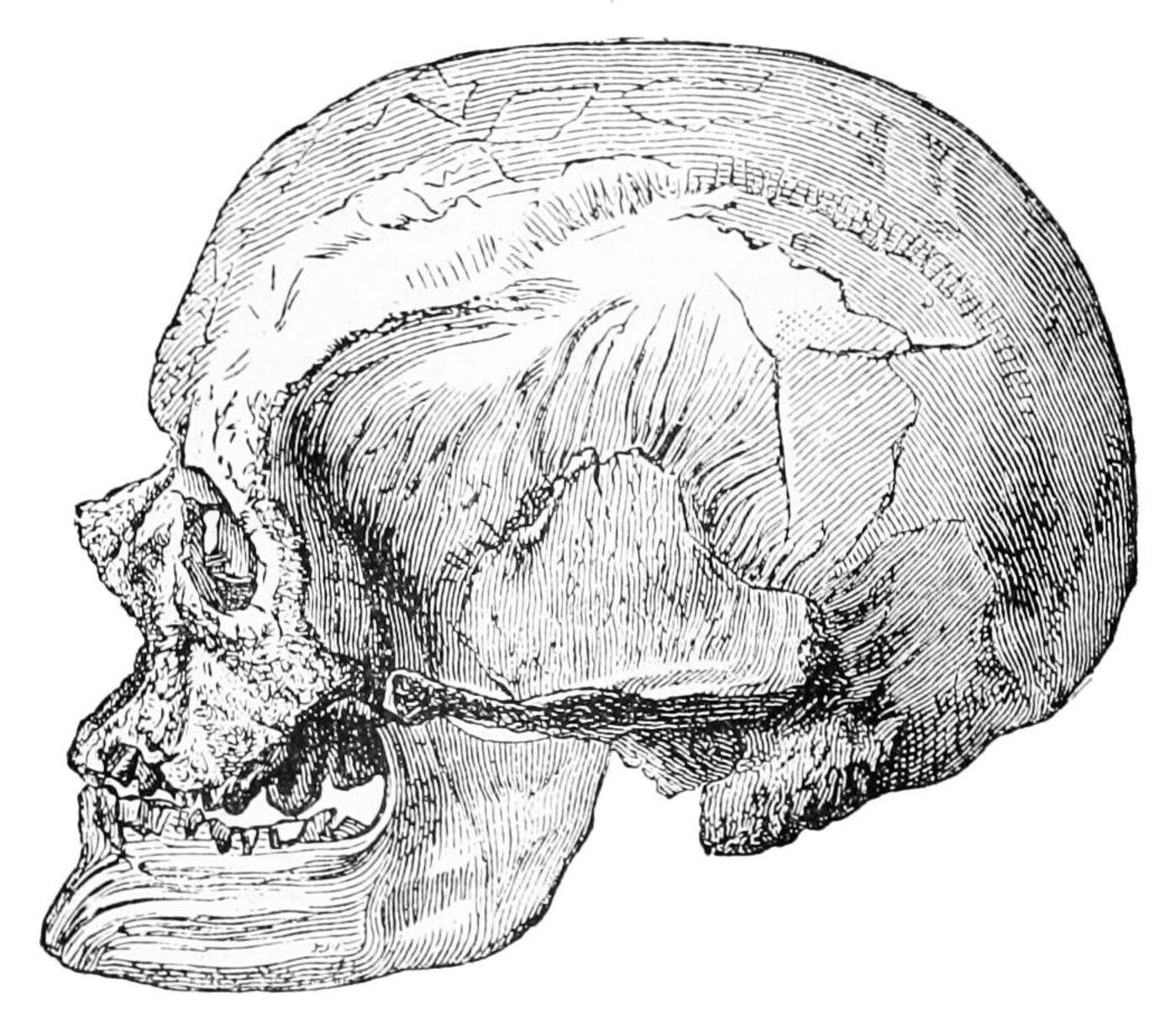
What radically distinguishes Cro-Magnon is therefore not their anatomy but their behaviour. Where earlier homininsHomininHomininMember of the subtribe Hominina, comprising the human lineage (Homo, Australopithecus, Paranthropus…) but excluding orangutans and gibbons. The term progressively replaces "hominid" in its narrow sense.→A member of the human lineage in the broad sense, including modern humans, their ancestors and related great apesgreat apesThe family of great apes (Hominidae) comprising orangutans, gorillas, chimpanzees, bonobos and humans.→.→ had developed effective tools, these newcomers display an overflowing creativity: they sculpt, engrave, adorn their bodies, make musical instruments and bury their dead with care. This density of symbolic behaviourSymbolic behaviourA set of practices (adornment, pigments, art, burial) reflecting symbolic thought; long ascribed to Homo sapiens alone, now attested for Neanderthals too.→ is so striking that researchers long spoke of an Upper Palaeolithic "revolution", a sudden explosion of modern thought. The debate remains lively: some now prefer to speak of a gradual accumulation, with roots reaching deep into AfricaAfricaThe cradle of humankind: the continent where the first hominins appeared, then Homo sapiens around 300,000 years ago, before the expansion to the rest of the world.→ long before the arrival in Europe. But no one disputes the scale of what unfolds on European soil.
The arrival in Europe and coexistence with Neanderthals
When the first groups of Homo sapiens entered Europe, the continent was not empty. For more than 300,000 years it had been the domain of the Neanderthals, perfectly adapted to the glacial cold and bearers of the MousterianMousterianThe stone-tool industry typical of Neanderthals, based on the Levallois flaking technique.→ stone-tool industry. For several millennia the two humanities therefore coexisted on the same territory, in an overlap that radiocarbon dating places, depending on the region, between 45,000 and 40,000 years before present1.
This coexistence was not a mere crossing of paths. PalaeogeneticsPalaeogeneticsThe study of ancient DNA extracted from remains (bones, teeth, sediments, walls) to reconstruct the past of populations.→ has shown that the two populations interbred: even today, non-African humans carry about 1 to 2% Neanderthal DNADNAThe molecule carrying genetic information, used to reconstruct kinship between species.→. The Aurignacian marks the moment when the balance tipped. Around 40,000 years ago, Neanderthals vanish from the record, while the Aurignacian culture spreads from the Iberian Peninsula to Central Europe. The causes of this extinction remain debated, competition for resources, climatic instability, demographic weakness, gradual absorption, but the outcome is clear: Homo sapiens remains alone.
The Aurignacian itself is not a ready-made import. It is defined by a coherent package: standardised flint blades and bladelets, split-based antler points, thick "carinated" scrapers, and above all that flowering of symbolic objects with no equivalent in earlier cultures. It is this material signature that allows prehistorians to track, site after site, the advance of modern humanity across the continent.
The "revolution" of portable art
The term portable artPortable artTransportable art objects (figurines, engravings on bone or ivory), such as the Palaeolithic Venuses.→ (or mobiliary art) refers to transportable art objects, statuettes, figurines, engravings on bone or ivory, as opposed to cave artCave (parietal) artArt made on the walls of caves and shelters (paintings, engravings), as opposed to portable art.→ fixed to the walls of caves. It is in this domain that the Aurignacian achieves its most spectacular breakthrough. The world's oldest undisputed figurative representations indeed come from the caves of the Swabian Jura, where they are dated to about 40,000 years, and perhaps as old as 43,000 years according to the most recent estimates1.
These works are carved from mammoth ivoryMammoth ivoryMammoth tusk worked by Palaeolithic craftspeople to carve figurines, beads, points and ornaments.→, a hard, dense and precious material. They reveal a true Ice Age bestiary: horses, mammoths, bison, big cats, waterbirds, bears. The famous Venus of Hohle Fels, a female figurine with amplified forms, is one of the oldest known representations of the human body, already foreshadowing the celebrated "Venuses" of the GravettianGravettianAn Upper Palaeolithic culture (c. 33,000–21,000 BC) spanning from the Atlantic to Siberia, famous for its ivory female figurines ("Venuses") and, at Dolní Věstonice, the oldest fired ceramics.→GravettianAn Upper Palaeolithic culture (c. 33,000–21,000 BC) famous for its female figurines, the "Venuses".→ that would follow. Far from being mere doodles, these objects testify to a fully mastered technique: the material had to be selected, roughed out, sculpted in the round and polished. Dozens, even hundreds, of hours of work lie behind each piece.
Why this explosion? The answer touches the very heart of what makes modern humanity. To sculpt an animal or a hybrid being is to create a mental image and give it a shareable material form. It is to summon the absent, the myth, the invisible. This ability to manipulate symbols, to make an object "stand for" something else, is perhaps the deepest marker of sapiens thought. Aurignacian portable art is its first massive and lasting expression.
The Lion-man of Hohlenstein-Stadel
No object embodies this new power of imagination better than the Löwenmensch, the "Lion-man" discovered in 1939 in the Hohlenstein-Stadel cave, in the Lone Valley2. Carved from a mammoth tusk and about thirty centimetres tall, this figurine depicts a standing human body topped by the head of a cave lion. It is, to this day, one of the oldest known figurative sculptures, dated to around 40,000 years2.
The significance of the Lion-man goes far beyond its technical feat. For it depicts no real animal, nor any real human being: it is a composite creature, a being that exists only in the mind of its maker. For many researchers, it is the oldest material proof of mythological or religious thought, the capacity to imagine supernatural beings, to blend human and animal in a single figure. The making of the object, estimated at several hundred hours of work, further suggests that it held exceptional value for the community, perhaps a ritual or shamanic role.
Reconstructed from hundreds of ivory fragments, the Lion-man underwent several successive restoration campaigns as new chips were recovered from the cave sediments. A second, smaller figurine on the same theme was identified in a neighbouring cave, suggesting that the motif of the human-feline hybrid belonged to a genuine shared symbolic repertoire. Now kept in the Ulm Museum, the Lion-man has become the emblem of European Ice Age art.
Flutes, the world's oldest musical instruments
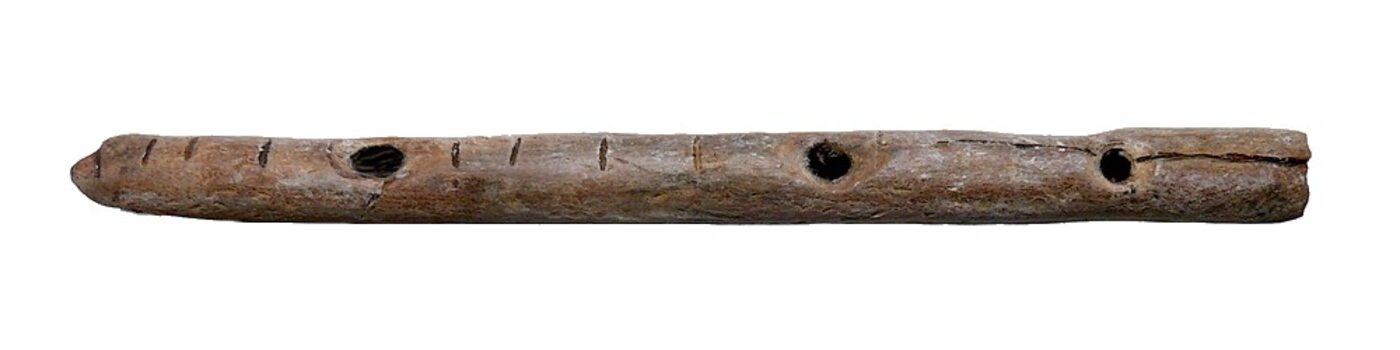
If the Lion-man gives a face to Aurignacian symbolic thought, the flutes of the Swabian Jura give it a voice. In the caves of Hohle Fels, Geißenklösterle and Vogelherd, archaeologists have unearthed several Palaeolithic flutes, regarded as the oldest known musical instruments in the world1. The most complete, excavated at Hohle Fels in 2008, is carved from the wing bone of a griffon vulture: a tube some twenty centimetres long, pierced with five finger holes and notched at one end to form a mouthpiece.
Other flutes, older still, were fashioned from mammoth ivory, a true technical tour de force, since the tusk had to be split in two, each half hollowed out, then glued back together airtight to form a tube. The most precise dates, obtained at Geißenklösterle, place these instruments at around 42,000 to 43,000 years3. Replicas played by modern musicians show that these flutes produced a range of clear, tuned notes, capable of genuine melodies.
The meaning of these objects is immense. Music has no immediate survival value: you cannot hunt, feed yourself or keep warm with a flute. Its presence as early as the Aurignacian therefore points to a developed social and ritual life, in which organised sound played a role, gathering, transmission, celebration, perhaps communication with the sacred. That the first Homo sapiens of Europe devoted time and skill to making musical instruments says a great deal about the richness of their inner world.
Ornaments and identity
The Aurignacian is also the age of personal ornament. Sites yield an abundance of beads, pendants and pierced teeth: marine shells sometimes carried over hundreds of kilometres, carefully perforated teeth of fox, deer or wolf, ivory beads cut in series. These objects, once again, have no practical function. They are markers of identity.
To wear an ornament is to display something: belonging to a group, status, age, role, perhaps alliances. The standardisation of certain ivory beads, produced in large numbers to a constant pattern, even suggests a shared visual "code", recognisable from one group to another. The presence of shells from distant seas, meanwhile, reveals long-distance exchange or circulation networks, the sign of a connected, mobile society able to forge ties beyond the immediate circle.
This social dimension of ornament echoes the care given to burialsBurialThe intentional deposition of a body, sometimes with offerings; a marker of symbolic behaviour.→. To bury a dead person accompanied by ornamented objects is to acknowledge in the individual a value that outlives death, and to assert a bond between the living and the departed. The whole, art, music, ornament, burial, sketches the portrait of a fully symbolic humanity, concerned to signify, to transmit and to remember.
Tools and technical innovation: bladelets and spear points
Behind this symbolic efflorescence lies a technical revolution. The Aurignacian rests on a new mastery of stone knappingknappingThe set of operations for fracturing a stone block to extract flakes or blades.→. From carefully prepared flint blocks, knappers detached long, regular blades, then fine bladelets, thin elongated flakes, sometimes retouched (the so-called "Dufour" bladelets) and intended to arm projectiles or composite knives1. This serial production, economical with raw material, contrasts with the more massive methods of the Neanderthal Mousterian.
The toolkit also includes thick "carinated" and "nosed" scrapers, true cores used to extract bladelets, as well as burins, borers and specialised side-scrapers. But the most emblematic innovation comes from the working of bone and antler: the split-based spear points, carved from reindeer antler. Their base, split into two tongues, allowed the point to be hafted securely onto a wooden shaft, a technical solution that characterises the Early Aurignacian and reflects genuine hunting engineering3.
These light, effective throwing weapons considerably increased the range and safety of hunting the great herbivores of the glacial steppes. Combined with collective organisation and a fine knowledge of game, they made the Aurignacians formidable predators. The working of bone and ivory, moreover, is exactly the same skill that produces the flutes and the figurines: there is no watertight boundary between technique and art, but a continuum of mastered gestures.
Symbolism and thought
What, in the end, do these objects tellTellAn artificial mound formed by the accumulation of successive layers of settlement remains at the same spot, typical of the Near East. Each destruction-rebuilding event adds a stratum.→ us about the minds of their makers? Taken together, figurative art, the hybrid being, music, ornament, burial, they sketch a cognitive revolution: the advent of a fully symbolic mode of thought, able to represent what is not there, to imagine the impossible, to encode information in objects, and to share all of this within a community.
The Lion-man in particular opens a dizzying window onto the mental life of the first modern Europeans. To conceive a being that mingles human and beast presupposes articulate language, collective memory, a mythology. Researchers see in it the sign of a structured spiritual world, in which narratives explained the origin of the world, the fate of the dead, the place of humans among animals. Music, for its part, presupposes a perception of time, rhythm and harmony, and a will to produce shared emotion. Each of these capacities feeds the others: a mythology can be sung, an ornament can encode a story, a buried offering can stand for a belief about the afterlife. The Aurignacian thus reveals not a scatter of isolated inventions but an interlocking symbolic system, in which images, sounds, objects and rites reinforce one another within the life of the group.
Should we then speak of a "revolution" that arose abruptly in Europe? The debate remains open. Numerous African discoveries, engraved ochreOchreA red or yellow mineral pigment (iron oxides), used from prehistory for adornment, funerary rites and art.→ pigments, shell beads, elaborate tools, show that the roots of symbolic thought are far older than the Aurignacian and reach into the African cradle of Homo sapiens. What the Aurignacian represents may not be the sudden invention of the modern mind, but its first spectacular and continuous flowering, preserved by the exceptional conditions of the European caves.
Legacy: towards the Gravettian
The Aurignacian was no flash in the pan. Around 33,000 years ago it gave way to a new Upper Palaeolithic culture, the GravettianGravettianAn Upper Palaeolithic culture (c. 33,000–21,000 BC) famous for its female figurines, the "Venuses".→, which prolonged and amplified its momentum. The female figurines, sketched out as early as Hohle Fels, then multiplied across all of Europe in the form of the celebrated Palaeolithic "Venuses", from the Atlantic to Siberia. Portable art diversified, hunting techniques were perfected, exchange networks expanded across ever greater distances. The spear-thrower, or atlatlatlatlA spear-thrower, a hooked stick that extends the hunter's arm and increases a dart's range, used before the adoption of the bow.→, would soon extend the reach of the hunt even further, while regional styles began to crystallise into distinct artistic traditions.
Later still came the SolutreanSolutreanA European Upper Palaeolithic culture (c. 22,000–17,000 BC), remarkable for its leaf-shaped lithic points worked with flat retouch. Contemporary with the second art phase of Cosquer Cave.→ and the MagdalenianMagdalenianThe last great Upper Palaeolithic culture (c. 17,000–12,000 BC), the peak of cave art (Lascaux).→, which would carry cave art to its peak with the great frescoes of Lascaux, Chauvet and Altamira. But all of this is rooted in the Aurignacian impulse: it was the Aurignacian that first made image, sound and ornament a lasting part of the human experience. The continuity is striking: for more than 25,000 years, the hunter-gatherersHunter-gatherersA way of life based on hunting, fishing and gathering wild resources, without farming or herding; it dominated almost the whole of human history.→ of the European Upper Palaeolithic never ceased to sculpt, engrave and paint.
Recognition of this legacy culminated in 2017, when UNESCO inscribed the caves and Ice Age art of the Swabian Jura on the World Heritage List3. Six caves, Hohle Fels, Geißenklösterle, Sirgenstein, Vogelherd, Bockstein and Hohlenstein-Stadel, spread across the Ach and Lone valleys, are protected there as witnesses to the birth of art and music. It is the first time a group of sites has been distinguished precisely for having yielded the oldest evidence of our species' figurative and musical creativity.
Conclusion
The Aurignacian marks a threshold in the history of humanity. Within a few millennia, the first Homo sapiens of Europe, the Cro-Magnon people, carved the world's oldest figures, blew into the oldest flutes, adorned their bodies with shells and beads, and shaped tools of a new effectiveness. Above all, with the Lion-man of Hohlenstein-Stadel, they left the material trace of an imagination able to invent beings that do not exist, a gateway to myth, narrative and the sacred.
Whether we speak of a "revolution" or a gradual flowering, the conclusion stands: it is with the Aurignacian that the symbolic creativity of our species becomes, for the first time, abundant, lasting and legible in the archives of the Earth. The caves of the Swabian Jura, the setting of these treasures, remind us that art and music are not late refinements of civilisation, but companions of Homo sapiens since the Ice Age. Contemplating the lion face of that ivory statuette, or listening to the replica of a vulture-bone flute, we strain to hear the very first gestures of the modern human mind.
Defining the Aurignacian: a name, a culture, a chronology
The term "Aurignacian" denotes the first great material culture of the European Upper PalaeolithicPalaeolithicThe oldest and longest period of prehistory (c. 3.3 Ma–12,000 BC), defined by chipped stone tools and a hunter-gatherer way of life.→ unambiguously attributed to our own species, Homo sapiens. It takes its name from the cave of Aurignac, in the Haute-Garonne region of France, where the abbé Édouard Lartet conducted excavations from 1860 onwards that yielded characteristic tools and faunal remains. The word itself was established in the early twentieth century by the prehistorian Henri Breuil, who, in the great debate over the succession of industries, imposed the idea of a distinct Aurignacian inserted between the Neanderthal MousterianMousterianThe stone-tool industry typical of Neanderthals, based on the Levallois flaking technique.→ and later cultures. Since then, the term has come to embrace a vast technical and symbolic complex that flourished over nearly ten thousand years, from the Atlantic to the gates of Asia.
The chronology of the AurignacianAurignacianThe earliest culture of the European Upper Palaeolithic (c. 43,000–33,000 BC), tied to the arrival of Homo sapiens and the first artworks.→ has been considerably refined thanks to advances in radiocarbon dating, particularly the purification of bone collagen and the calibration of dating curves. Today, specialists distinguish several phases: a Proto-Aurignacian, appearing around 43,000 to 41,000 years before present; an Early Aurignacian, between roughly 40,000 and 37,000 years; and a Late or Evolved Aurignacian, which continues until around 33,000 years before giving way to the GravettianGravettianAn Upper Palaeolithic culture (c. 33,000–21,000 BC) famous for its female figurines, the "Venuses".→. These dates, expressed in calendar years, remain the object of lively discussion, since the margin of uncertainty on the oldest determinations is still measured in centuries, even millennia.
The geographical extent of the Aurignacian is remarkable. It is found from the LevantLevantA region of the eastern Mediterranean Near East (Israel, Lebanon, Syria, Jordan), a major crossroads of the first human migrations out of Africa.→ and Anatolia all the way to south-western France and northern Spain, by way of the Danube valley, Central Europe and Italy. This dispersal follows, in essence, the great river axes and natural corridors along which the first modern hunter-gatherers colonised the continent. Notably, no clear trace of Proto-Aurignacian or Early Aurignacian has been found south of the Ebro basin in Spain: in those regions the Late Mousterian persists longer, and the Evolved Aurignacian appears only around 37,500 years ago, a sign that the transition between Neanderthals and Homo sapiens did not unfold everywhere at the same pace.
The Proto-Aurignacian and the transition debate
One of the most debated questions in European prehistory concerns the precise nature of the Proto-Aurignacian and its role in the transition between the Middle and the Upper Palaeolithic. This facies, characterised by the abundant production of fine, regular bladelets, often retouched, is generally regarded as the work of the very first Homo sapiens to reach Europe. But the anatomical identification of the artisans remains delicate, because the layers yielding these tools rarely contain human remains that can be dated with certainty.
The heart of the debate sets two schools against each other. For some, the Proto-Aurignacian marks a clean break: it represents the irruption of a new population, equipped with a technical and symbolic toolkit radically different from that of the Neanderthals. For others, the boundary is blurrier, and several so-called "transitional" industries, the ChâtelperronianChâtelperronianA transitional material culture (c. 45,000-40,000 years ago) straddling the Middle and Upper Palaeolithic in France and northern Spain; curved-backed knives and, at the Grotte du Renne at Arcy, ornaments and bone tools attributed to Neanderthals.→MousterianThe stone-tool industry typical of Neanderthals, based on the Levallois flaking technique.→ in France, the Uluzzian in Italy and Greece, the Bohunician in Central Europe, muddy the picture by mixing old traits and innovations. These industries pose a formidable question: who made them? Neanderthals influenced by their modern neighbours, Homo sapiens with still-archaicArchaicRefers to an ancient, now-extinct human population or form (Neanderthals, Denisovans, ghost lineages), as opposed to anatomically modern humans.→ tools, or mixed populations?
The dates themselves have fuelled the controversy. One team proposed a tightened chronological scheme, placing the appearance of the Proto-Aurignacian and the Early Aurignacian within a precise bracket; other researchers contested these results, arguing that contamination and stratigraphic reworking rendered certain dates too young or too old. This close, at times sharp dialogue illustrates the difficulty of reconstructing a pivotal moment of our history from a few grams of charcoal and bone. What is at stake, ultimately, is the timetable of the encounter between two humanities, and the exact tempo of Neanderthal extinction.
Who were the Cro-Magnons?
The name "Cro-Magnon" has become, in everyday language, almost synonymous with prehistoric man. It designates the first representatives of Homo sapiens in Europe, contemporaries of the Aurignacian and its sequels. But the name has a precise origin and a birthplace: a small rock shelterHomininA member of the human lineage in the broad sense, including modern humans, their ancestors and related great apes.→ in the village of Les Eyzies, in the Dordogne, at the heart of the Vézère valley. In 1868, during the construction of a railway line, workmen unearthed human bones. The geologist Louis Lartet, son of Édouard Lartet, the excavator of Aurignac, was called in to examine the deposit.
Lartet exhumed the partial skeletons of several individuals: four adults and one infant, accompanied by perforated shells used as ornaments, an object made of ivory, and worked reindeer antler. The best-preserved skull, known as "Cro-Magnon 1", at once became a reference specimen. As early as 1869, Lartet proposed for these humans the subspecies name Homo sapiens fossilis, asserting that they were modern humans, clearly distinct from the Neanderthals discovered a few years earlier. The site itself is later than the strict Aurignacian, it dates to around 28,000 years ago, and thus belongs to the Gravettian, but the term "Cro-Magnon" has spread, for convenience, to all the first sapiens of Europe.
Anatomically, the Cro-Magnons were modern humans in the full sense of the term: tall stature, a high, rounded cranium, a vertical forehead, a projecting chin, a face with little prognathism, and the absence of the massive brow ridge that characterises Neanderthals. Their brain, of a volume comparable to ours, was housed in a globular braincase. Robust and adapted to a cold climateClimateThe long-term average atmospheric conditions of a region; its variations (glaciations, aridifications) shaped migrations, agriculture and the collapse of prehistoric societies.→, they nonetheless displayed all the skeletal characteristics of present-day humanity. To study Cro-Magnon is therefore to look at ourselves across nearly thirty thousand years: these glacial hunters were not an intermediate stage on the way to humankind, they were already fully human.
The "Upper Palaeolithic Revolution": Mellars versus continuity
For decades, the Aurignacian embodied the idea of a true "Upper Palaeolithic Revolution", the sudden appearance, in Europe, of a cluster of modern behaviours: figurative art, ornament, music, standardised tools, long-distance exchange networks, elaborate burialsBurialThe intentional deposition of a body, sometimes with offerings; a marker of symbolic behaviour.→. The prehistorian Paul Mellars was one of the most influential champions of this thesis. For him, the Aurignacian testifies to an abrupt qualitative leap, closely associated with the arrival of Homo sapiens, and best documented in the European record. This "human revolution", formalised in a landmark edited volume published at the end of the 1980s, made Europe the privileged theatre of the advent of the modern mind.
Yet this Eurocentric vision has been profoundly challenged. From the year 2000, the prehistorians Sally McBrearty and Alison Brooks turned the argument on its head in an article with a provocative title, "the revolution that wasn't". Compiling the African data, they showed that most of the traits regarded as characteristic of the European Upper Palaeolithic, ochre pigments, shell beads, elaborate tools, technical diversification, the exploitation of varied raw materials, extended social networks, appeared in Africa much earlier, sometimes as far back as the Middle Stone AgeMiddle Stone AgeA long phase of African prehistory (c. 300,000 to 40,000 years ago), the African equivalent of the Middle Palaeolithic, marked by the rise of symbolic behaviour.→, tens of thousands of years before the Aurignacian.
The debate thus pits two models against each other. On one side, a short, abrupt revolution, localised in Europe and linked to a singular cognitive event, perhaps a mutation favouring language or symbolic cognition. On the other, a long, gradual, African emergence, made of accumulations and sporadic reappearances, of which the Aurignacian would be merely the most visible flowering, favoured by the exceptional preservation conditions of the European caves. Today, the balance tilts decisively towards the second model: behavioural modernity was not born in Europe, but found there a ground on which to express itself with unprecedented richness. The Aurignacian does not invent the modern mind; it offers its first great showcase.
The Swabian Jura, cradle of art and heritage of humanity
If the Aurignacian has a capital, it is surely the Swabian Jura, that region of limestone plateaus in Baden-Württemberg, in south-western Germany, hollowed with caves along the Ach and Lone valleys. It is there, within a radius of a few dozen kilometres, that the oldest figurative artworks and the oldest known musical instruments in the world are concentrated. The caves of Hohle Fels, Geißenklösterle, Sirgenstein, Vogelherd, Bockstein and Hohlenstein-Stadel form an ensemble of unique density, excavated for more than a century and studied notably by teams from the University of Tübingen under the direction of Nicholas Conard.
Recognition of this exceptional concentration culminated in 2017, when UNESCO inscribed the "Caves and Ice Age Art in the Swabian Jura" on the World Heritage List. Six caves are protected there as witnesses to the joint birth of figurative art and music. It is the first time a group of sites has been distinguished precisely for having yielded the oldest evidence of our species' symbolic creativity. The inscription emphasises that these caves, occupied more than 40,000 years ago by the first Homo sapiens to reach the upper Danube valley, harbour a heritage of outstanding universal value.
What these caves yield is not merely an accumulation of objects, but the coherent portrait of a culture. Ivory animal figurines, horses, mammoths, cave lions, water birds, hybrid figures, miniature portable artPortable artTransportable art objects (figurines, engravings on bone or ivory), such as the Palaeolithic Venuses.→, bone and ivory flutes, countless ornaments: the whole sketches a society that, from its very arrival in Europe, possessed a fully constituted symbolic repertoire. The Swabian Jura has thus become, in the eyes of prehistorians, the privileged laboratory for studying the beginnings of the human imagination.
The Lion-man of Hohlenstein-Stadel: anatomy of a masterpiece
Of all the treasures of the Swabian Jura, the Lion-man of Hohlenstein-Stadel cave remains the most striking. This mammoth-ivory figurine, some thirty centimetres tall, represents a hybrid being: a standing body, in human posture, surmounted by the head of a cave lion. Dated to the Early Aurignacian, that is, around 40,000 years ago, it constitutes the oldest indisputable representation of an imaginary creature in the history of art. No animal of this kind ever existed: its creator conceived it in the mind before drawing it out of the tusk.
The story of its discovery is almost as extraordinary as the object itself. The fragments were unearthed in 1939, on the eve of the Second World War, by the geologist Robert Wetzel. With the excavation interrupted, the hundreds of ivory splinters lay forgotten in boxes for decades. Only from the 1960s onwards, and during later campaigns, was the figurine patiently reconstructed. Excavations resumed in the twenty-first century recovered several hundred additional fragments, nearly 575 from the relevant layer, which made a far more complete restoration possible.
This final restoration, carried out in 2012 and 2013, was a goldsmith's task: the earlier reconstructions had to be dismantled, each splinter cleaned, then the whole reassembled, an operation that alone required more than 370 hours. But the most dizzying figure concerns the original manufacture. Archaeologists reproduced the statuette using replicas of Aurignacian flint tools, carving mammoth ivory according to period techniques. Their conclusion: sculpting the Lion-man would have demanded on the order of 320 hours of work, several weeks of exclusive labour. That a community of hunter-gatherers could spare one of its members for such a length of time to produce an object of no material utility says a great deal about the importance of the symbolic in their world. The Lion-man was no trinket: it was, in all likelihood, a figure charged with meaning, perhaps cultic, whose wear traces suggest it was long handled and passed on.
The flutes, and the birth of music
If the Lion-man gives a face to Aurignacian symbolic thought, the flutes of the Swabian Jura give it a voice, and reveal that music has accompanied our species since its first steps in Europe. The excavations at Hohle Fels, Geißenklösterle and Vogelherd have yielded the remains of several Palaeolithic flutes, regarded as the oldest known musical instruments in the world. The most complete, brought to light at Hohle Fels in 2008 by Nicholas Conard's team, is carved from the naturally hollow wing bone of a griffon vulture: a tube originally about thirty-four centimetres long for barely eight millimetres in diameter, pierced with five finger holes and notched into a V at one end to form a mouthpiece.
Other flutes, older still, were fashioned from mammoth ivory. Their manufacture was a tour de force: a piece of tusk had to be split lengthwise, each half hollowed out with extreme precision, then the two parts glued back together perfectly airtight to reconstitute a sounding tube. Such mastery, applied to so demanding a material, demonstrates that these instruments were not the product of chance but of an established technical tradition. The most precise dates, obtained at Geißenklösterle through a high-resolution radiocarbon analysis published in 2012, place these flutes at around 42,000 to 43,000 years, potentially older still than the one from Hohle Fels.
The significance of these discoveries goes beyond anecdote. Replicas played by modern musicians show that these flutes produced a range of clear, tuned notes, allowing genuine melodies. Yet music has no immediate survival value: you cannot hunt, feed yourself or keep warm with a flute. Its presence as early as the Aurignacian therefore attests to a developed social and ritual life, in which organised sound played a role, nocturnal gathering around the fire, the transmission of narratives, celebration, communication with a supposed beyond. Researchers stress that this musical development accompanies, in the same layers, the flowering of figurative art and a host of innovations: music, image and technique form one and the same creative ferment.
The Aurignacian Venuses and the human body
Alongside animals and hybrid beings, the Aurignacian also sculpted the human body, and the female body in particular. The cave of Hohle Fels yielded, in layers contemporary with the flutes, a small mammoth-ivory figurine now famous as the Venus of Hohle Fels. Barely six centimetres tall, it represents a woman with amplified forms: voluminous breasts, a prominent belly, broad hips, a marked sex, while the head is replaced by a suspension ring, a sign that the object was worn as a pendant. Dated to around 40,000 years, it ranks among the oldest figurative representations of the human body in the world.
This Venus is not an isolated object: it heralds, several millennia in advance, the great series of Palaeolithic "Venuses" that would multiply during the GravettianGravettianAn Upper Palaeolithic culture (c. 33,000–21,000 BC) famous for its female figurines, the "Venuses".→, from the Atlantic to Siberia. The link is direct: female figurines, sketched out as early as the Aurignacian of the Swabian Jura, become a major theme of European portable art. Their meaning remains enigmatic, symbols of fertility, ritual representations, figures of female identity, objects of exchange or of learning, but their recurrence across thousands of kilometres and tens of millennia makes them one of humanity's oldest shared motifs.
What is striking is the precocity of the imaging of the body. From its very settlement in Europe, Homo sapiens does not content itself with representing the game it hunts: it represents itself, and more precisely the part of humanity bound up with childbearing and the perpetuation of the group. With the Venus of Hohle Fels, Aurignacian art crosses a further threshold: it becomes reflexive, turning its gaze upon the human body and making of it an object of thought and belief.
Stone and bone: a technological revolution
Behind this symbolic efflorescence lies a profound technical mutation. The Aurignacian rests on a new mastery of stone knapping, founded on the systematic production of elongated blanks. From carefully prepared flint blocks, knappers detached long, regular blades, then fine bladelets, thin, narrow flakes, sometimes retouched along the edge. The most characteristic, the Dufour bladelets, with marginal retouch, were intended to arm projectiles or composite knives: inserted in series into a shaft or a handle, they formed formidable cutting edges or barbs. This chain production, especially economical with raw material, contrasts with the more massive methods of the Neanderthal MousterianMousterianThe stone-tool industry typical of Neanderthals, based on the Levallois flaking technique.→.
The Aurignacian toolkit also includes typical forms that prehistorians use as "index fossils": thick scrapers known as "carinated" or "nosed", which are in fact cores used to extract bladelets; robust burins, intended for the working of bone and antler; borers, side-scrapers and splintered pieces. Each type answers a precise task within a reasoned operational chain, the sign of advanced technical planning.
But the most emblematic innovation belongs to the working of hard animal material. The split-based spear points, carved from reindeer antler, constitute the marker par excellence of the Early Aurignacian. Their base, split into two tongues, allowed the point to be hafted securely onto a wooden shaft, cushioning the shock of impact. These light, resistant throwing weapons considerably increased the range and safety of hunting the great herbivores of the glacial steppes. Above all, the working of bone and ivory that produced these spear points is exactly the same skill that gave rise to the flutes and the figurines: there is, in the Aurignacian, no watertight boundary between technique and art, but a continuum of mastered gestures applied to the same material.
Ornaments, exchange and long-distance networks
The Aurignacian is also the age of systematic ornament. Sites yield an abundance of beads, pendants and pierced teeth: marine shells sometimes carried over hundreds of kilometres from Mediterranean or Atlantic shores, carefully perforated teeth of fox, deer, wolf or bear, ivory beads cut in series to repeated patterns. These objects, once again, have no material function: they are markers of identity and of social bond.
To wear an ornament is to display something, belonging to a group, status, age, role, perhaps matrimonial alliances or personal qualities. The standardisation of certain ivory beads, produced in large numbers to a constant canon, even suggests the existence of a shared visual "code", recognisable from one group to another, perhaps the first form of a social signalling system. As for the presence of shells from distant seas, it reveals exchange or circulation networks over very long distances: exotic raw materials, ornaments, know-how and no doubt partners circulated along routes that linked scattered communities.
These networks constitute one of the major arguments in favour of the behavioural modernity of the Aurignacians. To exchange over hundreds of kilometres presupposes stable relations between groups, a common language or shared conventions, a form of trust and deferred reciprocity. Far from the image of isolated bands, the Aurignacian sketches a Europe meshed with contacts, where ideas, styles and objects travelled as far as people did. This connectivity perhaps explains the speed with which figurative art, lithic techniques and modes of ornament spread across the continent.
Coexistence and acculturation: Aurignacians and Neanderthals
The arrival of the Aurignacians in Europe did not take place on an empty continent. For several millennia, the first Homo sapiens rubbed shoulders with the last Neanderthals, whose territory they eventually came to occupy. This coexistence left troubling traces, foremost among them the so-called "transitional" industries that mix Mousterian traditions and Upper Palaeolithic innovations: the ChâtelperronianMousterianThe stone-tool industry typical of Neanderthals, based on the Levallois flaking technique.→ in France, the Uluzzian in Italy and Greece.
The Châtelperronian is particularly debated. At certain sites, such as the Grotte du Renne at Arcy-sur-Cure, ornaments, pierced teeth, beads, ivory rings, and bone tools have been found associated with Neanderthal remains. Two interpretations clash. For the proponents of acculturation, these symbolic objects would be the fruit of imitation: the last Neanderthals would have copied, without always understanding them, the ornaments of their sapiens Aurignacian neighbours. For other researchers, on the contrary, Châtelperronian ornament has its own characteristics, distinct from the Aurignacian models, which would argue for an autonomous symbolic development by Neanderthals.
The debate is far from settled, and it engages fundamental questions: was Neanderthal capable of a symbolic thought comparable to our own? Do the transitional industries result from direct contact, from influence at a distance, or from independent inventions? Fine stratigraphic and chronological analyses of key sites have sometimes called into question the simple acculturation scenario, by showing that the layers were more complex than had been believed. What is certain is that the two humanities crossed paths, sometimes exchanged, genetics has confirmed interbreedingInterbreedingGenetic mixing between human populations or species; between Neanderthals and Homo sapiens it left 1 to 2% of Neanderthal DNA in non-Africans.→, and that this encounter was one of the decisive moments of prehistory. The Aurignacian marks, in the end, the disappearance of Neanderthal and the lasting establishment of our species.
Cognition, symbolism and language
What, in the end, do all these objects tell us about the minds of their makers? Taken together, figurative art, the hybrid being, music, ornament, burialBurialThe intentional deposition of a body, sometimes with offerings; a marker of symbolic behaviour.→, they sketch the advent of a fully symbolic mode of thought: able to represent what is not there, to imagine the impossible, to encode information in durable objects, and to share all of this within a community.
The Lion-man in particular opens a dizzying window onto the mental life of the first modern Europeans. To conceive a being that mingles human and beast presupposes the capacity to combine distinct categories mentally, an operation that the cognitive sciences regard as characteristic of the modern mind. It also presupposes articulate language, able to name the absent and the fictive, a collective memory to transmit the narrative, and probably a mythology that gave meaning to the figure. Researchers see in it the sign of a structured spiritual world, in which narratives explained the origin of things, the fate of the dead and the place of humans among animals.
Each of these capacities feeds the others: a mythology can be sung, an ornament can encode a narrative, an offering placed in a grave can stand for a belief about the afterlife. The Aurignacian thus reveals not a scatter of isolated inventions but an integrated symbolic system, in which images, sounds, objects and rites reinforce one another within the life of the group. The question of language remains the hardest to settle, for want of direct traces; but the whole Aurignacian dossier, abstraction, fiction, transmission, shared code, argues strongly for the existence of a language fully modern in its structure and possibilities.
Legacy: from the Aurignacian to the Gravettian and beyond
The Aurignacian was no flash in the pan. Around 33,000 years ago it gave way to a new Upper Palaeolithic culture, the GravettianGravettianAn Upper Palaeolithic culture (c. 33,000–21,000 BC) famous for its female figurines, the "Venuses".→, which prolonged and amplified its momentum. The female figurines, sketched out as early as Hohle Fels, then multiplied across all of Europe in the form of the celebrated Palaeolithic "Venuses", from the Atlantic to Siberia. Portable artPortable artTransportable art objects (figurines, engravings on bone or ivory), such as the Palaeolithic Venuses.→ diversified, hunting techniques were perfected, the spear-thrower soon extended the reach of the shot, and exchange networks expanded over ever greater distances, while regional styles began to crystallise into distinct artistic traditions.
Later still came the Solutrean and the Magdalenian, which would carry cave artCave (parietal) artArt made on the walls of caves and shelters (paintings, engravings), as opposed to portable art.→ to its peak with the great frescoes of Lascaux, Chauvet and Altamira. But all of this is rooted in the Aurignacian impulse: it was the Aurignacian that first made image, sound and ornament a lasting part of the human experience. The continuity is striking: for more than twenty-five thousand years, the hunter-gatherers of the European Upper Palaeolithic never ceased to sculpt, engrave, paint and make music, passing down from generation to generation a symbolic heritage endlessly reinvented.
This legacy is neither solely European nor solely prehistoric. By making symbolic creation a permanent trait of our species, the Aurignacian inaugurates a trajectory that leads, through countless relays, to all the later forms of art, music and religion. The flutes of the Swabian Jura are the distant ancestors of all instruments; the Lion-man, the ancestor of all the composite creatures of mythology, from sphinxes to centaurs. In this respect, the Aurignacian does not belong only to the past: it founds a part of what we still are.
Conclusion: the first flowering of the modern mind
The Aurignacian marks a threshold in the history of humanity. Within a few millennia, the first Homo sapiens of Europe, the Cro-Magnon people, carved the world's oldest figures, blew into the oldest flutes, adorned their bodies with shells and beads woven into long-distance networks, and shaped tools of a new effectiveness. Above all, with the Lion-man of Hohlenstein-Stadel, they left the material trace of an imagination able to invent beings that do not exist, a gateway to myth, narrative and the sacred.
Scientific debate has shifted the lines: few still believe in a "revolution" arising ex nihilo in Europe, but rather in the flowering, on soil and in caves favourable to preservation, of a behavioural modernity whose roots reach into the African cradle of our species. Whether we speak of revolution or of gradual blossoming, the conclusion stands: it is with the Aurignacian that the symbolic creativity of our species becomes, for the first time, abundant, lasting and legible in the archives of the Earth. The caves of the Swabian Jura, the setting of these treasures now inscribed on the World Heritage List, remind us that art and music are not late refinements of civilisation, but companions of Homo sapiens since the Ice Age.
Contemplating the lion face of that ivory statuette, or listening to the replica of a forty-thousand-year-old vulture-bone flute, we strain to hear the very first gestures of the modern human mind, and we recognise in them, intact, the part of ourselves that creates, imagines and remembers.
Mon pote m'avait parlé de ce site. Il avait raison, c'est vraiment bien expliqué.
Mon fils de 10 ans m'a demandé de lui imprimer l'article. C'est dire si ça parle aux enfants.
En tant que graphiste, je cherche des univers visuels forts. Ce site est une source d'inspiration constante.
L'origine de l'Aurignacien est l'une des grandes questions du Paléolithique supérieur européen. Son apparition soudaine et sa diffusion rapide sont-elles le reflet d'une migration ou d'une transmission culturelle ? Les données génétiques récentes penchent pour une migration de populations depuis le Proche-Orient mais la question de la transmission de la culture reste ouverte.
L'Aurignacien représente la première culture lithique clairement associée à Homo sapiens en Europe, il y a environ 43 000 à 28 000 ans. Sa diffusion rapide depuis le Proche-Orient vers l'Europe occidentale coïncide avec l'arrivée des premiers hommes modernes et le recul des dernières populations néandertaliennes. Les parures et l'art mobilier aurignaciens montrent d'emblée un comportement symbolique développé.