Sixty-five thousand years ago, the first humans set foot on a virgin continent. Coming from AfricaAfricaThe cradle of humankind: the continent where the first hominins appeared, then Homo sapiens around 300,000 years ago, before the expansion to the rest of the world.→, they had crossed unknown seas and would go on to found the oldest continuous civilization in human history: Aboriginal Australian civilization. On sandstone walls, granite cliffs and rocky surfaces across this vast continent, they left an extraordinary legacy: millions of engraved or painted works spanning 50,000 years of history, cosmology and daily life.
Australian rock art is the oldest and most extensive body of visual art in human history. Sites such as Kakadu in the Northern Territory, Murujuga in Western Australia, and the Quinkan shelters in Queensland contain hundreds of thousands of images: kangaroos, crocodiles, long-extinct animals, supernatural beings, hunting scenes and dances. These works are not mere decoration: they constitute a living memory, a link between generations and between the world of the living and that of the ancestors.
The Continent of the First Modern Humans
For a long time, Australia was thought to have been settled only 40,000 to 50,000 years ago. The discovery of the Madjedbebe rock shelterRock shelterA shallow cavity at the foot of a cliff or under a rocky overhang, offering natural shelter; a favoured site of prehistoric habitation and rock art.→ in the Northern Territory overturned this chronology. In 2017, excavations published in the journal Nature revealed stone tools, ochreOchreA red or yellow mineral pigment (iron oxides), used from prehistory for adornment, funerary rites and art.→ pigments and grinding stones dating back 65,000 years. This date makes Aboriginal Australians the descendants of the first Homo sapiensHomo sapiensThe present-day human species, which emerged in Africa around 300,000 years ago, the only surviving human lineage after the extinction of Neanderthals and Denisovans.→ to leave Africa and colonize a new continent.
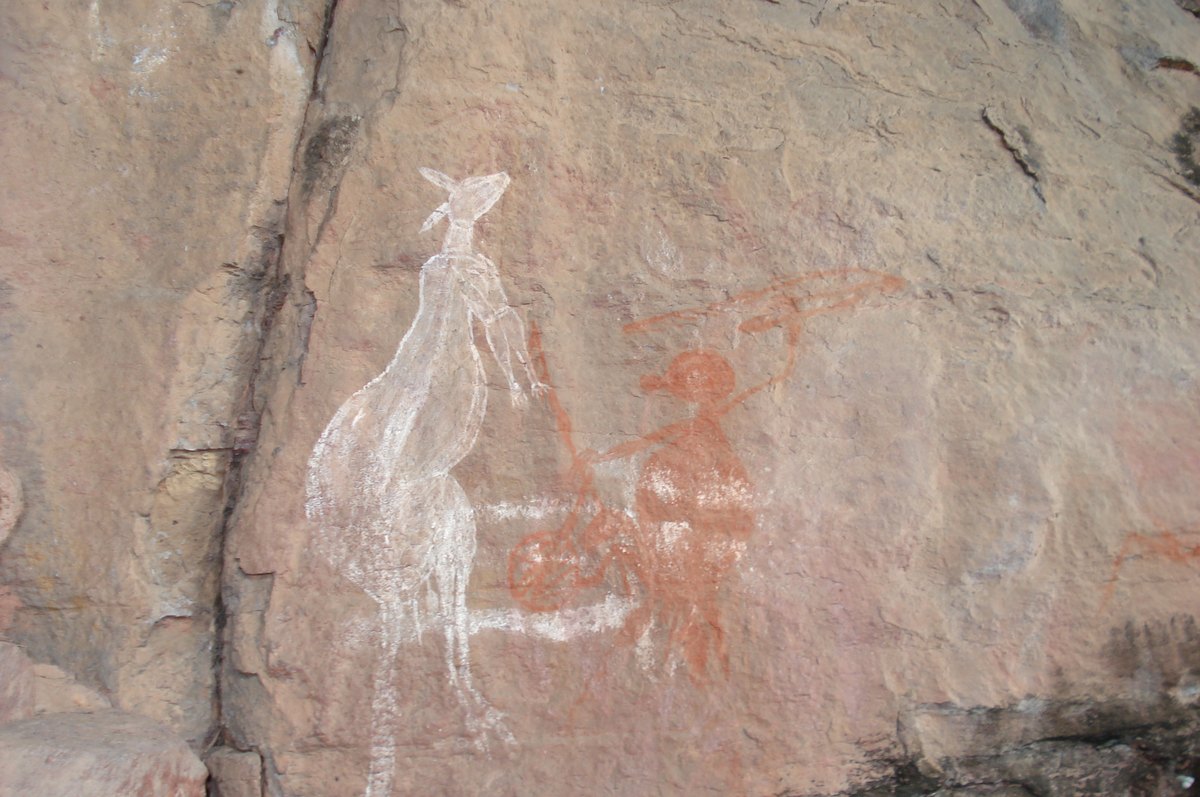
These first Australians brought with them technologies and knowledge developed in Africa: ochre working for symbolic painting (attested from 100,000 years ago at other African sites), obsidian knappingknappingThe set of operations for fracturing a stone block to extract flakes or blades.→, and composite tool-making. On Australian soil, they developed their own artistic tradition, adapted to local materials, the animals of their environment, and their worldview: the Dreamtime cosmology, a complex framework in which mythical ancestors shaped the landscape and established the laws of society.
Kakadu: 5,000 Sites, a 50,000-Year Gallery
Kakadu National Park, a UNESCO World Heritage Site since 1981, is one of the most important rock art sites on the planet. More than 5,000 sites are recorded there, with works spanning at least 20,000 years -- and probably much longer. The rock shelters at Ubirr and Nourlangie Rock contain some of the most striking examples: animals painted in "X-ray" style, with their bones and internal organs visible inside -- an artistic convention unique to the Arnhem Land tradition, reflecting remarkably precise anatomical observation.
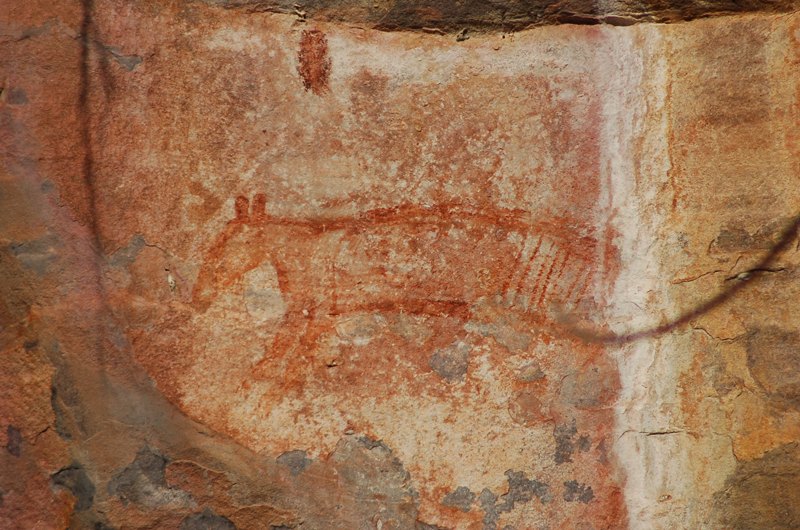
One of Kakadu's most moving discoveries is the presence of the thylacine -- the "Tasmanian tiger" -- in the Ubirr paintings. This large carnivorous marsupial, resembling a striped dog, disappeared from mainland Australia around 3,000 years ago (and from Tasmania in 1936). Its presence in rock art means these paintings date back at least that far. Other representations may depict even older extinct megafaunaMegafaunaThe very large animals (mammoths, giant ground sloths, etc.) of the Pleistocene, most of which became extinct at the end of the last ice age.→, such as the diprotodon -- a marsupial the size of a rhinoceros that vanished 46,000 years ago.
Wandjina and Gwion Gwion: Two Traditions of the Kimberley
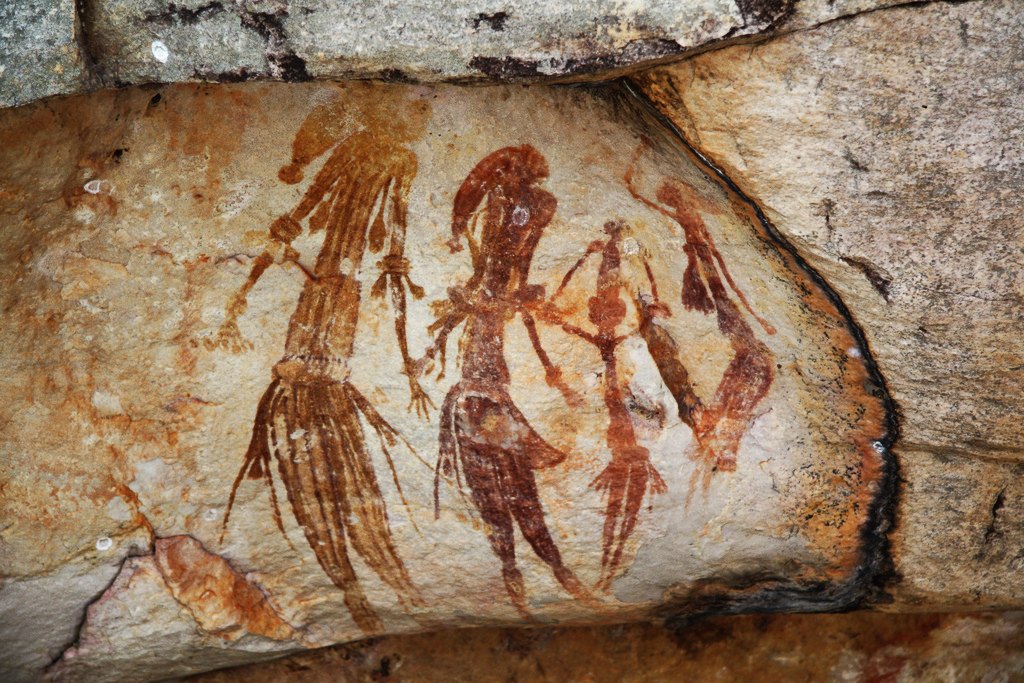
The Kimberley region of Western Australia is home to two of the most mysterious and evocative pictorial traditions in the world. Gwion Gwion figures (formerly called Bradshaw paintings, after the European settler who discovered them in 1891) depict slender, richly adorned figures shown in motion. Dated by some researchers to at least 17,000 years ago -- based on carbon-14 dating of wasp nests overlying the paintings -- these highly stylized figures differ so radically from later Aboriginal art that their origin has long been debated.
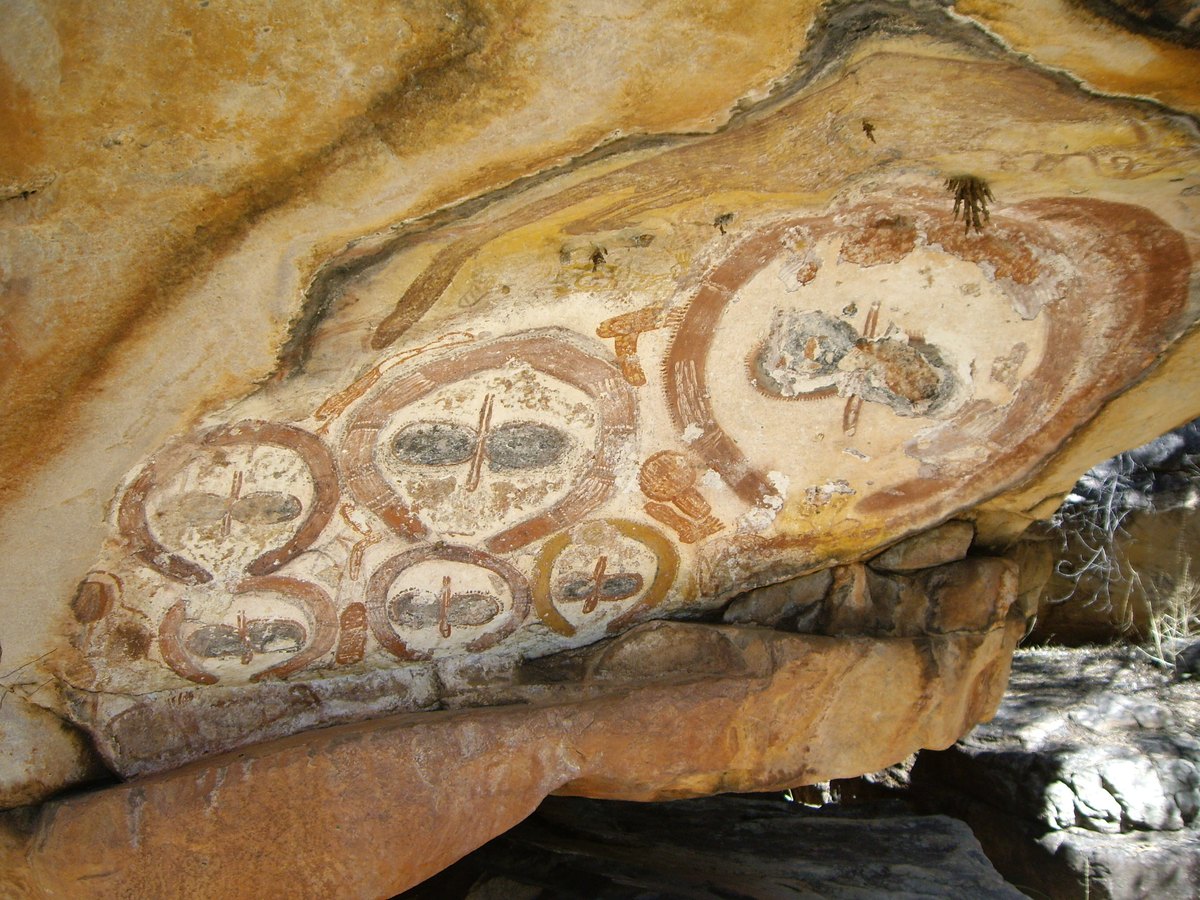
The Wandjina are monumental supernatural beings: large round or oval faces, without mouths, surrounded by halos reminiscent of monsoon clouds. Associated with rains and fertility, they dominate the cosmology of the Worrora, Ngarinyin and Wunambul peoples. Unlike other rock art traditions, Wandjina images are still actively renewed by clan custodians: artists periodically repaint older images to revive their spiritual power. This ritual renewal makes the Kimberley a living space, where rock art is not a dead heritage but an ongoing practice.
The World's Most Threatened Heritage
The petroglyphs of Murujuga (Dampier Archipelago, Western Australia) constitute the largest concentration of rock engravings on the planet: more than one million figures carved into red basalt, some possibly dating back 50,000 years. But this exceptional site has faced intense industrial pressure since the 1960s: a liquefied natural gas processing plant borders the classified site. Industrial acids, heat and vibrations are gradually degrading the engravings. In 2022, a bid for UNESCO World Heritage status relaunched debate over the balance between economic development and preservation of the past.
More broadly, Australian rock art is threatened by climateClimateThe long-term average atmospheric conditions of a region; its variations (glaciations, aridifications) shaped migrations, agriculture and the collapse of prehistoric societies.→ change, bushfires (including the catastrophic 2019-2020 fires), erosion and uncontrolled tourism. 3D digitization programs now allow these treasures to be archived before further deterioration. Aboriginal communities are increasingly involved in managing these sites, restoring a direct link between traditional custodians of knowledge and heritage protection. For these works do not belong to the past: they are alive, meaningful, and continue to speak to those who hold the key.
No comments yet. Be the first.