On August 15, 2008, nine-year-old Matthew Berger followed his father, paleoanthropologist Lee Berger, into the South African veld near Malapa. When the boy tripped over a rock, his father recognized a fossilized clavicle. This chance discovery launched one of the most significant finds in 21st-century paleoanthropology: Australopithecus sediba.
Malapa Cave: A Death Trap
Malapa was a collapse cave that trapped animals seeking water approximately 1.977 million years ago. Their bodies were rapidly buried by calcareous sediments, producing exceptional fossil preservation1. Two main specimens were recovered: MH1, a young male aged 12-13 with a nearly complete skull and 420 cc brain capacity, and MH2, an adult female with partial postcranial remains. Uranium-lead dating yields a remarkably precise age of 1.977 +/- 0.002 million years2.
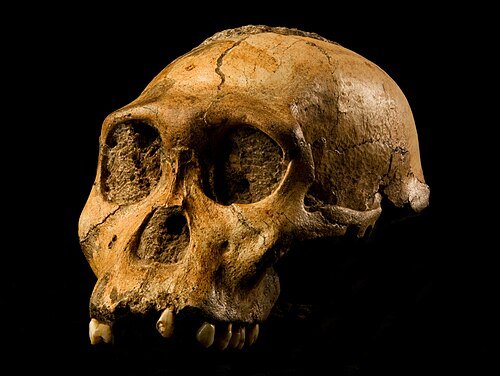
A Unique Mosaic Anatomy
Australopithecus sediba presents an unprecedented combination of archaic australopith features (small brain, large canines, long arms) and derived Homo-like traits: a pelvis shaped like a human birth canal, a hand with a long opposable thumb suited for precision grip, and a reorganized brain with relatively developed frontal areas3. This mosaic makes sediba a compelling but controversial candidate for the ancestor of Homo.
Ancestor of Homo or Parallel Evolution?
The proposal that sediba is ancestral to Homo erectus faces a chronological problem: Homo habilis and Homo rudolfensis teeth from Ethiopia are dated to 2.8-2.4 million years4, predating sediba's 1.977 Ma. This leaves three possibilities: sediba represents a parallel South African lineage with convergent Homo-like features; it is ancestral to an as-yet-unidentified African Homo species; or early Homo dates from Ethiopia are imprecise. The debate remains open.
No comments yet. Be the first.