A discovery that unsettles the story of our origins
For a long time, archaeology textbooks reserved personal ornament, pigment and body decoration for our species alone, Homo sapiensHomo sapiensThe present-day human species, which emerged in Africa around 300,000 years ago, the only surviving human lineage after the extinction of Neanderthals and Denisovans.→, as if the taste for symbols had emerged late and exclusively with modern humans. The NéandertalNeanderthalsA fossil humanity of Eurasia, robust and cold-adapted, extinct around 40,000 years before present.→ was cast in the thankless role of the sturdy but crude cousin, skilled at hunting and knappingknappingThe set of operations for fracturing a stone block to extract flakes or blades.→ stone yet lacking the aesthetic spark we believed was ours alone. The Cueva de los Aviones, a small cavity on the coast of south-eastern Spain, has helped to crack that picture for good. Excavations at the site yielded pierced marine shells, remains of red and yellow pigments, and shell containers still lined with colouring residues. All of it was sealed beneath a floor of calcitecalciteCrystalline form of calcium carbonate that makes up cave concretions (stalactites, stalagmites, flowstone).→ dated to about 115,000 years ago, at a time when only the NéandertalNeanderthalsA fossil humanity of Eurasia, robust and cold-adapted, extinct around 40,000 years before present.→ occupied the Iberian Peninsula.
The significance of this discovery is considerable. If Neanderthal hands pierced shells to suspend them, prepared pigment mixtures and handled colouring materials tens of thousands of years before comparable evidence appeared in AfricaAfricaThe cradle of humankind: the continent where the first hominins appeared, then Homo sapiens around 300,000 years ago, before the expansion to the rest of the world.→ or Europe with Homo sapiens, then the idea of a cognitive monopoly held by our species begins to waver. Published in 2018 in the journal Science Advances by Dirk Hoffmann, João Zilhão and their colleagues, these results invite us to rethink what it means to be human, and to ask to whom the adventure of the symbol truly belongs1. This article revisits the facts, the method and the caution needed to interpret these remains fairly.
Cueva de los Aviones, a key site in south-eastern Iberia
The Cueva de los Aviones lies near Cartagena, in the Murcia region, on a coast today carved into cliffs and inlets. When Neanderthals frequented it, sea level and the shoreline differed from present conditions, but the sea remained close enough for its inhabitants to have direct access to coastal resources. This proximity is essential, because it explains the presence at the site of numerous marine mollusc shells, gathered alive or already dead on the foreshore and then carried into the cavity. The site belongs to a set of Iberian caves that, over the past two decades, have profoundly renewed our view of the last Neanderthal populations of Western Europe4.
The archaeological deposit that concerns us lay beneath a layer of calcite, a mineral formation that builds up slowly from carbonate-rich water circulating through the rock. This crust acted as a natural lid, protecting and above all sealing the underlying remains. Everything lying beneath this stalagmitic floor is necessarily older than the floor itself. This stratigraphic configuration, where a dated mineral layer caps an archaeological layer, offers researchers a precious chronological guarantee, provided the calcite itself is correctly dated. That is precisely what the team set out to do, using methods we shall detail further on.
The objects recovered are not a handful of isolated finds. They include shells of several species, blocks and powders of pigment, and natural receptacles fashioned from mollusc valves. This coherent assemblage, combining colouring matter with supports for ornaments, reinforces the idea that we are not dealing with mere taphonomic accidents but with a set of deliberate, repeated human activities.
Pierced marine shells, turned into ornaments
The heart of the discovery lies in the pierced marine shells. Several shells show perforations that are not easily explained by natural wear alone, by the action of the waves, or by predation from other marine animals. The position, shape and regularity of these holes instead suggest an intention, that of hanging the object from a cord. A pierced shell can be threaded onto a string to form a necklace, sewn onto a hide garment, or fastened in the hair. In every case it ceases to be a simple shell fragment and becomes an element of body ornament, worn and displayed.
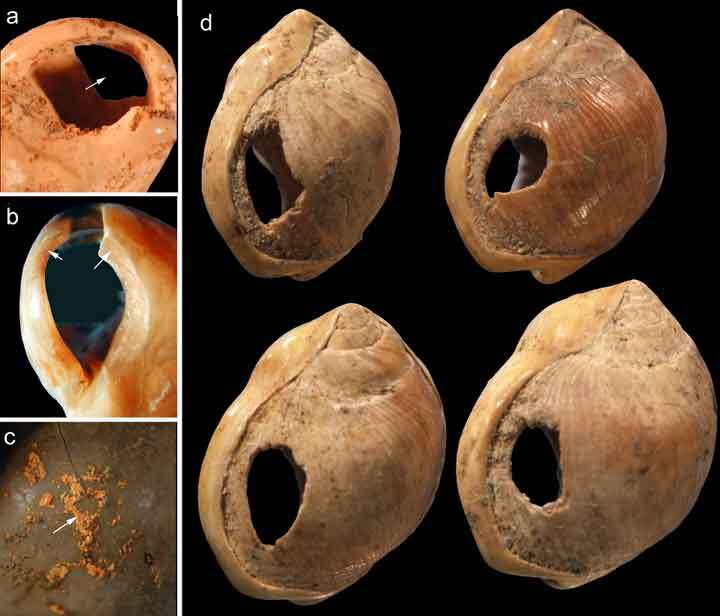
This apparently ordinary act in fact involves a complex chain of operations. One must first select suitable shells, neither too fragile nor too thick, then make the perforation without breaking the object, which implies fine control of the gesture and no doubt the use of a pointed tool. One must then have a cord, tendon, plant fibre or leather strip, to suspend the piece. Each of these stages testifies to transmitted know-how and to a purpose that goes beyond mere survival. An ornament is not eaten, nor used to hunt or to guard against the cold. Its function lies elsewhere, in the register of communication, of belonging, or of self-display.
The fact that such ornaments have been observed elsewhere in Iberian contexts, notably in other caves that have yielded worked and coloured shells, supports the idea of a shared practice rather than an isolated accident. The Neanderthals of the region seem to have maintained a particular relationship with marine resources, not only for food but also for adornment, which considerably widens the portrait we can draw of their abilities3.
Ochre, a mastered colouring material
Alongside the shells, the Cueva de los Aviones yielded pigments, and in particular ocreOchreA red or yellow mineral pigment (iron oxides), used from prehistoryPrehistoryThe span of human history before the invention of writing, from the Palaeolithic to the Metal Ages, known mainly through material remains.→ for adornment, funerary rites and art.→. Ochre denotes a family of colouring earths rich in iron oxides, whose hue ranges from yellow to dark red depending on their composition and on whether they are heated. At the site, researchers identified red and yellow pigments, but also, more remarkably, residues of complex mixtures preserved inside shell containers. These natural receptacles thus served as small dishes in which colouring materials were prepared, combined and perhaps stored.
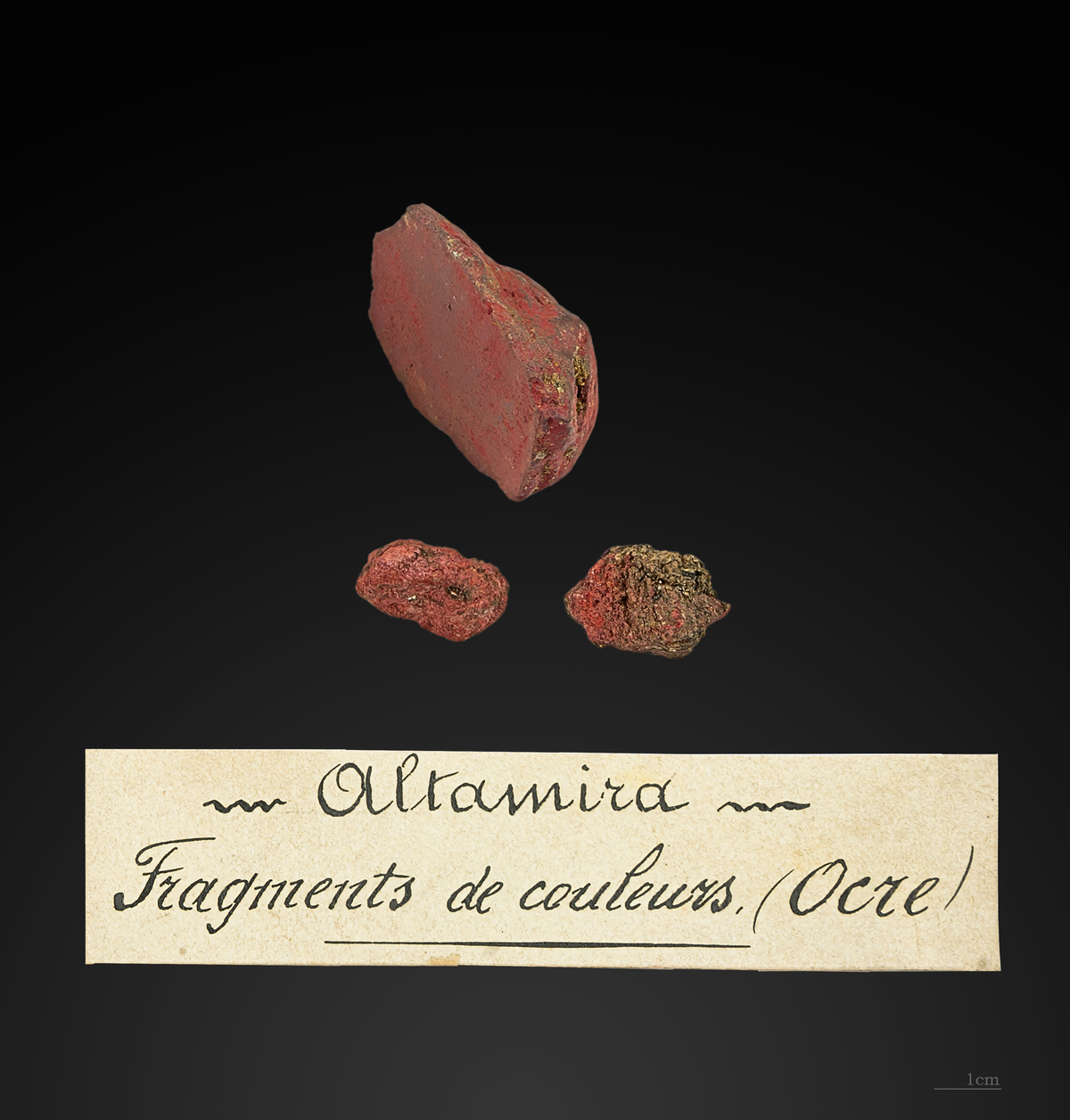
The presence of mixtures is a precious clue. Combining several pigments, possibly with other mineral materials to alter shine or texture, implies a precise aesthetic or technical intention. One does not simply grab the first red earth to hand; a preparation is elaborated, which brings this behaviour close to the making of genuine recipes. This mastery of pigment immediately recalls the famous ochre-processing workshops documented in the Middle Stone AgeMiddle Stone AgeA long phase of African prehistory (c. 300,000 to 40,000 years ago), the African equivalent of the Middle Palaeolithic, marked by the rise of symbolic behaviour.→ of southern Africa, associated there with Homo sapiens, where colouring materials were prepared and stored in abalone shells. The comparison is striking and underlines a parallelism of behaviours between two distinct human lineages2.
What was this ochre for? The hypotheses are many and not mutually exclusive. The pigment could decorate the shells themselves, heightening the brilliance of an ornament. It could be applied to the body, to the skin or the hair, in an act of body painting. It could enter into more technical uses, such as the treatment of hides or the haftinghaftingThe way a blade or point is fixed onto a handle or shaft, a key stage in making a composite tool.→ of tools. The truth probably lies in a bundle of uses, but the preservation of mixtures in dedicated containers weighs strongly in favour of an ornamental and intentional dimension.
115,000 years, uranium-thorium datinguranium-thorium datingDating method measuring, in calcite, the ratio of uranium to the thorium produced by its decay, effective up to nearly 500,000 years.→
The strength of the demonstration rests on the dating. Without a reliable age, a pierced shell is merely a curiosity; with a firmly established age, it becomes a milestone in the history of humanity. To date the site, the team turned to datation uranium-thoriumUranium-thorium datingA method dating calcite formations (stalagmites, flowstones) via uranium decay into thorium; useful beyond the range of radiocarbon.→, a radiometric method particularly suited to calcite formations such as the stalagmitic floor that sealed the deposit. The principle rests on the radioactive decay of uranium into thorium. Uranium is soluble in water and is deposited with the calcite, whereas the thorium produced is not. By measuring the ratio between the remaining uranium and the accumulated thorium, one can work back to the moment the calcite formed.
The analyses gave an age of between 115,000 and 120,000 years for the crust that covered the remains. Since this crust was deposited after the archaeological deposit was abandoned, the shells, pigments and containers lying beneath it are necessarily older still, or at least contemporary with the end of their burialBurialThe intentional deposition of a body, sometimes with offerings; a marker of symbolic behaviour.→. This stratigraphic logic, in which the dated mineral provides a minimum age for what it covers, forms the backbone of the chronological argument. Here datation uranium-thoriumUranium-thorium datingA method dating calcite formations (stalagmites, flowstones) via uranium decay into thorium; useful beyond the range of radiocarbon.→ has the advantage of covering a far wider window of time than radiocarbon dating, which tops out around 50,000 years and could therefore not reach such antiquity.
This age of 115,000 years places the discovery in a striking perspective. It predates by 20,000 to 40,000 years the comparable evidence generally associated with modern humans. In other words, at the moment these Neanderthals were piercing shells and preparing pigments on the Iberian coast, our own species had not yet left, or not yet so clearly, equivalent traces in the regions where it is documented. This chronological gap lies at the heart of the study's impact1.
Néandertal, the only possible actor
One point is decisive for the interpretation. At the time in question, around 115,000 years before present, the Iberian Peninsula was inhabited only by the NéandertalNeanderthalsA fossil humanity of Eurasia, robust and cold-adapted, extinct around 40,000 years before present.→. Homo sapiens had not yet arrived in Western Europe, where its presence is firmly attested only much later. As a result, there is no alternative candidate to explain the pierced shells and pigments of Aviones. These objects are the work of Neanderthals, and not the result of a more recent occupation or a mixing of populations. This exclusivity is what gives the discovery its full demonstrative force.

This observation compels us to revise a stubborn image. The NéandertalNeanderthalsA fossil humanity of Eurasia, robust and cold-adapted, extinct around 40,000 years before present.→ was not a being confined to strictly utilitarian gestures. The data accumulated in recent years instead sketch the portrait of a humanity with developed cognitive abilities, capable of planning, of transmitting know-how and, as Aviones suggests, of ornamentation and aesthetic manipulation of matter. Far from the archetype of the brute, these populations shared with us a set of skills once thought reserved for our lineage alone.
It should be stressed that the NéandertalNeanderthalsA fossil humanity of Eurasia, robust and cold-adapted, extinct around 40,000 years before present.→ and Homo sapiens share a relatively recent common ancestor on the scale of human evolution. The possibility that certain symbolic behaviours were inherited from this common ancestor, rather than invented independently by each lineage, deserves to be raised. Aviones does not settle this debate definitively, but it provides a weighty argument by demonstrating the antiquity and autonomy of the Neanderthal repertoire.
Symbolic behaviour, what can be said and what remains unknown
Here a rigorous distinction must be drawn between the observed facts and their interpretation. The facts are solid and material. Shells were pierced. Red and yellow pigments were gathered. Colouring mixtures were prepared and preserved in shell containers. A calcite floor dated by datation uranium-thoriumUranium-thorium datingA method dating calcite formations (stalagmites, flowstones) via uranium decay into thorium; useful beyond the range of radiocarbon.→ seals the whole around 115,000 years. These elements are not open to major dispute, because they rest on direct observations and on reproducible measurements1.
The interpretation in terms of comportement symboliqueSymbolic behaviourA set of practices (adornment, pigments, art, burial) reflecting symbolic thought; long ascribed to Homo sapiens alone, now attested for Neanderthals too.→ is, by contrast, of another nature. To say that an ornament is symbolic is to assert that it carried a shared meaning, that it signalled, for example, belonging to a group, a status, an identity, a belief. Yet the exact meaning these Neanderthals attached to their coloured shells escapes us and will no doubt always escape us. We observe the gesture and its product, but we have no access to the subjective intention nor to the cultural code that underpinned it. This is why the word symbolic must be handled with caution, as a reasonable interpretive hypothesis and not as a fact demonstrated in the same way as the perforation of a shell.
This caution does not weaken the discovery; it makes it more rigorous. The scientific approach consists precisely in separating what is measured from what is inferred. The material evidence for a comportement symboliqueSymbolic behaviourA set of practices (adornment, pigments, art, burial) reflecting symbolic thought; long ascribed to Homo sapiens alone, now attested for Neanderthals too.→ is here among the oldest and most convincing attributed to the NéandertalNeanderthalsA fossil humanity of Eurasia, robust and cold-adapted, extinct around 40,000 years before present.→, but it remains a reading of the remains, an interpretation supported by converging clues rather than an absolute certainty. To acknowledge this limit is to remain faithful both to the data and to the critical spirit that gives research its value.
Significance and prospects
Beyond the particular case of Aviones, this discovery is part of a broader movement rehabilitating Neanderthal abilities. In recent years, several European sites have yielded evidence of ornamental practices, of pigment use, even of wall markings attributed to Neanderthals. Taken in isolation, each of these clues might invite doubt; brought together, they trace a coherent trend. The NéandertalNeanderthalsA fossil humanity of Eurasia, robust and cold-adapted, extinct around 40,000 years before present.→ now appears as a humanity fully endowed with what is called behavioural modernity, or at least with a large part of its components.
The comparison with the Middle Stone Age of southern Africa is particularly illuminating. On that continent, groups of Homo sapiens prepared ocreOchreA red or yellow mineral pigment (iron oxides), used from prehistory for adornment, funerary rites and art.→, pierced shells and engraved geometric motifs at periods close to or slightly more recent. To observe analogous behaviours in two separate human lineages, in Neanderthal Iberia and in sapiens Africa, suggests either a deep common inheritance or a remarkable convergence of cognitive trajectories. In both cases, the boundary once drawn between them and us blurs and loses its sharpness.
Yet the field remains open and alive. The dating of very ancient sites, the exact nature of the perforations, the precise function of the pigments continue to be the subject of debate and reassessment. New excavations, new physico-chemical analyses and new dating methods will refine, qualify or reinforce the picture. The Cueva de los Aviones is not a full stop but a landmark stage, a place where the NéandertalNeanderthalsA fossil humanity of Eurasia, robust and cold-adapted, extinct around 40,000 years before present.→ reminds us that the history of the symbol, of ornament and of colour is older, more shared and more deeply human than we had imagined2.
Je retrouve ici exactement l'univers que j'essaie de reconstituer dans mes parties de jeux historiques.