A Celtic warrior unearthed beneath a future solar park
In central Germany, not far from the small town of Bad Camberg in the state of Hesse, archaeologists have uncovered the grave of a Celtic elite figure buried roughly 2,500 years ago. The discovery came during preventive investigations carried out before the construction of a solar park, part of the routine checks that precede any major building project. What began as an ordinary survey turned into one of the region's most striking finds of the Iron AgeIron AgeThe last period of protohistoryProtohistoryThe transitional period between prehistory and history, covering societies without their own writing but known through external texts.→ (from c. 1200 BC in Europe and the Near EastNear EastA region of western Asia (Levant, Mesopotamia, Anatolia, Iran), cradle of the Neolithic revolution, agriculture, the first cities and writing.→), marked by iron metallurgyMetallurgyThe techniques of extracting and working metals (copper, bronze, gold); its rise in the Eneolithic and Bronze Age transformed tools, weapons and social hierarchies.→ and the first kingdoms.→. Announced in 2026 by the regional archaeology service of Hesse, the burialBurialThe intentional deposition of a body, sometimes with offerings; a marker of symbolic behaviour.→ offers some of the strongest evidence yet assembled for the existence, on these lands, of a local ruling aristocracy during the early La TèneLa TèneThe European second Iron Age (c. 450-50 BC), named after a Swiss site; the Celtic apogee, curvilinear art, oppida and coinage.→ period1.
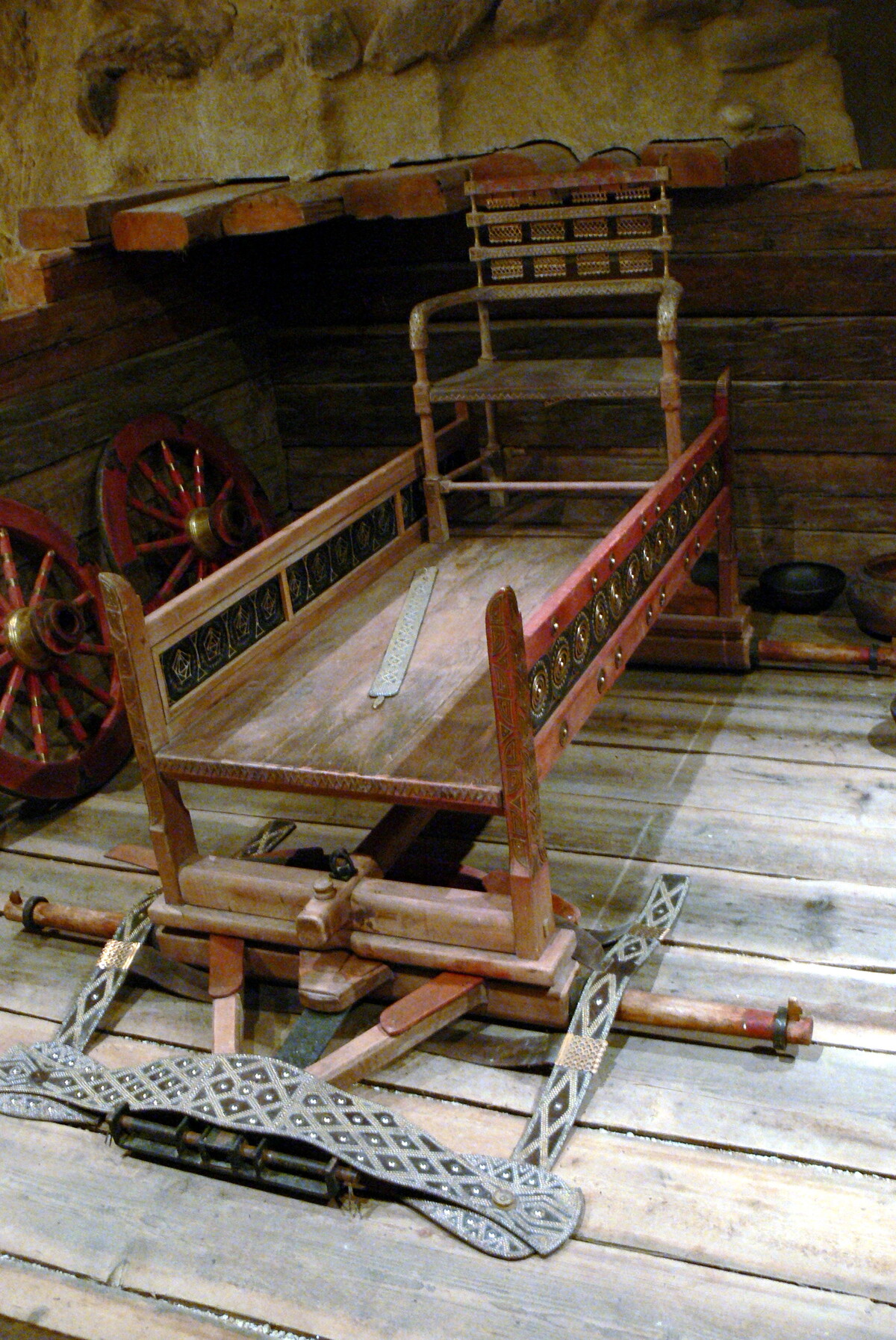
A team from the firm SPAU GmbH carried out the excavation in about two weeks, allowing the construction project to resume without major interruption. The deceased's skeletal remains did not survive the passage of time: neither bone nor teeth endured in the acidic soil. It is therefore the objects placed around the body, the grave goods, that speak in place of the departed. And they tellTellAn artificial mound formed by the accumulation of successive layers of settlement remains at the same spot, typical of the Near East. Each destruction-rebuilding event adds a stratum.→ a story of rank, wealth and distant connections. From the very first geophysical surveyGeophysical surveyTechniques (magnetometry, radar) detecting buried structures underground without digging, by measuring physical anomalies.→ of the ground, a circular anomaly had aroused the researchers' suspicions, hinting at the possible presence of an elite grave. No one, however, imagined what the earth would ultimately reveal.
The chariot, a surprise in the soil of Hesse
The true revelation of the excavation was the presence of a two-wheeled chariot, buried beside the deceased. The wood of the vehicle has vanished entirely, devoured by the centuries, but the metal fittings held firm and still trace the position of the wheels, hubs and axle. Fittings from two wheel hubs, axle caps and iron wheel-rim fragments were recovered, confirming without ambiguity that a vehicle accompanied the dead into his final resting place2. "Even after the geophysical survey of the planned area, we speculated about the possible presence of a Celtic elite grave. However, nobody expected that we would ultimately find not only a princely grave, but even a chariot burial," summed up Kai Mückenberger, district archaeologist for the Limburg-Weilburg district.
Chariot burialsChariot burialA protohistoric elite grave containing a chariot (two or four wheels), a marker of rank among the Celts.→ are extremely rare in Hesse. Only a handful of examples had been identified before, and officials from the regional archaeology service state that none matches the quality of the Bad Camberg grave. To preserve the most fragile objects, the excavators removed certain sections of soil as intact blocks, so that they could be studied slowly in a laboratory. That caution is already bearing fruit: X-rays and computed tomography scans have detected additional objects hidden inside these blocks of earth, items that have not yet been fully uncovered or identified. The chariot, a symbol of mobility and prestige, was no mere means of transport. Among the CeltsCeltsA set of Iron Age peoples sharing related languages and cultures, spread from central Europe to the Atlantic.→, it embodied the status of the warrior, his ability to move, to fight and to command, and it was meant, in funerary imagination, to carry the deceased toward the next world.
Gold at the neck, arms and fingers
The grave goods discovered in the burial point plainly to a person of high social standing. Archaeologists recovered several pieces of gold jewelry, among them rings likely worn on the fingers, as well as ornaments intended for the arms and the neck. Such objects are rare in Celtic burials of this period and lend the discovery an exceptional dimension1. Gold, an unalterable and gleaming metal, was not limited to a decorative function: it displayed its wearer's place at the summit of the hierarchy, a rank that death itself was not meant to erase.
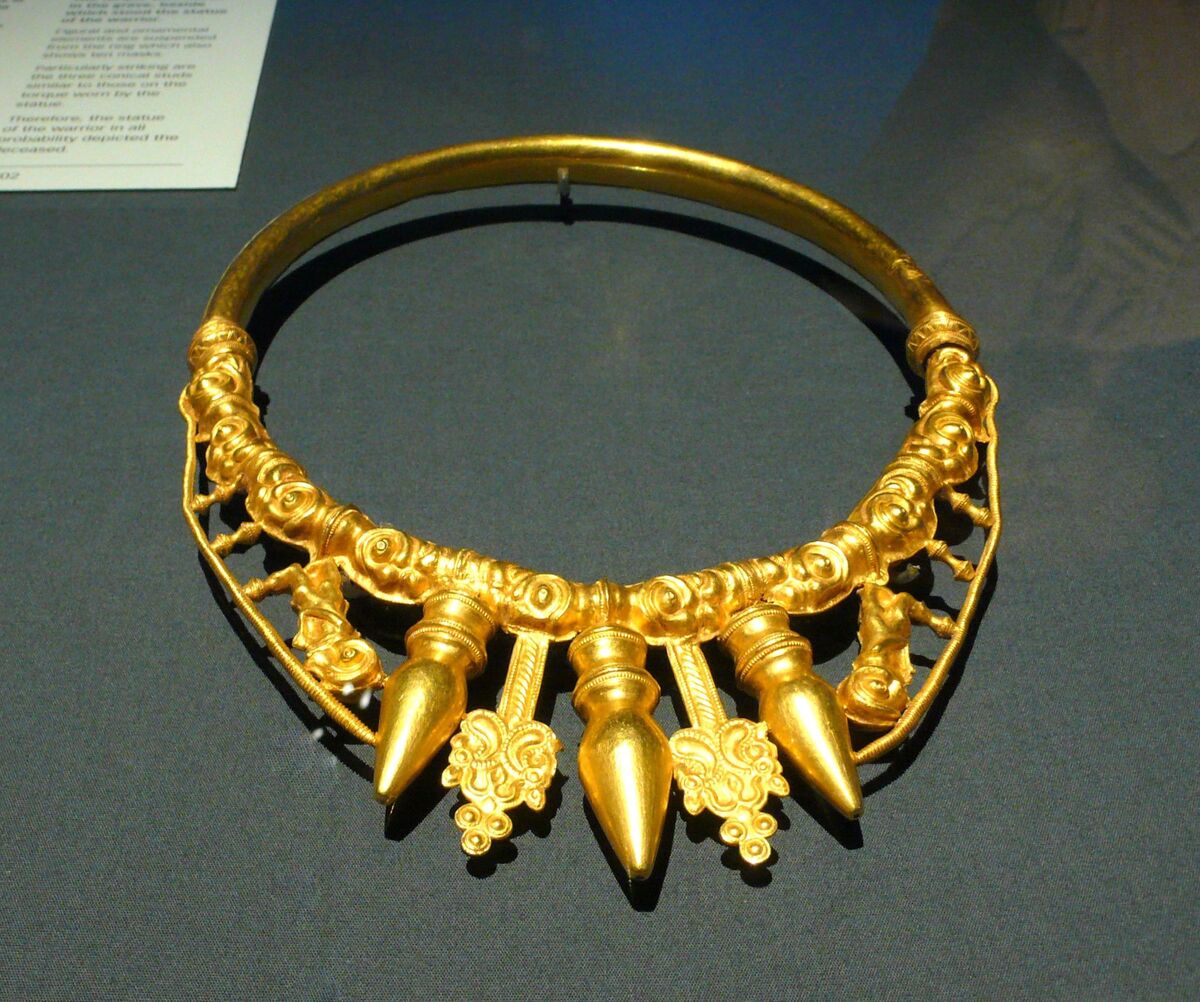
To these jewels were added weapons, further markers of the deceased's status. Spearheads and a knife were brought to light, and it was in fact an iron spearhead that was the very first object recovered from the site, almost like a signature announcing the martial nature of the grave. Since no bone or tooth survived, it is impossible to confirm directly the sex or age of the individual. Nevertheless, the whole assemblage, weapons and ornaments combined, led researchers to describe the burial as that of an elite male warrior. La Tène goldsmithingGoldsmithingThe art of working precious metals (gold, silver) into jewellery, vessels and ornaments; the Maikop kurgans are among the earliest evidence of elite goldsmithing.→ testifies to a refined craftsmanship, in which worked gold joined bronze, iron and coral in a visual language reserved for the powerful. Each ring, each torc, took part in a staging of power that extended into the grave itself.
An Etruscan jug from beyond the Alps
Among the most notable finds is a beaked jug, an oinochoe, imported from Etruria in present-day Tuscany, Italy. This bronze vessel, fashioned hundreds of miles from Hesse, is one of the most eloquent signs of the trade network that linked the Celtic world to the Mediterranean2. Such objects were highly prized during the Iron Age and travelled over long distances across Europe. Comparable vessels have already been reported at Glauberg, one of Germany's best-known Celtic sites, which places Bad Camberg within a geography of connected elites.
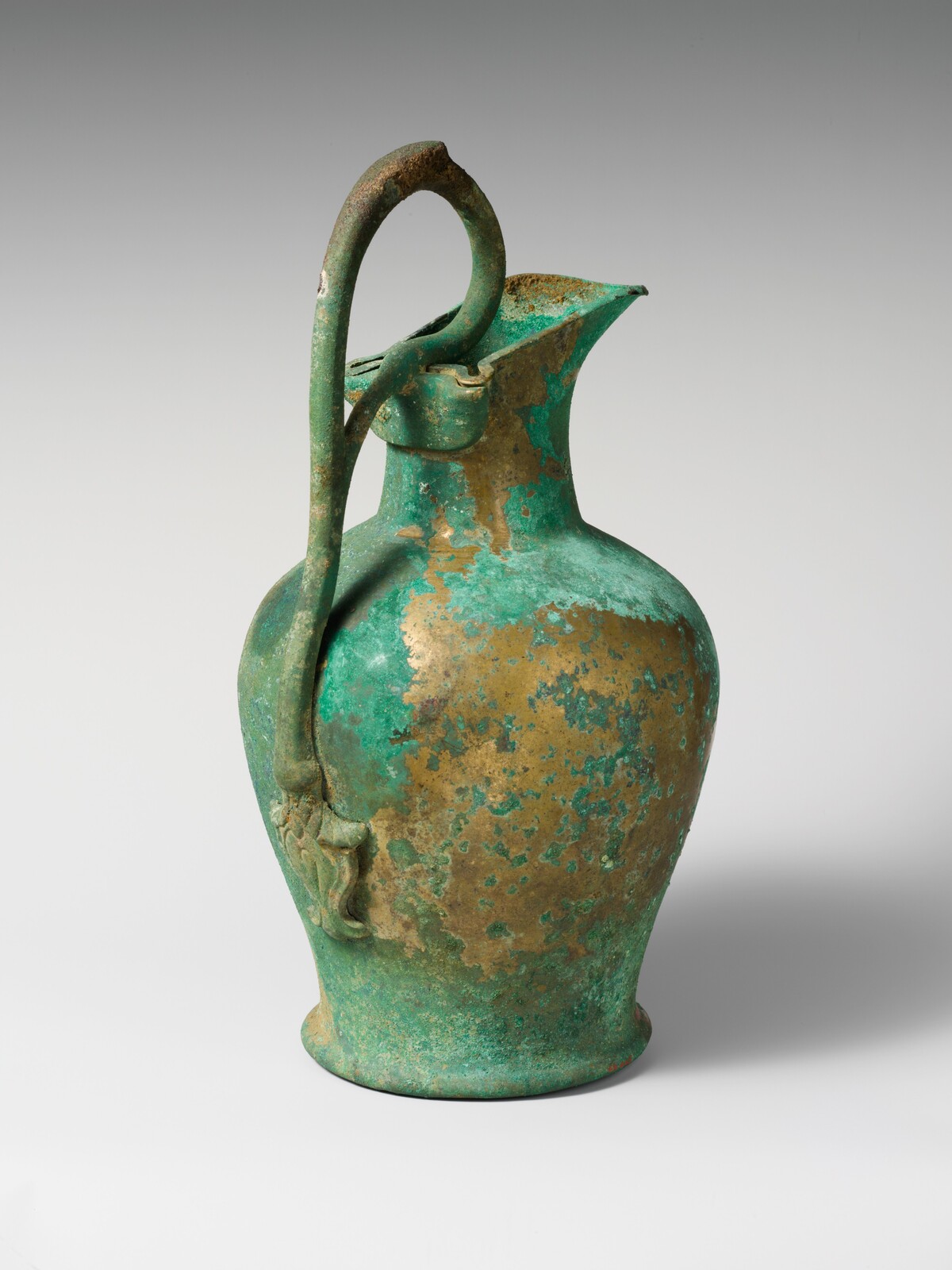
The presence of this imported jug shows that the inhabitants of present-day Hesse maintained contact with communities linked to the Mediterranean world. It points toward relations with populations settled south of the Alps and suggests that the deceased belonged to a wealthy and well-connected group. These vessels were not mere containers: they belonged to the aristocratic culture of the feast, where Mediterranean wine, served in prestige tableware, sealed alliances and hierarchies. To drink in the manner of the elites of the South was to display one's belonging to a narrow circle, that of the powerful able to procure the most distant goods. The Bad Camberg oinochoe is thus far more than an object: it is the material witness of a diplomacy of prestige that crossed the Alps.
Chariot burials, a common thread of Celtic Europe
The Bad Camberg grave belongs to a long funerary tradition that runs across Iron Age Europe, that of chariot burials. These graves, in which a chariot or wagon accompanies the deceased, appear as early as the final Hallstatt phase and continue into the beginning of La Tène. They are found from France, with the Arras culture of British Yorkshire that derives from them, to Germany, by way of sites that have become emblematic. In France, the rich graves of Lavau and Vix yielded cauldrons, imported vessels and sumptuous ornaments that overturned the understanding of Celtic societies3. The burial of the Lady of Vix, in particular, with its immense Greek bronze krater, showed how fully these elites took part in exchange networks on a continental scale.
Placing a chariot in a grave was no trivial gesture. It mobilised considerable resources and presupposed the work of specialised craftsmen, capable of forging the wheel rims, assembling the hubs and fitting the axle. Dismantling or laying the vehicle in the pit was a codified ritual, in which each metal piece played a role. Whether the chariot was actually used by the deceased in life or specially made to accompany him in death, it proclaimed an extraordinary status. Across Europe, these burials draw the map of a warrior aristocracy that shared common codes, similar tastes and the same will to inscribe its power in stone, metal and earth. Bad Camberg enriches this constellation, adding a new landmark in an area where such graves remained exceptional.
In the wake of the Prince of Glauberg
The Bad Camberg grave dates to roughly the same period as the famous burial of the Prince of Glauberg, a major figure of Celtic Hesse whose discovery in the 1990s transformed the understanding of Iron Age societies in the region. At Glauberg, archaeologists unearthed richly furnished graves, followed in 1996 by the discovery of a nearly life-size sandstone statue depicting a warrior4. This effigy, dated to the fifth century BCE, shows a man wearing armor, a torc at the neck and a leaf-shaped headdress, a set of attributes also found in the grave goods of the neighboring burials.
The comparison with Glauberg is compelling, yet it calls for nuance. The Bad Camberg burial contains fewer luxury goods than that of the Prince of Glauberg. The two graves, however, appear linked to the same social stratum, that of an elite whose members held influence and prestige within Iron Age communities. For the officials of Hessian archaeology, the discovery provides direct proof of what researchers had long suspected without being able to establish: the existence of a local Celtic elite around Bad Camberg, whose traces had until now remained too faint. The burial now confirms that high-ranking individuals lived in this part of Hesse during the fifth century BCE, filling a gap in the map of regional Celtic power. It also sheds light on the culture of aristocratic feasting, those banquets where imported wine was served in Mediterranean tableware to assert one's rank.
What the grave will never tell
Despite its wealth, the Bad Camberg burial demands caution. The precise identity of the deceased will remain forever unknown: without bone or teeth, no genetic or isotopic analysis will be able to restore his face, his origin or his personal history. The terms "prince" or "princess," often used to evoke these lavish graves, are convenient shorthand rather than proven titles. As specialists remind us, calling a grave "princely" in no way proves that the person buried there held a formal royal title. Researchers use the word to designate the sumptuous burials of the Iron Age, those that contain weapons, bronze vessels and decorated chariots, so many markers of status.
At Bad Camberg, the gold and the chariot marked the deceased as an important figure, while the weapon fragments led archaeologists to describe him as a warrior. The Etruscan jug, for its part, points toward connections with communities south of the Alps. But it is, strictly speaking, an elite burial, not an identified throne. Research is continuing: scholars are now opening the remaining blocks of soil and studying the objects they hold, while X-ray and CT imaging continues to reveal pieces still buried. Each fragment may enrich the story of the man buried there and of the community that placed a chariot at his side. His name and the wooden frame of his vehicle are gone, but the metal fittings still mark the position of the vehicle meant to carry him into the afterlife. Through these remains, a whole Celtic society of central Germany can be glimpsed, with its hierarchies, its distant trade, its craftsmanship and its funerary traditions, at a time when the Celts played a leading role across much of Europe.
Votre site a remplacé les magazines culturels que j'achetais avant. Plus à jour, et gratuit en plus.
Passionnant. J'avais jamais vraiment creusé ce sujet. Maintenant je veux aller plus loin.