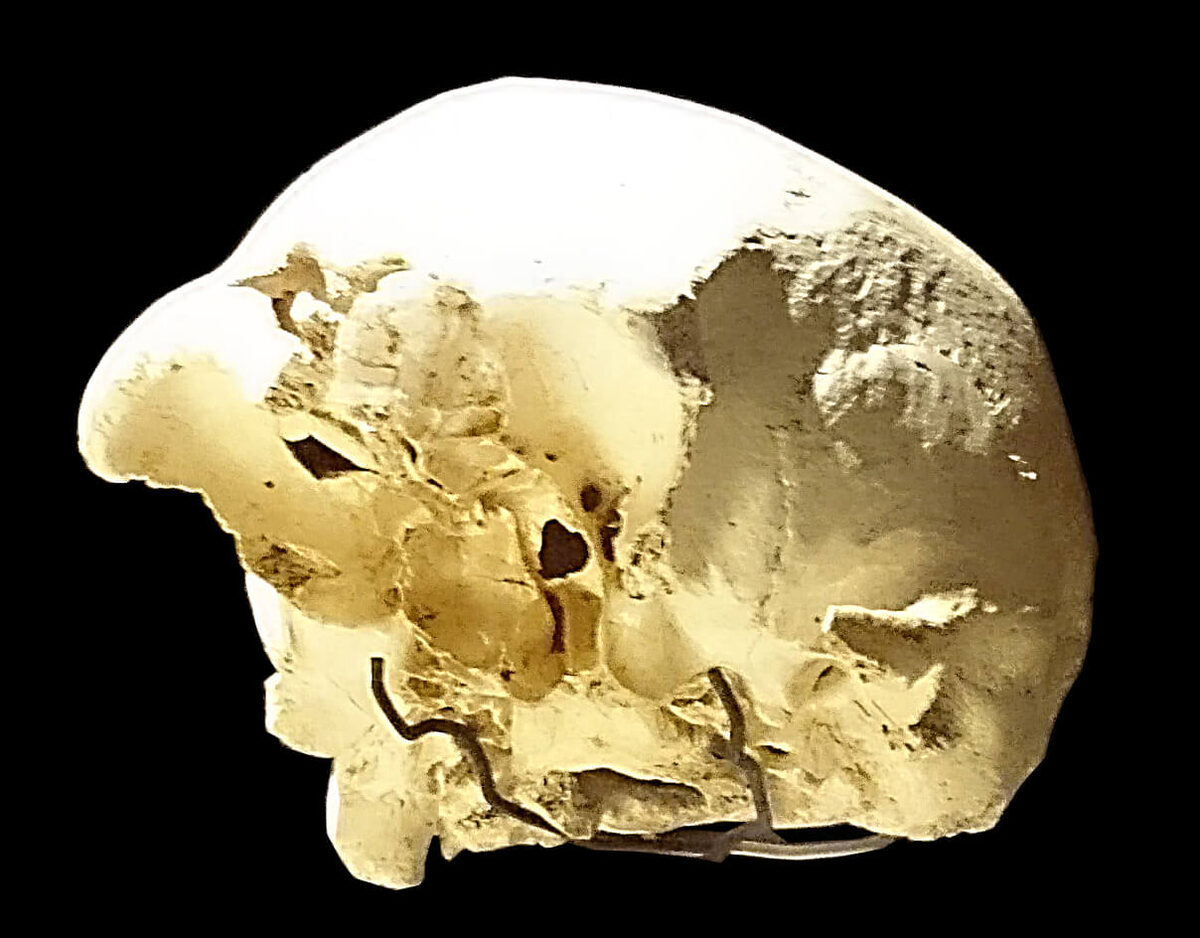
Nearly four hundred and thirty thousand years ago, in a cave in northern Spain, a child died. Its skull, shattered and then patiently reassembled by researchers, now bears an almost tender name: Benjamina. Behind this nickname hides one of the most moving fossils in all of palaeoanthropologyPalaeoanthropologyThe science that studies human evolution from the fossil remains of hominins (bones, teeth, footprints) and their context, to reconstruct our biological origins.→. For this small being, designated in the scientific literature by the austere label Cranium 14, suffered from a rare congenital malformation of the skull, a craniosynostosisCraniosynostosisPremature fusion of an infant's skull sutures, distorting growth and potentially impairing brain development.→. And yet, despite this handicap, the child lived. For several years. Long enough for its mere survival to tellTellAn artificial mound formed by the accumulation of successive layers of settlement remains at the same spot, typical of the Near East. Each destruction-rebuilding event adds a stratum.→ a deeply affecting story: that of a human group, far older than the NeanderthalsNeanderthalsA fossil humanity of Eurasia, robust and cold-adapted, extinct around 40,000 years before present.→, capable of caring for a child who was different.
Benjamina's story reaches us from the Sima de los HuesosSima de los HuesosA natural shaft at Atapuerca (Spain) that yielded over 6,500 bones of at least 29 Homo heidelbergensis individuals dated to −430,000: the largest Middle Pleistocene human fossil assemblage.→, the "pit of bones," a chasm buried in the heart of the sierra of AtapuercaAtapuercaA complex of archaeological sites in the Sierra de Atapuerca (Burgos, Spain), a UNESCO site, yielding an exceptional sequence of human fossils, including the Sima de los Huesos and Homo antecessor.→. It is there, at the bottom of a dizzying shaft, that the remains of dozens of hominidsHomininHomininMember of the subtribe Hominina, comprising the human lineage (Homo, Australopithecus, Paranthropus…) but excluding orangutans and gibbons. The term progressively replaces "hominid" in its narrow sense.→A member of the human lineage in the broad sense, including modern humans, their ancestors and related great apesgreat apesThe family of great apes (Hominidae) comprising orangutans, gorillas, chimpanzees, bonobos and humans.→.→ of the species Homo heidelbergensisHomo heidelbergensisMiddle Pleistocene human species, often seen as the common ancestor of Neanderthals and our own species.→ lie. Among them is this child's skull, which specialists studied for years until they had reconstructed its clinical history and, through it, a rare window onto the social and emotional life of our distant predecessors1.
What Benjamina reveals goes far beyond anatomy. If a severely affected child was able to grow up within its group, it is because that group fed, protected and accompanied it. The survival of a vulnerable individual, in a world of hunting and gathering where every member had to contribute, cannot be taken for granted. It implies a collective investment, a form of patience, perhaps of affection. This is the very heart of the debate this fossil has reopened: at what point, in our lineage, did attention to others, compassion, what we call empathy, first appear? Benjamina suggests that the answer reaches very far back in time, long before Homo sapiensHomo sapiensThe present-day human species, which emerged in Africa around 300,000 years ago, the only surviving human lineage after the extinction of Neanderthals and Denisovans.→.
Atapuerca and the Sima de los Huesos
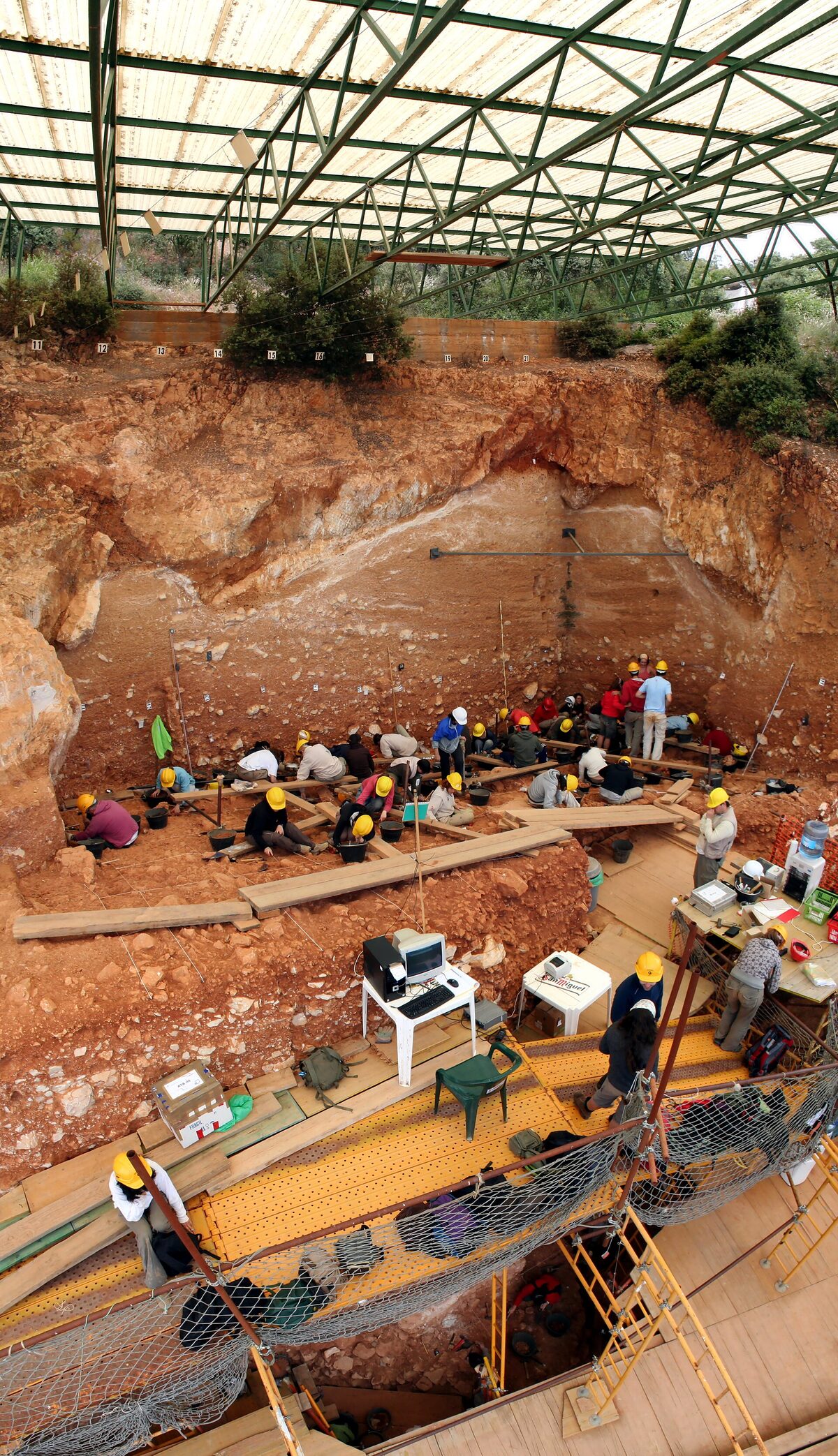
To understand Benjamina, one must first descend into the sierra of Atapuerca, a modest limestone ridge located about fifteen kilometres east of Burgos, in Castile and León. Beneath its hills, covered with holm oaks, opens a network of karstKarstA limestone landscape shaped by rock dissolution, rich in caves and passages; its sediments can preserve bone and DNA over long timespans.→ galleries carved out by water over hundreds of thousands of years. This underground labyrinth has proved to be one of the most extraordinary prehistoric sites on the planet. Since the late 1970s, methodical excavation campaigns have unearthed a succession of archaeological layers spanning more than a million years of human occupation. Atapuerca is today a UNESCO World Heritage Site, and its name has become, for specialists, synonymous with the most ancient European prehistoryPrehistoryThe span of human history before the invention of writing, from the Palaeolithic to the Metal Ages, known mainly through material remains.→.
Within this complex, one site stands out for its unique character: the Sima de los Huesos. The Spanish name says it all, or almost. It is a pit, a natural shaft about a dozen metres deep, reached today only after an arduous journey through the passages of the Cueva Mayor cave. At the bottom of this shaft, researchers uncovered an accumulation of human bones with absolutely no equivalent anywhere. Thousands of fragments, belonging to dozens of individuals, lay mingled together, sometimes with the remains of cave bears that had also fallen there, into the darkness of the chasm.
The richness of the Sima de los Huesos is such that it has yielded, on its own, the overwhelming majority of the Middle PleistoceneMiddle PleistoceneGeological subperiod (about 770,000 to 126,000 years ago) marked by growing behavioural complexity among hominins.→ human fossils known in the world. Where most sites of this period provide only an isolated fragment, a tooth, a piece of jaw, the pit of Atapuerca has returned almost complete skulls, pelvises, long bones, finger bones, the tiny ossicles of the ear. This abundance changes everything. It allows researchers to study not an individual but a population: its variations, its pathologies, its age ranges, its array of men, women, children and elders. It is in this treasure trove that Benjamina's skull lies.
One question has haunted researchers since the first discoveries: how can such a concentration of bodies at the bottom of a pit be explained? Natural hypotheses, individuals who fell in by accident, or were swept in by water, struggle to account for the whole. The almost total absence of tools, the rarity of predatory carnivore remains, the predominance of young adults, all this has led part of the team to put forward a bold hypothesis: what if the bodies had been deliberately placed there, thrown into the pit by the living? The Sima de los Huesos would then be the oldest known testimony of an intentional treatment of the dead, a rudimentary form of burialBurialThe intentional deposition of a body, sometimes with offerings; a marker of symbolic behaviourSymbolic behaviourA set of practices (adornment, pigments, art, burial) reflecting symbolic thought; long ascribed to Homo sapiens alone, now attested for Neanderthals too.→.→, predating Neanderthal interments by hundreds of millennia.
The very accessibility of the pit shapes how its treasures reach us. Today, reaching the bone-bearing layers means crawling through narrow galleries, hauling out sediment, and sieving it with extreme care, since a single careless gesture can destroy in an instant what hundreds of millennia have preserved. Each fossil is mapped in three dimensions before being lifted, then cleaned, consolidated and identified in the laboratory. The reconstruction of a skull such as Benjamina's is the fruit of this long chain of operations, in which dozens of dispersed fragments are matched edge to edge until a coherent form emerges. Nothing about the diagnosis was immediate; it is the outcome of years of meticulous, collective labour.
The discovery of Cranium 14
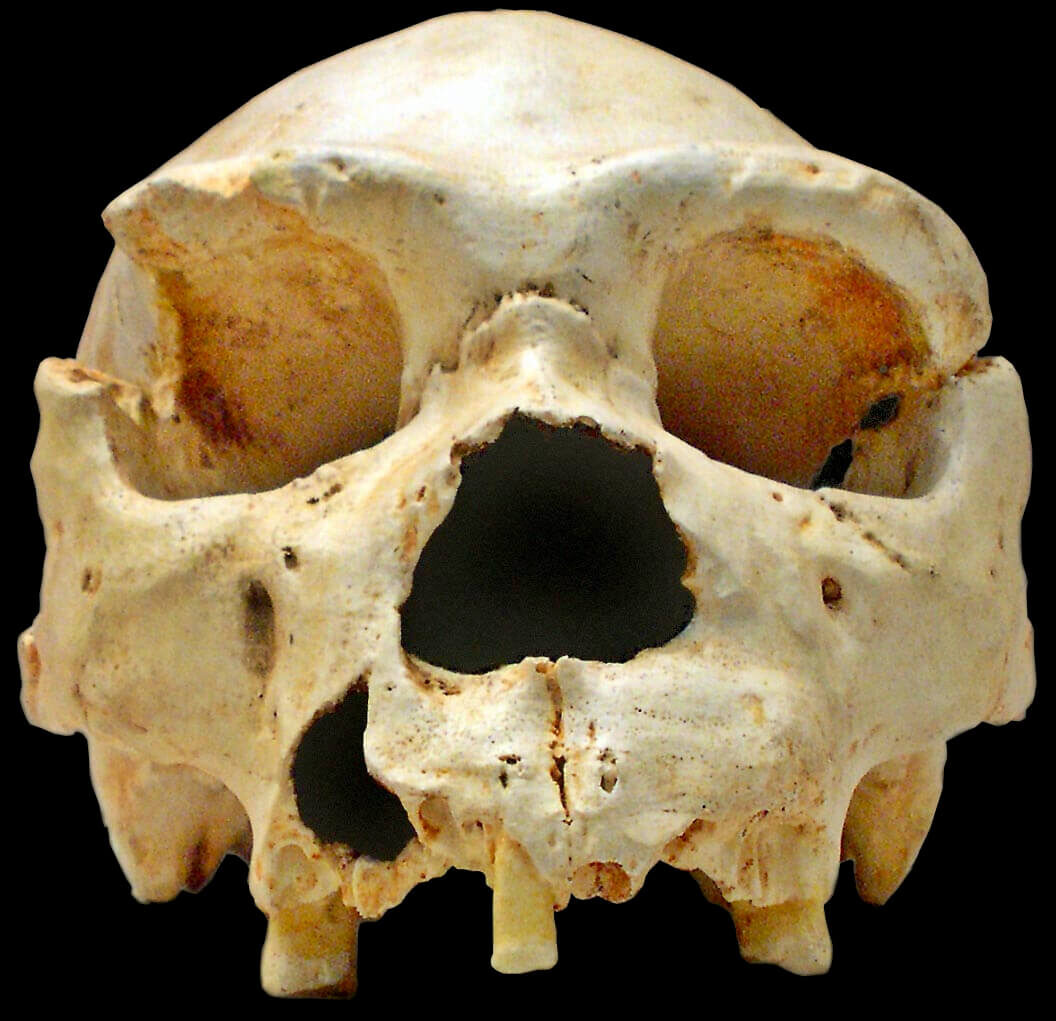
The skull known as Cranium 14 did not come out of the ground in one piece. Like most of the Sima fossils, it was found in pieces, as several dozen fragments scattered through the sediment. It was the patient and meticulous work of the researchers, fragment after fragment, that made it possible to reconstruct the cranial vault, to glue it back together, and gradually to reveal a shape. But this shape had something abnormal about it. Where one expected the regular curve of a child's skull, the back of the braincase showed a marked asymmetry, a deformation that nothing in ordinary development could explain.
One must grasp what such a deposit represents for science. Most of what we know about human evolution rests on isolated fossils, scattered in time and space, which have to be linked to one another through fragile hypotheses. Each tooth, each splinter of bone then becomes a precious but solitary clue. The Sima de los Huesos breaks with this logic of scarcity. By bringing together dozens of individuals from a single population, more or less contemporary, it offers researchers something no other Middle Pleistocene site had ever given them: a demographic sample, a human group captured in its diversity. One can observe the natural variability of traits, distinguish what falls within the norm from what is pathological, and measure the range of ages and conditions.
It is this peculiarity that makes the diagnosis of a case like Benjamina's possible. To recognise a deformation as abnormal, one needs a reference, a set of healthy skulls against which to compare the suspect specimen. The Sima provides exactly this basis for comparison. Without it, the asymmetry of Cranium 14 might have passed for a simple individual variation, or for a deformation occurring after death, in the sediment. It is the abundance of material that allows researchers to assert that this shape departs from expected development and that it does indeed reflect a congenital condition.
The anatomical analysis, carried out by a team that included Spanish specialists from Atapuerca, identified the cause of this deformation: a premature fusion of the lambdoid suture, that is, the line of articulation that, at the back of the skull, normally separates the parietal bones from the occipital bone. This early, abnormal closure of a cranial suture has a precise medical name: craniosynostosis. The diagnosis, made on a fossil hundreds of thousands of years old, is in itself a feat of medical palaeoanthropologyPalaeoanthropologyThe science that studies human evolution from the fossil remains of hominins (bones, teeth, footprints) and their context, to reconstruct our biological origins.→2.
The nickname Benjamina, given by the researchers, is not insignificant. In tradition it evokes the youngest child, the last-born of a family, the one surrounded with particular tenderness. By naming this child thus, the team wanted, in a way, to restore its humanity, behind the dryness of a catalogue number. For beyond the object of study, this is indeed a child: a small individual who lived, perhaps played, certainly suffered, and whose deformed skull now bears witness to a singular existence within a prehistoric group. The age at death has been estimated at roughly five to ten years, a range that varies with the method used but agrees on one essential point: Benjamina was no newborn, and had passed well beyond early infancy.
It is also worth recalling how exceptional it is to be able to make a precise pathological diagnosis on a fossil this old. Most ancient bones, when they survive at all, are too damaged or too incomplete to allow a confident reading of disease. The quality of preservation at the Sima de los Huesos, and the completeness of the reconstructed vault, are what made it possible to move from a vague observation of asymmetry to the firm identification of a specific congenital condition. In this sense, Benjamina is as much a triumph of preservation and method as it is a window onto an individual life.
Craniosynostosis explained
To grasp the significance of Benjamina's case, one must understand what craniosynostosis is. A newborn's skull is not a rigid bony sphere. It is made up of several bony plates separated by flexible lines of junction, the sutures, and by the fontanelles, those membranous areas one can feel pulsing in an infant. This architecture is not incidental: it is indispensable. It allows the skull to deform slightly during birth and, above all, it permits the rapid growth of the brain during the first years of life. As long as the sutures remain open, the braincase can enlarge in step with the brain it houses.
Craniosynostosis occurs when one or more of these sutures fuse too early, before brain growth is complete. The skull can then no longer grow normally in the direction perpendicular to the closed suture; it compensates by developing excessively in other directions. The result is a characteristic deformation of the vault, whose precise shape depends on the suture affected. In Benjamina's case, it is the lambdoid suture, at the back of the skull, that closed prematurely, producing a clear asymmetry of the occiput.
It is worth recalling how fast the human brain grows during the first years of life. At birth it represents only a fraction of its adult size; it nearly triples in volume over the early years. This explosive growth requires a braincase capable of enlarging at a sustained pace, which only open sutures allow. When one of them closes prematurely, the whole balance of this growth is disrupted. The brain, expanding, pushes against a wall that no longer yields in a given direction, and the vault deforms to absorb the strain. The final shape of the skull thus bears the faithful imprint of the failing suture.
In modern humans, isolated lambdoid craniosynostosis is one of the rarest forms of this condition, which makes its presence on so ancient a fossil all the more exceptional. Depending on its severity, craniosynostosis can have varying consequences: a mere cosmetic deformation in the mildest cases, but also, in more serious forms, increased pressure inside the skull, neurological disturbances, developmental delays, sensory or motor difficulties. One cannot, of course, examine Benjamina's brain, long since gone, but the observed deformation suggests the child may have had an atypical development. One understands, then, why such conditions can have consequences that go beyond appearance alone, even though severity varies enormously from one case to another. Today these conditions are treated surgically, sometimes within the first months of life, to free the brain's growth and correct the shape of the skull. Nothing of the sort, naturally, was possible four hundred and thirty thousand years ago.
This medical reading, however, only acquires its full meaning once one asks how long the child lived with its condition. A deformation, however well diagnosed, says little about social life if the affected individual died at once. It is the question of duration that turns anatomy into history, and it is to that question that we now turn.
How we know she survived
How can one assert, from a fossil skull, that a child with a congenital malformation survived for several years? The answer lies in the very nature of bone, that living tissue which is constantly remodelled throughout life. A bone does not freeze the shape it had at birth: it grows, changes, and keeps the trace of the constraints it has undergone. In the case of craniosynostosis, the suture fused too early continues to influence the growth of the skull for as long as it develops. The longer the child lives, the more the deformation becomes marked and durably inscribed in the bone.
Now Benjamina's skull shows a fully formed deformation, one that could only have arisen over several years of growth. Had the child died in infancy, shortly after the suture closed, the deformation would have remained slight, barely sketched. Its clear expression on the fossil indicates, on the contrary, that the skull continued to develop for a long time under the constraint of the abnormal suture. It is this reasoning, based on the dynamics of bone growth, that allows researchers to conclude that Benjamina lived for several years with the malformation, and not a few weeks or months2.
The estimate of age at death confirms this reading. Examination of the dentition, and in particular of the eruption and wear of the teeth, together with the state of bone maturation, converge on a child who had passed well beyond birth and early infancy. Benjamina not only survived birth: the child grew, over several years, in a condition that set it apart from the other children of the group. It is this lifespan, attested by the bone, that turns a simple pathological case into a document about social life.
One must measure here what it meant, for a child with a possibly atypical development, to reach the age of five, seven or ten in a PalaeolithicPalaeolithicThe oldest and longest period of prehistory (c. 3.3 Ma–12,000 BC), defined by chipped stone tools and a hunter-gatherer way of life.→ environment. Infant mortality was considerable. A fragile child, perhaps impaired in its abilities, had no chance of surviving alone. Its survival could only rest on others: on those who fed it, carried it, protected it from danger, integrated it despite its difference into the daily life of the group. It is this prolonged dependence, and the fact that it was shouldered, that lies at the heart of Benjamina's message.
Care, empathy and social life in the Palaeolithic
Benjamina's survival opens a window onto a dimension of prehistory that stone tools and animal bones are not enough to illuminate: social and emotional life. A group of Middle Pleistocene hominidsHomininA member of the human lineage in the broad sense, including modern humans, their ancestors and related great apes.→ was not a mere band of hunters concerned only with their own subsistence. It was a community bound by relationships, by reciprocal obligations, and probably by ties we would recognise as familial or emotional. Taking charge of a vulnerable child over several years implies organisation, a sharing of resources, a collective will not to abandon one of their own.
This idea of prolonged care does not come from nowhere. Other, more recent fossils have already documented cases where injured, sick or elderly individuals clearly benefited from the help of their group. We know of Neanderthals who survived serious injuries, the loss of an arm, or blindness, under conditions that would have been fatal without assistance. What Benjamina adds that is specific is antiquity. With the Sima de los Huesos, we go back well beyond the Neanderthals, to Homo heidelbergensis, into a past where such displays of solidarity were not necessarily expected.
The term empathy must be handled with care here. By it we mean the capacity to represent another's state, to perceive their suffering or need, and to respond to it. Benjamina's fossil does not directly prove the existence of this mental capacity; it shows its effects. A child who would not have survived without help did survive: this is the material clue of caring behaviour, and therefore, by deduction, of a form of sensitivity to the fate of another. Researchers readily speak of "prosocial" behaviour, that is, oriented towards the well-being of others, to describe what this case reveals3.
It is worth dwelling on the concrete, almost material dimension of this care. In a nomadic group that follows game and resources, moving about with a child unable to keep up represents a permanent constraint. Someone must carry it, slow down, sometimes give up a chance to hunt or gather so as not to leave it behind. Each day of Benjamina's life implied, on the part of those around it, a series of small decisions all pointing in the same direction: that of keeping the child among the living. These are not isolated heroic gestures, but a constancy, a habit of care, that is most striking in this case. That constancy points to a certain stability of bonds, a distribution of tasks that made room for the weakest, and behind the deformed skull one glimpses a social structure able to bear the weight of one of its members without sacrificing it.
This constancy raises questions about the very organisation of the group. For a vulnerable child to survive several years, there must be a certain stability of bonds, a distribution of tasks that leaves room for the weakest. Behind the deformed skull one glimpses a social structure capable of absorbing the weight of one of its members without sacrificing it. It is this image of a community held together by solidarity, rather than a mere band turned towards immediate survival, that palaeoanthropology is beginning to reconstruct from fossils like this one. The care given to Benjamina was not a single exceptional act but a way of life, repeated across seasons and journeys, woven into the ordinary fabric of the group.
One may also wonder what such care reveals about the inner world of these beings. To anticipate another's need, to remember a bond, to act for someone whose usefulness was at best uncertain, all this hints at faculties richer than long supposed. We cannot read the thoughts of a Middle Pleistocene hominid, and prudence forbids us from lending them our own feelings without reservation. Yet the fossil at least authorises the question, and for a period of which we know almost nothing of thoughts or emotions, the mere fact of being able to pose it marks a considerable advance.
The debate on human altruism
Benjamina's case is part of a long-running scientific debate: at what point, in the evolution of our lineage, did the behaviours we associate with altruism, compassion, concern for others, first appear? For a long time a view prevailed according to which these traits were peculiar to Homo sapiens, or even to a relatively recent "modern" humanity, capable of symbolism, elaborate language and morality. Fossils like Benjamina call this late chronology into question and invite us to push the appearance of solidarity considerably further back.
Several interpretations compete. For some researchers, the care of vulnerable individuals reflects the existence of advanced cognitive and emotional capacities in Homo heidelbergensis, close to those attributed to more recent humans. Benjamina's survival would then be tangible proof of an already constituted empathy, of a complex emotional life, hundreds of thousands of years before us. Others adopt a more cautious reading, stressing that care for kin can be explained, in part, by mechanisms also observed in other social species, without necessarily implying an elaborate morality.
Evolutionary biology brings elements to this discussion. Helping kin can be favoured by natural selection when it benefits related individuals, who share part of our genetic heritage: this is the logic of kin selection. Helping one's child, one's brother, one's cousin amounts, in a sense, to promoting the transmission of one's own genes. But this explanation, valid for accounting for the emergence of helping behaviours, does not exhaust the question of their subjective experience. That a behaviour is advantageous in evolutionary terms does not prevent it from being accompanied by real emotions, attachment, tenderness.
The debate, in the end, bears less on the facts, Benjamina's survival is solidly established, than on their interpretation. Should one see in it the dawn of human empathy, the trace of an already fully developed compassion, or only the expression of deep social mechanisms shared by many species? What is certain is that this fossil has shifted the limits of what can be debated. Before it, few would have wagered that the question of altruism already arose, with such acuteness, among Middle Pleistocene humans.
Homo heidelbergensis
The hominids of the Sima de los Huesos are generally assigned to the species Homo heidelbergensis, or to a very closely related population, which occupies a strategic place in the history of our lineage. The name of this species comes from a jawbone discovered in the early twentieth century near Heidelberg, in Germany. Homo heidelbergensis, in a broad sense, designates Middle Pleistocene human populations, spread across Europe and AfricaAfricaThe cradle of humankind: the continent where the first hominins appeared, then Homo sapiens around 300,000 years ago, before the expansion to the rest of the world.→, that display a mix of ancient and more advanced features, and that lie somewhere between the more archaicArchaicRefers to an ancient, now-extinct human population or form (Neanderthals, Denisovans, ghost lineages), as opposed to anatomically modern humans.→ forms of the genus Homo and more recent humans.
Anatomically, these hominids already possessed a large brain, close in size to that of present-day humans, but housed in a skull with robust features: a sloping forehead, marked brow ridges, a powerful face. Their body was massive, built for endurance and strength. They were skilled hunters, capable of taking on big game, and mastered an elaborate stone industry. Certain clues, at other sites attributed to this species, suggest the use of fire and the making of wooden throwing weapons.
The position of Homo heidelbergensis in the human family tree is debated, but one point is broadly agreed: the European populations of this species, including those of Atapuerca, lie at the root of the lineage that will lead to the Neanderthals. Analyses of the Sima de los Huesos fossils have revealed already Neanderthal-like features, notably in the face and dentition. Some genetic studies of ancient DNAAncient DNAGenetic material preserved in old remains, often degraded, sequenced with cutting-edge techniques.→ extracted from these fossils have confirmed their kinship with the Neanderthal lineage, making the hominids of Atapuerca a kind of proto-Neanderthals.
The contribution of ancient genetics deserves attention, for it has profoundly altered our understanding of the Atapuerca hominids. For a long time their place in the human tree was debated on the basis of anatomy alone, always an interpretive exercise. The extraction of DNADNAThe molecule carrying genetic information, used to reconstruct kinship between species.→ from fossils this old, long thought impossible, eventually yielded results. It confirmed that the populations of the Sima de los Huesos belong to the branch leading to the Neanderthals, and not to that of our own species. This filiation gives Benjamina's case a particular resonance. If the displays of care and solidarity attributed to the Neanderthals already find an echo in their ancestors at Atapuerca, then these behaviours have a considerable historical depth, rooted in the common trunk from which several human forms, including our own, arose.
It is worth pausing on what this filiation means beyond mere classification. By tying the Atapuerca hominids to the branch that leads to the Neanderthals, ancient DNA inscribes Benjamina in a continuous history, one that links these Middle Pleistocene populations to the Neanderthals and, beyond them, to the whole of humankind. The caring behaviours observed in some find an echo in others, like the links of a single chain. This continuity gives the Atapuerca case its broadest reach: it is not an isolated episode but an early testimony of a disposition that will run through the evolution of our lineage, surfacing again and again across hundreds of thousands of years.
Dating and context
The dating of the Sima de los Huesos fossils has been the object of long work, for it conditions the entire interpretation of the site. The dating methods applied to the sediments and the concretions that sealSealA small engraved object (often steatite) used to stamp a mark in clay; the Indus seals, bearing animals and signs, attest to administration and trade, though their script remains undeciphered.→ the deposit now converge on an age of the order of four hundred and thirty thousand years. This antiquity places the Sima in the first half of the Middle Pleistocene, at a time when Europe was peopled by hominids who are neither anatomically modern humans nor yet quite classic Neanderthals, but rather their direct predecessors.
This chronological context is essential for measuring the significance of Benjamina's case. Four hundred and thirty thousand years is an abyss of time. It is several times the age of the oldest cave paintings, well before the appearance of Homo sapiens in Africa, and further still from the first documented Neanderthal burials. That caring behaviours can be inferred at such temporal depth overturns the ordinary chronology of moral and social humanity.
The environmental context, too, deserves attention. The Atapuerca hominids lived in a mid-mountain landscape, punctuated by contrasting climatic phases, where they had to contend with competition from large predators and the irregularity of resources. It is in this demanding setting, where each member of the group represented a cost and a burden, that the survival of a fragile child takes on its full meaning. Nothing, in the logic of mere subsistence, required keeping it alive. And yet it lived.
Finally, the context of the deposit itself feeds the interpretation. If one accepts the hypothesis of an intentional accumulation of bodies at the bottom of the pit, then the Sima de los Huesos would testify not only to care given to the living but also to a certain attitude towards the dead. Care for the living and treatment of the deceased would together outline the contours of a social life endowed with a dimension that one hardly dared attribute to hominids this ancient.
Limits and interpretive caution
However moving it may be, Benjamina's story calls for methodical caution. The science of human fossils advances on uncertain ground, where every conclusion rests on fragmentary clues and indirect reasoning. It is important to distinguish what is solidly established from what is interpretation, or even the projection of our own values onto a distant past.
Several points are robust. The diagnosis of lambdoid craniosynostosis, based on the morphology of the skull, is widely agreed upon. The child's survival over several years, deduced from bone growth and age at death, rests on serious anatomical grounds. On the other hand, the real extent of Benjamina's handicap remains uncertain: one cannot assert with certainty that the deformation was accompanied by severe disorders. If the craniosynostosis had remained relatively mild, the child could have led a life close to that of its peers, which would temper the force of the argument about exceptional care.
The very notion of empathy poses a problem of interpretation. To attribute to Middle Pleistocene hominids mental states comparable to our own is a delicate inference. We observe effects, an improbable survival, and from them we deduce psychological causes. But between bone and emotion the gap is wide, and the temptation is strong to fill this void with our own sensibility. The most rigorous researchers invite us to speak of caring behaviour rather than empathy in the full sense, so as not to prejudge what was going on in the minds of these beings.
One can extend the reflection by asking what Benjamina's survival teaches us about these hominids' relationship to time and to the future. Taking charge of a child over several years implies a form of commitment over the long term, a capacity to inscribe one's action in a horizon that exceeds the immediate moment. The group probably expected no immediate benefit from this fragile child; yet it kept it alive, day after day, season after season. This patience, this fidelity to a being whose contribution remained uncertain, outlines a temporality of care that one does not spontaneously associate with populations this ancient.
It must also be remembered that Benjamina is a unique case, or almost. A single observation, however striking, is not enough to establish a general rule about the behaviour of an entire species. The strength of the Atapuerca dossier lies in its convergence with other, later clues of care for the vulnerable; but the isolated case must be handled with measure. Prehistory imposes this humility: it hands us fragments, and it is up to us to resist the temptation to draw from them stories that are too confident. Benjamina speaks to us, but what it says must be heard with rigour as much as with emotion.
The same caution applies to the question of how representative Benjamina really is. A single child, however eloquent its bones, cannot stand for an entire species, and the dossier owes its strength to its convergence with later evidence rather than to this one case alone. Read alongside the survivors documented among the Neanderthals, however, Benjamina ceases to be an anomaly and becomes one of the earliest points in a long line of evidence for care extended to the fragile.
Conclusion
Before concluding, Benjamina must also be situated in the history of the discipline itself. This fossil has helped transform the way palaeoanthropology looks at the social behaviours of the people of the past. For a long time, for lack of direct traces, the emotional life of extinct hominids was held to be inaccessible, relegated beyond the field of science. Cases like that of Atapuerca have shown that it is possible, from bone and its pathologies, to reach back cautiously to human relationships, to care and solidarity. In this, Benjamina has not only enriched our knowledge of an ancient species: it has widened the realm of the thinkable for an entire discipline.
At the end of this journey, the small skull of the Sima de los Huesos appears for what it is: an exceptional document about the most ancient human condition. Benjamina is not merely a clinical case of craniosynostosis four hundred and thirty thousand years old. It is the witness of a group of hominids who, faced with a child who was different, chose, consciously or not, to carry, feed and accompany it for years. In that choice one can sense something that resembles us.
This fossil reminds us that the behaviours we hold to be the noblest, care, solidarity, attention to the weakest, are neither the exclusive privilege of our species nor the preserve of a recent modernity. They sink their roots very far back in time, into the common trunk from which the Neanderthals and we ourselves arose. To recognise this is to broaden our moral genealogy, and to grant our distant predecessors a share of that humanity we believed belonged to us alone. There remains, of course, the share of uncertainty, the necessary caution, the respect for the limits of what stone can say. But something, in this child's story, exceeds scholarly analysis alone. Across hundreds of millennia, Benjamina holds out to us the image of a fragility welcomed rather than rejected. And it is perhaps there, in this window onto the empathy of our ancestors, that the most precious of the lessons of palaeoanthropologyPalaeoanthropologyThe science that studies human evolution from the fossil remains of hominins (bones, teeth, footprints) and their context, to reconstruct our biological origins.→ lies.
Je l'ai projeté en cours et les élèves ont posé beaucoup de questions. Très bon support.
Le site de Steinheim en Allemagne, dont provient le crane de Benjamina, est un contexte archéologique fondamental pour comprendre l'Europe du Pléistocène moyen. Ces homininés qui précèdent les Néandertaliens classiques présentent déjà certains caractères qui annoncent la morphologie néandertalienne. La question de leur attribution à Homo heidelbergensis ou à une autre espèce reste ouverte.
Benjamina est l'un des cranes néandertaliens les plus étudiés et les plus discutés. Sa morphologie a longtemps été au coeur du débat sur la relation entre Néandertaliens et Homo sapiens archaïques. La réévaluation de sa datation et de son attribution taxonomique illustre bien les difficultés que pose la classification des homininés du Pléistocène moyen.