In the heart of India, some forty kilometres south of Bhopal, the capital of the state of Madhya Pradesh, a long plateau of reddish sandstone rises out of the dry forest. Enormous boulders, eroded into the shapes of towers, mushrooms and vaults, form a labyrinth of shaded corridors and hollows. Beneath these overhangs, people lived, slept, knapped tools and painted images for tens of thousands of years. This place is called Bhimbetka, and it holds one of the largest and oldest bodies of rock art on the planet. Inscribed on the UNESCO World Heritage List in 2003, it gathers more than seven hundred natural rock sheltersRock shelterA shallow cavity at the foot of a cliff or under a rocky overhang, offering natural shelter; a favoured site of prehistoric habitation and rock art.→, several hundred of which still preserve paintings.1
Bhimbetka is not a deep cave like Lascaux or Altamira, but a succession of open shelters, bathed in light, where the images can be read almost in the open air. The oldest surviving paintings date back to the MesolithicMesolithicThe period between the Palaeolithic and the Neolithic (c. 10,000–6,000 BC in Europe), still based on hunting and gathering.→, and some engraved marks may be far older still; the most recent belong to historical periods, down to a few centuries before our own era. Across these walls unfold hunting scenes, dances, processions of horsemen, herds of animals and a host of enigmatic signs. This feature sets out to walk through this sanctuary of stone, to retrace its discovery and study, to describe its paintings and their techniques, and to explain why Bhimbetka reminds us that rock art was a truly worldwide phenomenon, and not the sole preserve of the Franco-Cantabrian caves of Europe. For what these walls tellTellAn artificial mound formed by the accumulation of successive layers of settlement remains at the same spot, typical of the Near East. Each destruction-rebuilding event adds a stratum.→ us is not the story of an isolated people, but that of a humanity which, everywhere, feltFeltA non-woven fabric made by pressing and matting wool fibres; steppe nomads used it for rugs, saddles and appliqués, remarkably preserved in the frozen Pazyryk tombs.→ the need to fix the world in images.
Bhimbetka, a treasure in the heart of India
The site lies in the hills of the Vindhya range, at the foot of the Deccan plateau, in the district of Raisen. The name Bhimbetka derives from Bhima, one of the five Pandava brothers of the great Indian epic, the Mahabharata, and legend has it that this colossal hero halted among these rocks; Bhimbetka would thus mean something like "the seat of Bhima". The legend alone shows how large these places loom in the local imagination, long before archaeologists took an interest in them. The neighbouring villages held these hills in a mixture of respect and familiarity, and certain walls were known to the inhabitants as special places, sometimes linked to stories or ritual practices.2
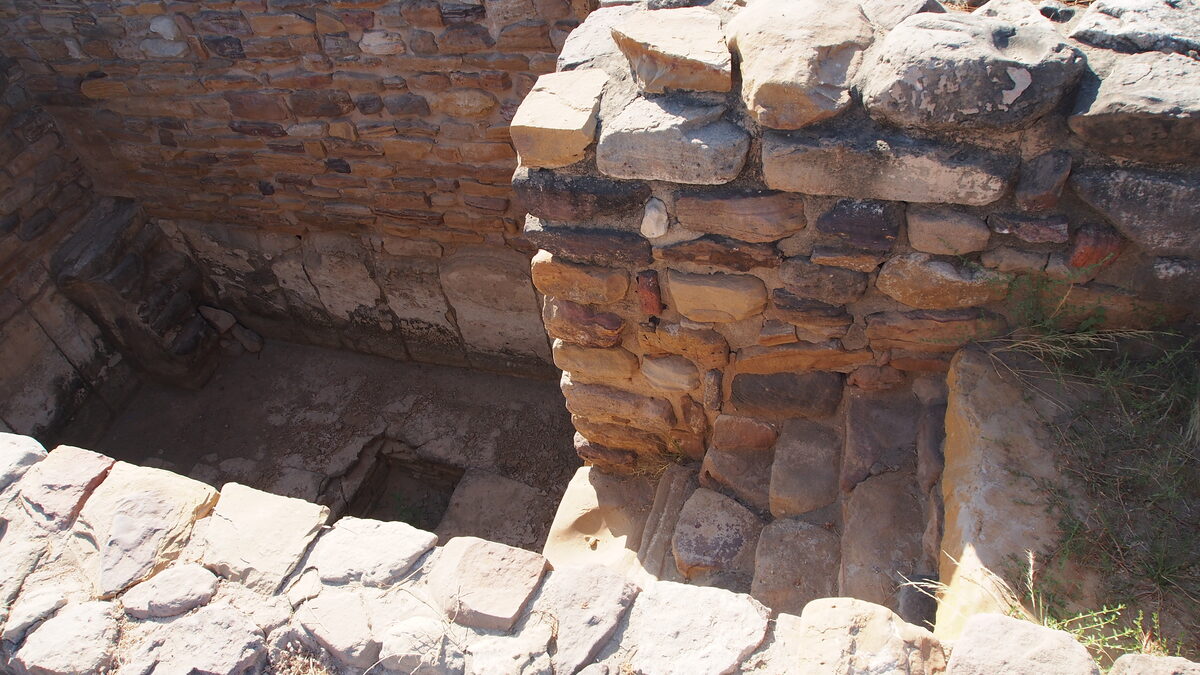
Geologically, the shelters are cut into a very ancient quartzitic sandstone, a hard and resistant rock patiently hollowed out by water, wind and temperature changes. The result is a spectacular landscape: heaps of gigantic boulders, split and stacked, forming galleries, porches and open chambers. These shallow cavities, lacking the gloom of European karstKarstA limestone landscape shaped by rock dissolution, rich in caves and passages; its sediments can preserve bone and DNA over long timespans.→ caves, remain open to daylight. This is an essential difference, for the art of Bhimbetka was not made for darkness: it decorated living spaces, thresholds and ceilings visible from the ground. People did not descend into the earth to paint in secret; on the contrary, they adorned places that were frequented, shelters where they slept, ate and gathered.
The natural setting played a decisive role in the long occupation of the site. The forest surrounding the hills, protected today, teemed with game and edible plants: deer, antelope, wild boar, fruit, tubers and wild honey. Springs and streams provided water all year round, including through the long dry season. The shelters offered protection from the monsoon, the burning sun and predators. It is easy to see why human groups chose to settle here, generation after generation, making Bhimbetka an exceptional window onto the continuity of human settlement in central India. Few places allow us to follow, in a single spot, a human presence so long and so little interrupted.
The site covers a protected area of about 1,893 hectares, surrounded by an even wider buffer zone. Across this space the shelters are distributed, only a portion of which are open to the public. The whole forms a cultural landscape in which nature and the human trace are inseparable, and in which the rock itself becomes an archive. Walking through these hills, one crosses at once a remarkable forest ecosystem and an open-air museum, where every wall may hide an image many thousands of years old. This interweaving of the natural and the cultural is precisely what justified, in the eyes of UNESCO, protection at the highest international level.1
Bhimbetka's location, at the geographical centre of the Indian subcontinent, is no accident. The Vindhya hills mark a transition between the northern plains and the Deccan plateau, a threshold that people have crossed and inhabited since time immemorial. As a natural crossroads, the site lay on the ancient routes along which populations, techniques and ideas moved. This centrality doubtless helps to explain the longevity of its occupation and the diversity of influences one senses in its paintings. Bhimbetka was not an isolated dead end, but a place of passage and of dwelling, anchored in a network of exchanges that reached far beyond the horizon of the hills.
The discovery: V. S. Wakankar, 1957
Like many great sites, Bhimbetka owes its scientific recognition to an intuition and a trained eye. In 1957, the Indian archaeologist Vishnu Shridhar Wakankar was travelling by train across Madhya Pradesh. Through the window he glimpsed rock formations that reminded him of the painted shelters he had studied in Europe, notably in Spain and France. Intrigued, he got off at the nearest station and set out to explore these hills on foot. What he found surpassed his expectations: a multitude of shelters covered with paintings, unknown to science, entire friezes of animals and hunters running across the sandstone. The almost legendary scene has become one of the founding stories of Indian archaeology.2
Wakankar was no amateur: trained as an archaeologist and passionate about rock art, he devoted a large part of his career to Bhimbetka. From the 1970s onwards, systematic excavation campaigns were carried out in collaboration with Indian academic and heritage institutions. The research revealed not only the paintings but also an archaeological stratigraphyStratigraphyThe study of the superimposed layers (strata) of an archaeological site; each layer corresponds to a phase of occupation and yields a relative chronology.→ of great richness: stone tools, hearths, bones and traces of occupation piled up over several metres' thickness, spanning immense periods. Each layer tells an episode of this long history, from the Palaeolithic hunter to the villager of the metal ages. It is this double reading, of the floors and of the walls, that gives Bhimbetka its exceptional scientific value.
The work of Wakankar and his successors transformed Bhimbetka from a local curiosity into a site of worldwide importance. The Archaeological Survey of India, the institution responsible for the country's archaeological heritage, took charge of protecting and studying the site.3 The recording of the paintings, their methodical description and their relative dating gradually allowed researchers to reconstruct a sequence stretching from the earliest prehistoryPrehistoryThe span of human history before the invention of writingWritingA system of conventional signs used to fix language or information durably; its appearance (c. 3300 BC) marks, by convention, the end of prehistory.→, from the Palaeolithic to the Metal Ages, known mainly through material remains.→ to historical times. Scholars traced the figures by hand, photographed them, classified them by style and by superposition, patiently building a chronology where no absolute date was immediately available.
In 2003, UNESCO confirmed this importance by inscribing the rock shelters of Bhimbetka on the World Heritage List, on account of their exceptional testimony to the evolution of human societies in India and to the tradition of rock art.1 This international recognition crowned nearly half a century of research and placed Bhimbetka alongside the greatest painted sites on the planet. It also underlined a feature that specialists had noticed: the continuity between the oldest paintings and certain artistic traditions still alive in the neighbouring villages, as if the gesture of painting the rock had never entirely ceased.
This thread of continuity between past and present is one of the most moving aspects of Bhimbetka. The colours, the motifs and even some of the techniques echo practices still observed in the region, where walls are painted for festivals and rituals. Without claiming an unbroken line across thousands of years, scholars note striking resemblances that invite reflection on how deeply rooted certain artistic gestures can be. At Bhimbetka, prehistory is not a sealed and distant chapter, but a long beginning whose distant echoes can perhaps still be sensed in the living culture around the hills.
It is worth stressing how telling this late discovery is. For centuries, this immense heritage remained before the eyes of local populations without being recognised as such by the scholarly world. This gap reminds us that many treasures of rock art, on every continent, have been identified only recently, often by chance during a journey or thanks to an intuition. The story of Bhimbetka is also that of a change of outlook: science had to take seriously these images of hunters and animals, long regarded as mere curiosities, before they could rise to the rank of heritage of humanity.
The five groups of shelters
The whole of Bhimbetka does not form a single, compact site, but a constellation of shelters scattered across the hills. Researchers have distinguished five large groups or clusters of shelters, identified by letters, which structure the reading of the site. Of the roughly seven hundred shelters recorded, several hundred bear traces of painting, and some are entirely covered, from the walls up to the ceilings.1
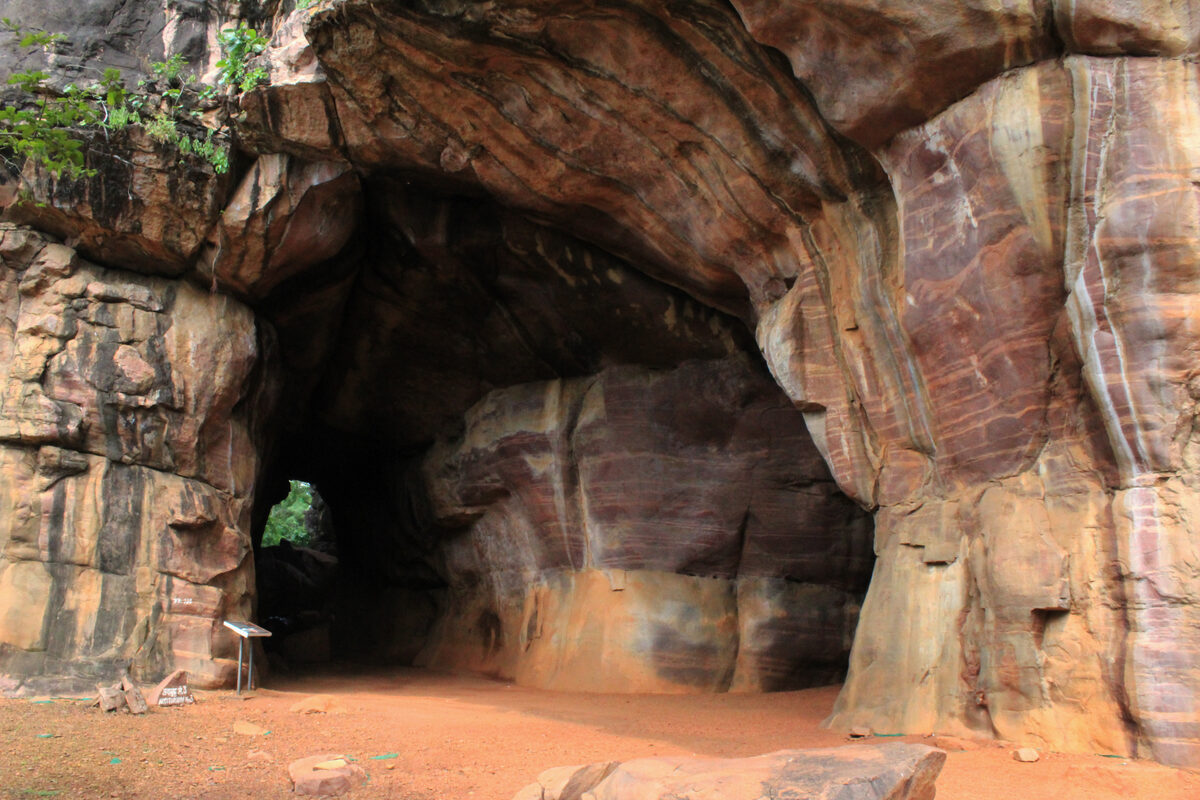
The most famous of the shelters is doubtless the one nicknamed the "Auditorium", a vast cavity shaped like a natural cathedral, open to the four cardinal points and dominated by an imposing rock. Its almost monumental configuration suggests that it may have played a central role in the life of the groups who frequented it, perhaps as a place of gathering or collective activity. Nearby, the "Zoo Rock", so named for the density of animals painted on its walls, offers one of the finest concentrations of animal figures on the site: one can count dozens of intertwined species, painted in different periods.
Each group has its peculiarities. Some shelters are saturated with superimpositions, where paintings of different periods overlap in a dizzying palimpsest; an older figure can be seen half vanishing beneath a more recent one, and the wall becomes a vertical stratigraphic section. Other shelters preserve more isolated and more legible compositions, where a single scene stands out against the bare sandstone. The distribution of the images is not random: concentrations are observed in the largest and most accessible shelters, which suggests that the choice of locations followed social or symbolic logics, and not merely convenience. Some shelters seem to have been favoured places, revisited and repainted over many generations.
Around the painted shelters, the ground itself is a book. Excavations have brought to light sequences of occupation, tools, food remains and arrangements. Some blocks bear cupules, those small hemispherical hollows cut into the rock, among the oldest marks on the site and counted by some researchers among the earliest evidence of symbolic activity in India. Bhimbetka is therefore not only a gallery of paintings: it is a complete archaeological landscape, in which art and daily life answer one another. The walk between the shelters, today marked out for visitors, partly follows the very paths that the prehistoric occupants already took, from one porch to another, from a watering point to a lookout over the plain.
The diversity of the shelters also reflects the diversity of their uses. Some, vast and sheltered, may have served as lasting dwellings; others, smaller and more remote, perhaps had a particular function, as a halt, a hiding place or a space reserved for certain activities. This functional variety, hard to reconstruct in detail, adds to the richness of the site and warns us against treating it as a homogeneous whole. Bhimbetka is rather a mosaic of places with their own histories, linked by the continuity of a human presence and by the permanence of a single gesture: to mark the rock.
The very layout of the groups invites the visitor to think in terms of routes and viewpoints. From certain shelters the eye sweeps over the surrounding plain; others nestle deep among the boulders, intimate and shaded. The painters chose their walls within this landscape, and it is tempting to read in their choices a sense of place, an attention to the play of light, shelter and visibility. Far from being scattered at random, the images seem to dialogue with the terrain that carries them, as though the rock and its setting were part of the work itself.
A sequence from the Palaeolithic to historical times
What gives Bhimbetka its exceptional value, beyond the beauty of its paintings, is the depth of time it documents. The archaeological layers excavated in the shelters reveal a human occupation that begins in the PalaeolithicPalaeolithicThe oldest and longest period of prehistory (c. 3.3 Ma–12,000 BC), defined by chipped stone tools and a hunter-gatherer way of life.→ and continues, without any real break, down to historical periods. Few sites in the world offer such continuity in a single place, and it is this chronological thickness that makes Bhimbetka a laboratory for the study of the long durations of prehistory.1
The deepest levels yield Palaeolithic tools, evidence of the presence of very ancient hunter-gatherersHunter-gatherersA way of life based on hunting, fishing and gathering wild resources, without farming or herding; it dominated almost the whole of human history.→. Here one finds worked pebbles, flakes and tools characteristic of the great technical traditions of Indian prehistory. These Palaeolithic occupations are not necessarily associated with the surviving paintings, for the oldest pigments rarely withstood erosion; but they attest that the shelters served as refuge from very remote times. The excavators were able to follow, layer after layer, the evolution of knappingknappingThe set of operations for fracturing a stone block to extract flakes or blades.→ techniques, from coarse pebble tools to finer and more standardised pieces.
Then comes the Mesolithic, a pivotal period to which most of the oldest still-visible paintings are attributed. The Mesolithic hunter-gatherers of Bhimbetka used microliths, those tiny stone blades hafted to form composite weapons, arrowheads or sickle elements. It is in this period that hunting scenes, animal figures and the first clearly identifiable human representations multiply. The density of Mesolithic paintings makes Bhimbetka one of the great centres of this art in India, and one of the rare places where a type of tool kit and a painted tradition can be so closely associated.
Over the millennia, the sequence continues with the NeolithicNeolithicThe "New Stone Age": a period marked by farming, herding, settlement and pottery, from around 10,000 BC.→ and the appearance of new motifs, then with the ChalcolithicChalcolithicThe "Copper Age": a transition between the Neolithic and the Bronze Age, marked by the first copper objects (Ötzi's era).→ and historical periods. Domestic animals now enter the stage, the first depictions of cattle, perhaps scenes linked to nascent farming. The most recent paintings testify to societies already deeply transformed: one sees horsemen, battles, processions, sometimes inscriptions in ancient scripts. This chronological layering can also be read on the walls, where the latest images cover the oldest, creating that famous palimpsest effect. Bhimbetka thus offers a section through the long span of humanity in central India, from the Palaeolithic hunter to the horseman of historical ages, on one and the same support of stone.
This continuity has a significance that goes beyond archaeology. It shows that the great transformations of human history, the shift from hunting to farming, the appearance of metals, the birth of hierarchical societies, did not happen all at once, but were slowly inscribed in the life of people, down to their way of painting. At Bhimbetka, we witness these turning points not through texts or official monuments, but through the modest and powerful images of ordinary communities, who crossed the ages leaving on the stone the trace of their gaze upon the world.
The painted bestiary
Animals dominate the imagination of Bhimbetka. On the walls they parade by the dozen, sometimes by the hundred, in a variety that reflects the fauna of the forests and plains of central India. This bestiary is one of the richest in world rock art, and it is a precious source for reconstructing the past environment of the region, its habitats and ecological balances.2
One recognises deer and antelope, the favourite game of hunters, often shown in herds or pursued by armed figures. Bison and buffalo, massive and powerful, hold a place of honour, sometimes painted on a large scale, some reaching several metres. The tiger, lord of the Indian forest, appears with its characteristic stripes, as does the leopard. There are also elephants, whose imposing silhouettes adorn certain shelters, menacing wild boar, monkeys clinging to branches, reptiles, fish and a host of birds. A few rarer figures, such as snakes or animals hard to identify, complete this teeming inventory.
Some animal figures are treated with striking realism, attentive to postures, horns, coats and the tension of a body in movement; others are more schematic, reduced to a few strokes that suffice to identify them. The variety of styles points to the variety of periods: each era painted animals in its own way, and the specialist learns to read these differences as so many chronological signatures. One also notices singular scenes, such as the famous depiction of a large mythical or composite animal, nicknamed the "dragon" or the "beast of Bhimbetka", whose interpretation remains debated and which reminds us that rock art was not only a naturalistic inventory, but also a space of imagination.
The relationship between human and animal runs through all the art of Bhimbetka. The beasts are hunted, but they are also, it seems, observed, magnified, perhaps revered. The disproportionate place given to certain species, the recurrence of certain motifs, suggest a strong symbolic bond, in which the animal is not merely prey but an actor in the mental world of the painters. Through this bestiary, a certain vision of the world takes shape, one in which the boundaries between the human, the animal and the sacred appear permeable. The painters did not merely copy nature: they offered a reading of it charged with meaning.
This bestiary also has the value of an ecological document. The species represented, their relative abundance, their presence or absence according to the periods, inform researchers about past landscapes and their transformations. The recurrence of certain large mammals evokes dense, game-rich forests; the late appearance of domestic animals signals the shift to new ways of life. Thus the walls of Bhimbetka are not only works of art: they form an involuntary naturalist archive, in which the history of the environments of central India can be read between the lines over tens of thousands of years.
Hunting scenes, dance and social life
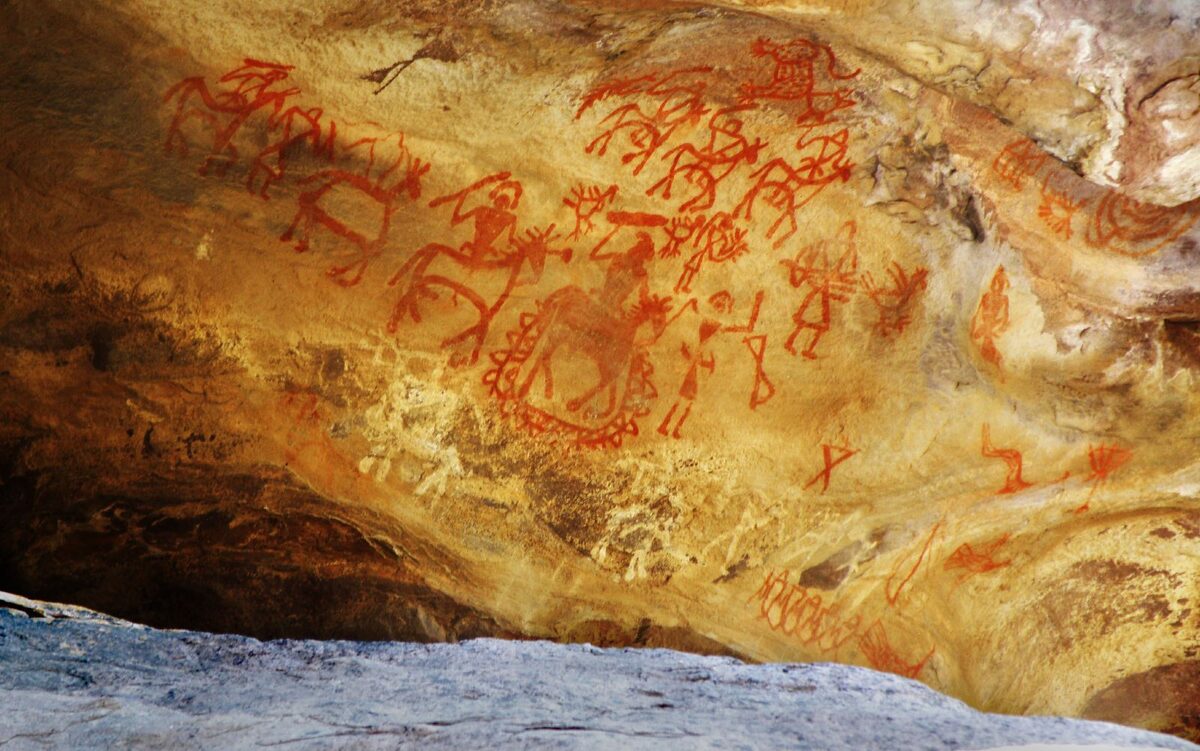
If animals dominate, the human figure is never far away. Bhimbetka stands out for the abundance of its narrative scenes, in which human groups act together. Hunting, of course, is ever-present: one sees files of hunters armed with bows, spears and sticks, encircling game, pursuing it, sometimes trapping it in enclosures or nets. These compositions, often very dynamic, render movement with astonishing liveliness, as if the painter had wanted to freeze the decisive instant of the chase or the shot.2
Beyond hunting, it is a whole social life that is displayed. Dance scenes show rows of figures holding hands or with raised arms, in rhythmic attitudes that evoke collective rituals. One can make out musicians, processions, gatherings around central figures. Some silhouettes wear headdresses, ornaments, perhaps masks, signs of a social or ceremonial codification. Daily life surfaces too: women at work, children, scenes of gathering or honey collecting sometimes depicted with precious detail, like those clusters of bees and those climbers hanging from ropes. These images restore to us ordinary gestures, thousands of years old, with disconcerting freshness.
The more recent periods add new motifs. Horsemen mounted on horses appear, harnessed elephants, warriors bearing swords and shields, even scenes of pitched battle. These images testify to the region's entry into more complex, hierarchical societies, in which the horse and warfare gain importance. In them one reads the transformation of ways of life, from the hunter-gatherer to the horseman of historical times, all on the same walls, sometimes only centimetres apart. The passage from one world to another is not told in a text: it is shown, image after image, on the stone.
This narrative richness makes Bhimbetka an anthropological document of the first importance. Where European Palaeolithic art often favours the isolated animal on a neutral ground, the art of Bhimbetka stages human collectives in action, in visual narratives that seem to want to tell something. It shows us, across the millennia, gestures, rhythms, social organisations, a memory in images of the life of hunter-gatherers and then of the farming and warrior societies of central India. This is perhaps its most profound singularity: Bhimbetka does not only paint the world, it tells the life of the people who inhabited it.
Techniques and pigments
The painters of Bhimbetka worked with a restricted but durable palette, drawn from local mineral resources. The dominant colour is red, obtained from ochres and haematite, an iron oxide abundant in the region. White, drawn from kaolin or lime, comes second, often used in the more recent paintings. Yellow, green and brown are encountered more rarely. This range of tones, applied to the pale rock, has crossed the ages with remarkable resistance, partly thanks to the chemical stability of the pigments and to the protection offered by the overhangs, which sheltered the walls from driving rain and runoff.2
The pigments were ground and mixed with a binder, doubtless of plant or animal origin, water, fat or resin, to form an adhesive paint. The painters applied it with their fingers, with pads of fibre or rudimentary brushes made of chewed twigs or animal hair. The strokes range from the fine line to flat infill, and some figures combine outline and coloured surface. The mastery of the gesture, the sureness of the line on irregular surfaces, sometimes high up or on the ceiling, attest to a genuine skill, transmitted and perfected over the generations. Painting on sandstone, whose grain catches the pigment, required a knowledge of materials and supports that these artists had clearly acquired.
Even before painting, people marked the rock by engraving. The cupules of Bhimbetka, those hollows pecked into the sandstone, are among the oldest known petroglyphsPetroglyphAn engraving made on a rock surface by pecking, incising or abrading, as opposed to rock painting; a form of prehistoric art found on every continent.→ and raise the question of the distant origins of symbolic activity. To engrave or hammer the stone is already to turn the wall into a support of meaning, long before the use of colours. The act of hollowing out, repeated, patient, speaks of a particular relationship to the rock, regarded not as a mere backdrop but as a material to be invested, to be symbolically inhabited.
Dating these works remains a major challenge. Unlike objects buried in the archaeological layers, wall paintings lend themselves poorly to classical dating methods, and mineral pigments do not always contain the organic matter needed for radiocarbon. Researchers therefore rely on several converging clues: the stratigraphy of the shelters, when fragments of painted wall fall into datable layers, the superimpositions of motifs, which reveal the relative order of the images, the styles, and the objects depicted, such as horses, chariots or metal weapons, which provide chronological markers. This methodological caution is the mark of a rigorous science, aware of the limits of its tools, which prefers a bundle of solid clues to a false precision.
The study of techniques also informs us about the organisation of the painters. The repetition of certain motifs, the consistency of styles within a single shelter, suggest the existence of shared conventions, transmitted from generation to generation. Painting was not an improvised act but part of a tradition, with its rules, its favoured themes and its ways of doing things. Some researchers have even proposed to see in it the trace of specialist artists, or at least of people recognised for their skill within the group. Whatever the case, the quality of execution of many figures forbids us to see them as mere scribbles: they are considered, mastered works, meant to endure.
Rock art, a worldwide phenomenon
For a long time, the history of prehistoric art was written around a few European caves: Lascaux, Altamira, Chauvet, in the Franco-Cantabrian arc. These extraordinary sanctuaries shaped our image of the art of origins, to the point that they were sometimes thought to be the exclusive cradle of artistic creation. But they are only part of a far larger picture. Bhimbetka, by its scale and its antiquity, forcefully reminds us that rock art was a worldwide phenomenon, present on every inhabited continent, in very diverse periods and forms.1
From Australia, where Aboriginal peoples painted and repainted the walls over tens of thousands of years, to southern and Saharan AfricaAfricaThe cradle of humankind: the continent where the first hominins appeared, then Homo sapiens around 300,000 years ago, before the expansion to the rest of the world.→, rich in thousands of painted sites, by way of the Americas, Central Asia and India, everywhere people marked the rock. This universality says something profound about our species: the need to represent, to tell, to fix images on stone seems inscribed in modern humanityHomo sapiensThe present-day human species, which emerged in Africa around 300,000 years ago, the only surviving human lineage after the extinction of NeanderthalsNeanderthalsA fossil humanity of Eurasia, robust and cold-adapted, extinct around 40,000 years before present.→ and Denisovans.→ itself. Rock art is not a European invention, but an expression shared by societies separated by oceans and millennia, which nonetheless felt, independently, the same creative impulse.
Bhimbetka occupies a singular place in this panorama. By the number of its shelters, by the duration of the occupation it documents, by the continuity of its pictorial tradition from the Mesolithic to historical times, it offers an almost unique case of chronological depth. Where many sites yield only a snapshot, a narrow window onto a given period, Bhimbetka unrolls a long history, showing how art transformed in step with the societies that produced it. Compared with European cave art, it favours the collective scene, narrative, human action, opening another window onto people's relationship with the world, turned more towards the community than towards the solitary animal.
To set Bhimbetka against the European caves is therefore not to oppose them, but to enrich our understanding of one and the same human phenomenon. The differences of style, theme and context are so many variations on a common impulse. By widening our gaze beyond Europe, we discover that the art of origins was manifold, teeming, rooted in countless environments and cultures, and that each great region of the world contributed its own voice to it.
To recognise rock art as a world heritage is also to correct a long Eurocentric outlook. The shelters of Bhimbetka, the sites of Aboriginal Australia, the frescoes of the Sahara, the paintings of the Drakensberg in South Africa or the walls of Patagonia together compose a visual memory of all humanity. Placing them side by side, we measure both the unity of the gesture, to mark the rock in order to speak of the world, and the extraordinary diversity of its forms according to peoples and periods. Bhimbetka is not a peripheral site: it is one of the major chapters of this world history of the image, on a par with the most famous caves of Europe.
Conservation and tourism
Protecting a site like Bhimbetka poses considerable challenges. The paintings, exposed to the open air beneath overhangs, suffer from erosion, variations of temperature and humidity, the action of micro-organisms, the growth of lichens and, at times, human damage. If some images have crossed the millennia, it is thanks to a fragile balance that modern visitation can break in just a few years. The conservation of open-air art is, by nature, more delicate than that of closed caves, where the atmosphere can be controlled.1
Since the World Heritage inscription in 2003, the Archaeological Survey of India has ensured the management and conservation of the site.3 Measures regulate visitor access: only a few shelters, among the most spectacular, are open to the public and linked by a marked path, while the great majority remain set apart, preserved from visitation. This management seeks to reconcile two often contradictory demands: to open the site to the knowledge and wonder of as many people as possible, and to protect an irreplaceable heritage. Information panels, discreet facilities and regular monitoring frame the visit without distorting the place.
Tourism is at once an opportunity and a risk. It makes Bhimbetka known, supports its protection and feeds the local economy by generating jobs and income; but poorly managed visitation can accelerate the deterioration of the paintings, through repeated contact, the humidity brought by visitors, the dust stirred up or graffiti. Public awareness, the training of local guides, the surveillance of the shelters and research into conservation methods are all responses to this challenge. The site also benefits from its proximity to Bhopal, which makes it an accessible destination and an anchor point for promoting India's prehistoric heritage to schools, researchers and travellers.
Beyond material conservation, Bhimbetka raises the question of transmission. How can one convey, to visitors of the twenty-first century, the depth of time and meaning of these often discreet, half-faded images? How can this place be linked to the populations who live around it today, and whose artistic traditions, motifs painted on house walls, ritual decorations, perhaps sink their roots into this long history? The preservation of Bhimbetka is not only a matter of stone and pigment: it also engages the living memory of a region and the place of prehistory in the cultural identity of contemporary India.
Research, finally, is not finished. New shelters may still be studied, new methods of pigment analysis and dating are being developed, and digital imaging techniques today make it possible to reveal almost-erased figures, invisible to the naked eye. Each campaign brings its share of refinements and, sometimes, of surprises. Bhimbetka thus remains a living site for science, whose potential is far from exhausted. To conserve is therefore also to preserve the possibility of understanding better, tomorrow, what these walls still have to teach us about the long human adventure in India.
Conclusion
Bhimbetka is far more than an archaeological site: it is a book of stone in which humanity wrote, over tens of thousands of years, the story of its life in the heart of India. From the first Palaeolithic hunters to the horsemen of historical times, from engraved cupules to dances painted in red ochre, the site unrolls a human continuity of rare density. More than seven hundred shelters, several hundred decorated walls, a teeming bestiary and scenes of hunting, dance and combat compose an immense frescoFrescoA term used by extension for large painted compositions on the walls of decorated caves, although the technique differs from the classical mural fresco.→ of the human condition, a testimony that few other places in the world can equal.
In recognising this treasure, UNESCO also did justice to a truth long neglected: rock art was not the preserve of Europe, but a universal language, spoken at every latitude and in every period of prehistory and early history. Bhimbetka, by its beauty and its depth of time, holds a place of the first rank in this world memory. To preserve it is to keep open a window onto what we are: beings who, since the dawn of our history, have felt the need to trace images on the rock to speak of the world, to tell their lives and to inscribe themselves in it for those who would come after.
Un immense merci pour ces fenêtres ouvertes sur le passé le plus lointain.