On the banks of the Scarpe, a few kilometres east of Arras, a small commune in the Pas-de-Calais bears a name that, for specialists in prehistoryPrehistoryThe span of human history before the invention of writingWritingA system of conventional signs used to fix language or information durably; its appearance (c. 3300 BC) marks, by convention, the end of prehistory.→, from the Palaeolithic to the Metal Ages, known mainly through material remains.→, rings out like that of a founding place. Biache-Saint-Vaast has nothing spectacular about it: no decorated cave, no monumental cliff, no visible necropolisNecropolisA large organised burial ground, a "city of the dead", often spanning several periods.→. And yet it was here, in the sands and silts of an ancient river terrace, that the oldest human remains ever discovered in northern France lay buried. Two fragmentary skulls, brought to light in the late 1970s, made this site a landmark in the science of human origins. They belong to beings who lived here around 175,000 to 180,000 years ago, at a time when Europe was passing through one of its great glaciations and when the humanity of our continent did not yet wear the face we know today.
These men and women were not quite NeanderthalsNeanderthalsA fossil humanity of Eurasia, robust and cold-adapted, extinct around 40,000 years before present.→ in the classic sense of the term, and they were no longer Homo erectus. They stood at the junction, in that long transition which, over tens of thousands of years, gave rise in Europe to the Neanderthal lineage. It is this in-between position that gives Biache-Saint-Vaast its exceptional value. The site tells not of a frozen instant but of a process: that of a population of homininsHomininHomininMember of the subtribe Hominina, comprising the human lineage (Homo, Australopithecus, Paranthropus…) but excluding orangutans and gibbons. The term progressively replaces "hominid" in its narrow sense.→A member of the human lineage in the broad sense, including modern humans, their ancestors and related great apesgreat apesThe family of great apes (Hominidae) comprising orangutans, gorillas, chimpanzees, bonobos and humans.→.→ which, generation after generation, adapted to a cold, open and changing world. Through the bones, the flintFlintA hard, brittle siliceous rock, knapped by prehistoric people to produce blades, points and sharp tools.→ tools and the thousands of animal remains abandoned on the spot, a whole story of coevolution between an emerging humanity and its environment can be glimpsed. This feature retraces that adventure, from the chance discovery by a volunteer in 1976 to the lessons researchers continue to draw from it today [[#s1]].
The Pas-de-Calais 175,000 years ago
To understand Biache-Saint-Vaast, one must first erase the landscape we know. Forget the beet fields, the slag heaps and the brick towns. A hundred and seventy-five thousand years ago, the region belonged to an entirely different world. We are in the middle of the SaalianSaalianThe penultimate major glacial period of the PleistocenePleistoceneThe geological epoch of the great ice ages (c. 2.6 Ma–11,700 BP), spanning most of human prehistory.→ in northern Europe (c. 300,000 to 130,000 years ago), with a cold, steppeSteppeA vast semi-arid, treeless grassland of Eurasia, suited to nomadic herding and the horse; a corridor for the movement of peoples and technologies in later prehistory.→ climateClimateThe long-term average atmospheric conditions of a region; its variations (glaciations, aridifications) shaped migrations, agriculture and the collapse of prehistoric societies.→; the Biache-Saint-Vaast Neanderthals lived during it.→, the penultimate great glaciation that covered northern Europe. The ice caps descending from Scandinavia did not directly reach the Artois, but their proximity imposed a harsh climate, a cold steppe swept by winds, dotted with grasses, wormwood and rare thickets. PermafrostPermafrostPermanently frozen ground; in the Altai, water seeping into kurgans froze into ice lenses that preserved bodies, textiles and wood for millennia.→ hardened the ground for part of the year, and the great rivers carried masses of sediment torn from the uplands.
Picturing this era requires an effort of imagination. Sea level, lowered by the accumulation of ice in the polar caps, was far below today's; the Channel did not exist as we know it, and vast plains now submerged linked the continent to the British Isles. Northern France was therefore not an extremity but a crossroads, open onto immense territories that humans and herds could roam freely. Biache-Saint-Vaast lay at the heart of this enlarged continental world, a borderless steppe stretching as far as the eye could see.
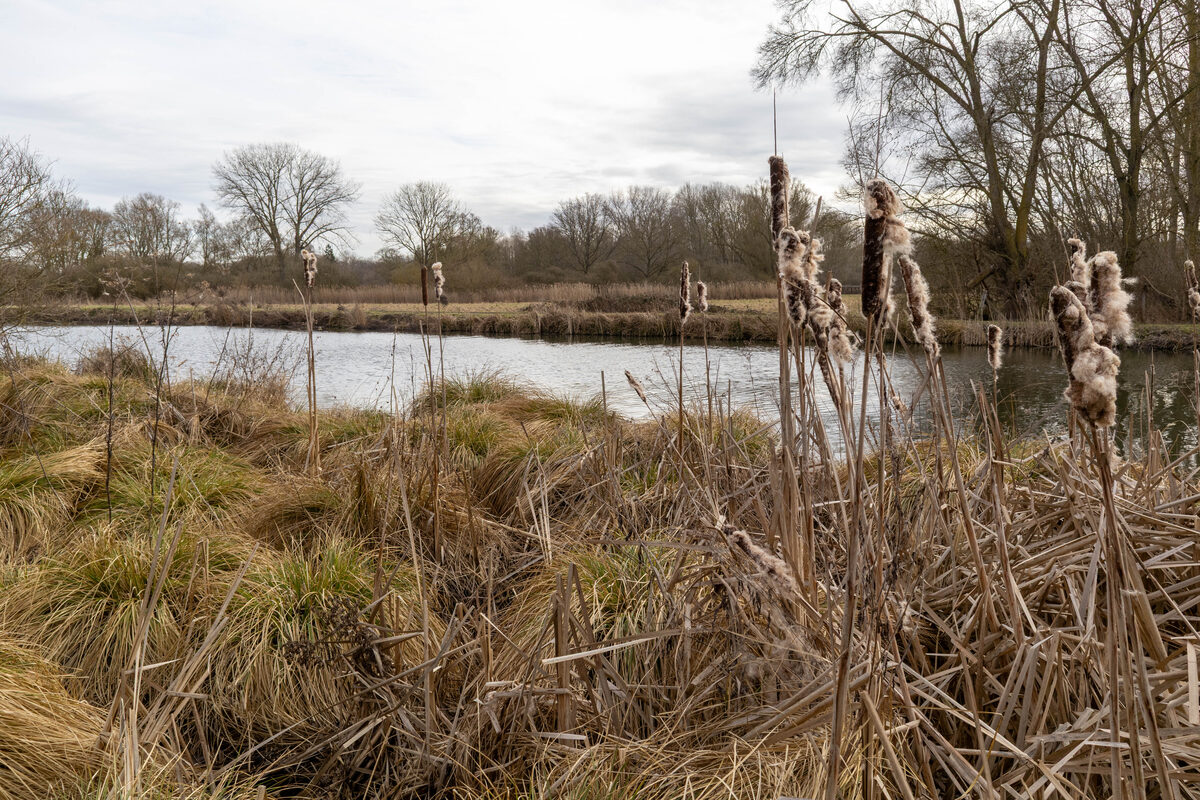
The Scarpe of that time was not the quiet, canalised river of today. It was a wandering watercourse, braided into multiple channels, its bed shifting with floods and frosts. At Biache, the river carved out and then filled a depression, accumulating successive layers of gravel, sand and silt. It is these deposits that trapped, protected and preserved the remains of human and animal life. The site's stratigraphyStratigraphyThe study of the superimposed layers (strata) of an archaeological site; each layer corresponds to a phase of occupation and yields a relative chronology.→, meticulously recorded by the excavators, reads like a book: each stratum corresponds to a phase of the river and the climate, and allows human occupations to be placed within a fine chronology [[#s3]].
This setting is essential. Unlike the caves of the Périgord or the Meuse valley, which offer natural shelters, the northern plain preserved almost nothing. Acidic soils and erosion usually erase the traces of the first humans. It took the rare conjunction of rapid sedimentation and burialBurialThe intentional deposition of a body, sometimes with offerings; a marker of symbolic behaviour.→ away from the air for human bones nearly 180,000 years old to reach us. Biache-Saint-Vaast is, in this sense, a happy accident of geology: a window opened onto an age whose testimony has disappeared everywhere else in the region [[#s1]].
The animal world accompanied this cold steppe. Herds of large herbivores roamed the valley: steppe bison, aurochs, horses, deer, but also rhinoceroses and, in wooded areas, bears. These animals were both the chief resource of the human hunters and a structuring factor of the landscape, which they maintained through grazing. To understand the environment of Biache is thus to understand a complete ecosystem in which humans were only one predator among others, but a predator whose technical intelligence was beginning to make the difference.
The discovery of 1976
This quality makes Biache-Saint-Vaast a reference site for the stratigraphy of the Middle PleistoceneMiddle PleistoceneGeological subperiod (about 770,000 to 126,000 years ago) marked by growing behavioural complexity among hominins.→ in north-western Europe. Prehistorians use it as a yardstick, against which they compare other sites in the region to establish correlations. To understand the order and age of the Biache layers is to have a solid chronological framework for a whole swathe of regional prehistory. The site thus transcends its own history to become a tool for dating and comparison on a continental scale.
The scientific history of Biache-Saint-Vaast begins on 5 May 1976. On that day, a volunteer named F. Carré, who was taking part in the fieldwork, uncovered a first fragment of human skull. The find was not the product of pure chance: it occurred within rescue excavations undertaken on the site, which was threatened by development works. But it had something miraculous about it, so rare are human remains of this antiquity. In a few moments, a rescue dig turned into a major site of European palaeoanthropologyPalaeoanthropologyThe science that studies human evolution from the fossil remains of hominins (bones, teeth, footprints) and their context, to reconstruct our biological origins.→ [[#s2]].
The very length of the Biache sequence deserves emphasis. The site does not correspond to a single occupation but to a succession of deposits spanning tens of thousands of years. This temporal depth is a rare privilege for an open-air site. It makes it possible to follow, layer after layer, the alternation of coolings and warmings, the advance and retreat of wooded landscapes, the appearance and disappearance of certain animal species. Where an ordinary site provides only a snapshot, Biache offers a genuine chronology, a continuous record of the glacial world of northern Europe.
The excavations were directed by Professor Alain Tuffreau, a prehistorian specialising in the PalaeolithicPalaeolithicThe oldest and longest period of prehistory (c. 3.3 Ma–12,000 BC), defined by chipped stone tools and a hunter-gatherer way of life.→ of northern France, whose name remains inseparable from the site. Under his direction, operations continued, with interruptions and resumptions, until 1982. This was a long, methodical undertaking, carried out in sometimes difficult conditions: the water table lay close to the surface, the sediments were waterlogged, and the race against the demands of regional planning imposed a sustained pace. Rescue excavation means extracting from a threatened soil the maximum of information before the mechanical shovel wipes everything away [[#s3]].
This rescue context deserves a pause, for it defines a certain archaeology of the second half of the twentieth century. Unlike planned excavations, chosen and scheduled by researchers, rescue excavations are dictated by the urgency of major works. Biache-Saint-Vaast is an emblematic example: without the vigilance of the team and the decision to dig before destruction, these skulls would have gone to the tip, and northern France would have lost forever its most ancient memory. The discipline also gains a lesson in method: it is by combining geology, sedimentology, the study of faunas and that of tools that dispersed remains can be given meaning [[#s1]].
The excavation in fact yielded far more than human bones. It uncovered vast occupation surfaces, with concentrations of flint tools, animal bones bearing cut marks, hearths and the spatial organisation of activities. Each object was located in three dimensions, drawn, photographed and placed back within its layer. It is this rigour that still allows the site to be re-examined today: the excavation archives constitute a precious resource, exploited by successive generations of researchers [[#s3]].
Biache 1 and Biache 2, two skulls
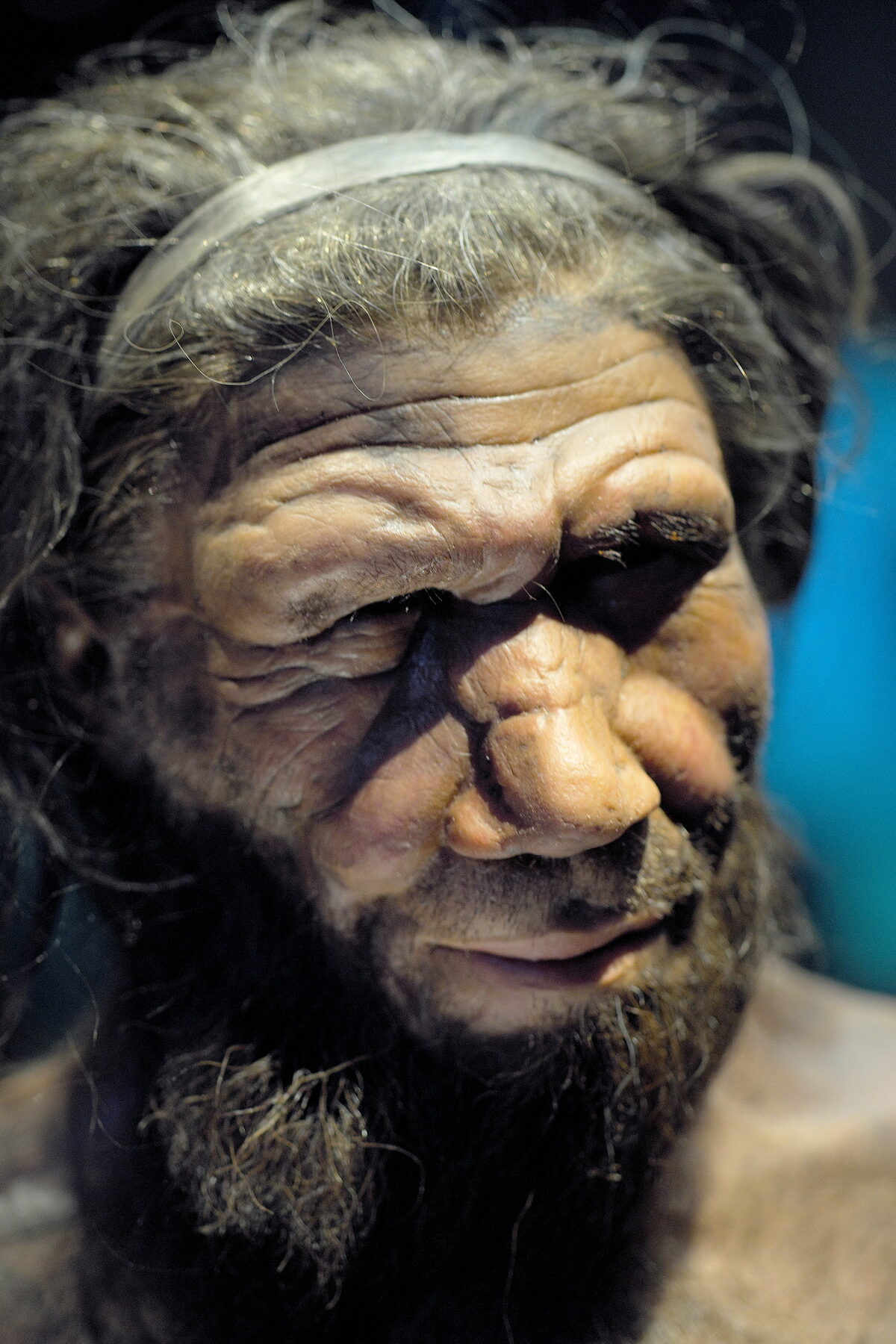
The site yielded not one but two individuals, designated by the labels Biache-Saint-Vaast 1 and Biache 2. The first, discovered in 1976, is the best known and most thoroughly studied. It is a fragmentary, incomplete skull, of which part of the vault and base survive. Analyses carried out over the following decades concluded that it was very probably a female individual, a young woman whose broken remains bear the mark of a particular treatment before their burial [[#s4]].
The context in which the skulls were found is significant. The human fragments were not isolated in a protected recess but mingled with the rest of the occupation, among the flints and animal bones. This proximity between human remains and the debris of daily life raises fascinating questions about the status of these dead. Were they treated like game, abandoned on the spot, or given special attention? The answer remains open, but the mere presence of these bones in such a context, at so remote an age, is in itself remarkable.
Biache 2, uncovered later, is a second individual, interpreted as male. Its presence confirms that the site preserved not an isolated accident but the repeated traces of a human presence on the spot. Two skulls of this antiquity, from a single site in northern Europe, form an assemblage of extreme rarity. They offer palaeoanthropologists the precious possibility of comparing two contemporary individuals and measuring the variability of a single population, rather than reasoning from a unique and inevitably ambiguous fossil [[#s2]].
The state of the remains calls for a remark. The Biache skulls are not complete, carefully buried skeletons; they are fragments, and above all, in the case of Biache 1, analysis revealed disturbing clues. The base of the skull shows an enlargement of the foramen magnumForamen magnumThe opening at the base of the skull through which the spinal cord connects to the brain. Its position (rear → forward) is a bipedalism indicator: placed beneath the skull in bipeds, at the rear in quadrupeds.→ and fractures which, for some researchers, suggest intentional extraction of the brain. Such a cautious interpretation echoes other known cases in the Palaeolithic where human skulls appear to have undergone manipulations exceeding mere taphonomic accident. Without being able to decide between a dietary practice, a ritual gesture or a particular funerary treatment, these observations remind us that these ancient humans' relationship with their dead was already, no doubt, charged with meaning [[#s4]].
These two skulls, despite their fragmentary character, were the subject of a thorough anatomical study, published notably in the Bulletins and Mémoires of the Anthropological Society of Paris. It is from this meticulous study, measurement after measurement, that the interpretation of the evolutionary status of the inhabitants of Biache derives. For behind these bone fragments lies a fundamental question: at what moment in human history do these beings stand, and what do they tellTellAn artificial mound formed by the accumulation of successive layers of settlement remains at the same spot, typical of the Near East. Each destruction-rebuilding event adds a stratum.→ us about the birth of the Neanderthals?
"Pre-Neanderthals"
The term that recurs most often to describe the people of Biache-Saint-Vaast is that of pre-NeanderthalsPre-NeanderthalMiddle Pleistocene human populations (c. 300,000 to 130,000 years ago) already showing incipient Neanderthal traits, at the hinge between Homo heidelbergensisHomo heidelbergensisMiddle Pleistocene human species, often seen as the common ancestor of Neanderthals and our own species.→/erectus and classic Neanderthals.→, or early Neanderthals. It conveys a precise idea: these individuals are no longer Homo erectus, but they are not yet the classic Neanderthals known from more recent sites such as La Ferrassie or La Chapelle-aux-Saints. They occupy an intermediate position on the long evolutionary road which, in Europe, leads from the first human occupants to the Neanderthals of the last glacial period [[#s2]].
The vocabulary itself deserves clarification. The word pre-Neanderthal can be misleading, for it does not designate a distinct species but an evolutionary stage. Some researchers prefer to speak of early Neanderthals, others of Middle Pleistocene forms with Neanderthal affinities. These debates over terminology are not mere quarrels about words: they reflect the real difficulty of naming populations that lie at the heart of a transformation. How does one label a being that is already partly what it will become, and still partly what it descends from? Biache-Saint-Vaast obliges us to accept this measure of indeterminacy, characteristic of any transitional form.
This notion of a transitional form lies at the core of the site's scientific value. The Neanderthals did not appear all at once, like a fully formed species landing on the continent. They are the product of a gradual, in-place evolution of a European lineage that slowly accumulated, generation after generation, the traits we recognise as Neanderthal: the bony ridge above the orbits, the elongated shape of the skull, the general robustness, the particular organisation of the face and teeth. Biache-Saint-Vaast captures an instant of this slow crystallisation [[#s1]].
To place things in time, one must remember that the so-called classic Neanderthals flourished mainly between about 120,000 and 40,000 years ago. The inhabitants of Biache lived more than 50,000 years before that peak. They belong to what prehistorians call marine isotope stage 6, or sometimes the end of stage 7, a period when the Neanderthal lineage was fully under construction. In other words, when we look at the Biache skulls, we look at an ancestor in the making, a link in a chain of which, for a long time, only the ends were known [[#s3]].
This particular place explains why Biache-Saint-Vaast is regularly cited in international syntheses on the origin of the Neanderthals, alongside sites such as the Sima de los HuesosSima de los HuesosA natural shaft at Atapuerca (Spain) that yielded over 6,500 bones of at least 29 Homo heidelbergensis individuals dated to −430,000: the largest Middle Pleistocene human fossil assemblage.→ in Spain, Swanscombe in England or Ehringsdorf in Germany. All document this pivotal moment of the Middle Pleistocene when the Neanderthal face gradually takes shape. Each brings its piece to the puzzle; that of Biache is all the more precious in that it comes from northern France, a region where human fossils of this antiquity are almost entirely absent.
What the morphology reveals
It is worth insisting that palaeoanthropology is a cumulative science. No single fossil settles a question; each is one voice in a long conversation stretching across laboratories and generations. The Biache skulls entered that conversation in the 1980s and have never left it. As casts circulated, as measurement standards were refined, as comparative series grew, the meaning attributed to these fragments was continually adjusted. This is not a weakness but a strength: it is precisely because Biache was so carefully excavated and described that it can keep contributing to a debate its discoverers could not have foreseen in full.
Before going into the detail of the bones, a difficulty peculiar to palaeoanthropology must be recalled. A fossil is never an open book: it must be deciphered, compared, measured, and sometimes the conclusions revised as new methods appear. The interpretation of the Biache skulls has thus evolved since their discovery, as the discipline advanced. What researchers of the 1980s read on these fragments has been refined, nuanced and completed by later work. This dynamic dimension is the hallmark of a living science, in which every fossil remains open to re-examination.
The detailed examination of the Biache-Saint-Vaast skulls, in particular Biache 1, explains why researchers place them at the junction between Homo erectus and Neanderthals. Some features look back towards the past, towards more archaicArchaicRefers to an ancient, now-extinct human population or form (Neanderthals, Denisovans, ghost lineages), as opposed to anatomically modern humans.→ forms; others already announce the Neanderthal lineage. It is precisely this mosaic of traits that defines a transitional form [[#s4]].
Among the traits inherited from ancient forms, one notes a certain general robustness and a still massive cranial architecture, recalling the world of Homo erectus and their immediate descendants. But other features, closely examined by anthropologists, clearly prefigure the Neanderthals: the organisation of the inner-ear region, the morphology of certain structures at the base of the skull, the shape of the back of the head. The combination is significant. It shows that Neanderthal traits did not appear all at the same time but became established in stages, some parts of the anatomy evolving faster than others [[#s2]].
This phenomenon, which specialists call mosaic evolution, is one of the great lessons of modern palaeoanthropology. It contradicts the simplistic image of a gradual, uniform transformation of one species into another. At Biache, one observes that a single individual can possess simultaneously archaic-looking traits and thoroughly Neanderthal innovations. This finding compels us to think of human evolution not as a straight line but as a bush of populations that exchange, diverge and converge over time and with climatic variations [[#s3]].
The cranial capacity, one of the most commented indices in anthropology, already lies within a high range, comparable to that of later human populations. This means that these beings possessed a voluminous brain, capable of sustaining complex technical and social behaviours. The intelligence of Biache was not that of a diminished forerunner: it was that of an accomplished hunter, able to devise strategies, transmit know-how and organise in a group. Morphology here speaks not only of anatomy; it speaks of behaviour.
Finally, it must be stressed how much these conclusions rest on patient comparative work. A skull fragment means nothing in isolation; it takes on meaning only when set against series of European and African fossils, casts and standardised measurements. It is the networking of data, on a continental scale, that made it possible to fix the place of Biache in the human tree. This local site thus became an international reference, cited as early as the 1980s in debates on the origin of the Neanderthal lineage [[#s4]].
Levallois toolmaking and the way of life
There is something almost paradoxical in the durability of stone. The bodies of the Biache people are all but gone, reduced to a few fragments; their language, their beliefs, their bonds have left no direct trace. Yet their most banal gestures, the striking of a flint, the reshaping of a core, survive with astonishing fidelity. Through these humble flakes we reach, more surely than through the rare bones, the mind at work: a mind that plans, anticipates, remembers a sequence of actions and passes it on. The toolkit is, in a sense, the most eloquent testimony these ancient hunters left of themselves.
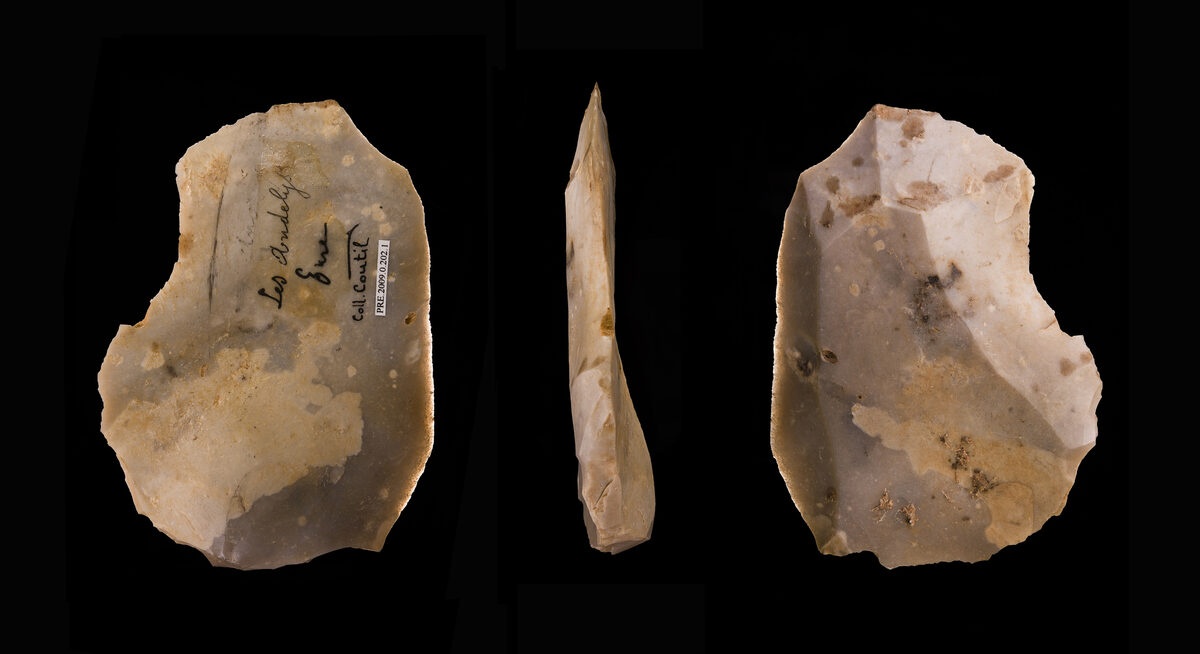
The people of Biache-Saint-Vaast left not only their bones: they abandoned on the spot thousands of flint tools, which say much about their technical intelligence. The lithic industry of the site belongs to the MousterianMousterianThe stone-tool industry typical of Neanderthals, based on the Levallois flaking technique.→ and, above all, employs the famous LevalloisLevallois techniqueA Middle PalaeolithicMiddle PalaeolithicA Palaeolithic period (c. 300,000 to 40,000 years ago) associated mainly with Neanderthals and early Homo sapiens, marked by Levallois tools.→ flint-knapping method: a core is prepared so a flake of predetermined shape can be struck off in one blow; a hallmark of Neanderthal skill.→ technique, that sophisticated knapping process which is one of the great signatures of the Neanderthals and their immediate predecessors [[#s2]].
Flint is, for prehistorians, an incomparable source of information. Unlike perishable materials such as wood, hide or fibre, knapped stone crosses the millennia without degrading. Each flake preserves the memory of the gestures that produced it: the angle of the blow, the preparation of the block, the sequence of removals. By working back up the operational chain, that is, the whole series of manufacturing stages, researchers literally reconstruct the gestures of the Biache knappers, as one might rewind a film. This technical reading gives indirect access to the thought of these people.
The Levallois method is no mere tinkering. It presupposes genuine mental anticipation. The knapper does not simply strike a flint block at random: he prepares it at length, shaping its surface as one prepares a mould, so that the final blow detaches a flake of a shape and size determined in advance. This ability to conceive an object before producing it, to hold several manufacturing stages in mind, testifies to abstract, planned thought. It places the people of Biache very far from the image of primitive beings clumsily striking pebbles [[#s3]].
These tools, sharp flakes, points and scrapers, served a wide range of tasks: butchering game, cutting meat, working hides, scoring bone or wood. The marks left on the site's animal bones, cut marks and butchery striations, correspond precisely to the butchery gestures these flints allow. There is a remarkable coherence here between tool and use, between the knapping workshop and the butchered carcass. The site is not a mere passing place but a living space where tools were made, repaired and used as close as possible to daily needs [[#s1]].
The raw material itself yields information. The flint used comes from local or regional sources, which tells us about the movements and territory of the group. To choose a good flint nodule, to know where to find it, to transport and conserve it: all these are behaviours that imply an intimate knowledge of the landscape and its resources. The Biache toolkit thus outlines, in negative, a social and territorial organisation, that of mobile hunters who roamed the Scarpe valley and its surroundings according to game and raw materials [[#s3]].
Through these flints, then, a whole way of life can be reconstructed: that of small human groups, nomadic or semi-nomadic, whose survival rested on hunting, on a fine mastery of stone and on the rigorous transmission of know-how. The Levallois technique, passed from generation to generation, is in itself a major cultural fact. It proves that, long before the art of decorated caves, the humanity of northern France already possessed an elaborate technical culture, stable over time.
The hunted fauna and the Saalian environment
The Biache-Saint-Vaast site is also, and perhaps above all, an extraordinary conservatory of the fauna of the Middle Pleistocene. The excavations yielded thousands of animal bones, which paint the picture of an animal world now vanished and allow the reconstruction of the environment in which the early Neanderthals moved [[#s3]].
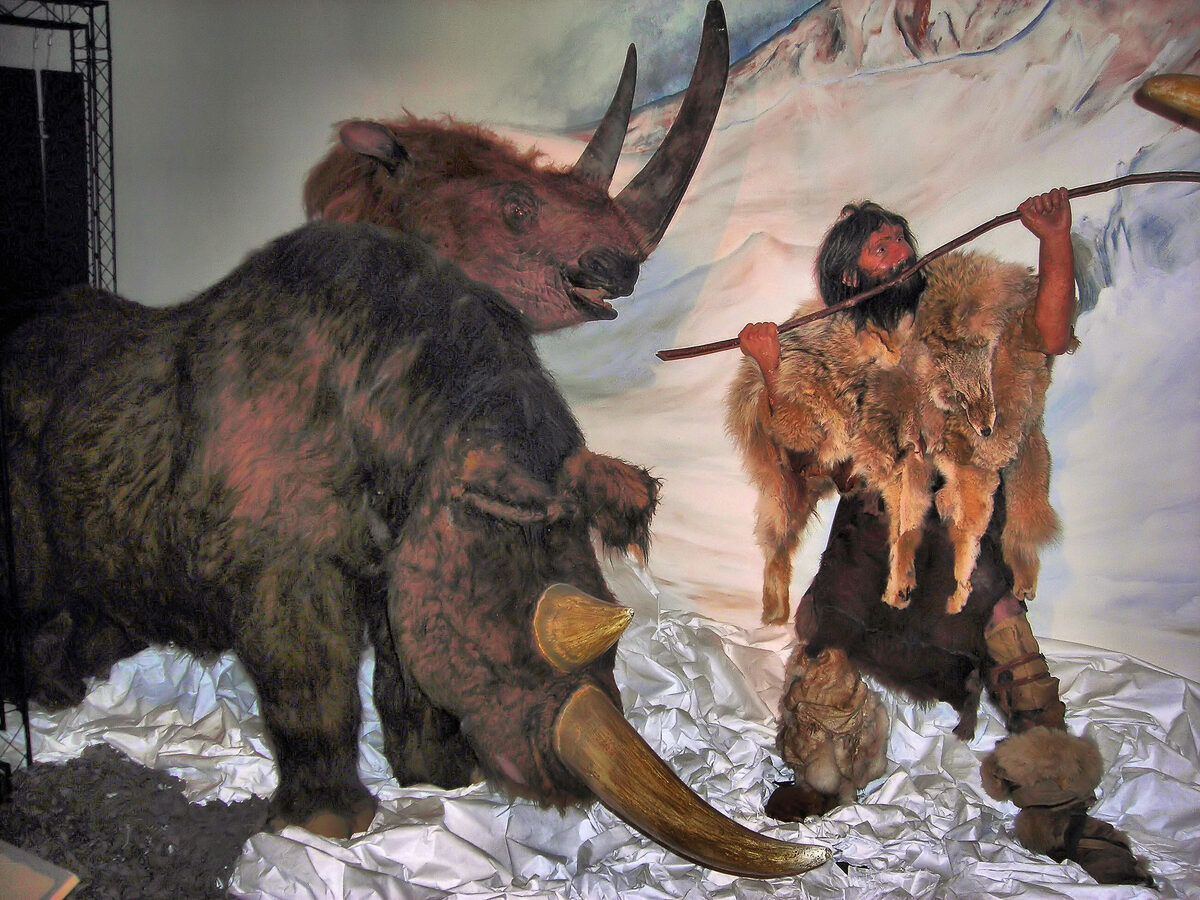
One must imagine what hunting represented for these populations. In a cold, open environment, animal meat and fat were a vital necessity: they provided the energy indispensable for withstanding harsh winters. Hunting an aurochs or a bison was no trivial undertaking; it demanded collective organisation, a knowledge of herd behaviour, the choice of the right moment and the right place. Behind the butchered bones of Biache lie coordinated hunting scenes, ambushes, shared efforts whose success conditioned the survival of the group.
Among the identified species are the aurochs, wild ancestor of our domestic cattle, the steppe bison, the bear, the rhinoceros and the deer. These large mammals were the preferred game of the Biache hunters. Some, like the aurochs and the bison, offered substantial quantities of meat, fat, hide and bone, resources vital for surviving in a cold climate. Others, like the rhinoceros, represented formidable prey, whose hunting demanded considerable coordination and courage. The presence of the bear moreover reminds us that humans shared their territory with other large predators [[#s2]].
The study of these bones, or archaeozoology, goes far beyond a mere inventory. Palaeontologists examine the marks left on the bones to distinguish what stems from human action, carnivore action or natural processes. At Biache, many bones bear characteristic cut marks, fractures made to extract marrow, scraping marks. These clues prove that the animals were hunted, or at least butchered and consumed by humans, and did not simply die on the spot. The site is a place of butchery and consumption, where carcasses were brought back and processed [[#s1]].
The archaeozoology of Biache also sheds light on the question of scavenging. In a landscape peopled with large carnivores, humans were not the only ones to exploit carcasses. Distinguishing a hunted prey from an animal recovered after its natural death, or contested with a predator, requires a fine analysis of the bone marks and their order of succession. Studies carried out on the site tend to show an often early and privileged human access to carcasses, compatible with genuine hunting activity rather than mere opportunism. This point is not minor: it reinforces the image of active, competent early Neanderthals, able to rival the other large predators of the steppe.
This fauna is also a thermometer. The composition of the species, combined with the study of pollen, sediments and micromammals, makes it possible to reconstruct the climate and landscape with precision. The site's different layers record variations: sometimes more temperate phases with a forest cover, sometimes frankly cold and steppe phases. Biache is therefore not the portrait of an instant but the film of an environment in motion, oscillating to the rhythm of the glacial cycles of the Saalian [[#s3]].
It is here that the expression coevolution between Neanderthals and their environment, used in the works devoted to the site, takes on its full meaning. Over the nearly 60,000 years covered by the Biache sequence, one sees the human populations adapting to the fluctuations of the climate, adjusting their hunting strategies, following the movements of the herds. Humans and their environment do not form two separate entities but a system in constant interaction. To study Biache is to observe, over a considerable span, the dialogue between an emerging humanity and a demanding nature [[#s3]].
The oldest human in northern France
The rarity of such finds also explains the intensity of scholarly attention devoted to Biache. When a fossil record is as sparse as that of the Middle Pleistocene in the north, each specimen is examined, remeasured and debated far beyond what a more abundant record would warrant. A single skull can tip an argument, support or undermine a hypothesis about the tempo and geography of Neanderthal origins. Biache, with its two individuals, therefore carries a weight out of all proportion to its modest physical size, and that weight has only grown as the questions surrounding Neanderthal emergence have sharpened.
One must gauge what this status represents: the Biache-Saint-Vaast skulls are the oldest known human fossils in northern France, and among the oldest in north-western Europe. In a vast region stretching from the Flemish plains to Picardy, no other human remains go back so far in time. Biache alone thus holds the place of doyen of regional humanity [[#s1]].
It is worth placing Biache within the geography of the great sites of the same period. On the European scale, the Middle Pleistocene is documented by only a handful of sites that have yielded human remains. In Spain, the Sima de los Huesos at AtapuercaAtapuercaA complex of archaeological sites in the Sierra de Atapuerca (Burgos, Spain), a UNESCO site, yielding an exceptional sequence of human fossils, including the Sima de los Huesos and Homo antecessor.→ produced an exceptional assemblage of fossils; in England, Swanscombe yielded a famous skull fragment; in Germany, sites such as Ehringsdorf or Steinheim made their contribution. Biache-Saint-Vaast belongs to this constellation of key sites, and holds within it the unique place of witness for northern France, a geographical link that was missing from the chain.
This primacy is not merely a curiosity of records. It has a deep scientific significance. Human fossils of the Middle Pleistocene are extremely rare everywhere in the world, and even more so in the plain regions of northern Europe, where preservation conditions are unfavourable. Every skull counts, every fragment adds a datum to a desperately incomplete skeletal record. By yielding two individuals, Biache at a stroke doubles the little that was available for this period and this region [[#s4]].
This antiquity also places northern France back within the great history of the human peopling of Europe. For a long time, the northern plains tended to be regarded as margins, occupied late and intermittently. Biache-Saint-Vaast demonstrates the contrary: as early as the Middle Pleistocene, in the midst of a glacial period, human groups lived, hunted and knapped flint on the banks of the Scarpe. Far from being a desert, the north was a territory inhabited by populations perfectly adapted to the cold [[#s2]].
The site finally invites us to revise our intimate scale of time. When one treads today on the soil of the Pas-de-Calais, one walks on a land whose human memory reaches back nearly 180,000 years. The GaulsGaulsCeltic peoples settled in Gaul (France, Belgium and neighbouring regions) during the second Iron Age, before their integration into the Roman Empire.→, the Romans, the Gothic cathedrals, the modern wars: all the known history of the region fits within the last few millimetres of this immense thickness of time. Biache-Saint-Vaast is dizzying, reminding us that beneath our feet sleeps a humanity incomparably older than anything written history recounts [[#s1]].
Preserving and promoting the heritage
A site of such importance raises concrete questions of conservation. The Biache-Saint-Vaast skulls, exceptional scientific objects, must be protected, studied and, as far as possible, made accessible to the public. Their fragility imposes strict conservation conditions; the originals are precious and handled with the utmost care, while casts allow comparative study and museum display without risk to the authentic pieces [[#s2]].
The scientific longevity of a site depends on the quality of its initial documentation. It is here that the rigorous work carried out under the direction of Alain Tuffreau takes on its full value. Because every object was carefully located, recorded and published, the Biache collections remain usable decades after their discovery. A poorly excavated site dies with its excavators; a well-excavated site keeps yielding lessons long afterwards. Biache-Saint-Vaast belongs firmly to the second category, and it is also in this that it stands as a model.
Promoting such a heritage requires an effort of mediation. Making a wide public understand the importance of two skull fragments 175,000 years old is far from obvious. The heritage institutions of the Pas-de-Calais work at it, placing Biache within the broader story of regional prehistory and stressing what the site teaches us about our origins. Exhibitions, publications, online resources: so many channels that keep the memory of the site alive long after the end of the excavations [[#s1]].
This heritage is also a living scientific heritage. The collections from Tuffreau's excavations, human bones, fauna, lithic industries, continue to be re-examined in the light of new methods. Dating, the analysis of bone surfaces, use-wearuse-wearMicro-traces left on a tool by its use, studied through use-wear analysis to reconstruct its function.→ study of the tools, and tomorrow perhaps biomolecular analyses, open perspectives the excavators of the 1970s could not imagine. A well-documented site is never definitively closed: it remains a reserve of data for the future [[#s3]].
Finally, Biache-Saint-Vaast illustrates the importance of preventive and rescue archaeologyRescue archaeologyArchaeology triggered by development works (roads, railways, buildings) to study and record remains threatened with destruction before construction; in France it is carried out notably by Inrap.→ in the building of our knowledge. Without the decision to dig before development, this treasure would have vanished without a trace. Every major public-works project is thus an occasion, sometimes unique, to save a portion of collective memory. To protect buried heritage is to protect a history that belongs to all and which, without vigilance, fades silently beneath the shovel of the machines [[#s2]].
Conclusion
It is tempting, standing before these fragments, to feel the vertigo of deep time and the strangeness of these near-humans who were not us. But the deeper lesson of Biache may be one of continuity. The planning behind a Levallois flake, the coordinated hunt of a bison, the perhaps meaningful handling of the dead: all these speak of minds and societies recognisable, in their essentials, as human. Across an abyss of nearly two hundred millennia, the people of Biache-Saint-Vaast hold out to us a distant but genuine kinship, and it is this recognition, as much as the science, that gives the site its quiet power.
Biache-Saint-Vaast is not an easy site to tell. It offers neither colourful frescoFrescoA term used by extension for large painted compositions on the walls of decorated caves, although the technique differs from the classical mural fresco.→, nor spectacular burial, nor immediately appealing art object. Its richness is of another order: it lies in two skull fragments, in thousands of flints and bones, and above all in the unique position it occupies in human history. At the junction between Homo erectus and the classic Neanderthals, the inhabitants of Biache embody a decisive moment of our evolution, the moment when the Neanderthal lineage slowly took shape under the icy sky of northern France.
The site also raises, in the background, the question of our relationship with deep time and our distant cousins. These early Neanderthals were not the shaggy brutes of popular folklore but intelligent, adapted beings, endowed with an elaborate technical culture and perhaps already with a form of symbolic relationship with their dead. To rediscover them is to correct an image and to recognise in them a part of our own humanity. They are not our direct ancestors in the strict sense, the Neanderthal lineage having died out, but they belong to the great human family from which our species inherited, in part, through the hybridisationHybridisationCrossing between two distinct species or lineages, such as Homo sapiensHomo sapiensThe present-day human species, which emerged in Africa around 300,000 years ago, the only surviving human lineage after the extinction of Neanderthals and Denisovans.→ and Neanderthals, leaving a trace in the genome.→ documented by recent genetics.
Through this site, a long-term history takes shape: nearly 60,000 years of dialogue between an emerging humanity and a changing environment, between hunters adapted to the cold and a fauna now vanished. The skulls of Biache 1 and Biache 2, discovered through the vigilance of a volunteer and the persistence of a team led by Alain Tuffreau, gave northern France its oldest human face. They remind us that the adventure of our origins did not play out only in the caves of the south or the valleys of AfricaAfricaThe cradle of humankind: the continent where the first hominins appeared, then Homo sapiens around 300,000 years ago, before the expansion to the rest of the world.→, but also here, on the banks of a modest river of the Artois, nearly one hundred and eighty thousand years ago [[#s1]].
J'ai croisé ces données avec la chrono-carte. La cohérence chronologique et géographique est remarquable.