On the roadside between Maroua and Garoua, in the North Region of Cameroon, a marble field stretches across the semi-arid landscape. On its white, pink, and greenish slabs, some 500 geometric figures have been engraved by human hands -- perhaps three centuries ago, perhaps three millennia. The Bidzar site, first reported in 1933, remains one of the most enigmatic and least-known petroglyphPetroglyphAn engraving made on a rock surface by pecking, incising or abrading, as opposed to rock painting; a form of prehistoric art found on every continent.→ assemblages in Central AfricaAfricaThe cradle of humankind: the continent where the first hominins appeared, then Homo sapiens around 300,000 years ago, before the expansion to the rest of the world.→.
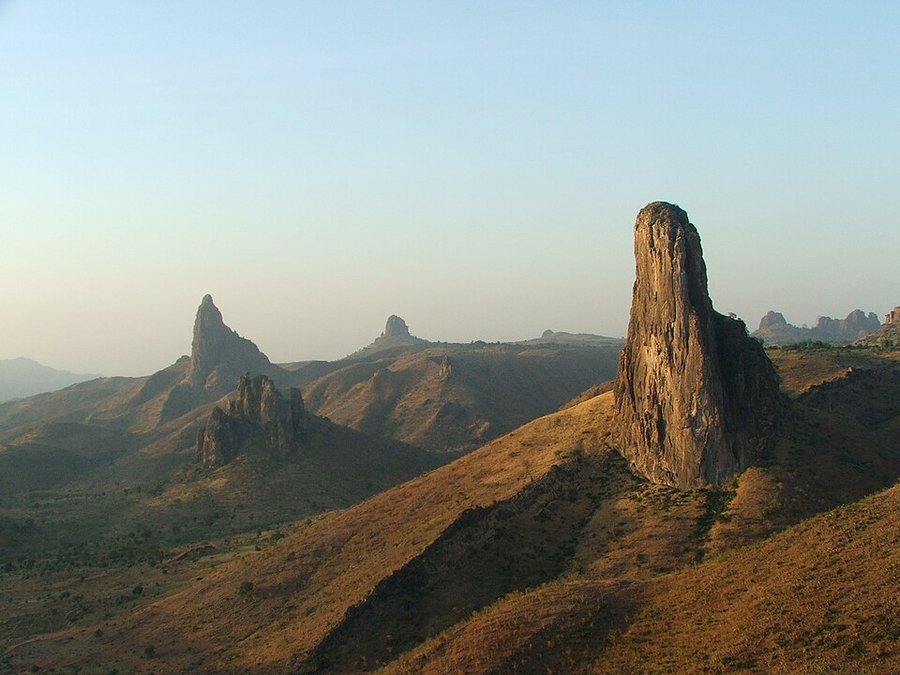
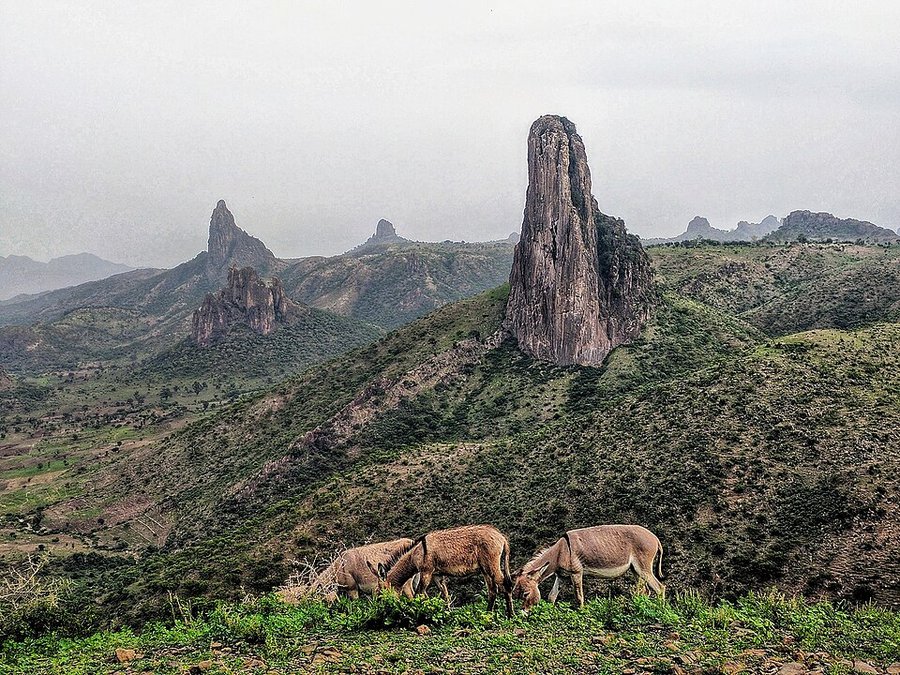
Bidzar (sometimes spelled Bitzar) is a village in the Mayo-Louti department, North Region, populated mainly by Guidar with a few Moundang and Guiziga families. West of the main road, an outcrop of cipolin-type calcite marble extends over several square kilometers. This marble -- traversed by chloritoschist veins that give it green, pink, or bluish tones -- had ideal characteristics for engraving: a relatively soft surface, sub-horizontal planes suited to incision. The engraved slabs concentrate near the junction with the road to Guider, over an area of 2.5 km north to south and 1 km east to west.[1]
Marble Geometries: Describing the Works
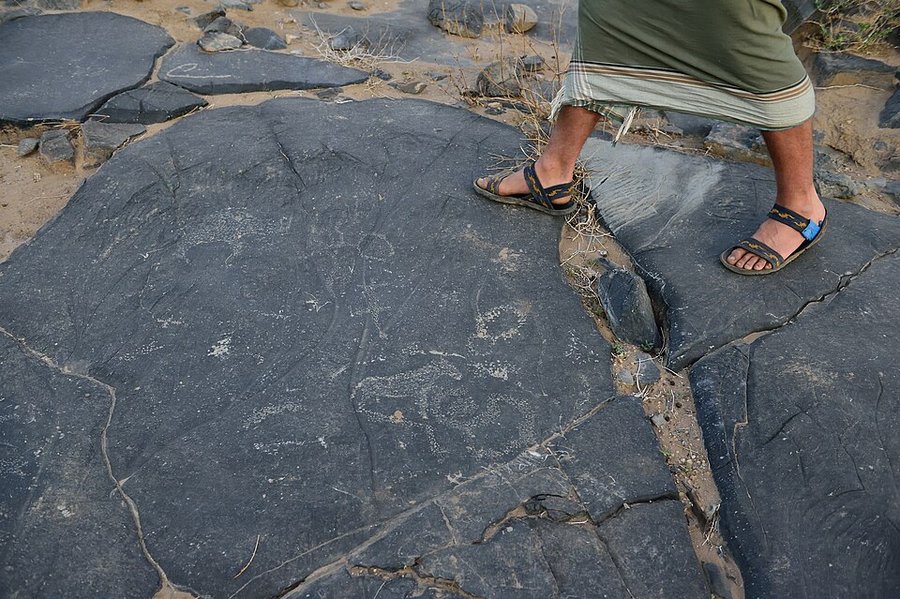
All the Bidzar engravings are geometric in character: tangent, concentric, and intersecting circles, hatched figures, linear networks. Among them are also cupules -- simple bowls ground into the rock, one of the most universal forms of rock art worldwide -- as well as motifs that some researchers interpret as schematic representations of objects or living beings.
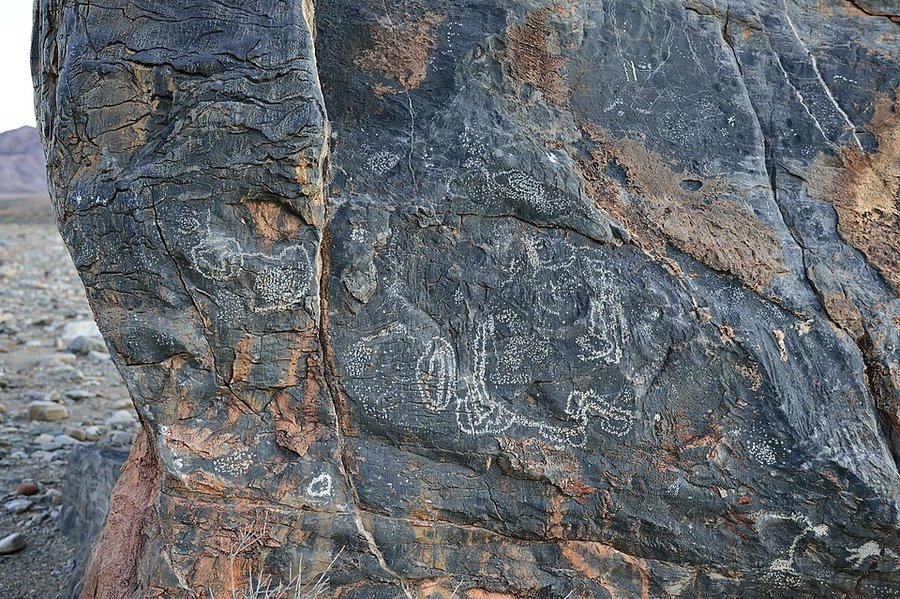
The technique used is indirect punctiform percussion: a punch is placed on the marble surface, then struck with a hammer, detaching a small flake. Repeated blows create the desired line. The craftspeople systematically chose the most uniform, least eroded surfaces, avoiding lapiezed or grooved areas. Nearly 500 representations have been counted across the site, distributed without apparent organization -- but with recurring themes suggesting shared intent.
A Dating That Defies Modern Methods
Dating the Bidzar engravings is one of the main scientific challenges. No radiometric dating has been possible: the marble contains no organic matter directly associated with the engravings, and OSL (luminescence) or rock varnish dating techniques remain difficult to apply to this type of support.
The current estimate relies on chemical weathering of the limestone support: the more degraded the marble around the engravings, the older they are. This imprecise but possible reasoning yields a very broad bracket: 300 to 3,000 years. Some engravings may thus date from the early centuries AD, during the savanna kingdoms that preceded Islam in the region; others may be only a few centuries old. The layering of motifs -- some crossing or superimposing others -- clearly indicates multiple and successive occupations of the site.
A Unique Site in Central Africa
What makes Bidzar exceptional is the absence of any known equivalent in Cameroon. Unlike the great rock art traditions of North Africa (Tassili n'Ajjer, Ahaggar) or southern Africa (San, Drakensberg), where representations are often figurative -- animals, humans, hunting scenes -- Bidzar offers an exclusively geometric and abstract repertoire. This brings the site closer to the rock art traditions of the Ogooue (Gabon), also characterized by geometric figures, although the supports and themes differ.
Alain Marliac, who conducted the first systematic excavations of the site in the 1970s-1980s, was the first to document the engravings rigorously and propose an interpretation. According to him, their recurrence and organization suggests they were linked to mythological or cosmogonic representations, perhaps to a proto-scriptural communication system or ritual practices of which the current Guidar populations have no memory. The meaning of these works was lost with the civilizations that produced them.
Threats and Conservation Prospects
The Bidzar site faces serious threats. The calcite marble that serves as support for the engravings is also the raw material for local cement factories and artisanal quarries. Decades of intensive exploitation have reduced the extent of the outcrops and irreversibly fragmented some slabs. Natural erosion compounds this degradation.
In 2018, Cameroon's Ministry of Arts and Culture submitted the site to the UNESCO World Heritage indicative list under criterion (i) -- a masterpiece of human creative genius -- thereby acknowledging the universal value of these engravings. This indicative inscription does not yet legally protect the site in a binding way, but constitutes a first step toward stronger legal protection.
Other sites in the region are also under prospection: the Tinguelin cliffs, Mount Makabai near Maroua, and several rocky formations in the Diamare region feature enigmatic designs whose origin and meaning remain to be elucidated. The prehistoryPrehistoryThe span of human history before the invention of writing, from the Palaeolithic to the Metal Ages, known mainly through material remains.→ of North Cameroon has doubtless not yet revealed all its secrets -- and it is near Bidzar, on a dusty roadside, that the first lines of this still largely unknown history can be read.
Rock Art Traditions of Central and Western Africa: A Panorama
The Bidzar petroglyphs are not an isolated phenomenon: they form part of a broader ensemble of rock art traditions covering central and western Africa, from the shores of Lake Chad to the Gabonese forests, from the plateaus of Niger to the foothills of the Mandara Mountains. This continental panorama, still imperfectly documented for lack of sufficient resources for systematic research, reveals a diversity of graphic practices that reflects the cultural richness of a part of the world often under-represented in global prehistoric syntheses.[6]
In Nigeria, the sites of Birnin Kudu in Jigawa State have yielded rock engravings combining geometric motifs and animalistic representations that in some respects recall the Saharan traditions of Niger and Chad. In the Air massif of Niger, rock engravings dating from the Saharan NeolithicNeolithicThe "New Stone Age": a period marked by farming, herding, settlement and pottery, from around 10,000 BC.→ (8000-3000 BC) offer an extraordinarily rich iconographic repertoire of bovine representations -- testimony to a flourishing pastoralismPastoralismA way of life based on herding livestock (cattle, sheep, goats), often mobile, which spread across the Green Sahara and, in that region, preceded farming proper.→ in a then-verdant Sahara -- which contrasts with the geometric abstraction predominant at Bidzar. These differences in style and subject probably reflect distinct cultural traditions as much as different ecological contexts.
The Ennedi massif in Chad, inscribed on the UNESCO World Heritage List in 2016, constitutes one of the most spectacular rock art ensembles in central Africa. The paintings and engravings of the Ennedi span several millennia, from the earliest representations of cattle and hunters to scenes of Arab horsemen dating from recent centuries. The figurative richness of the Ennedi stands in radical contrast to Bidzar's abstraction, suggesting different symbolic functions and cognitive worlds, even though the two traditions are geographically neighbouring at the continental scale.
In the Central African Republic, in the Bangui region and in the rocky massifs of the west, little-studied petroglyphs present cupules and geometric motifs that recall those of Bidzar, perhaps suggesting a common cultural area or parallel traditions. In Gabon, the engravings of the Ogooue valley -- documented since the 19th century by explorers and more systematically since the 1980s -- offer examples of anthropomorphic and geometric figures that illustrate the permanence of rupestrian practice in equatorial forest environments, very different from the semi-arid milieu of northern Cameroon.[6]
The fundamental distinction between figurative traditions -- privileging representations of animals and humans, as in the pastoral Sahara -- and abstract traditions -- privileging geometric motifs, cupules and linear networks, as at Bidzar -- is not strictly geographic: it reflects symbolic and cultural choices that archaeologists endeavour to decipher. These choices may reflect differences in the functions assigned to rock art (hunting propitiation, territorial marking, ritual communication) as much as stylistic traditions specific to particular cultural groups.
Scientific Expeditions from 1933 to the Present Day
The history of archaeological research on the Bidzar petroglyphs is closely linked to the colonial and post-colonial history of Cameroon, and reflects the successive opportunities and limitations of scientific investigation in this part of central Africa. The first official mention of the site in colonial administrative literature dates from the 1930s, when agents of the French mandatory administration noted in their tour reports the presence of "engraved stones" in the Bidzar massif foothills, without proposing any systematic interpretation.[7]
The first genuinely scientific studies of the site are associated with the work of Alain Marliac, a researcher attached to ORSTOM (later IRD), who conducted systematic surveys across northern Cameroon from the 1970s through the 1980s. Marliac produced the first drawn records of Bidzar's motifs, assembled an initial iconographic corpus and proposed a first periodisation of the prehistoric occupations of the region, situating the petroglyphs within a broader archaeological context covering Neolithic and Iron AgeIron AgeThe last period of protohistory (from c. 1200 BC in Europe and the Near East), marked by iron metallurgy and the first kingdoms.→ occupations in the Mandara foothills.
The 2000s marked a renewal of scientific interest in the site, with the involvement of the University of Ngaoundere and Cameroonian researchers trained at European and North American universities. Collaborations with the French CNRS and Belgian institutions made it possible to implement more sophisticated analytical methods, notably geophysical prospecting of zones around the site to identify possible associated occupation contexts, and physico-chemical analyses of mineral deposits within the cupules to attempt to refine their dating.[7]
In 2018, a process was launched to nominate the Bidzar site and its surroundings for UNESCO World Heritage status, a dossier supported by the Cameroonian government with the technical assistance of international experts. The preparation of this dossier led to a more exhaustive inventory of the site's petroglyphs and an in-depth reflection on protection and valorisation strategies. Although the nomination has not yet resulted in inscription, it has stimulated a dynamic of research and conservation whose effects are perceptible in recent publications on the site.
The current state of research at Bidzar is that of a site still imperfectly documented but benefiting from growing attention, both from the international scientific community and from Cameroonian authorities. The challenges are numerous: limited financial resources for fieldwork, logistical access difficulties in a region remote from urban centres, and the need to train a new generation of Cameroonian researchers capable of taking long-term responsibility for the documentation and valorisation of this exceptional heritage.
The Significance of Cupules: A Universal Prehistoric Language?
Cupules -- those hemispherical hollows pecked by percussion into rock -- constitute probably the most universally widespread type of petroglyph in human history. Present on five continents, from rocks on the Indian subcontinent to Irish dolmens, from pebbles in the Dordogne to Australian sandstone blocks, cupules have been produced by extremely diverse societies over a chronological range extending from the Middle PalaeolithicMiddle PalaeolithicA Palaeolithic period (c. 300,000 to 40,000 years ago) associated mainly with Neanderthals and early Homo sapiens, marked by Levallois tools.→ (certain cupules in South Africa and India are dated to more than 70,000 years ago) to the contemporary era in some cultural traditions.[8]
This ubiquity poses the question of significance acutely: do cupules correspond to the same symbolic function in all these contexts, or are they formal convergences masking radically different meanings? The dominant answer in current research is resolutely pluralist: cupules do not constitute a "universal language" in the sense of a shared semantic code, but rather a minimal graphic form -- the hemispherical hollow pecked into rock -- simple enough to have been independently reinvented many times over, and versatile enough to be charged with different meanings depending on cultural context.
Several interpretive hypotheses have been proposed and tested through comparative analyses. The lunar calendar theory suggests that cupules were used to count nights or lunar cycles, each hollow representing a unit of time. This interpretation, appealing in its elegance, runs into the difficulty of verifying the exact number of cupules in assemblages often altered by erosion, and the absence of systematic correspondence between cupule groupings and documented astronomical cycles. Fertility rites constitute another recurring hypothesis: the cupule as matrix, as generative cavity, as abstract representation of femininity or the nurturing earth.[8]
Research in archaeoacoustics has opened an unexpected perspective: percussion on rock surfaces to create cupules produces specific sounds whose properties vary according to the nature of the rock, its thickness and its spatial situation. Some sites containing numerous cupules appear to have been selected in part for their exceptional acoustic properties, suggesting that the very production of cupules -- the act of striking rock -- could have been a ritual musical act as much as a graphic one. This sonic dimension of rock art is increasingly recognised as a significant component of its production context.
At Bidzar, cupules are associated with concentric circle motifs and linear networks in an ensemble that is not without recalling, in its compositional principles, the abstract rock art traditions of peninsular India (Bhimbetka and Kupgal sites) or the motifs engraved on Irish Neolithic rocks (Newgrange, Loughcrew). These intercontinental parallels are probably independent convergences rather than evidence of contact: they testify to the deep tendency of the human mind to organise rock surfaces according to geometric principles that transcend cultures and epochs.
Cosmogony, Propitiation and Communication: What Do the Bidzar Circles Say?
The iconographic analysis of Bidzar's motifs, though hampered by the absence of a direct cultural context permitting grounded interpretation, nevertheless allows the identification of significant recurrences and the formulation of hypotheses about the uses and meanings of these engravings. The most frequent motif -- the concentric circle, often associated with a central cupule -- presents a structure that evokes, in many human cultural traditions, the sun, water or the spiral movement of life.[9]
The solar interpretation of concentric circles is supported by ethnographic analogies from geographically proximate cultures. Among the Dogon of Mali, whose cosmology was extensively documented by Marcel Griaule in the mid-twentieth century, circles and spirals are fundamental elements of the symbolic system, associated with notions of creation, cosmic movement and the complementarity of dry and wet. It would be hazardous to project Dogon cosmology directly onto the Bidzar engravers -- geographically distant and probably very different culturally -- but this comparison illustrates the depth and permanence of the symbolic associations that circular figures can evoke in sub-Saharan African traditions.
The territorial cartography hypothesis -- networks of lines and points as symbolic representations of landscapes, routes or boundaries -- has been proposed for certain African petroglyph ensembles presenting configurations that evoke schematised topographies. At Bidzar, certain groupings of cupules and engraved lines could represent valleys, watercourses or migration paths, constituting a form of "mental map" engraved in rock and legible by group members. This interpretation is difficult to test in the absence of precise knowledge of the prehistoric landscape of the region, but joins similar interpretations proposed for other African sites.[9]
Propitiation rites -- ceremonies intended to secure the benevolence of natural or spiritual forces before a hunt, a planting or a migration -- constitute a third major interpretive hypothesis for the Bidzar petroglyphs. In many hunter-gatherer and African agricultural societies, rupestrian sites are places of contact with the world of spirits and ancestors, where specific ritual acts -- offerings, sacrifices, songs, dances -- allow the conditions of collective life to be negotiated with supra-human powers. If the Bidzar engravers participated in such practices, the site itself may have been conceived less as a "tableau" to be looked at than as a "place of action" where ceremonies unfolded, with the engravings constituting their material support and lasting memory.
The absence of documented continuity between the prehistoric engravers of Bidzar and the current populations of the region -- the Guidar, the Fali, the Mandara -- makes these interpretations necessarily speculative. Unlike certain African rock art sites such as those of the San of southern Africa, where descendants or near-descendants of the artists can explain the significance of certain motifs, Bidzar presents itself as an orphaned heritage whose creators have disappeared or been profoundly culturally transformed without leaving a direct transmission of the engravings' significance.
The Guidar Peoples and the Transmission of the Memory of the Stones
The Guidar -- also known as Kilba in the Nigerian ethnographic literature -- constitute the population most directly associated with the territory where the Bidzar petroglyphs are found. Spoken in the northern foothills of the Mandara massif, in Cameroonian territory and in border zones with Nigeria, the Guidar belong to the Chadic linguistic group of the Afro-Asiatic family, and their presence in the region is attested by historical and oral sources for at least the 17th century.[10]
Guidar oral traditions sometimes make mention of "written stones" or "rocks of the ancients" in the local landscape, but these references generally remain vague and do not constitute a corpus of detailed interpretations of specific motifs. Ethnographic surveys conducted with older community members have gathered accounts associating certain rupestrian sites with tutelary spirits, places of ill omen, or founding ancestors whose names have been forgotten. These fragmentary traditions suggest a residual memory of the special character of these sites, but do not allow a coherent system of interpretation of the engravings to be reconstructed.
The question of cultural continuity between the Bidzar engravers and the contemporary Guidar is one of the most delicate in Cameroonian archaeology. Genetic analyses of regional populations, still few in number, suggest a complex demographic history including several waves of migration, assimilation and population replacement between the time the engravings were made (probably the first millennium CE, or even earlier) and the historical period. It is therefore possible that contemporary Guidar are very distant descendants of the engravers, or partial cultural heirs to a tradition whose specific significance was lost during profound historical transformations.[10]
This situation contrasts with that of the San of southern Africa, whose culture and cosmology -- known through ethnographic recordings of the 19th and 20th centuries made with still-practising communities -- allow certain motifs in the region's rock art to be interpreted with relative confidence. The absence of documented direct continuity for Bidzar places this site in a very different category, where interpretation must rely on cross-cultural comparisons and formal analogies rather than authenticated oral transmission, with the uncertainties this implies for any interpretive approach.
Collaboration programmes between archaeologists and the Guidar and Fali communities of the region are being developed, seeking to valorise the local rock art heritage as a cultural and identity resource for riverside populations while associating these communities with protection and research efforts. These "shared heritage" initiatives aim to transcend the traditional opposition between academic science and local knowledge, recognising that the fragmentary memories of current populations can constitute valuable investigative leads, even when they do not permit a direct and certain interpretation of the motifs.
Photogrammetry and Digital Documentation: Protecting Before Understanding
Faced with the combined threats of natural erosion, urban development and quarry expansion in the Bidzar region, the exhaustive digital documentation of the petroglyphs has established itself as an absolute priority of archaeological research. The University of Yaounde I initiated from 2019 a three-year programme of 3D digitisation of the site, combined with Structure from Motion (SfM) photogrammetry for the creation of high-resolution digital models of the engraved surfaces.[11]
SfM photogrammetry, a technique consisting in reconstructing a three-dimensional surface from a series of overlapping photographs taken from different angles, has the advantage of being relatively inexpensive in equipment, deployable by field teams without heavy specialised training, and capable of producing models sufficiently precise to document engravings whose relief is sometimes minimal -- a few millimetres of depth in the rock. The digital models thus created allow motifs to be visualised under artificial raking light that reveals details invisible under natural observation conditions, and enable precise metric measurements without contact with the surface.
The importance of these digital archives goes beyond the simple conservation of data: they also constitute a resource for remote comparative research. Researchers worldwide can access the 3D models of Bidzar without having to travel to the site, which democratises access to primary data and accelerates inter-site comparisons. Similar digital documentation projects have been conducted at major rock art sites such as Tassili n'Ajjer in Algeria, whose 3D digitisation by a Franco-Algerian team produced reference archives for Saharan rock artSaharan rock artThe body of prehistoric engravings and paintings across the Sahara, grouped into major stylistic phases (Wild Fauna, Cattle, Horse, Camel) from the Neolithic to antiquity.→ accessible to the international community.[11]
The question of accessibility of digital archives and data governance is a growing issue in research on African archaeological heritage. Who owns the digital data of a site? Who controls access and uses? These questions, touching on the sovereign rights of African countries over their own cultural heritage, have led to the elaboration of data-sharing protocols between Cameroonian institutions and international partners that attempt to reconcile open scientific access with respect for heritage sovereignty. The open-access model under licence is progressively being adopted as a standard in this field, but its concrete implementation remains uneven across institutions.
The juxtaposition between the physical fragility of the site -- a stone quarry operated less than a kilometre away directly threatens certain engraved zones -- and the relative robustness of the digital archives derived from it illustrates the fundamental tension of contemporary archaeological heritage conservation: document to avoid losing, but never be satisfied with documentation as a substitute for the physical preservation of the site. Mobilisation in favour of the effective protection of Bidzar remains a major challenge for the scientific community and Cameroonian authorities.
Perspectives: Bidzar in the Context of Emerging African Archaeology
The Bidzar petroglyphs are part of a pivotal moment for African archaeology, characterised by the growing influence of research conducted and theorised within the continent itself, by African researchers trained at African universities and benefiting from more equitable partnerships with institutions of the Global North. This "emerging African archaeology" is not merely a question of researchers' nationality: it implies a transformation of the questions asked, the methodologies privileged and the audiences targeted by research.[12]
For Bidzar, this dynamic translates notably into greater attention paid to the links between the rupestrian heritage and the cultural identities of contemporary Cameroonian populations. Heritage education initiatives targeting local communities and primary schools in the region aim to make the petroglyphs an identity and pedagogical resource for current generations, rather than a study object reserved for foreign specialists. This inscription of the site in local cultural policies is indispensable to its long-term protection, which cannot rest solely on national or international legal mechanisms.
The eventual inscription of Bidzar on the UNESCO World Heritage List, should it come to fruition, would bring considerable resources and visibility to the site, but would also entail risks: poorly managed tourist frequentation could accelerate the degradation of an already fragile site, and the reporting and management obligations inherent in UNESCO status require institutional and financial capacities that Cameroon will need to develop. The experience of other recently inscribed African sites -- Tiya, the Ennedi, but also less well-known sites like the Senegambian menhirs -- shows that inscription does not automatically guarantee effective on-the-ground protection.
Research at Bidzar is thus at a paradoxical moment: never have the available methods been so powerful for documenting, analysing and interpreting these millennial engravings; and yet the economic, logistical and institutional constraints weighing on archaeological research in central Africa remain considerable. Overcoming these constraints -- by mobilising innovative funding, training local teams and building genuinely equitable international partnerships -- is the condition for Bidzar to fully reveal the secrets that its engraved stones have kept for millennia.
Passionnant. J'avais jamais vraiment creusé ce sujet. Maintenant je veux aller plus loin.
J'envoie régulièrement vos articles à mes petits-enfants. Une belle façon d'apprendre ensemble.