Some discoveries look like nothing at all and yet unsettle a certainty. In late September 2026, the Saxony-Anhalt State Office for Heritage Management and Archaeology (LDA) announced the recovery, from the bottom of Lake Arendsee, of pieces of wood worked around 10,500 years ago by Mesolithic hunter-gatherersHunter-gatherersA way of life based on hunting, fishing and gathering wild resources, without farming or herding; it dominated almost the whole of human history.→. Nothing spectacular at first glance: a wooden post and a few split planks, lying on the muddy floor of a lake in northern Germany. But these ordinary objects, should they be confirmed as the remains of a structure, would force a rethink of the image we hold of these pre-agricultural populations. The researchers say it plainly: caution is needed. And caution, precisely, is at the heart of this story.
What the divers brought up
The pieces lay at a depth of about twenty metres, beneath a thin layer of lake sediment. Two elements stand out above all. First, a post roughly 1.60 metres long, bearing clear traces of felling and shaping: the tree was cut down, then worked by human hands, rather than simply having fallen into the water. Second, several split planks, up to 1.30 metres long, that is, wood split along the grain to obtain flat surfaces. These two technical signatures, felling and splitting, point unambiguously to woodworking, not a natural deposit of fallen branches.

It is these clues that license a bold hypothesis. To an archaeologist, a shaped post and regular planks evoke the components of a built structure: a wall, a floor, a platform, perhaps the remains of a dwelling. "The finds shed entirely new light on the Mesolithic period, for which traces of structures in central Germany have so far been known only in the form of soil discolorations," stressed state archaeologist Harald Meller.1 In other words, all that existed until now were dark stains in the earth, the ghosts of posts long since rotted away. Here, for the first time in the region, the wood itself has survived. The interpretive stakes are therefore considerable, because they touch a deeply rooted image: that of nomadic hunter-gatherers, pitching light camps, quickly raised and quickly dismantled, as the seasons and the game dictated. Planks and posts of some durability would tellTellAn artificial mound formed by the accumulation of successive layers of settlement remains at the same spot, typical of the Near East. Each destruction-rebuilding event adds a stratum.→ of a very different foothold in the landscape. The researchers caution, however, that the form and function of each piece must be analysed before any verdict: nothing yet says this was a house rather than some other kind of installation, built for fishing, mooring or storage, for example.
It is also worth weighing what the survival of such wood actually means. For this period and in this region, archaeologists had only ever held the ghosts of structures: post holes, darker discolorations in the sediment, where the wood had rotted and left nothing but its chemical imprint. The architecture could be guessed at, but never touched. At Arendsee, the material itself has come back to the surface, with its knots, its grain and the marks of the tool that shaped it. It is the difference between reading the outline of a shadow and holding the object that cast it. The LDA divers also brought up, alongside these spectacular timbers, the more usual remains of the period, stone tools and animal bones, which anchors the find in a genuine context of life rather than in an isolated deposit. Each piece of wood will now be studied in the laboratory, measured, dated by radiocarbon and, where possible, by dendrochronology, before anyone can say whether these elements fitted together or belonged to separate episodes.
Why this wood lasted 10,500 years
The question that springs to mind at once is one of preservation. How could wood cross more than ten millennia, when it usually rots away in a few years or decades? The answer lies in a geological peculiarity of Lake Arendsee. Most inland lakes slowly fill with sediment over the millennia and eventually dry out. Arendsee does the opposite: its floor keeps sinking. The lake in fact sits on an underground salt domesalt domeAn underground mass of salt that slowly deforms the overlying ground; at Arendsee, its subsidence makes the lake floor sink.→ that is slowly subsiding. Over time, this continuous collapse has swallowed and sealed the former shorelines under water and sediment.
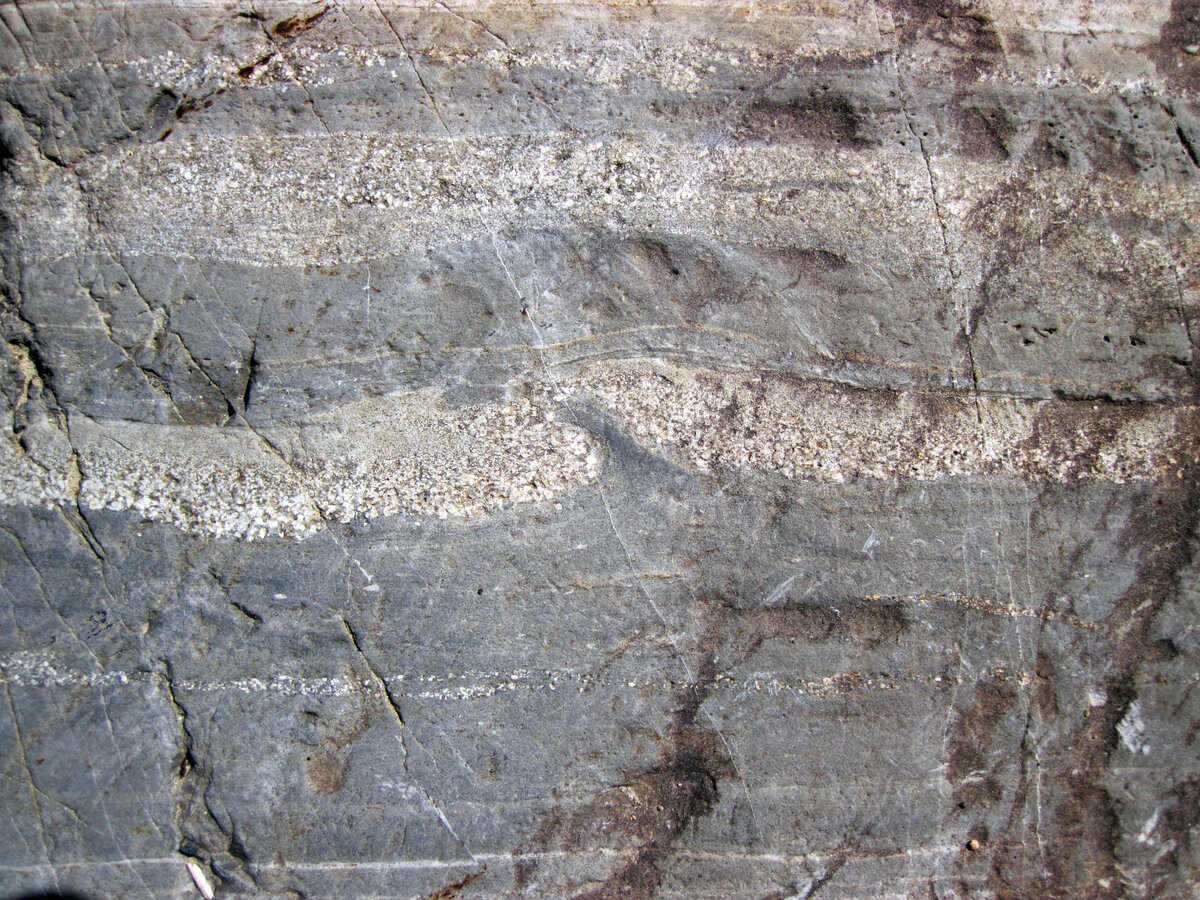
As a result, the former Mesolithic shoreline, where these groups lived at the water's edge, now lies drowned about twenty metres down, beneath a fine film of mud. And the conditions on that floor are ideal for organic matter. The water is cold and, above all, the mud is almost entirely free of oxygen. We speak of an anaerobicanaerobic environmentAn oxygen-free environment, such as waterlogged mud, where decay bacteria are inhibited, which preserves organic materials.→ environment. In dry, aerated soil, bacteria and fungi break wood down within a few years, because they need oxygen to thrive. Starved of air, these micro-organisms see their activity reduced to almost nothing, and decay halts. The wood then stays frozen in time, sometimes in a startling state of freshness. It is the same principle that, elsewhere in Europe, preserved the bog bodies or the oldest known dugout canoes. At Arendsee, this chemical lock was doubled by a mechanical sealSealA small engraved object (often steatite) used to stamp a mark in clay; the Indus seals, bearing animals and signs, attest to administration and trade, though their script remains undeciphered.→, the slow sinking of the floor having sheltered the shoreline from currents and erosion. This is, moreover, not the first organic treasure the lake has yielded: earlier dives had already located NeolithicNeolithicThe "New Stone Age": a period marked by farming, herding, settlement and pottery, from around 10,000 BC.→ fish traps, a medieval barge and a late medieval dugout canoe. The lake behaves like a strongroom that preserves, layer after layer, whole slices of life along its shores.
The Mesolithic, and the precedent of Star Carr
To gauge the significance of these pieces of wood, one has to place them back in their time. The MesolithicMesolithicThe period between the PalaeolithicPalaeolithicThe oldest and longest period of prehistory (c. 3.3 Ma–12,000 BC), defined by chipped stone tools and a hunter-gatherer way of life.→ and the Neolithic (c. 10,000–6,000 BC in Europe), still based on hunting and gathering.→ is the long transitional period between the Palaeolithic of the last glaciers and the Neolithic of the first farmers. In central Europe, the people of this time are still hunters, fishers and gatherers. They do not cultivate the land, keep no herds, and live off what a post-glacial, newly forested environment provides. AgricultureAgricultureThe cultivation of plants and production of food by working the soil, which emerged in the Neolithic in the Near East and independently elsewhere; it radically transformed human societies.→, for its part, will reach the region only much later. The first farmers, with their great longhouses, settle in central Germany only around 5500 BCE, roughly three millennia after the Arendsee wood. That is the whole point of the discovery: it concerns a world before agriculture, before the hoe and the cultivated field.
Such wooden structures are not, however, entirely unprecedented for this period. The great point of comparison lies in England, at the site of Star CarrStar CarrA Mesolithic site in Yorkshire (England) that yielded wooden installations, including a split-timber platform at the edge of a former lake.→ in Yorkshire. This Mesolithic site, barely older, yielded remarkable wooden installations: a platform of split timber at the edge of a former lake, often described as the earliest carpentry in the British Isles, together with traces of a possible dwelling structure. Star Carr thus shows that hunter-gatherers of this age could indeed work wood on a large scale and durably shape the margins of a body of water. But what Star Carr also recalls is the extreme rarity of such remains. Wood survives only under exceptional conditions, waterlogged and free of oxygen. Everywhere else it has vanished, and with it most of what these populations made. Our view of the Mesolithic is thus warped by a massive bias: stone endures and has reached us in abundance, wood almost always fades away. Every site that yields it, like Arendsee today or Star Carr before, reopens a window onto this submerged part of human ingenuity. It is worth noting in passing that the Arendsee wood is contemporary, give or take a few centuries, with another regional celebrity of the Mesolithic: the richly furnished burialBurialThe intentional deposition of a body, sometimes with offerings; a marker of symbolic behaviour.→ known as the Shaman of Bad Dürrenberg, some 9,000 years old. The same region and the same era, but seen this time from a new angle, that of architecture rather than of the grave.
Exploring the floor: underwater robot and sonar
Working at twenty metres down, on a drowned former shoreline, is a matter of underwater archaeologyUnderwater archaeologyDiscipline that studies submerged human remains, wrecks and sunken sites, using diving and underwater survey.→, a demanding discipline that combines diving, fine documentation and cutting-edge technology. After the first discovery, in the spring of 2026, the LDA teams took samples and individual objects to pin down the extent and age of the site. Then a second phase was launched, in collaboration with the Fraunhofer IOSB-AST institute in Ilmenau, to map the relief of the former shoreline.

The setup relies on a remotely operated underwater vehicle, a ROV, fitted with high-resolution sonar. By sweeping the floor, the craft draws a detailed map of the lake bed and of the structures hidden in the mud. "The support given to underwater work by state-of-the-art technologies developed at the Fraunhofer Institute in Ilmenau is invaluable to archaeology," noted Sven Thomas, dive operations manager for the LDA at Lake Arendsee.3 The value of this mapping is very concrete: by precisely locating the areas rich in remains, it makes it possible to target zones of interest and to plan future dives strategically, rather than exploring the floor blind. Underwater, every minute of work is counted and every move costly; a good map beforehand changes everything. It is also a scientific safeguard: it is better to document at length before touching anything, because these fragile archives can degrade the moment they are disturbed and exposed once more to oxygen.
What is really at stake
Beyond a few pieces of wood, a fundamental question is raised: did these groups of hunter-gatherers really build durable structures beside the lakes, three millennia before the hoe reached central Europe? If the answer is yes, the consequences go far beyond the single case of Arendsee. "If permanent buildings or intensively designed living spaces already existed 10,500 years ago, that is, 3,000 years before the arrival of the first farmers with their longhouses in Central Europe, this would have far-reaching consequences not only for our understanding of hunter-gatherers, but also for the origins of modern cultural landscapes," explains Marcel Weiß, project leader at the LDA.2
This caution is not mere verbal hedging. The history of archaeology is strewn with hasty interpretations that later analyses qualified or overturned. An isolated post can have a thousand uses, and planks may come from a floating object, a walkway or a bank reinforcement as readily as from a dwelling. It is precisely because wood is so rare for this period that each piece must be weighed on its own terms, without yielding to the lure of the most spectacular scenario. The LDA teams are therefore proceeding step by step, documenting first, dating next, and holding back their conclusions until the whole body of evidence converges.
The point is subtle. The great transformation of wild nature into a landscape shaped by human hands, with its fixed houses, its fields and its villages, is traditionally credited to the first farmers. If Mesolithic hunter-gatherers turned out to be capable, well before them, of a durable anchoring to the ground and of timber architecture, then the whole boundary between the "mobile" world before agriculture and the "settled" world after it would become blurrier, more gradual. The image of light dwellings, raised and dismantled within hours, would give way to that of communities attached to specific places, returning perhaps season after season to the same shaped shores. It is precisely because the stakes are so heavy that the researchers pile on the caveats. Nothing is settled: it still has to be established what each piece was, how it fitted together with the others, what it was for, and the whole has to be finely dated. The post and planks of Arendsee do not, on their own, prove the existence of a Mesolithic lakeside village. They reopen a question, wooden documents in hand, where only stains in the earth had been available. And that is perhaps the finest gift of a lake that slowly sinks its floor into a salt dome: not a fixed certainty, but a riddle at last made tangible, raised intact from ten thousand years of silence.
No comments yet. Be the first.