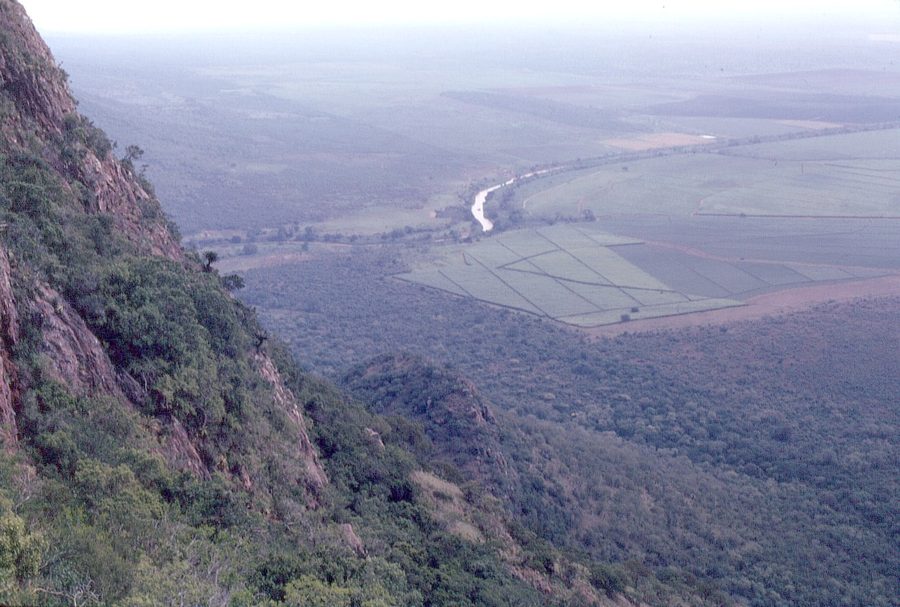
Two hundred thousand years ago, someone lay down on a fresh bed of grass, laid over a layer of warm ash, inside a cave overlooking a savanna landscape. This gesture , preparing a place to sleep , has now been documented with unprecedented precision. A 2026 study published in the Journal of Archaeological Science reveals that the occupants of Border Cave, perched in the Lebombo Mountains on the border of South AfricaAfricaThe cradle of humankind: the continent where the first hominins appeared, then Homo sapiens around 300,000 years ago, before the expansion to the rest of the world.→ and Eswatini, built and maintained plant-based sleeping arrangements over a period of more than 150,000 years.
Border Cave, a unique archive of human behaviour
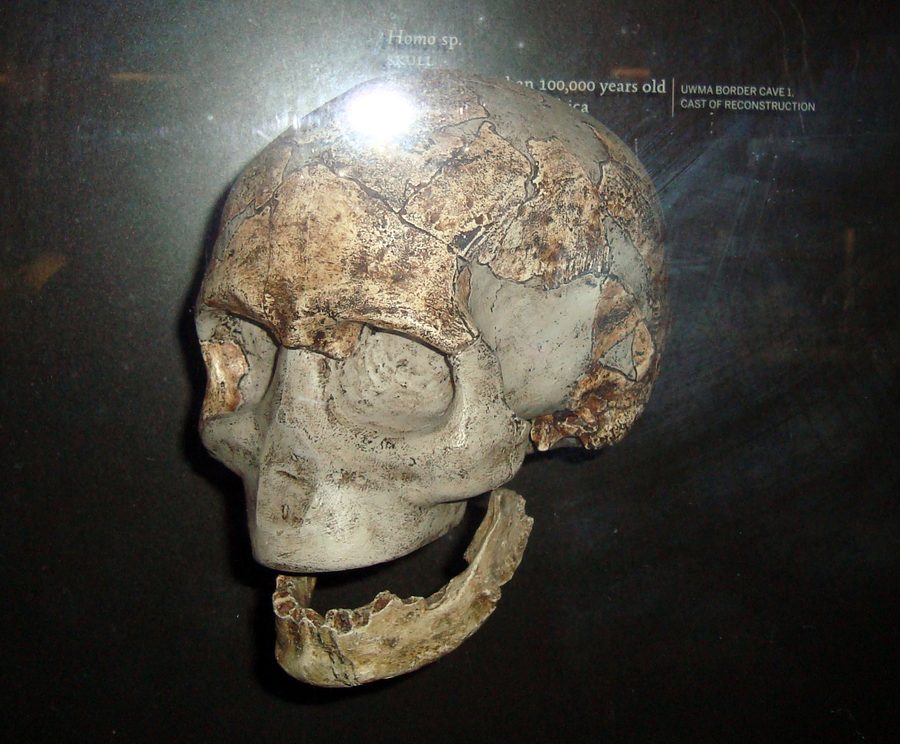
Known to archaeologists since the 1930s, Border Cave is one of the world's key reference sites for studying the behaviour of early Homo sapiensHomo sapiensThe present-day human species, which emerged in Africa around 300,000 years ago, the only surviving human lineage after the extinction of Neanderthals and Denisovans.→. The cave opens into a cliff face in the Lebombo Mountains, roughly 280 km northeast of Durban. Its exceptional setting , altitude, limestone rock , has allowed organic materials to survive over timescales that are extraordinarily rare for deposits of such antiquity. It has already yielded shell beads, engraved ochreOchreA red or yellow mineral pigment (iron oxides), used from prehistory for adornment, funerary rites and art.→ sticks, and even the remains of a child buried some 78,000 years ago. Now the cave reveals another chapter: how its inhabitants organised their living space, night after night.
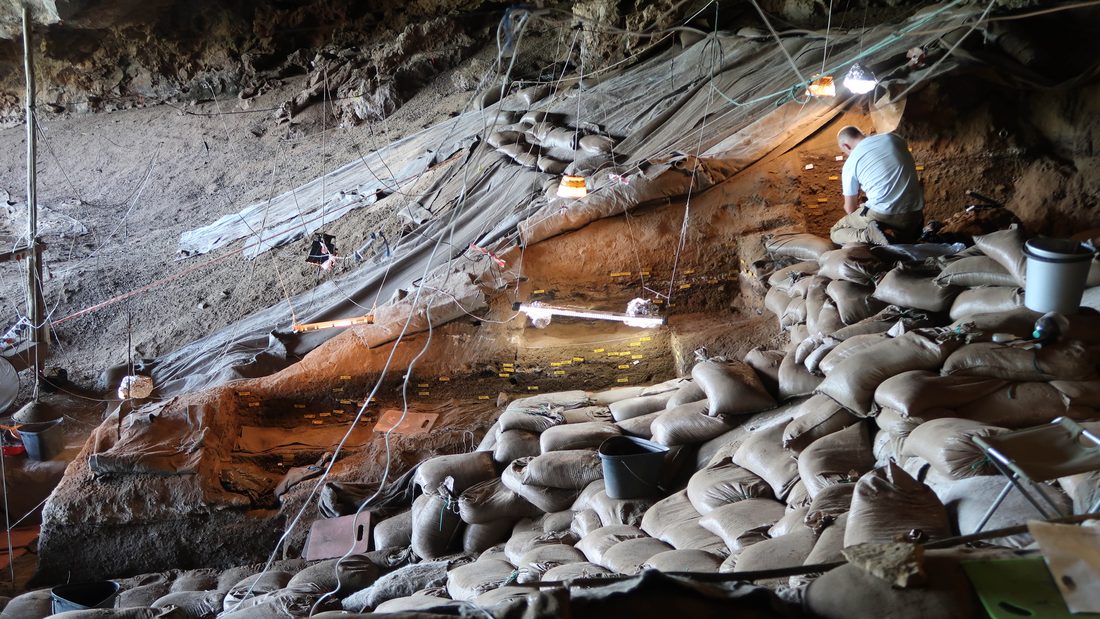
The study is authored by Peter Morrissey and Dominic Stratford of the University of the Witwatersrand (Johannesburg). Their approach relies on micromorphological analysis of sediments: examining soil layers centimetre by centimetre under a microscope, identifying the nature and arrangement of particles, and distinguishing human activity from natural processes. Applied to Border Cave, this method identified six distinct bedding types (six microfacies), each corresponding to a different way of constructing, using and abandoning a sleeping surface.
Grass on ash: a coherent, long-lasting system
The bedding material was dominated by grasses from the Panicoideae subfamily and rushes , broad-leafed plants available in the wetlands of surrounding valleys. This was no random choice: these species form naturally dense, supple mats ideal for sleeping.
But the most striking discovery is what occupants placed beneath the grass: a thick layer of ash. The ash served a triple purpose. It insulated the sleeper from damp ground, kept the sleeping area warmer, and , crucially , repelled crawling insects. Some of the wood burned to produce this ash, such as Tarchonanthus (the camphor bush), is still used as a natural insect repellent in parts of East Africa. The combination of fresh grass and ash reveals a deliberate logic of hygiene and comfort, transmitted and repeated across tens of thousands of years.
Burning the old bed to lay the new
Microscopic analysis revealed a recurring maintenance practice: used bedding was burned before being replaced with fresh grass. Phytolith layers , the tiny mineral structures produced by plants that survive combustion or decomposition , show characteristic signatures of in-situ burning followed by renewal. The oldest bedding deposits, dating to around 200,000 years ago, display heavily charred and trampled layers, evidence of intensive and repeated occupation.
This practice of burning old bedding before laying new material most likely served to eliminate parasites and odours. It combines mastery of domestic fire with the management of living space in a single coherent act , one of the earliest known examples of this kind of structured behaviour.
Six bedding types, three without known parallel
Of the six microfacies identified, three have parallels at other South African sites , notably Sibudu Cave (KwaZulu-Natal) and Diepkloof Rock ShelterRock shelterA shallow cavity at the foot of a cliff or under a rocky overhang, offering natural shelter; a favoured site of prehistoric habitation and rock art.→ (Western Cape), two key reference sites for Middle Stone Age human behaviour. The other three are, to date, without published equivalent in the scientific literature. These unique types differ in ash distribution, the organisation of plant remains, and the degree of trampling or burning. Researchers propose several explanations: seasonal differences in occupation, plant selection based on local availability, or practices specific to particular groups.
Beds that evolved over 150,000 years
The bedding did not remain identical throughout the cave's long occupation. The most recent deposits, dated between 60,000 and 43,000 years ago, show beds that are less fragmented, less burned and less trampled than their older counterparts. This suggests that patterns of cave use changed over time: perhaps shorter stays, smaller groups, or simply different habits in managing bedding. Morrissey and Stratford's study demonstrates that even the most fundamental behaviours , sleeping and maintaining a resting place , were not fixed, but adapted and evolved.
Overall, the bedding evidence spans an impressive timeframe: from 161,000 to 43,000 years ago, with some indicators reaching back to 200,000 years. The use of ash as a sleeping base runs throughout , a remarkable constant across more than 150 millennia.
Modern behaviour long before assumed modernity
These results feed into a broader debate on the emergence of so-called 'modern' behaviours in Homo sapiens. Border Cave has already yielded perforated shell beads, wooden sticks treated with poison, and a shaped tubular bone used as a digging stick , evidence of complex toolmaking and symbolic thought dating from 40,000 to over 200,000 years ago. Organised bedding adds to this picture: maintaining a clean, dry, parasite-free sleeping space, regularly renewing the material, and burning the old to lay the new is structured domestic behaviour, requiring anticipation, memory of technique, and transmission of know-how within the group.
As Morrissey notes, these behaviours "contribute to a growing picture of Middle Stone Age groups regularly maintaining their living spaces and managing their domestic environment, long before the appearance of agricultureAgricultureThe cultivation of plants and production of food by working the soil, which emerged in the Neolithic in the Near East and independently elsewhere; it radically transformed human societies.→ or permanent settlements."
Sources:
- Morrissey, P. & Stratford, D. (2026). "New microscale insights into plant-based bedding construction and maintenance between 200 000 and 43 000 years ago at Border Cave, South Africa." Journal of Archaeological Science, 191, 106592. doi:10.1016/j.jas.2026.106592
- Backwell, L. et al. (2021). "Fire and grass-bedding construction 200 thousand years ago at Border Cave, South Africa." Science, 369(6505), 863, 866. doi:10.1126/science.abc7239
- Wadley, L. et al. (2011). "Middle Stone Age bedding construction and settlement patterns at Sibudu, South Africa." Science, 334(6061), 1388, 1391.
- Science et Vie, Auriane Polge, 28 June 2026 , Border Cave, grass and ash beds 200,000 years old.
- Archaeology News, Dario Radley, 30 May 2026 , Stone Age humans built complex grass beds at Border Cave
L'angle est honnête et bien documenté. La bibliographie en fin de page est un vrai plus.
Je note tous vos articles dans un cahier. Comme à l'école, mais avec bien plus de plaisir.
L'idée que nos ancêtres de 200 000 ans faisaient déjà leur lit avec des herbes soigneusement choisies me touche beaucoup. Ce sont des gestes qui semblent si universellement humains : se faire un endroit confortable pour dormir, protégé des insectes. Ca rapproche ces hommes préhistoriques de nous de manière très concrète et très belle.
La découverte de litières en herbe vieilles de 200 000 ans à Border Cave est spectaculaire. Cela représente le plus ancien indice de comportement de confort domestique connu chez Homo sapiens. Les analyses botaniques ont montré que les occupants sélectionnaient des plantes riches en composés répulsifs contre les insectes, preuve d'une connaissance empirique de l'environnement végétal.