Five thousand five hundred years ago, in the heart of the northern Kazakh steppeSteppeA vast semi-arid, treeless grassland of Eurasia, suited to nomadic herding and the horse; a corridor for the movement of peoples and technologies in later prehistory.→, humans lived among horses. Almost exclusively. Excavations at the Botai site have yielded more than 300,000 horse bones, representing up to 99% of the identified fauna. Enclosures, fossilised dung deposits, pottery impregnated with mare's milk fats: everything seemed to point to the Botai culture as the first in history to domesticate the horse.
In 2009, Alan Outram's team at the University of Exeter consolidated this thesis in Science: tooth wear consistent with bit use, bone morphology resembling later domestic breeds, equine milk lipid residues in ceramics. The conclusion appeared inescapable: Botai, around 3,500 BC, had invented horseback riding and mare milking, a full millennium ahead of the then-prevailing consensus.
But ancient DNAAncient DNAGenetic material preserved in old remains, often degraded, sequenced with cutting-edge techniques.→ was about to change everything.
The 2018 shock: Botai horses are not our ancestors
In 2018, an international team led by Charline Gaunitz and Ludovic Orlando (University of Copenhagen) published in Science a study based on 42 ancient horse genomes, including 20 extracted directly from Botai remains. The result was striking: the Botai horses are not the ancestors of modern domestic horses.
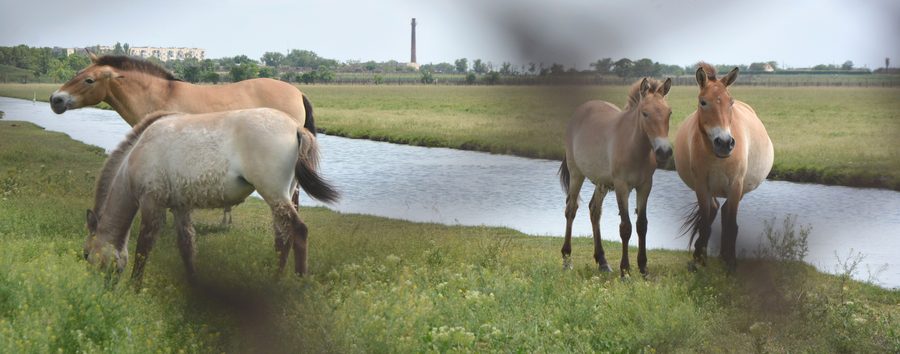
The Botai horses are the ancestors of... Przewalski's horses. These dun-coloured, stiff-maned equids found today in Mongolia and Ukrainian nature reserves were previously regarded as the planet's last truly wild horses. They are in fact the descendants of horses once managed by Botai people who escaped domestication and went feral over millennia. They are feral horses, not originally wild ones.
As for modern domestic horses, they share only 2.7% of their ancestry with Botai horses. A tiny fraction, almost negligible at the genomic scale. This means that a massive replacement of horse populations occurred somewhere between 3,500 and 2,000 BC, erasing Botai's legacy from the genetic heritage of modern horses.
The true cradle: the Pontic-Caspian steppes
If Botai horses are not our equine ancestors, where do the horses that conquered the world come from? In 2021, a mega-study bringing together more than 150 researchers and 264 ancient horse genomes (published in Nature) provided the answer: the modern domestic lineage, called DOM2, originated in the Volga-Don steppes of the Pontic-Caspian region, somewhere between 2,200 and 2,000 BC.
It is the Sintashta culture and its successors, carriers of the first spoke-wheeled chariots, that appear to have spread this new horse eastward and westward with remarkable speed. Within a few centuries, DOM2 supplanted all other horse populations across Eurasia in a genomic replacement of unprecedented scale. The Yamnaya culture and its expansions had already demonstrated that the steppes could generate explosive demographic dynamics; DOM2 horses provided the engine for the next phase.
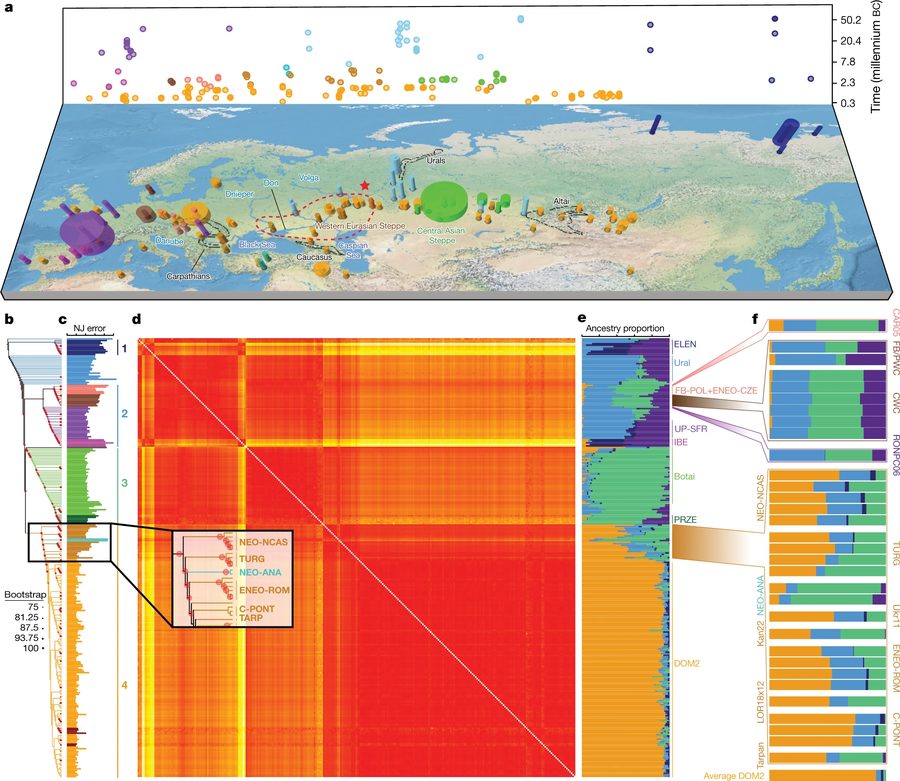
This scenario does not, however, settle the question of Botai. Did the humans of this culture truly domesticate the horse -- or merely intensify their hunting and herding relationship with a local wild species? The line between "intensive management of wild horses" and "domestication" is thin in archaeology, and the debate remains open.
A domestication in two acts?
The most radical revision suggested by these findings is the hypothesis of a double independent domestication. Botai may have domesticated its own local horses -- a northern Kazakh population -- for meat, milk and perhaps riding. This relationship persisted for centuries, but the Botai lineage was later marginalised, absorbed back into wild horse populations, ultimately giving rise to the Przewalski's horses we know today.
Simultaneously or subsequently, another domestication took place further west, on the Pontic-Caspian steppes, with horses from a genetically distinct lineage. It was this second attempt that produced the DOM2 horse -- the one that changed the world.
This is not the first time prehistoryPrehistoryThe span of human history before the invention of writing, from the Palaeolithic to the Metal Ages, known mainly through material remains.→ has revealed multiple independent domestications of the same species: dogs, pigs and sheep have all had separate centres of origin. The horse simply fits the same pattern of evolutionary and cultural convergence.
As for the Botai horses, they continue to graze in Mongolian reserves under the name Przewalski. They carry, unknowingly, five millennia of relationship with Kazakh humans -- and the imprint of a domestication that ancient DNA nearly made us forget.
Sources: Outram et al. (2009), Science 323:1332-1335; Gaunitz et al. (2018), Science 360:111-114; Librado et al. (2021), Nature 598:634-640; Wikipedia Botai culture; National Geographic, "Ancient DNA Study Pokes Holes in Horse Domestication Theory"; Frontiers in Environmental Archaeology (2023), "Horse domestication as a multi-centered, multi-stage process"
J'ai utilisé cet article comme exemple de bonne vulgarisation dans un cours de rédaction web.