Between 2200 and 800 BCE, a constellation of brilliant civilizations illuminated the shores of the eastern Mediterranean and the plains of Europe: the Mycenaean kingdoms of mainland Greece, the Hittite empireHittite empireA great Anatolian power of the Late Bronze Age, centred on Hattusha; in the 13th century BCE its great kings arbitrated the affairs of their Syrian vassal kingdoms.→ of Anatolia, the maritime power of Cyprus, the merchant cities of UgaritUgaritA wealthy Bronze Age merchant city-kingdom on the Syrian coast (Ras Shamra); its cuneiform archives and alphabet make it a major source on the ancient Near East.→ and Byblos, Minoan Crete with its sumptuous frescoes, and, overseeing it all, eternal Egypt. Together, these civilizations formed the first "connected world" in human history, bound by trade networks of unprecedented scope.1
Then, around 1200 BCE, this world seemed to falter. Palaces were abandoned, cities reduced to ash, entire empires erased from the map. For centuries, historians labeled this episode the "Bronze AgeBronze AgeA protohistoric period following the Neolithic, defined by bronze metallurgy (a copper-tin alloy) and the rise of the first cities and states; in Egypt it corresponds to the age of the first pyramids.→ Collapse," one of antiquity's most captivating mysteries. Today, archaeological and paleoclimatological research proposes a far more nuanced reading: less a brutal collapse than a long transformation, less the end of the world than a passing of the torch.
The Bronze Age: A Connected World
The Bronze Age takes its name from the metal that formed its economic and technological backbone. Bronze, an alloy of copper and tin, revolutionized human societies by offering a material that was at once strong, malleable, and recyclable, ideal for tools, weapons, and prestige objects. But bronze carries a fundamental geological constraint: copper and tin deposits are almost never found in the same place on Earth.2
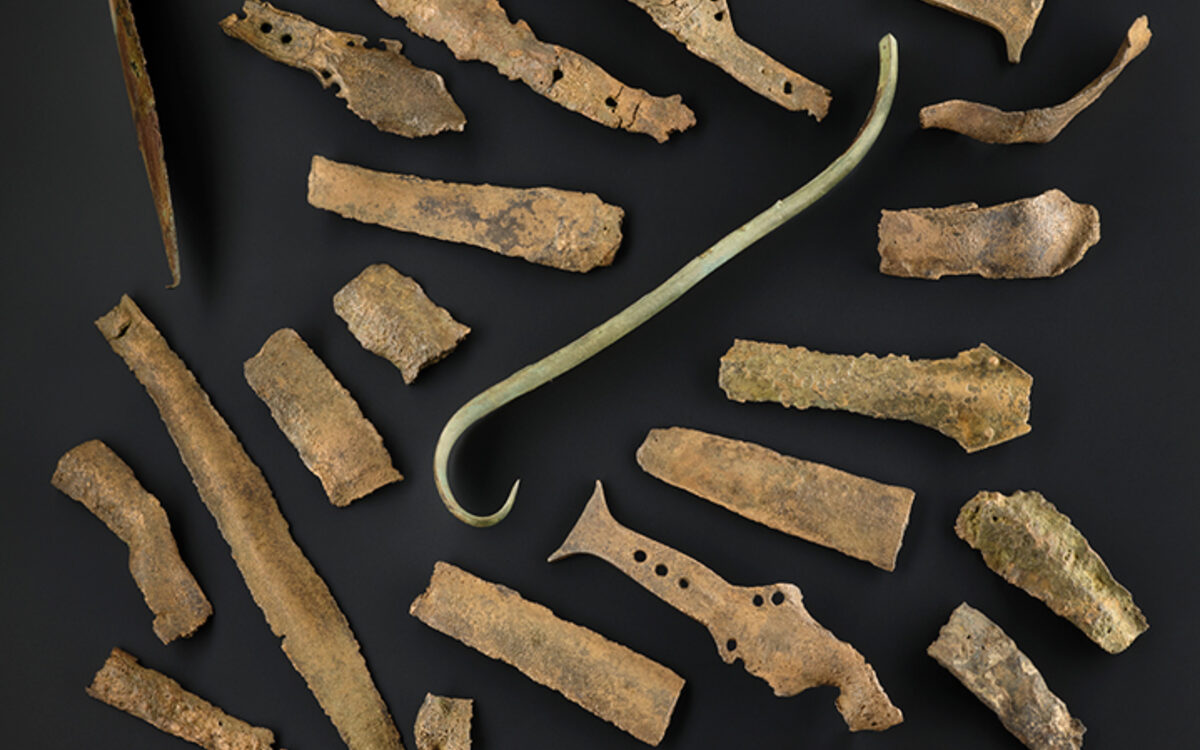
This constraint drove the long-distance trade that would come to define the entire period. The Mycenaeans of the Peloponnese sourced their copper from Cyprus (whose very name, Kupros, evokes the metal), their tin from Anatolia and as far as Central Asia and Cornwall, and their gold from the Carpathians. Cypriot craftsmen shipped their ox-hide copper ingots to every shore of the Mediterranean. The merchants of Ugarit, a major Levantine port, served as intermediaries between East and West.
Archaeologist Anne Lehoërff, a specialist in the period, describes this first globalized world: "The entire society was transformed. Working with bronze requires a steady supply chain, so it demands the establishment of networks, control of those networks, and responses to new needs."1 Across western Europe, a vast interregional network stretching from Scotland to Andalusia — the "Atlantic Bronze Age" — moved Cornish tin, Welsh copper, and metals from the Alps. This network reached even beyond European borders to interact with the eastern Mediterranean.
The Great Civilizations of the Bronze Age
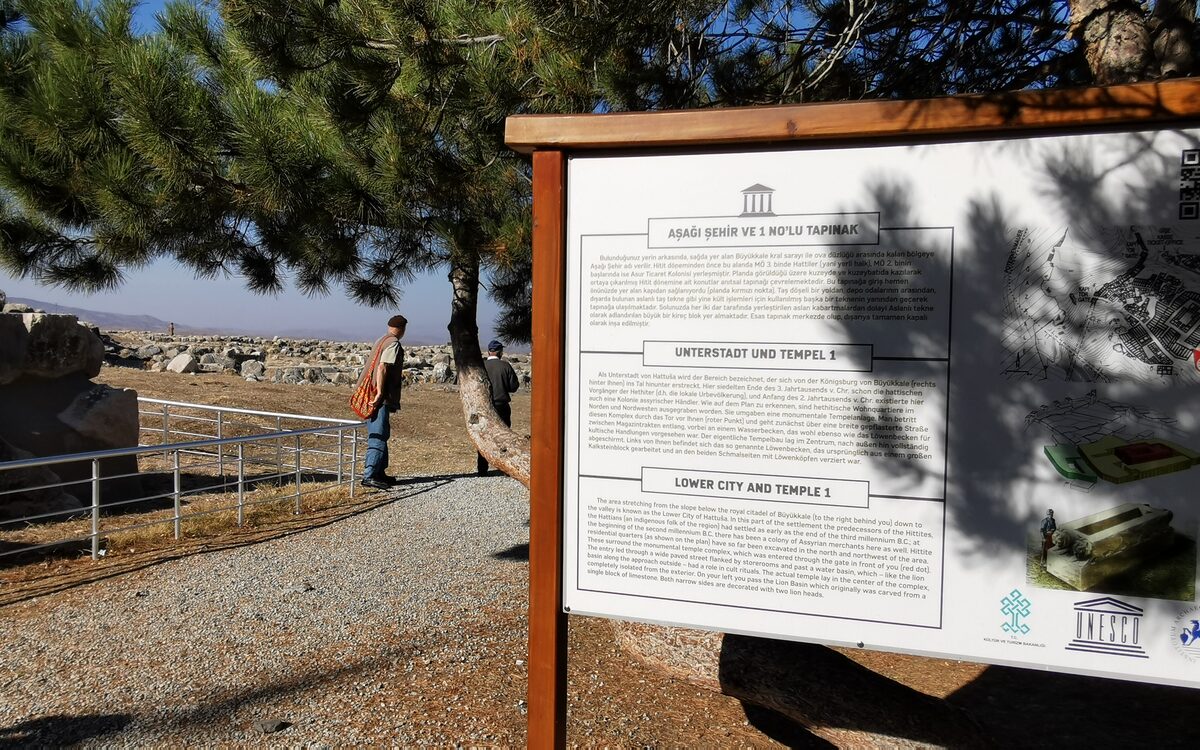
This web of exchange nurtured civilizations of remarkable diversity. To the east, the pharaohs of Egypt ruled one of the oldest and best-organized states in the known world. The Egyptian bureaucracy, with its papyrus archives and monumental building projects, represented the pinnacle of administrative centralization of the era. The Hittite empire, founded in Anatolia around 1600 BCE, was its direct rival: the two powers clashed at the Battle of Kadesh (c. 1274 BCE), which ended in the earliest known written peace treaty in human history.3
In the Aegean, two cultures of great sophistication developed in parallel. Minoan civilization, centered on Crete and its labyrinthine palaces (Knossos, Phaistos, Akrotiri), was renowned for its iconography of nature and its frescoes of dolphins and leaping bulls. Unlike the warrior imagery of its neighbors, Minoan palace culture "rested on a form of coercion but did not emphasize a military identity of power," notes Maia Pomadère, a specialist in the Aegean world.1
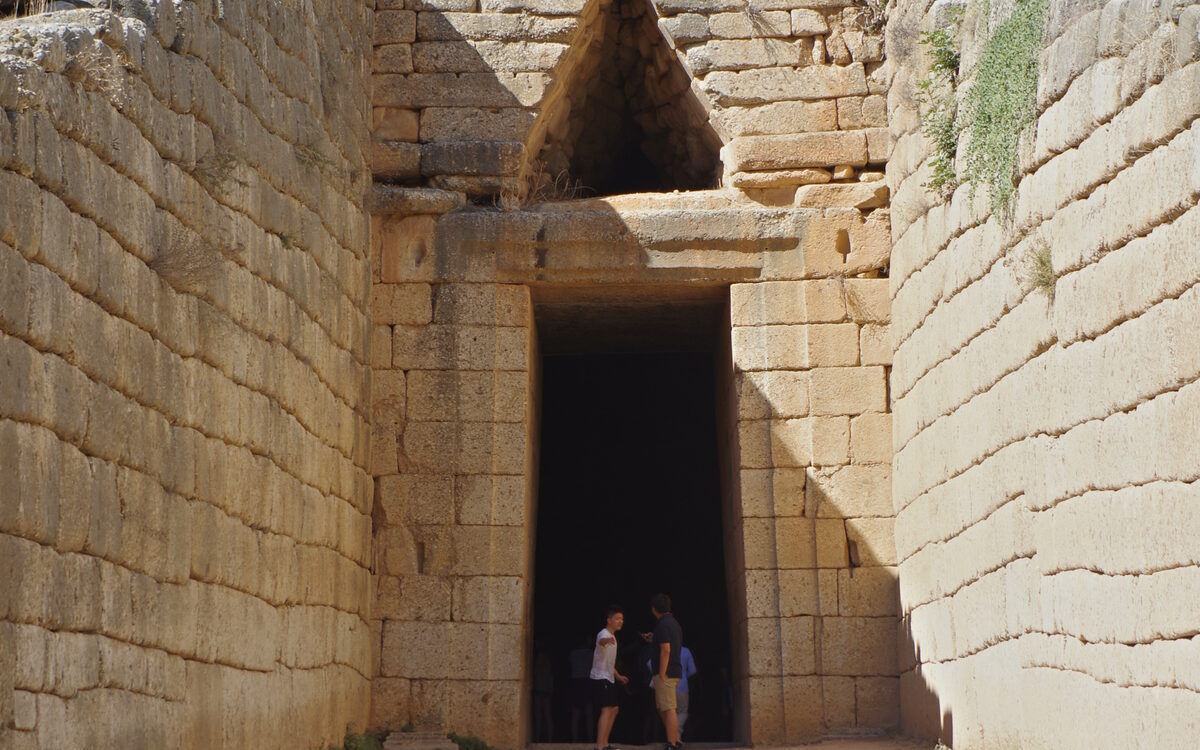
The Mycenaeans, whom Homeric texts also call "Achaeans," formed the other great Aegean power. Settled in Cyclopean fortresses perched on hilltop citadels (Mycenae, Tiryns, Pylos), they developed a syllabic writingWritingA system of conventional signs used to fix language or information durably; its appearance (c. 3300 BC) marks, by convention, the end of prehistory.→ system, Linear B, used primarily to keep palace accounts. Their clay tablets, fired by chance in the fires that destroyed their palaces, are the only written Mycenaean documents to survive. They reveal a meticulous palace administration, far removed from Homer's epic warriors.
At Ugarit (modern Ras Shamra, Syria), a major port city at the intersection of the Hittite, Egyptian, and Mycenaean worlds, archaeologists recovered an extraordinarily rich archive. Ugarit's cuneiformCuneiformThe oldest known writing, born at Uruk; its signs, impressed into clay with a reed stylus, are wedge-shaped (from Latin cuneus).→ tablets record commercial transactions, diplomatic correspondence, and literary texts in no fewer than eight different languages, making it one of the intellectual capitals of the Bronze Age world.
MetallurgyMetallurgyThe techniques of extracting and working metals (copper, bronze, gold); its rise in the Eneolithic and Bronze Age transformed tools, weapons and social hierarchies.→ as Engine of Social Transformation
Bronze was more than a technical material: it was also a powerful driver of social change. Initially, bronze metallurgy served elites, who commissioned prestige objects: jewelry, vases, ritual instruments. Gradually, bronze production democratized and expanded into everyday use. Bronze sickles replaced flintFlintA hard, brittle siliceous rock, knapped by prehistoric people to produce blades, points and sharp tools.→ sickles in the fields. Specialized tools enabled new construction and craft techniques.2
Among these innovations, the sword occupies a special place. It appeared in western Europe between 1700 and 1600 BCE and represented, according to Anne Lehoërff, "a turning point in the arms race." Unlike the dagger or axe, the sword was an unambiguously lethal weapon, designed exclusively to kill other people at close range. Its appearance marked the emergence of a new social figure: the professional warrior in arms, the very Achilles that Homer would sing centuries later.
This progressive militarization coexisted, however, with a great variety of social forms. In western Europe, the late Bronze AgeLate Bronze AgeThe final phase of the Bronze Age in the Near East (c. 1550 to 1200 BCE), an age of great empires and international diplomacy, ended by a general collapse.→ societies were distinguished by their decentralization. Pierre-Yves Milcent, an archaeologist specializing in the region, describes societies "without a state, decentralized, choosing not to develop vertical concentrations of power, bureaucratic administration, complex economies, or durable urbanization." Yet proto-urbanProto-urbanRefers to a large agglomerated centre with urban features (density, craft, communal functions) without being a city in the classical sense.→ settlements, like those at Corent and Jenzat in Auvergne, did emerge before the final decline.
The Crisis of 1200 BCE: A "Polycrisis"
Around 1200 BCE, within half a century, the political landscape of the eastern Mediterranean transformed radically. The Hittite empire collapsed. Mycenaean palaces were destroyed or abandoned: Mycenae, Tiryns, Pylos, Thebes. Layer VIIa at Troy (Hissarlik), with its arrowheads, burn marks, and bodies buried without proper graves, testifies to violent destruction around 1200 BCE. Ugarit was burned and never rebuilt. In Egypt, Ramesses III had to confront the incursions of the "Sea Peoples."
For a long time, historians sought a single cause for this upheaval: an invasion by the Sea Peoples, widespread earthquakes, social revolt. Current research favors the concept of a "polycrisis" — an entanglement of mutually reinforcing factors, none of which alone constitutes the primary cause.
Paleoclimatologist David Kaniewski has reconstructed the climateClimateThe long-term average atmospheric conditions of a region; its variations (glaciations, aridifications) shaped migrations, agriculture and the collapse of prehistoric societies.→ of the late Bronze Age from the analysis of lake sediments and fossil pollen. His work reveals that between 1900 and 1200 BCE, the eastern Mediterranean enjoyed an exceptional climate optimum: mild temperatures, abundant rainfall, flourishing agricultureAgricultureThe cultivation of plants and production of food by working the soil, which emerged in the Neolithic in the Near East and independently elsewhere; it radically transformed human societies.→. Then, starting around 1200 BCE, a new solar activity cycle triggered a gradual climate deterioration, with phases of cold and drought stretching over roughly 300 years. "This change has the shape of a W," the researcher explains: "There is first a cold, dry phase, then an improvement around 1000 BCE, before an even colder and drier final phase."4
The Sea Peoples: The First Climate Migrants
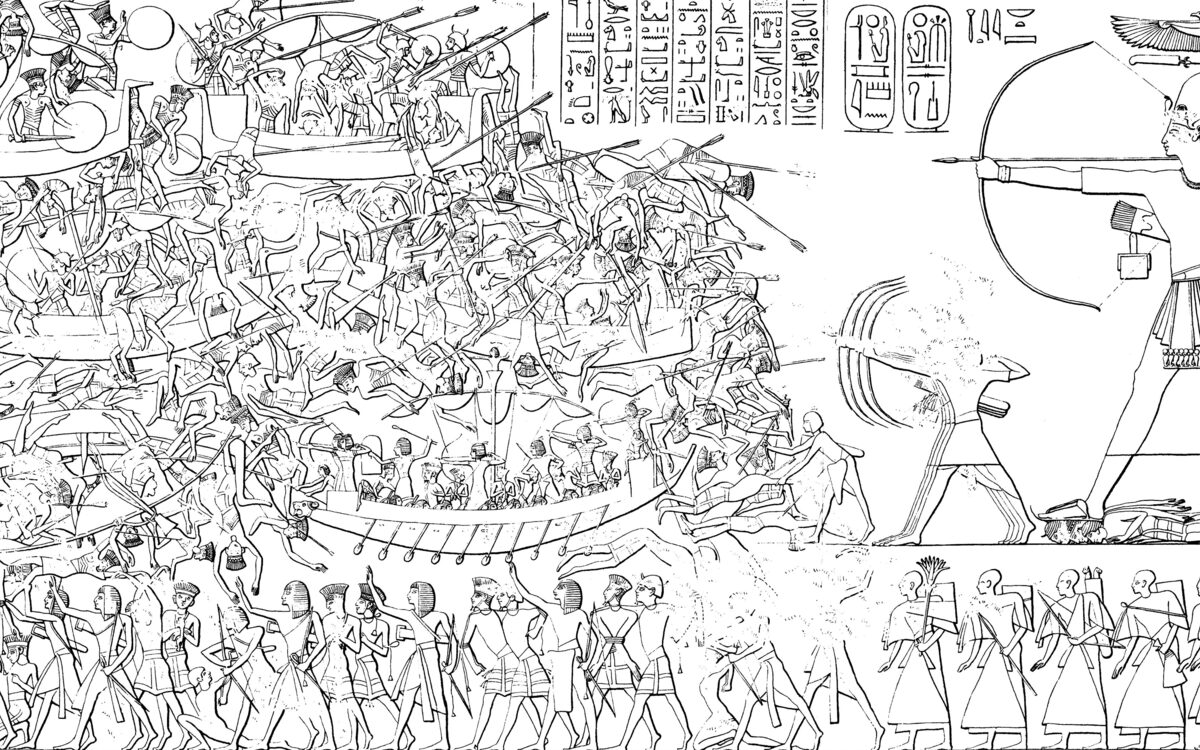
It is in this context of climate deterioration that the story of the Sea Peoples must be reread. These groups with enigmatic names (Philistines, Achaeans, Tjeker, Sherden, Peleset...) raided eastern Mediterranean coasts for nearly half a century before being repulsed by Ramesses III in a naval battle in 1177 BCE. The pharaohPharaohThe title of the ruler of ancient Egypt, regarded as a living god guaranteeing cosmic order (Maat), supreme head of state, army and worship.→ immortalized his victory on the walls of his funerary temple at Medinet Habu.
This relief, though a piece of propaganda, is an exceptional archaeological source. It lists the names and characteristics of each defeated people and, crucially, shows not only warriors but also women, children, and ox-carts loaded with belongings. For David Kaniewski, this is decisive proof that the Sea Peoples were not organized military invaders but entire migrating populations: "the first documented climate migrants in human history."4
This reading transforms the interpretation of the crisis. Famines caused by climate deterioration pushed Anatolian, Cypriot, and Aegean populations to move toward the more fertile lands of the LevantLevantA region of the eastern Mediterranean Near East (Israel, Lebanon, Syria, Jordan), a major crossroads of the first human migrations out of Africa.→ and Egypt. The resulting conflicts between locals and migrants over increasingly scarce resources escalated in a context of already-weakened palatial states. The commercial networks that had made the Bronze Age great became chains of vulnerability: a break at one point cascaded throughout the system.
Internal Factors: Rigidity and Revolt
The crisis of 1200 BCE did not come from outside alone. Maia Pomadère emphasizes that "economic systems that were too rigid collapsed under the weight of both inability to adapt and internal revolts." The Mycenaean and Hittite palace systems, so effective during periods of growth, proved unable to adjust quickly to deteriorating agricultural conditions.
The Pylos tablets, written in the hours before the palace burned, reveal an administration in a state of emergency: bronze requisitioned for weapons manufacture, workers reassigned, coastal defenses organized. This rare accounting data also witnesses the disarray of a palatial administration facing a threat it could no longer control.
In western Europe, the process was different but converging. After a period of demographic growth and intensified exchange, the fortified hilltop settlements resembling proto-cities (Corent, Jenzat in Auvergne) were rapidly abandoned around 800 BCE in the context of renewed climate deterioration. Dispersed farms and hamlets, reminiscent of the early Bronze Age, reappeared.
The Collapse of Mycenae and the End of Linear B
At Mycenae, the city of "rich storehouses of gold" praised by Homer, the destruction of the palaces had an irreversible cultural consequence: the disappearance of Linear B. This syllabic writing system, adapted from Minoan Linear A, was the instrument of palatial bureaucracy. When the palaces fell, so did the scribes, the archives, and the reading skills. Mycenaean Greece plunged back into illiteracy for roughly four centuries, until the adoption of the Phoenician alphabet around 800 BCE.
It is this spectacular cultural rupture that long fed the myth of collapse. But archaeologists nuance: populations did not disappear. They moved, redistributed, adapted. Recent excavations at rural Mycenaean sites show continuous occupation that the ashes of the palaces masked. "When we look at the history of peoples rather than kings, we find that people kept on living, kept redrawing their exchange networks," summarizes Anne Lehoërff.1
The Transition to the Iron AgeIron AgeThe last period of protohistory (from c. 1200 BC in Europe and the Near East), marked by iron metallurgy and the first kingdoms.→
The late Bronze Age crisis was also a transition to a different model. As copper and tin exchange networks broke down, human societies turned to a different metal, more abundant and less dependent on long-distance circuits: iron. The metal was not new per se (meteoritic iron had been worked since the third millennium), but its smelting temperature (1,500°C vs. 900°C for bronze) had made large-scale production difficult. Gradual mastery of this technique, first in Anatolia and then across the eastern Mediterranean, changed the equation.
Iron is "certainly more widespread, but much harder to produce, since it melts at 1,500°C rather than 900°C like bronze," explains Pierre-Yves Milcent. "But it is also more abundant, which is a major advantage." This advantage transformed the geopolitics of exchange: Iron Age civilizations no longer needed to control transcontinental tin routes. The metal was available locally, across a much wider range of regions.2
In the eastern Mediterranean, it was the end of the great empires that freed new actors. The Phoenician city-states, finally free of Hittite and Mycenaean dominance, launched into commercial colonization. Gades (Cadiz), Carthage, Utica: they established trading posts across the Mediterranean and set up the first documented direct contacts between western Europe and the Near EastNear EastA region of western Asia (Levant, Mesopotamia, Anatolia, Iran), cradle of the Neolithic revolution, agriculture, the first cities and writing.→. They also spread their alphabet, from which Greek, Latin, and through them nearly all the world's alphabets today descend.
The Lesson of the Bronze Age
The history of Bronze Age civilizations and their decline carries a lesson that transcends antiquity. These societies built a first world-system of remarkable sophistication, founded on regional specialization, long-distance cooperation, and continuous technical innovation. This system enabled demographic and cultural growth without precedent for several centuries.
But this very interconnectedness, which was its strength, became its fragility. When climate change weakened harvests, when forced migrationsMigrationsLong-distance movements of populations; a major driver of human history (the exit from Africa, the peopling of continents, Neolithic and steppe expansions).→ pushed states toward rising military expenditure, when commercial networks seized up, the polycrisis cascaded. The most rigid and trade-dependent societies collapsed. The most adaptable and decentralized passed through the crisis and prepared the Iron Age.
As Anne Lehoërff reminds us, "the notion of collapse is debatable because it assumes that people disappear. But history does not stop. It never stops." The Mycenaeans, the HittitesHittitesBronze Age people who founded a powerful empire in central Anatolia in the 2nd millennium BC, skilled in rock-cut architecture and defence.→, and the Ugaritians vanished as political entities. But their children, their techniques, and their myths crossed the centuries to irrigate the successive Mediterranean civilizations — Greek, Phoenician, Roman, Arab. The Bronze Age did not die: it transformed.
Les migrations préhistoriques deviennent enfin lisibles quand on les relie à votre carte. Beau travail.