You must first picture the dark. Not the dimness of a wood nor a starlit night, but the total, compact darkness of the underground world, where no ray of light has ever reached. It was in this absolute night, 336 metres from the entrance of a cave in the Tarn-et-Garonne department of France, that NeanderthalsNeanderthalsA fossil humanity of Eurasia, robust and cold-adapted, extinct around 40,000 years before present.→, 176,500 years ago, broke hundreds of pieces of stalagmiteStalagmiteA calcite formation rising from a cave floor by drip-by-drip deposition; its slow growth allows precise dating.→ and arranged them on the floor to form two large rings and four regular piles, scattered with traces of fire.1 This scene, sealed by calcitecalciteCrystalline form of calcium carbonate that makes up cave concretions (stalactites, stalagmites, flowstone).→ and then protected by a rockfall that blocked the original entrance, remained intact for tens of thousands of years. When cavers reopened it in 1990, and when a scientific team finally managed to date it in 2016, it overturned our image of the Neanderthal. For these constructions predate the arrival of Homo sapiensHomo sapiensThe present-day human species, which emerged in Africa around 300,000 years ago, the only surviving human lineage after the extinction of Neanderthals and Denisovans.→ in Europe by roughly one hundred and thirty thousand years: they constitute, to this day, the oldest known human architecture in the deep subterranean environment. This feature retraces the history of Bruniquel Cave, the inquiry that led to this result, and what it tells us about our vanished cousins.
A cave sealed in the Aveyron gorges
Bruniquel Cave opens on the flank of the Aveyron gorges, in the Tarn-et-Garonne department of Occitania, east of Montauban. The perched village of Bruniquel, one of the most beautiful villages of France, overlooks the confluence of the Aveyron and the Vère, in the heart of a region dense with prehistoric sites. Since the nineteenth century the area has yielded many decorated or inhabited shelters and caves, and the name Bruniquel itself is bound up with the early history of PalaeolithicPalaeolithicThe oldest and longest period of prehistory (c. 3.3 Ma–12,000 BC), defined by chipped stone tools and a hunter-gatherer way of life.→ research. But the cavity discussed here has nothing to do with those daylit shelters: it is a deep karstKarstA limestone landscape shaped by rock dissolution, rich in caves and passages; its sediments can preserve bone and DNA over long timespans.→ network, developed in the limestone, whose interest lies precisely in its closure.2
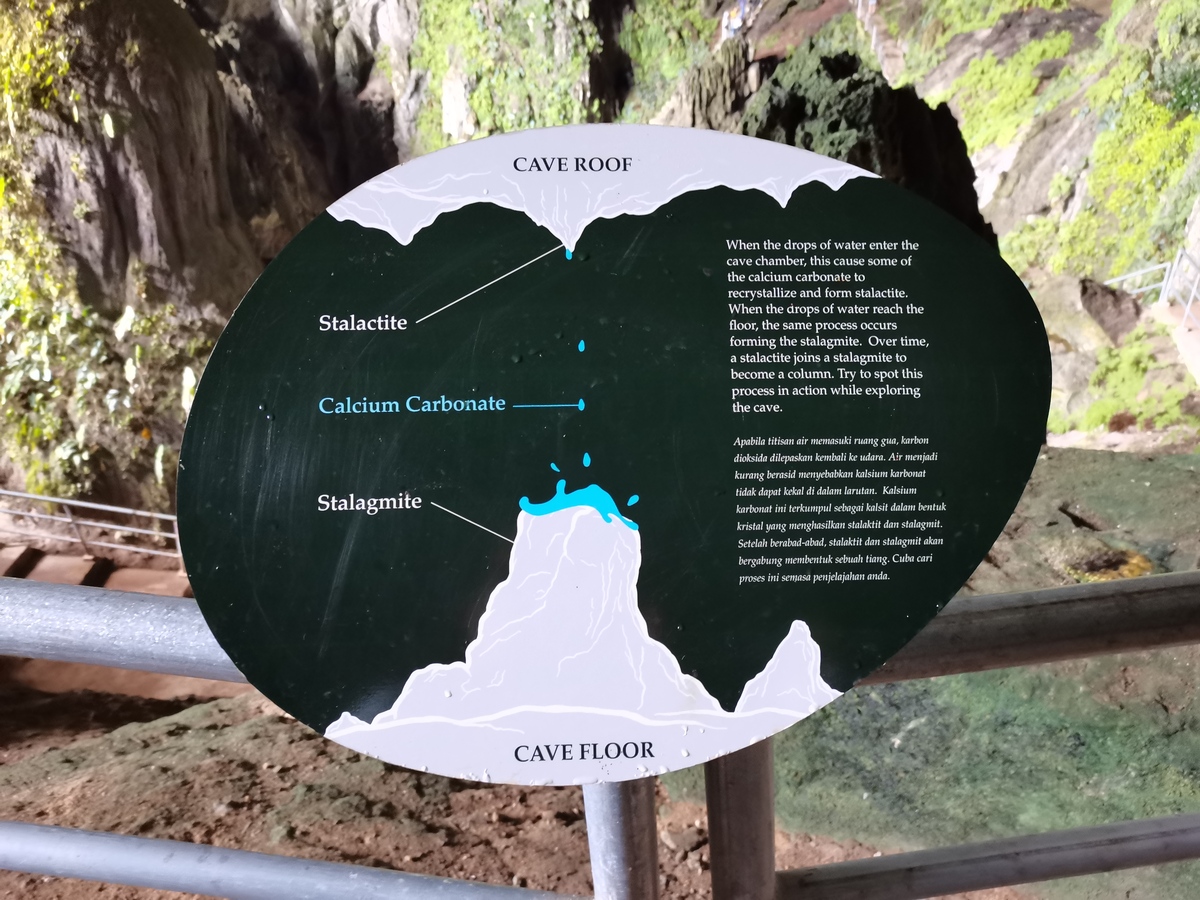
The distinctive feature of Bruniquel, the one that gives it all its scientific value, is that its original entrance was blocked very early, and then lastingly, during the PleistocenePleistoceneThe geological epoch of the great ice ages (c. 2.6 Ma–11,700 BP), spanning most of human prehistory.→. A succession of rockfalls, flowstone layers, and scree cones progressively sealed the opening, isolating the interior from the outside world. This natural closing acted as a time capsule: it sheltered the floors, the concretions, and everything already inside the cave, barring any later visit and, above all, any intervention by Homo sapiens or any other late occupant. It is this sealing which, once dated, would become one of the pillars of the structures' attribution to Neanderthals. For more than one hundred and seventy thousand years, no one could cross the rockfall to reach the deep chamber where the rings stood.
The cave extends deep underground, far from daylight. The built structures lie 336 metres from the present entrance, well beyond the zone the sun reaches even at the most favourable hours. At that distance, and in the cavity's configuration, the darkness is total and permanent. To get there, to stay there, to work there therefore required an artificial source of light, fire, and a deliberate will to push into a hostile space, damp and cold, where nothing invites one to settle. This setting alone places the discovery out of the ordinary: before Bruniquel, no human construction was attested so far underground for a period so remote.
1990: a teenager reopens the cavern
The modern history of Bruniquel begins in February 1990, and it owes much to the stubbornness of a teenager. Bruno Kowalczewski, a young member of the Caussade caving and archaeological society, took an interest in a faint air current that his father had spotted escaping from a rockfall, an almost infallible sign that a cavity hides behind the pile of stones. For about three years, the boy doggedly cleared the rubble blocking the passage, until he opened a narrow crawlway through which a body could slip. At the end of this long labour, the squeeze gave onto a vast underground network that had stayed closed since the Pleistocene.3
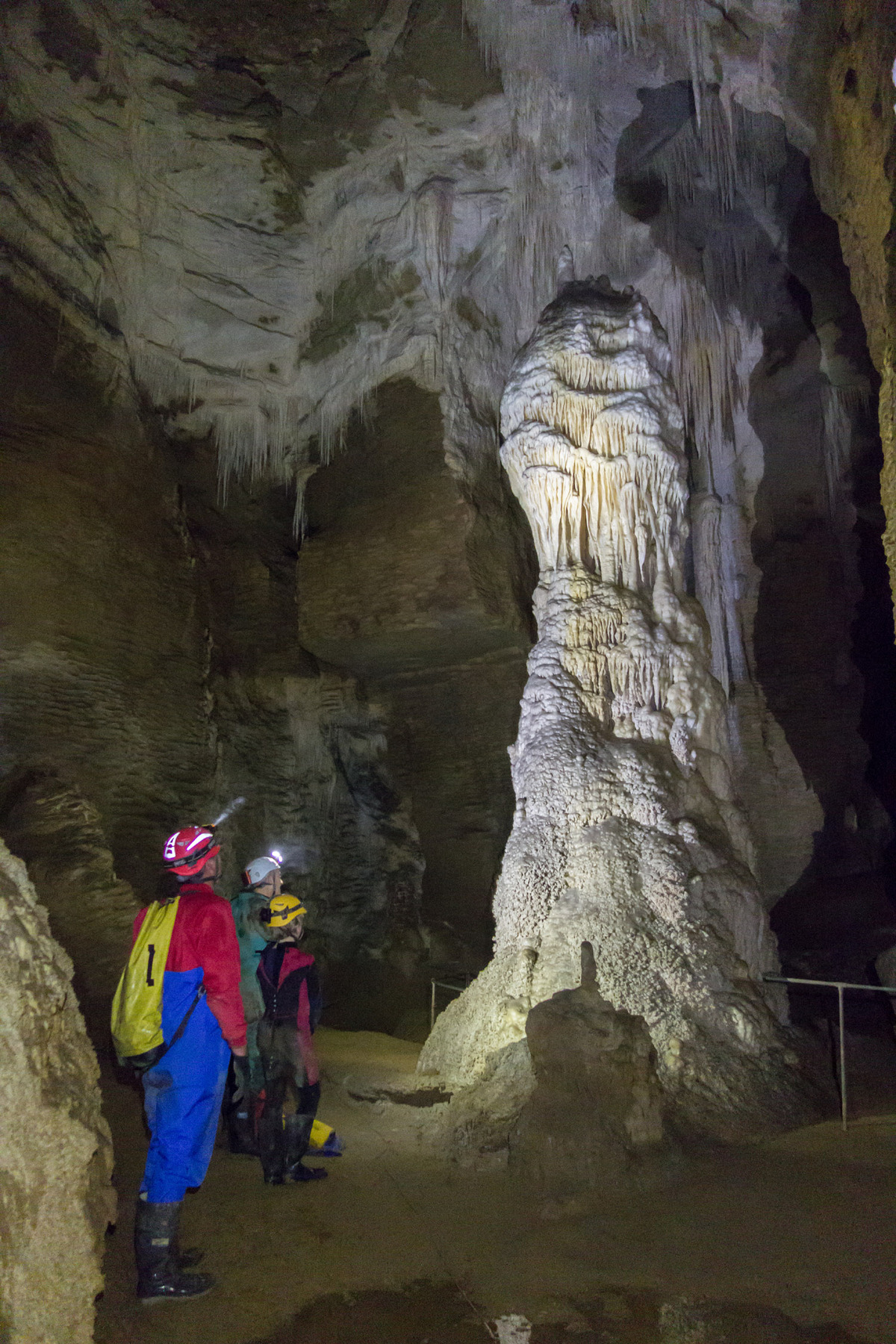
Exploring the galleries, the Caussade cavers reached a large deep chamber where a baffling scene awaited them: broken pieces of stalagmite, accumulated and laid out on the floor in more or less circular shapes, accompanied by blackened concretions and burnt remains. The whole was anything but natural. The intuition quickly took hold that these were human arrangements, but their age and their makers remained an enigma. The discoverers had the wisdom not to trample the chamber and to alert specialists, which would later allow a rigorous study of a miraculously preserved site.
Scientific responsibility for the early work fell to François Rouzaud, prehistorian and curator, who grasped the interest of the site and launched its study from the early 1990s. A plan of the rings was drawn, the chamber's topography documented, and samples taken. In 1995, a fragment of burnt bone recovered in the cave was subjected to radiocarbon dating. The result was as frustrating as it was telling: the bone was dated to more than 47,600 years, meaning that carbon-14 was no longer detectable in it, which signals an age beyond the method's limit without giving its real value. From that moment, a great antiquity was suspected, but no one could yet put a figure on it. The file's fate then took a tragic turn: François Rouzaud died prematurely in 1999, and research came to a halt. For more than a decade, the rings of Bruniquel remained a suspended curiosity, no one knowing whether they were the work of Neanderthals or of modern humans.
Two rings and four stalagmite piles
What the Neanderthals left in this chamber is a set of six structures made solely of concretions, pieces of stalagmite broken off and then arranged. At the centre of the arrangement stand two annular rings. The large one, elliptical in shape, measures about 6.7 metres by 4.5 metres along its major and minor axes. The small one, also oval, reaches 2.2 metres by 2.1 metres. Around and inside these rings are distributed four piles, that is, more or less compact stacks, whose diameter ranges from 0.55 to 2.60 metres; two of these piles sit inside the large ring, the other two outside it.1
The very dimensions of the whole strike the imagination. Laid end to end, the elements that compose the structures represent a cumulative length of 112.4 metres of stalagmite, for a total weight estimated at about 2.2 tonnes of calcite. More than two tonnes of mineral matter, broken off, carried, and assembled in the dark, more than three hundred metres from the entrance: the figure alone imposes the idea of an organised worksite, carried out by a group, and not an isolated or accidental gesture. The rings are not mere alignments laid flat on the floor: they are built up in one to four superimposed courses of stalagmite, with shorter pieces slipped inside the courses to wedge them, and a few stalagmites set vertically against the rings, no doubt as reinforcement or props. The preserved height of the low walls stays modest, under about forty centimetres.
The spatial organisation of this arrangement, its regularity, the presence of props and wedges, all work to rule out the hypothesis of a chance accumulation. A natural collapse, an underground flood, or the action of animals would have left a chaotic heap; here, on the contrary, the elements are sorted, calibrated, oriented, and superimposed according to a logic. It is this coherence that convinced the researchers to see in it an intentional, planned construction, and not a caprice of geology. Yet the structures yield, to this day, no object of daily life: no stone tool, no knappingknappingThe set of operations for fracturing a stone block to extract flakes or blades.→ debris, no characterised domestic hearthhearthA combustion structure set on the ground, evidence of the mastery of fire and a marker of how a prehistoric dwelling was organised.→ in the usual sense, which leaves the question of their function wide open.
Speleofacts: a calibrated architecture
To designate these elements of a new kind, the researchers coined a word: speleofactsspeleofactsPieces of stalagmite broken off and moved by humans to serve as building material, a term coined at Bruniquel.→. The term, modelled on artefact, stresses that these are natural concretions, the stalagmites, transformed by human action into building materials. Nearly four hundred of them are counted in the chamber. Their examination reveals a deliberate working of the raw material: very few stalagmites are whole; about half of them correspond to middle sections, taken from the central part of a stalagmite whose base, the root fixed to the floor, and whose summit, the tip, have been removed. In other words, the builders broke stalagmites, then selected and kept segments of a comparable length.4

This calibration is one of the strongest arguments for an intent to build. The average length of the elements is 34.4 centimetres for the large ring and 29.5 centimetres for the small one, two values remarkably clustered around a module. One does not gather by chance hundreds of pieces of similar length: stalagmites had to be broken at chosen points, the sections sorted, and those that did not fit set aside. This gesture implies a mental representation of the desired result, a form of standardisation that evokes, all proportions kept, the preparation of materials with a view to assembly. In the great chamber, the speleofacts were then stacked, aligned, and sometimes stood upright, following a coherent construction method from one end of the arrangement to the other.
One must also measure the physical effort such an undertaking represents. Breaking massive, sometimes thick stalagmites requires strength and probably hammerstones. Moving more than two tonnes of calcite over an uneven floor, in the dark, by the sole glow of fires, amounts to sustained collective work. Carrying the loads, breaking, sorting, assembling: each of these steps implies coordination, a division of roles, perseverance over time. It is precisely this operational chain, legible in the result, that led the authors to speak of a social organisation more complex than had been imagined for this human lineage.
Fire 336 metres underground
No construction would have been possible without light, and Bruniquel bears the direct proof of it. The six structures all show traces of fire. The meticulous inventory records 57 reddened elements and 66 blackened by heat and soot, as well as fragments shattered by high temperatures. Crucially, the heated zones are concentrated on the very elements of the constructions, and not just anywhere in the chamber, which indicates that fire was maintained on the spot, in contact with the rings, and not brought by an accidental blaze or a diffuse phenomenon.1

To these mineral clues are added burnt organic remains, including a charred bone fragment about 6.7 centimetres long, attributed to a bear or a large herbivore. The presence of these fireplaces, set notably on top of certain piles, suggests a deliberate use of fire, whether to light the worksite, to mark precise points of the arrangement, or to produce heat and light charged with a meaning that escapes us. Whatever its purpose, fire here is inseparable from the structures: it is an integral part of them.
This apparently technical detail carries considerable weight. At 336 metres from the entrance, in permanent darkness, fire is not a comfort but an absolute necessity: without it, no one can reach the chamber, let alone work there for hours. The mastery of fire attested at Bruniquel is therefore not the well-known one of a campfire set in the open air or at the mouth of a shelter; it is that of a light carried and tended deep in a karst network, the very condition of deep exploration. Before this discovery, such an appropriation of the underground world, lighting included, by a pre-modern human species was quite simply unknown. It would not be seen again, in comparable form, until the parietal art of the Upper PalaeolithicUpper PalaeolithicThe final phase of the Palaeolithic (c. 45,000 to 10,000 years ago), marked by Homo sapiens in Europe, art, ornaments and a succession of cultures (Aurignacian, Gravettian, Solutrean, Magdalenian).→, tens of thousands of years later. The fire of Bruniquel is thus not merely a technical detail but a threshold crossed: it marks the moment when a human lineage turned a flame into a tool of exploration, carrying its own small sphere of daylight into a world that had none, and keeping it alive long enough to accomplish a deliberate task there.
Dating the undatable: uranium-thorium
How does one assign an age to a heap of stones devoid of usable bone, tools, or a classic occupation layer? That is the whole challenge Bruniquel posed, and it was by an elegant detour that the team met it. Radiocarbon, as we saw, was out of the game: beyond about fifty thousand years, carbon-14 is too degraded to yield a date, and the burnt bone of 1995 had given only a minimum, more than 47,600 years. The researchers therefore turned to another clock, far better suited to very long durations: uranium-thorium datingUranium-thorium datingA method dating calcite formations (stalagmites, flowstones) via uranium decay into thorium; useful beyond the range of radiocarbon.→uranium-thorium datingDating method measuring, in calcite, the ratio of uranium to the thorium produced by its decay, effective up to nearly 500,000 years.→, also called uranium-series dating.5

The principle rests on the natural radioactivity of calcite. When a stalagmite forms, water deposits in it tiny amounts of uranium, but no thorium, because the latter does not dissolve in water. Now uranium decays slowly into thorium over a known period. By measuring, in a sample of calcite, the ratio between the residual uranium and the thorium produced since the mineral formed, one calculates the time elapsed since the calcite crystallised. The method covers a window running from a few centuries to nearly five hundred thousand years, which falls precisely in the range sought. The difficulty at Bruniquel was to identify the right calcite to date, the one that chronologically brackets the moment of construction.
The solution lies in a sandwich reasoning. The researchers dated, on the one hand, the end of growth of the stalagmites before they were broken off, that is, the tips of the concretions incorporated into the structures, which gives an age earlier than the construction. They dated, on the other hand, the regrowth of calcite that began to deposit again on the speleofacts and on the burnt bone after they were put in place, which gives a later age. By bracketing the event in this way, and by repeating the measurements on several samples, they obtained a result of great precision and, above all, reproducible: 176,500 years, with an uncertainty of only 2,100 years. This figure places the construction at the heart of marine isotope stage 6, a glacial period, at a time when Europe was peopled only by Neanderthals. The chamber floor, sealed under calcite, and the entrance blocked by the rockfall, barring any later intrusion, lock the demonstration: no one could come to build or rework these rings afterwards.
2016: Jaubert, Verheyden, and Genty reopen the file
It took until 2013 for the file, dormant since the death of François Rouzaud, to be taken up on new foundations. Jacques Jaubert, professor of prehistoryPrehistoryThe span of human history before the invention of writing, from the Palaeolithic to the Metal Ages, known mainly through material remains.→ at the University of Bordeaux, decided to study and date the structures with modern means. Around him formed a multidisciplinary team in which the skills complemented one another: the geologist and concretion specialist Sophie Verheyden, of the Royal Belgian Institute of Natural Sciences, took charge of studying the speleofacts and the calcite; the palaeoclimatologist Dominique Genty, of the CNRS, brought his expertise in stalagmites; specialists in uranium-thorium dating, such as Hai Cheng and R. Lawrence Edwards, carried out the measurements; an imaging team produced a precise three-dimensional survey of the structures.1
The results appeared in the journal Nature on 25 May 2016, under the title Early Neanderthal constructions deep in Bruniquel Cave in southwestern France. The paper established the age of 176,500 years, described in detail the six structures, the calibrated speleofacts, and the traces of fire, and concluded that their origin was undoubtedly anthropogenic. The reasoning behind the attribution is of an implacable sobriety: at that date, the only humans present in the region were Neanderthals; they are therefore necessarily the builders. The authors' caution matches the stakes: they demonstrate the reality and antiquity of the construction without claiming to pierce its meaning.
The reach of the publication was immediately hailed by the community. Chris Stringer, of the Natural History Museum in London, a major figure in palaeoanthropologyPalaeoanthropologyThe science that studies human evolution from the fossil remains of hominins (bones, teeth, footprints) and their context, to reconstruct our biological origins.→, stressed that the discovery provides clear evidence that Neanderthals had fully human capabilities in the planning and construction of structures. He also noted that the cave may have offered a temporary refuge from the rigours of the glacial climateClimateThe long-term average atmospheric conditions of a region; its variations (glaciations, aridifications) shaped migrations, agriculture and the collapse of prehistoric societies.→, and that possible signs of occupation may yet be found under unexcavated sediments or under more recent calcite crusts. The authors themselves insist on what the discovery has that is doubly unprecedented: it reveals the appropriation of a deep karst space, lighting included, by a pre-modern human species, and it concerns elaborate constructions without known equivalent until then. Even the modern humans of the AurignacianAurignacianThe earliest culture of the European Upper Palaeolithic (c. 43,000–33,000 BC), tied to the arrival of Homo sapiens and the first artworks.→, more than one hundred thousand years later, left no such constructions deep in caves.
2026: the cave entrance reconstructed
Research at Bruniquel did not stop in 2016. In 2026, a new study, led by Kim Génuite and some twenty collaborators, among whom are Sophie Verheyden, Hubert Camus, and Jacques Jaubert, appeared in the journal Quaternary Science Reviews under an open licence. It tackles a question long left in the shadows: how, and above all when, did the cave entrance close, and what did it look like at the time when the Neanderthals crossed the threshold?6
To answer, the team deployed a range of integrated geomorphological methods: three-dimensional surveys inside and outside the network, thanks to laser point clouds acquired from 2022; high-resolution geomorphological mapping; electrical resistivity tomography, a geophysical technique that probes the subsurface without digging; and, once again, uranium-thorium dating. The combination of stratigraphic surveys and dating made it possible to establish that the closing of the cave, by a succession of rockfalls, flowstone layers, and scree cones, occurred before 142,900 years ago, that is, before the Last Interglacial. This result independently confirms the antiquity of the structures and of the other traces recorded on the floor: since access was blocked well before the arrival of Homo sapiens in Europe, no one but the Neanderthals could have intervened in the chamber.
The most telling contribution of this 2026 study is a virtual three-dimensional reconstruction of the old entrance as it stood at the beginning of marine isotope stage 6. The model suggests an opening less than two metres high, so narrow that the space immediately behind the threshold plunged very quickly into darkness. In other words, even in the days when the entrance was passable, Bruniquel was nothing like a shelter bathed in light: from the very first metres, fire was needed to go forward. This reconstruction offers a new palaeogeographic framework for future research and recalls an often neglected truth, namely that understanding the evolution of a cave entrance is indispensable for reconstructing the conditions and modalities of its occupation. In parallel, the researchers are working from the 3D model to locate the surfaces where possible human traces might survive, and to distinguish the more recent calcite deposits from the original state of the structures.
What were the structures for? Hypotheses and debates
Here is the true mystery of Bruniquel, the one science, for now, does not settle. Dating the construction, demonstrating its intentional character, attributing it to Neanderthals: all this Jaubert's team established with rigour. But the question of why remains open, and the authors themselves take care not to impose an answer. It is not known, they write in substance, whether these structures were built in a ritual setting or whether they served a symbolic function.3
Several hypotheses coexist, without any one prevailing. The first is ritual or symbolic: the arrangement in rings, the considerable investment of labour, the choice of a deep, hidden place beyond the reach of light, all this evokes a space apart, withdrawn from daily life, perhaps charged with a meaning we can only guess at. The very remoteness of the arrangement, far from any camp, feeds the idea of a non-utilitarian purpose. The second hypothesis is that of refuge or shelter: Chris Stringer suggested that the cave may have served as a temporary halt to escape the arctic conditions outside, a protection against the glacial cold. The third evokes territorial marking or a social function, the structures serving as a landmark or gathering place for a group.
It should be added that the circular form is, in itself, anything but trivial for the human imagination. The rings of Bruniquel evoke, from afar and without implying any filiation, the circular plans found in so many later prehistoric arrangements, stone-ringed hearths, huts, enclosures. That Neanderthals chose to arrange their speleofacts in rings, rather than in lines or shapeless heaps, is all the more intriguing because the extra work demanded by this geometry answers no obvious technical necessity. The arrangement seems wanted for its own sake, which revives, without settling it, the question of meaning.
Each of these leads runs up against the absence of domestic clues. No stone tool, no characterised food remains, no typical occupation layer has so far been uncovered in the chamber of the structures. This absence is double-edged. On the one hand, it weakens the hypothesis of an ordinary refuge, since an occupied shelter usually leaves waste; on the other, it rules nothing out, since remains may sleep under unexcavated sediments or under the calcite. The debate therefore remains suspended, and it is to the discipline's honour to acknowledge it. What Bruniquel demonstrates unambiguously is not the nature of the rite, but the capacity of its makers to conceive, plan, and carry out a complex arrangement, in the wrong place, in the worst conditions, for reasons that were their own.
A complex Neanderthal humanity
Bruniquel does not arise in isolation. The discovery crowns a series of works that, over the past twenty years, have profoundly revised the image of the Neanderthal, long caricatured as a dull brute incapable of abstraction. A convergence of clues, gathered at several European sites, now sketches the portrait of a human of complex cognition, capable of symbolic behaviours and of gestures with no strictly material purpose.7
In the Touraine, the cave of La Roche-Cotard yielded hundreds of organised finger marks on its walls, attributed to Neanderthals and dated to more than 57,000 years, among the oldest intentional parietal marks in Europe. In Spain, the caves of Cueva de los Aviones and Cueva Antón produced perforated marine shells coated with ochreOchreA red or yellow mineral pigment (iron oxides), used from prehistory for adornment, funerary rites and art.→, as well as pigments with elaborate mixtures, while red stains applied to the walls of the Ardales cave, in Andalusia, were dated by uranium-series to around 115,000 to 120,000 years, well before any presence of Homo sapiens in the peninsula, even if their interpretation remains debated. At Krapina, in Croatia, a set of sea-eagle talons bearing notches and polishing marks was interpreted as adornment, jewellery fashioned about 130,000 years ago.
To these testimonies are added other gestures which, taken in isolation, might seem anecdotal, but whose accumulation ends up making sense. Known at various points in Europe are uses of manganese and ochre, raptor feathers taken for their flight quills, shells gathered and carried, projectile points hafted with birch-bark glue, a substance whose manufacture demands a genuine technical protocol. Neanderthal burials, long contested, also tend to be reassessed, as do certain arrangements of bones or blocks. Each site, taken apart, lends itself to debate, for the archaeology of the symbolic is a minefield where ambiguity is the rule. But the repetition of clues, across different territories and millennia, makes ever less tenable the idea of a purely utilitarian Neanderthal, a stranger to any form of abstract or shared thought.
This convergence does not sketch a figurative art comparable to the frescoes of Lascaux or Chauvet, which would come much later with Homo sapiens. It reveals instead a register of its own: marks, colours, fashioned objects, use of fire and of the underground space, so many behaviours that exceed pure survival. Bruniquel occupies a singular place within it, and perhaps the most spectacular, because the demonstration there is particularly solid, locked by the sealing of the cave and the uranium-thorium dating, and because the antiquity, 176,500 years, is extreme. The construction precedes the arrival of modern humans on the continent by about one hundred and thirty thousand years. It compels us to recognise that the capacity to explore, arrange, and appropriate the deep world, with all it implies of planning, cooperation, and technical mastery, was not the preserve of our species alone.
Protecting a 176,500-year-old sanctuary
A site of such value, as fragile as it is exceptional, could not remain without protection. Bruniquel Cave is listed as a Historic Monument, and its access is strictly forbidden to the public and to the curious. Only authorised researchers enter it, under tightly controlled conditions and as rarely as possible, so as not to alter an ensemble that has come down intact through more than one hundred and seventy thousand years, an archive of behaviour whose like exists nowhere else in the world for so remote a period. The slightest trampling, the slightest contamination, the slightest ill-controlled breath of air could compromise information still untapped. Preservation therefore takes precedence over visiting, and it is precisely because the cave stayed closed for so long that it can speak to us today.2
There remains, at the end of this inquiry, a vertigo hard to contain. One hundred and seventy-six thousand five hundred years ago, in a glacial France peopled by Neanderthals, a group of men and women pushed more than three hundred metres underground, into a night where no human being had any obvious reason to go. By the glow of their fires, they broke stalagmites, sorted sections of comparable length, carried more than two tonnes of calcite, raised two rings and four piles, lit fires at the heart of their work. Then they left, the calcite sealed the scene, a rockfall closed the door, and their gesture waited, intact, in the darkness, for modern hands to come and reopen and date it.
We still do not know what they were seeking there, what meaning they gave to these rings of stone raised in the dark. But Bruniquel tells us the essential thing: they were seeking one. They had the will, the organisation, and the audacity to venture into the deep underground world and to leave a lasting trace there, one hundred and thirty thousand years before our species set foot on the soil of Europe. The boundary we had drawn between them and us, the one that reserved to Homo sapiens the privilege of abstraction and the conquest of the darkness, fades a little more with each excavation campaign. The rings of Bruniquel are, to this day, one of the most moving proofs of that rediscovered kinship.
Même sans être spécialiste de la période, l'argumentation est parfaitement suivable. Bravo.