There are places where history seems to have piled up in patient layers, never once interrupted. Byblos, called Gebal by its own people and today Jbeil on the Lebanese coast, is one of them. Inhabited since the NeolithicNeolithicThe "New Stone Age": a period marked by farming, herding, settlement and pottery, from around 10,000 BC.→, grown into a prosperous city by the third millennium before our era, it is reckoned among the oldest continuously occupied cities in the world. Yet it was an accident of terrain, a simple slide of the cliff after heavy rains, that would reveal its most spectacular secret, an intact royal necropolisNecropolisA large organised burialBurialThe intentional deposition of a body, sometimes with offerings; a marker of symbolic behaviour.→ ground, a "city of the dead", often spanning several periods.→ dating back to the Bronze AgeBronze AgePeriod of late prehistory marked by bronze metallurgy and the rise of maritime trade, beginning in the Near East around 3300 BCE.→Bronze AgeA protohistoric period following the Neolithic, defined by bronze metallurgyMetallurgyThe techniques of extracting and working metals (copper, bronze, gold); its rise in the Eneolithic and Bronze Age transformed tools, weapons and social hierarchies.→ (a copper-tin alloy) and the rise of the first cities and states; in Egypt it corresponds to the age of the first pyramids.→. What archaeologists found there tells at once of the wealth of a Levantine monarchy, the intensity of its ties with Egypt, and one of the great turning points of human history, the birth of our alphabetalphabetA writingWritingA system of conventional signs used to fix language or information durably; its appearance (c. 3300 BC) marks, by convention, the end of prehistory.→ system in which each sign notes a single elementary sound, allowing writing with a very small number of letters.→.
A city by the sea, among the oldest in the world
Byblos occupies a headland facing the Mediterranean, some forty kilometres north of Beirut. Archaeologists believe the site first hosted a community of fishermen roughly eight thousand years ago, before being continuously occupied from the fifth millennium before our era onward. True urbanisation, with monumental temples, ramparts and organised housing, took shape during the third millennium, which makes Byblos one of the oldest cities ever built, if not the very oldest according to some specialists.4
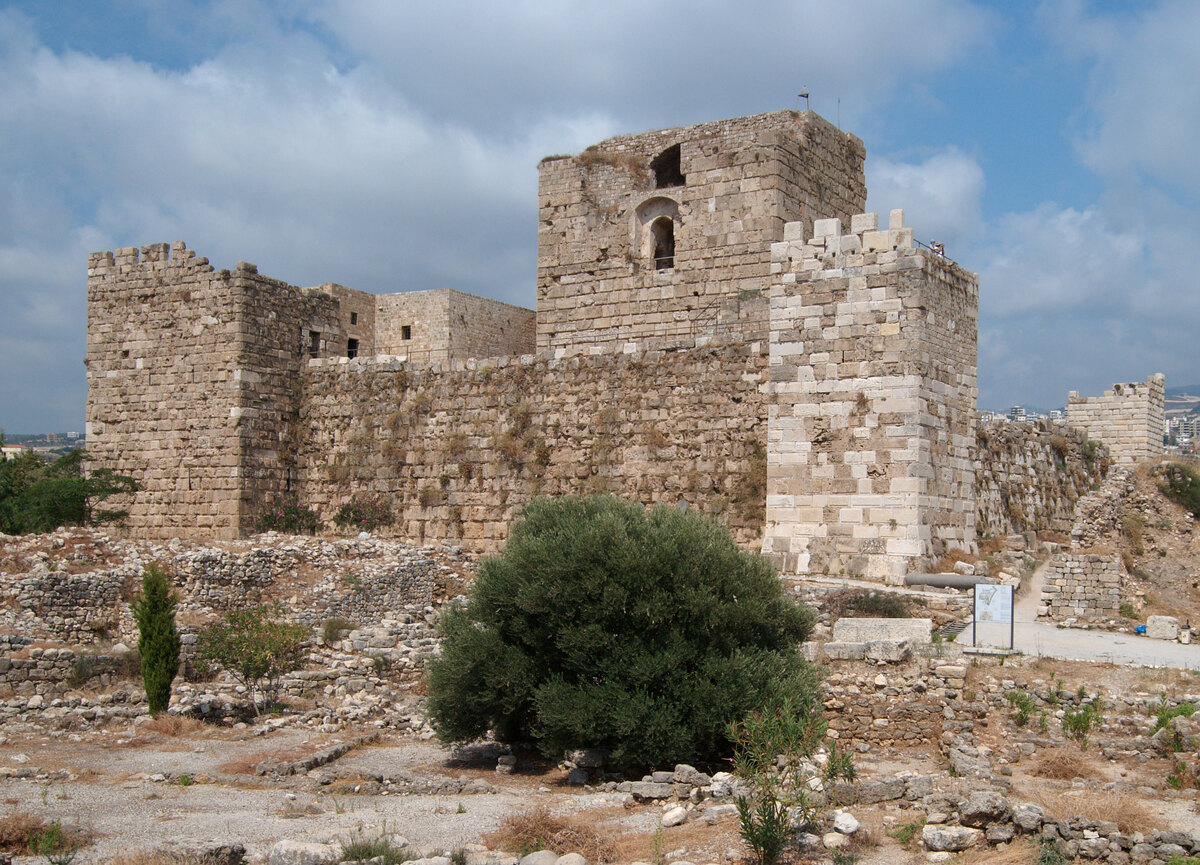
The city owes its longevity to its strategic position. Backed against the forested mountains of Lebanon and open to the sea, it became very early a commercial crossroads of the first rank. The name Byblos itself, handed down by the Greeks, derives from the word for papyrus, so closely was the city tied to the trade of that raw material coming from Egypt. Listed as a UNESCO World Heritage Site since 1984, Byblos bears witness to a history of uninterrupted construction, from the first fishermen to the Persian fortifications, the Roman road, the Byzantine churches and the Crusader citadel.4 It was within this thick layering of civilisations that the tombs of its kings lay sleeping, only a few metres below the surface.
1922, the landslide that woke the kings
On 16 February 1922, heavy rains triggered a landslide in the cliff bordering the sea at Jbeil. The scar opened in the ground exposed an underground chamber and, inside it, an imposing stone sarcophagus. The find was first examined by the French epigrapher and archaeologist Charles Virolleaud, before the systematic excavations were entrusted to an Egyptologist with a trained eye, Pierre Montet.1
Montet led the work at Byblos from 1922 to 1924. Around the first tomb brought to light, he cleared eight further burial shafts, bringing the total number of royal graves explored to nine. The task was delicate, for the site had partly collapsed and the layers had become mixed. Some chambers proved to have been robbed in antiquity, stripped of their gold, but others were found intact, offering archaeologists a faithful snapshot of the funerary rites of the princes of Byblos in the second millennium before our era.1 For Montet, trained in Egyptology, the presence of objects marked with the names of pharaohs was a windfall, a way to date the tombs precisely and to gauge the intensity of exchange between the Levantine coast and the Nile Valley.
Nine shaft tombs, the architecture of the afterlife
The burials of the royal necropolis follow a shared plan. Each consists of a vertical shaft cut into the rock, sometimes several metres deep, opening at its base onto a horizontal burial chamber. There, hidden from view, the deceased rested surrounded by his goods. Seven stone sarcophagi were recovered, while the chambers that lacked them probably held wooden coffins, now reduced to dust by time.1
Archaeologists distinguish two broad groups of tombs. The first dates back to the Middle Bronze Age, more precisely to the nineteenth century before our era. These burials, several of which remained unviolated, yielded funerary goods of considerable richness. The second group, entirely plundered in antiquity, is harder to date, but the surviving objects indicate that some chambers were used into the Late Bronze AgeLate Bronze AgeThe final phase of the Bronze Age in the Near East (c. 1550 to 1200 BCE), an age of great empires and international diplomacy, ended by a general collapse.→, between the sixteenth and eleventh centuries before our era.1 This long continuity of use makes the necropolis a precious vantage point on the evolution of royal practice at Byblos across nearly a thousand years, right up to the threshold of the transition to the Iron AgeIron AgeThe last period of protohistoryProtohistoryThe transitional period between prehistory and history, covering societies without their own writing but known through external texts.→ (from c. 1200 BC in Europe and the Near EastNear EastA region of western Asia (Levant, Mesopotamia, Anatolia, Iran), cradle of the Neolithic revolution, agriculture, the first cities and writing.→), marked by iron metallurgy and the first kingdoms.→.
The treasure of the princes, gold, obsidian and gifts from the Nile
The intact tombs of the first group returned funerary goods of remarkable opulence, blending local craft and Egyptian influence. Among them were gold-foil collars shaped as falcons, a motif inspired by Egypt yet fashioned at Byblos from unique models, as well as silver tweezers and mirrors, local adaptations of the Egyptian funerary repertoire that speak of great wealth.1
The most telling pieces are surely the objects bearing the names of pharaohs. In Royal Tomb I, that of the local ruler Abishemou, an obsidian and gold vase was found, engraved with the throne name of the pharaohPharaohThe title of the ruler of ancient Egypt, regarded as a living god guaranteeing cosmic order (Maat), supreme head of state, army and worship.→ Amenemhat III. In Royal Tomb II, that of Abishemou-Abi, son of the former, an obsidian and gold box this time carried the throne name of Amenemhat IV.1 Obsidian, a black and glossy volcanic glass, does not occur in the region, which underlines the reach of the city's supply networks. These objects were not mere merchandise but royal presents, diplomatic gifts from the sovereigns of the Middle Kingdom to the princes of Byblos, sealing an alliance and a friendship between two monarchies.
The presence of these carefully inscribed gifts also gives researchers a precious chronological anchor. Since the reigns of Amenemhat III and IV are dated with relative certainty, the tombs that contained their gifts can be fixed to the nineteenth century before our era. It is one of the rare cases where the archaeology of the LevantLevantA region of the eastern Mediterranean Near East (Israel, Lebanon, Syria, Jordan), a major crossroads of the first human migrations out of Africa.→ has a landmark from elsewhere, imported and engraved, to order its own history.
Byblos and Egypt, the empire of the cedar
To understand why pharaohs sent precious vases to the princes of Byblos, one must look to the mountains that tower over the city. Throughout the Bronze Age, Byblos was one of Egypt's most important trading partners, from the Old KingdomOld KingdomThe first great period of unified pharaonic Egypt (c. 2700-2200 BC, 3rd-6th Dynasties), the golden age of the great pyramids and of a strongly centralised state.→ to the Middle Kingdom. The reason can be summed up in one word, cedar. The cedrus libani, a tree with strong, durable and delightfully scented wood, was ardently coveted by the Egyptians, whose land lacked large timber.3
Cedar served to build palaces, to construct ships, to supply the resin used in mummification, and even paper. Wood exports to Egypt reach back to the fourth millennium, as early as the first dynastyFirst DynastyFirst line of kings of unified Egypt, around 3100 to 2900 BCE, which practised servant sacrifice.→, around 2900 before our era. The pharaoh Sneferu, who reigned around 2500 before our era, sent an expedition to bring back cedar wood from Byblos.3 Around this trade a far wider network was woven, through which Byblos offered Egypt precious metals, marble, aromatic resins, medicinal plants and objects of bronze, while the city received in return the gold, the stones and the prestige of the Nile civilisation.
These exchanges were so intense that Egyptian culture deeply permeated the elite of Byblos, right into their tombs. The princes had themselves buried with Egyptian-style objects, adopted certain iconographic codes and deities, and maintained a privileged relationship that spanned the centuries. The ties loosened during the First Intermediate PeriodFirst Intermediate PeriodA phase of political fragmentation in Egypt (c. 2181-2055 BC) between the Old and Middle Kingdoms: eclipse of royal power, autonomy of nomarchs, Herakleopolis-Thebes rivalry.→, when Egypt, plunged into internal turmoil, halted its expeditions to the Levant for a time, before resuming them under the Middle Kingdom.3 It was from this fertile dialogue between two worlds that the most famous object of the whole necropolis was born.
The sarcophagus of Ahiram, a masterpiece in stone
Among the burials explored by Montet, Tomb V yielded in 1923 the centrepiece of Byblos, the sarcophagussarcophagusA stone coffin, often carved, meant to hold the body of a high-ranking deceased person.→ of Ahiram. This limestone coffin, now held in the National Museum of Beirut, is dated to around the year 1000 before our era. It stands as one of the finest examples of PhoenicianPhoenicianRelating to the merchants and seafarers of the Levant who founded trading posts on the Iberian coasts and deeply influenced Tartessos.→ art, adorned with low-relief carvings depicting enthroned royal figures, mourning women and a funeral procession.2
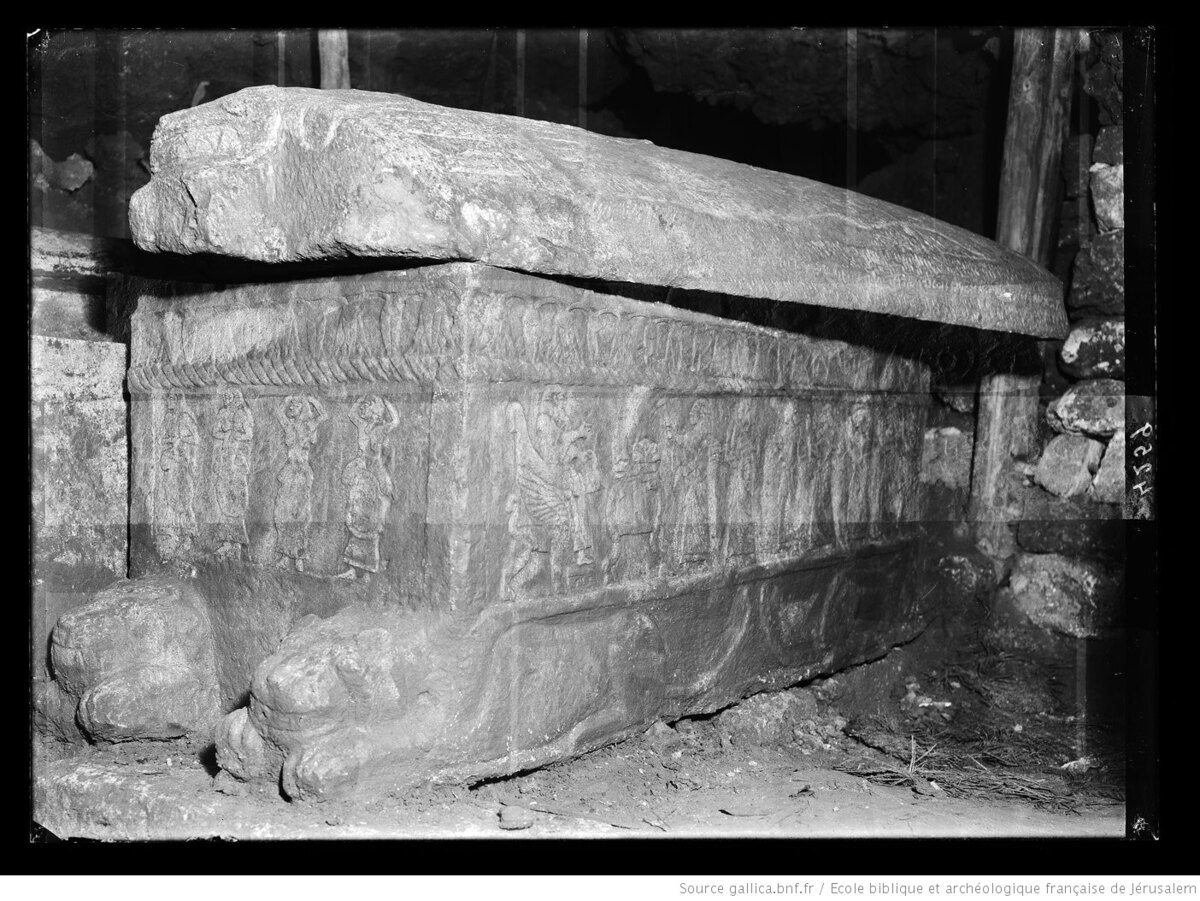
The main scene shows the king seated on a throne flanked by winged sphinxes, holding in his hand a drooping lotus flower, a symbol of death. Before him advances a procession of dignitaries bringing offerings, led by his own son, while a priestess extends a lotus toward him. The rectangular coffin is bordered by a frieze of lotus buds and flowers, and crouching lions emerge from each corner of the base. On the lid, two male figures face one another, separated by seated lions.6 The whole deploys a visual language in which royal authority, the passage to the afterlife and dynastic continuity can be read, in a style that fuses Egyptian and Syro-Levantine legacies.
The engraved curse, oldest major alphabetic inscription
If the sarcophagus of Ahiram is famous the world over, it is not for its beauty alone but for the text that runs along its rim and its lid. This inscription is regarded as the oldest known example of the fully developed Phoenician alphabetalphabetA writing system in which each sign notes a single elementary sound, allowing writing with a very small number of letters.→, in its twenty-two letters.2 It was engraved by Ittobaal, son of Ahiram, to honour his deceased father, and comes with a warning addressed to any who would defile the tomb.
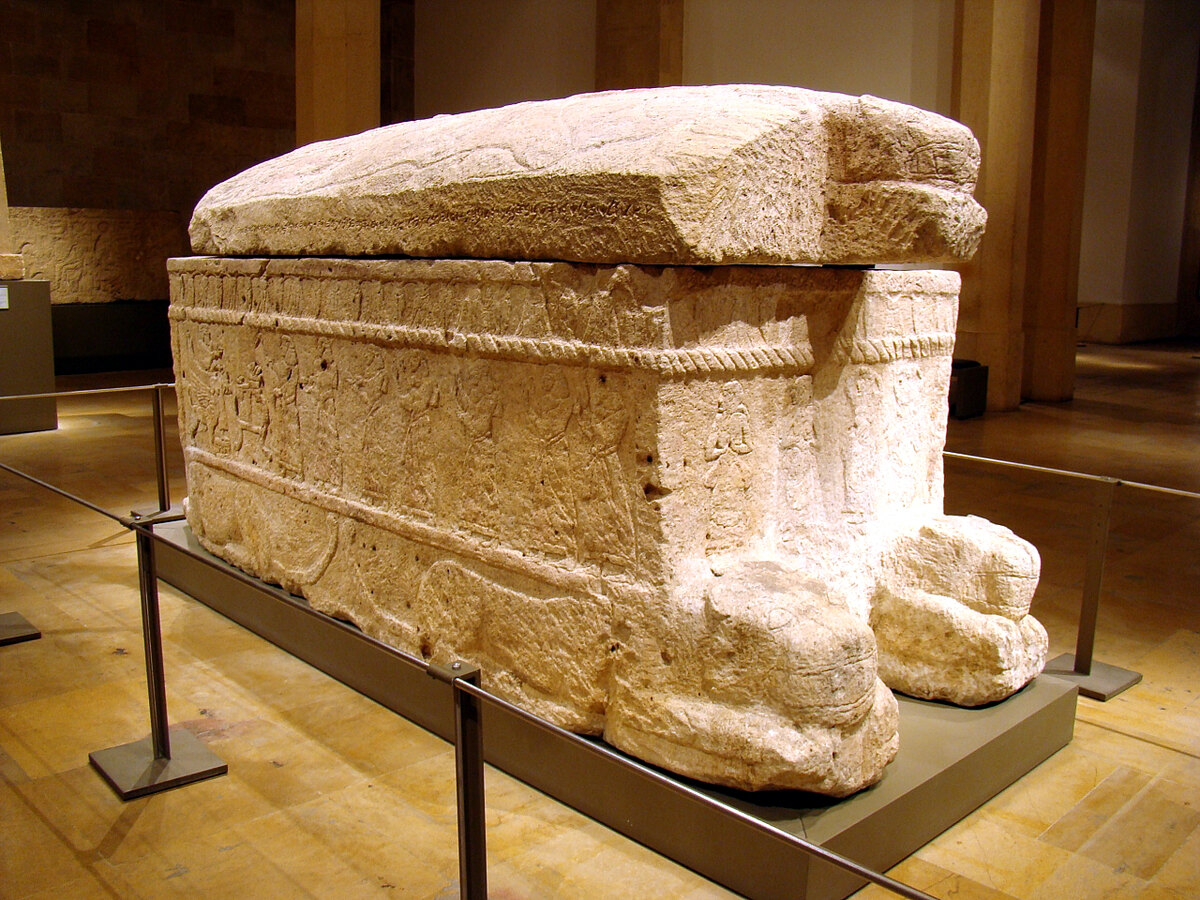
The text reads roughly as follows. A coffin, Ittobaal made it, son of Ahiram, king of Byblos, for Ahiram his father, when he placed him in the house of eternity. And if a king among kings, a governor among governors or a commander of an army should come up against Byblos and uncover this coffin, may the sceptre of his justice be stripped away, may the throne of his kingdom be overturned, and may peace flee far from Byblos.2 This curse, one of the oldest funerary protection formulas written in an alphabetic script, plunges us into the royal imagination of the Phoenicians, where the engraved word becomes a weapon against oblivion and plunder. Ahiram most likely reigned in the tenth century before our era, roughly at the time when biblical tradition places King Solomon.2
The dating of the object has fed a long scholarly debate. The sarcophagus itself goes back to around the year 1000, but certain objects found in the tomb had at first suggested the thirteenth or twelfth centuries. The shape of the letters eventually tipped the balance, and a tenth-century date for the inscription is now widely accepted.2
From Byblos to the world, an alphabet as legacy
The importance of the sarcophagus of Ahiram reaches far beyond the fate of one Levantine king. Its inscription marks one of the decisive milestones in the history of writing. The Phoenician alphabet, made of twenty-two signs noting only consonants, descends directly from the Proto-Sinaitic script, born among labourers of the Sinai Peninsula in the second millennium before our era, itself derived from a handful of Egyptian hieroglyphs.5 At Byblos, a city of scribes and merchants, this simple and supple writing found ideal ground.
The revolution lies in its simplicity. Where the cuneiformCuneiformThe oldest known writing, born at Uruk; its signs, impressed into clay with a reed stylus, are wedge-shaped (from Latin cuneus).→ and hieroglyphic systems demanded the memorisation of hundreds of signs, the alphabet reduced writing to about twenty letters, within the reach of a merchant and no longer of professional scribes alone. Spread by PhoenicianPhoeniciansA people of sailors and traders from the Levant (modern Lebanon) who founded trading posts across the western Mediterranean from the start of the first millennium BC.→ traders across the Mediterranean, this invention reached Greece around 850 to 800 before our era. The Greeks adapted it by adding vowels, giving birth to the Greek alphabet, direct ancestor of the Latin and Cyrillic alphabets and of many others.5 From Hebrew to Arabic, most of the alphabetic scripts of the present world trace back, step by step, to this matrix.
Thus the royal necropolis of Byblos condenses within a few underground chambers a vast share of our heritage. It tells of a Levantine monarchy powerful enough to receive the gifts of pharaohs, wealthy enough to be buried in gold and obsidian, and inventive enough to bequeath to humankind a tool as ordinary and as prodigious as the alphabet. At the hinge between the Bronze Age and the Iron Age, when the great empires wavered and the PhoeniciansPhoeniciansA people of sailors and traders from the Levant (modern Lebanon) who founded trading posts across the western Mediterranean from the start of the first millennium BC.→ were about to sail the Mediterranean, the kings of Gebal were already signing, without knowing it, the first chapter of a story that we go on writing, letter after letter, every single day.
No comments yet. Be the first.