On the Lebanese coast, forty-two kilometres north of Beirut, a city has kept watch for more than five thousand years. Byblos , ancient Phoenician Gebal, Gubla of the Akkadian texts , is one of the oldest cities in the world, inhabited without interruption since the NeolithicNeolithicThe "New Stone Age": a period marked by farming, herding, settlement and pottery, from around 10,000 BC.→. But its most precious secret lies underground: a Bronze AgeBronze AgeA protohistoric period following the Neolithic, defined by bronze metallurgy (a copper-tin alloy) and the rise of the first cities and states; in Egypt it corresponds to the age of the first pyramids.→ royal necropolisNecropolisA large organised burial ground, a "city of the dead", often spanning several periods.→ cut into the living rock, which yielded to astonished archaeologists treasures of extraordinary rarity. A time capsule sealed for three and a half thousand years, recounting, object by object, the story of a kingdom at its height and its exceptional ties with pharaonic Egypt.
Byblos, One of the World's Oldest Cities
Archaeological excavations have uncovered traces of occupation at Byblos dating back some 7,000 years. The first inhabitants, Neolithic fishermen, settled on this limestone promontory overlooking the sea for its natural advantages: a permanent freshwater spring, a small sheltered bay suitable for mooring boats, and proximity to the cedar forests of Lebanon that then covered the slopes of the nearby mountain range.
It was this forest that made Byblos's fortune. The Cedar of Lebanon (Cedrus libani) , tall, straight, resistant to rot, exuding a resin naturally repellent to insects , was the most precious raw material in the ancient Near EastNear EastA region of western Asia (Levant, Mesopotamia, Anatolia, Iran), cradle of the Neolithic revolution, agriculture, the first cities and writing.→ for shipbuilding, monumental architecture, and the making of royal coffins. Egypt, a land of desert and reeds, lacked it desperately. Byblos had it in abundance. This fundamental geographical imbalance would structure relations between the two civilisations for two thousand years.
As early as the Old KingdomOld KingdomThe first great period of unified pharaonic Egypt (c. 2700-2200 BC, 3rd-6th Dynasties), the golden age of the great pyramids and of a strongly centralised state.→ (around 2700 BC), Egyptian texts record the regular dispatch of fleets to the "land of cedar." The Egyptians called these ships kebenet , from the very name of the city, Gebal in Phoenician. Language has preserved the trace of this trade: in Greek, Byblos also meant papyrus, which Phoenician merchants from the city distributed throughout the Mediterranean. From Byblos thus comes the word "bible" , the books , and by extension the name of all the letters and alphabets of the Western world.
The Royal Necropolis: A Discovery of the Century
In 1921, young French archaeologist Pierre Montet , who would later discover the royal tombs of Tanis , began the first systematic excavations of Byblos. What he found exceeded all expectations: nine royal shaft tombs cut vertically into the limestone bedrock, some more than six metres deep, opening into lateral burialBurialThe intentional deposition of a body, sometimes with offerings; a marker of symbolic behaviour.→ chambers. Miraculously sealed since around 1800 BC, these hypogea had passed through the millennia unplundered.
The excavations, resumed and extended by Maurice Dunand from 1926 and for nearly half a century, gradually revealed a treasure of breathtaking richness. In the tombs of the kings of Byblos , some bearing Semitic names such as Abishemuabi, Abi-Shemu, and Ypshemu-abi , lay objects that tellTellAn artificial mound formed by the accumulation of successive layers of settlement remains at the same spot, typical of the Near East. Each destruction-rebuilding event adds a stratum.→ the story of a kingdom at its zenith, a refined aristocracy, and an exceptional diplomatic relationship with the greatest power of the ancient world.
The preservation is extraordinary. The local limestone, porous but stable, preserved metal, ivory, partially organic materials, and ceramics intact. Archaeologists discovered obsidian vases engraved with pharaohPharaohThe title of the ruler of ancient Egypt, regarded as a living god guaranteeing cosmic order (Maat), supreme head of state, army and worship.→ cartouches, gold inlaid caskets, Egyptian faience necklaces, gilded ceremonial bronze weapons, lapis-lazuli scarabs , silent witnesses of a diplomatic relationship that had transformed Byblos into an outpost of Egyptian luxury in the heart of the LevantLevantA region of the eastern Mediterranean Near East (Israel, Lebanon, Syria, Jordan), a major crossroads of the first human migrations out of Africa.→.
The Alliance with Egypt: Cedars for Gold and Prestige
The objects recovered from the necropolis paint a portrait of diplomatic exchange on multiple levels. The pharaohs of the Middle Kingdom , Amenemhat III, Amenemhat IV, Senusret III , sent sumptuous gifts to Byblos: alabaster vases inscribed with their cartouches, obsidian statuettes, gold and electrum jewellery. These royal presents, preserved in the tombs as prestige treasures, attest that the kings of Byblos were regarded as privileged partners , if not honoured vassals , of the Egyptian crown.
In return, Byblos supplied Egypt with its incomparable resources: cedar wood, a single beam of which might require several men to carry, transported on men's backs from the Lebanese highlands to the shipyards of the Nile Delta. Egyptian texts of the period mention the dispatch of entire cedar convoys "for the great solar barques" and "for the masts of warships."
But the alliance went beyond simple barter. The tutelary goddess of Byblos, the "Lady of Byblos" , Baalat Gebal in Phoenician , had been assimilated to Hathor, the Egyptian goddess of love, beauty, and foreign lands. Byblos's main temple housed a hybrid form of worship, where Phoenician rites mingled with Egyptian liturgies. Bilingual priests officiated in both languages. The princes of Byblos adopted Egyptian honorary titles and had themselves depicted according to the pharaonic iconographic conventions. It is this profound cultural syncretism that the necropolis reveals in its full scope.
A telling figure: among the objects exhumed from Byblos's nine royal tombs, more than half bear a hieroglyphic inscription or were manufactured in Egypt. No other funerary site outside Egypt presents such a concentration of objects from the pharaonic court.
The Tomb Treasures: A Staggering Inventory
The excavations yielded an inventory without equivalent in the Bronze Age Levant. Among the most remarkable finds are gold pectorals in the shape of eagles with outstretched wings, decorated with carnelian and lapis-lazuli inlays , a material that travelled from the mines of Afghanistan to Byblos's jewellery workshops. These pectorals, worn on the chests of deceased kings, testify to a sense of splendour and technical mastery in no way inferior to contemporary Egyptian productions.
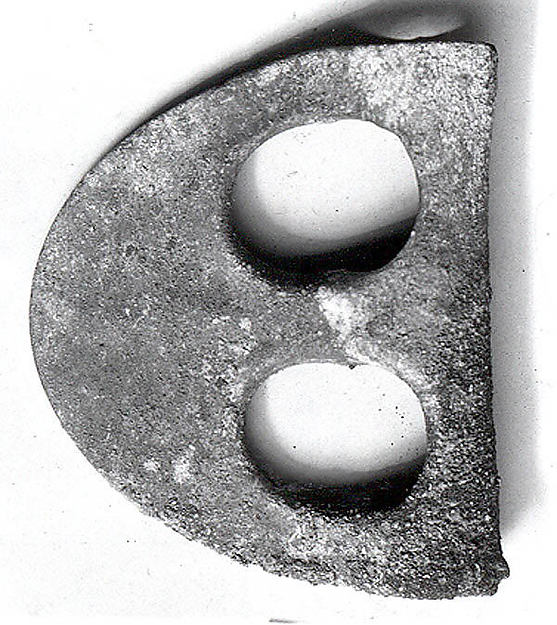
The ceremonial weapons form another fascinating category. Fenestrated bronze axes , with iron pierced by geometric openings that reduce weight without sacrificing strength , are characteristic of Levantine warrior elites in the Middle Bronze Age. They were not intended for combat: their fine finish, partial gilding, and deposition in royal tombs suggest they functioned as insignia of power, symbols of the sovereign's martial legitimacy.
The ceramics reflect Byblos's position as a commercial crossroads: local productions in the Canaanite tradition stand alongside Cypriot imports, Tell el-Yahudiyya ware from the Nile Delta, and Egyptian alabaster fragments reworked by local craftsmen. Byblos was not merely a stopover on the Levantine trade routes: it was a workshop, a place of encounters and fusions between the artistic traditions of the ancient Near East.
The tomb of King Abi-Shemu, probably the richest of the nine hypogea, yielded obsidian vases bearing the engraved cartouches of Amenemhat III and Amenemhat IV , irrefutable proof that these objects had been offered personally by the pharaohs to their Byblian counterpart. Alongside lay carnelian scarabs mounted in gold, polished bronze mirrors, and dozens of small blue faience figurines of Egyptian gods: Bes, Taweret, standing hippopotami. These apotropaic objects , meant to protect the deceased in the afterlife , testify to the sincere adoption of Egyptian funerary theology by the elites of Byblos.
Byblos, Cradle of the Phoenician Alphabet
The royal necropolis is contemporary with another revolution that would depart from Byblos to transform the history of humanity. Around 1050 BC , a few centuries after the Middle Bronze Age tomb period , a king of Byblos named Ahiram is buried in a magnificently carved limestone sarcophagus. On the lid, an inscription in Phoenician alphabet: twenty-two consonantal signs, distant heirs of the proto-Sinaitic script, which constitute the oldest complete known alphabetic inscription.
The Byblian alphabet was not born from nothing. It is the product of a long maturation, probably within bilingual scribes who mastered both Egyptian hieroglyphs and Mesopotamian cuneiformCuneiformThe oldest known writing, born at Uruk; its signs, impressed into clay with a reed stylus, are wedge-shaped (from Latin cuneus).→, and who sought a simpler writingWritingA system of conventional signs used to fix language or information durably; its appearance (c. 3300 BC) marks, by convention, the end of prehistory.→ system suited to Canaanite Semitic. These scribes worked in Byblos's chancelleries, drafting commercial contracts, offering lists, diplomatic letters. Their invention , noting each consonant with a unique sign , would, as it spread westward through Phoenician networks, engender the Greek alphabet, then Latin, then our letters today.
Byblos thus occupies a singular place in the history of civilisation: at once a witness to the Bronze Age Levant in all its diplomatic and commercial splendour, and the cradle of a graphic invention we inherit every time we write. The underground necropolis is not merely the museum of a vanished world; it is proof that this vanished world has, through invisible chains of transmission, shaped our own.
The Necropolis Today
Listed as a UNESCO World Heritage Site since 1984, the ancient city of Byblos is the subject of international protection. The archaeological site, which superimposes strata from the Neolithic to the Crusader period, is one of the most complex in the Near East. The excavations have not yet yielded all their secrets: a large part of the ancient surface remains buried beneath the medieval and modern city, and archaeologists estimate that new funerary chambers may exist at depths yet unexplored.
The repeated conflicts that have scarred Lebanon since the 1970s have made research difficult and sometimes impossible. But Byblos has survived millennia of invasions, earthquakes, and fires. Like its legendary cedars , a few millennial specimens of which still survive in the Cedars of God forest reserve , the ancient city endures, stubborn and silent, guardian of its underground treasure.
Les migrations préhistoriques deviennent enfin lisibles quand on les relie à votre carte. Beau travail.
Je le garde en favori pour ma prochaine dissert. Les transitions entre périodes sont bien expliquées.
La nécropole de Byblos est un contexte archéologique exceptionnel car il mêle influences égyptiennes, mésopotamiennes et locales dans les pratiques funéraires. Cette hybridation culturelle au Bronze moyen reflète la position de carrefour commercial qu'occupait Byblos dans le monde méditerranéen. Les nouvelles fouilles libanaises apportent régulièrement des précisions sur la chronologie et les pratiques rituelles.
Byblos est l'une des plus anciennes villes habitées en continu du monde, et sa nécropole de l'Age du Bronze livre régulièrement des trésors. Les sarcophages royaux découverts dans les années 1920 par Pierre Montet sont parmi les plus beaux exemples de l'art phénicien. Cette ville a joué un rôle capital dans la transmission de l'alphabet au monde grec.