Carnac, a megalithic capital older than we thought
The Carnac alignments, in the Morbihan department of southern Brittany, rank among the most famous archaeological landscapes in the world. Thousands of standing stones, arranged in parallel rows stretching over several kilometres, have shaped an enigmatic setting for thousands of years. For a long time, the exact age of these monuments remained uncertain, for want of sufficiently precise dating methods. A study published in 2025 in the journal Antiquity overturns that uncertainty: drawing on forty-nine radiocarbon dates, a French-Swedish team demonstrates that some of the stone rows in the area were built between 4600 and 4300 BC. This places these constructions among the oldest mégalitheMegalithA large stone raised or assembled by humans (menhir, dolmenDolmenA megalithic funerary structure made of one or more capstones resting on vertical uprights, often topped by an earth tumulus. From Breton dol (table) and men (stone).→, stone circleStone circleA Neolithic or Bronze Age monument of standing stones set in a ring, often ritual or astronomical in purpose.→), typical of the Neolithic and Bronze AgeBronze AgePeriod of late prehistory marked by bronze metallurgy and the rise of maritime trade, beginning in the Near East around 3300 BCE.→.→s in Europe, more than a thousand years before the first circles of Stonehenge1.
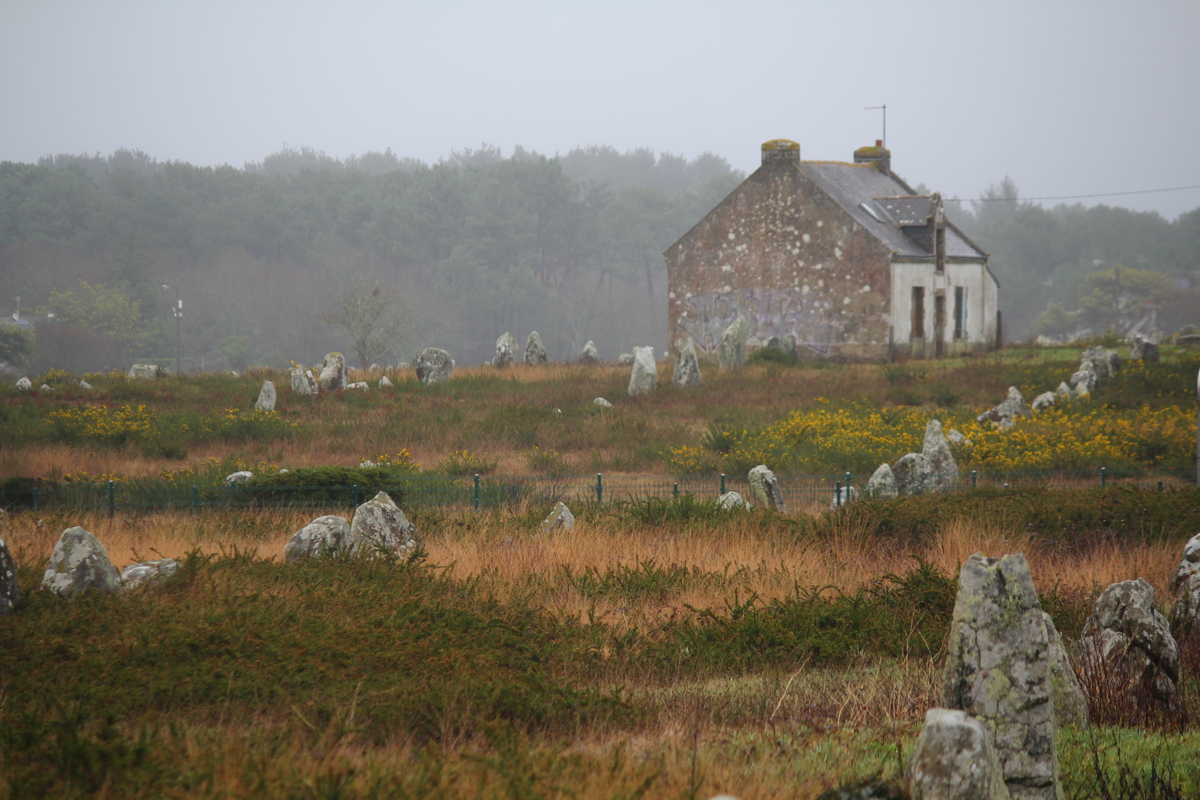
The finding does not rest on intuition or on a simple stylistic comparison, but on a converging body of scientific measurements. It confirms what several archaeologists had suspected for decades: the Atlantic seaboard, and the bay of Morbihan in particular, played a pioneering role in the invention of monumental architecture in stone. Far from being a periphery receiving influences from elsewhere, this region now appears as one of the very first centres of the European megalithic phenomenon.
The NEOSEA project and a dating method of unprecedented precision
The study is the outcome of the NEOSEA research project, led by archaeologist Bettina Schulz Paulsson at the University of Gothenburg, in Sweden, in collaboration with the preventive archaeology company Archeodunum and the University of Nantes2. This French-Swedish cooperation brings together specialists of the Atlantic NéolithiqueNeolithicThe "New Stone Age": a period marked by farming, herding, settlement and pottery, from around 10,000 BC.→, geoarchaeologists and statisticians around a shared goal: to set the monuments of Carnac within a reliable chronology, freed from the approximations that had surrounded them until now.
At the heart of the approach lies datation au radiocarboneRadiocarbon (carbon-14)A dating method based on the decay of carbon-14, usable back to about 50,000 years.→, a technique that measures the decay of carbon 14 contained in organic material in order to estimate its age. Taken in isolation, each measurement carries a margin of uncertainty. But the researchers combined their forty-nine dates with Bayesian statistical modelling, a mathematical approach that integrates the stratigraphic relationships between samples in order to narrow the time ranges considerably. By cross-referencing data drawn from charcoal, sediments and buried remains, the team was able to propose an estimate of a fineness rarely achieved for monuments of such antiquity.
This statistical work was paired with excavations carried out to the standards of contemporary archaeology. The soil layers were analysed with care, the samples documented in their exact context, and each structure placed within a sequence of occupation. It is this methodological rigour that gives the conclusion its strength: this is not a single, fragile date, but a chronological model built on a coherent body of evidence.
Le Plasker: a key site beneath the modern town
The area studied is called Le Plasker, located in Carnac itself, not far from the most visited alignments. This ground was the subject of a preventive excavation, ahead of a development project, which allowed archaeologists to explore methodically a space that is normally inaccessible. Beneath the surface, they uncovered the traces of a vast monumental landscape that has now vanished.
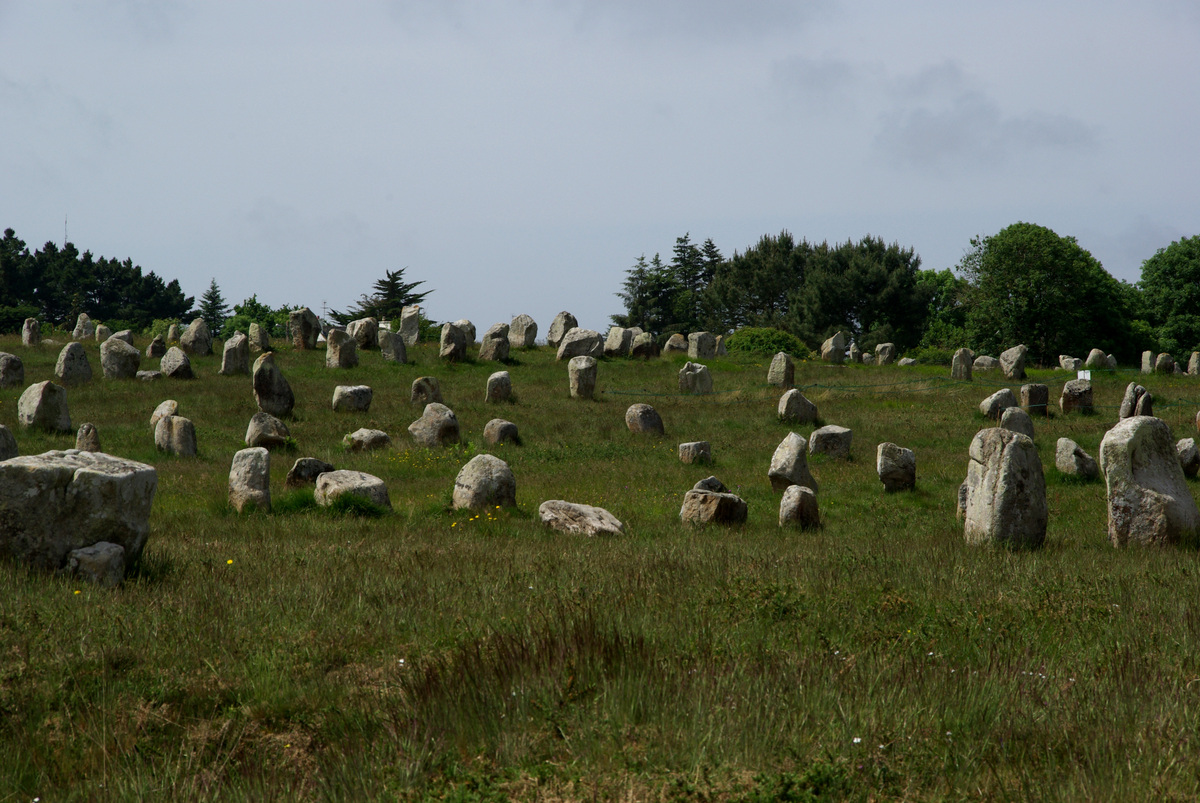
For the stones themselves, in this particular area, were removed long ago. What the excavators found were their packing pits: the cavities dug into the ground to wedge and hold each raised block upright. These negative imprints, often overlooked, prove to be of inestimable value. They preserve the memory of the exact placement of the monuments, the arrangement of the rows, and above all the organic material trapped when the stones were erected, which provides ideal anchor points for radiocarbon dating. Thanks to them, archaeologists were able to reconstruct a plan that the disappearance of the blocks seemed to have erased forever.
This configuration illustrates a reality of the Breton ground that is often forgotten: a significant proportion of the original menhirs were moved, reused or destroyed over the centuries, to build walls, clear fields or erect buildings. Modern archaeology learns to read these absences as much as the presences, and to reconstruct entire complexes from faint traces.
More than a thousand years before Stonehenge
The range of 4600 to 4300 BC, obtained for the building of the Plasker rows, takes on its full meaning when compared with the great contemporary or later monuments. Stonehenge, in southern England, whose first construction phases are generally placed around 3000 BC, then appears as a far more recent monument3. The gap exceeds a thousand years, a considerable span that invites us to rethink the place of Carnac in the history of prehistoric European societies.
This precedence is not merely a chronological curiosity. It means that the Neolithic communities of the bay of Morbihan mastered the extraction, transport and erection of blocks weighing several tonnes at a time when, elsewhere in Europe, such architecture was still unknown or in its infancy. Raising a menhir implies collective organisation, planning, a coordinated workforce and a strong symbolic intention. That such capacities existed so early on the Breton coast forces us to reassess the level of social complexity of these populations.
The comparison must nevertheless be handled with nuance. Stonehenge and Carnac are not monuments of the same nature: one is a circular arrangement of raised stones and lintels, the other a linear deployment of menhir rows over long distances. Bringing them together mainly serves to set a temporal marker that speaks to a wide audience. The true significance of the study lies less in the race for a record than in the demonstration of a remarkable earliness of Atlantic megalith building.
Stone rows tied to fire
One of the most original contributions of the research concerns the role of fire in the layout of the site. The packing pits of the standing stones were not found in isolation: in the ground, they were associated with hearths and cooking pits. This systematic proximity suggests that the erection of the menhir rows was accompanied by fire-related activities, whether communal meals, ritual gestures or practices still poorly understood.
This discovery enriches our picture of megalith building. Too often, the alignments are imagined as frozen, purely monumental structures. Yet the data from Le Plasker offer a glimpse of living places, where the raising of stones was part of a series of gestures, gatherings and successive arrangements. The hearths may mark the moments of collective labour, the celebrations accompanying the setting of the blocks, or recurring ceremonies on a space invested with meaning.
Methodologically, this association was precious. The charcoal from the hearths and cooking pits constitutes prime samples for radiocarbon dating, because it often corresponds to punctual events, brief in time. By linking these combustion structures to the neighbouring packing pits, the researchers were able to anchor the chronology of the whole firmly, while documenting the social and ritual dimension of the site.
The bay of Morbihan, cradle of European megalith building
Beyond the single case of Le Plasker, the study confirms the singular status of the bay of Morbihan in the history of megalith building. This region concentrates an exceptional density of monuments: the alignments of Carnac, but also great broken menhirs such as the one at Locmariaquer, tumuli, cairns and funerary mégalitheMegalithA large stone raised or assembled by humans (menhir, dolmen, stone circle), typical of the Neolithic and Bronze Age.→s. The convergence of recent dates tends to make this coastline one of the oldest known megalithic regions, if not the oldest.
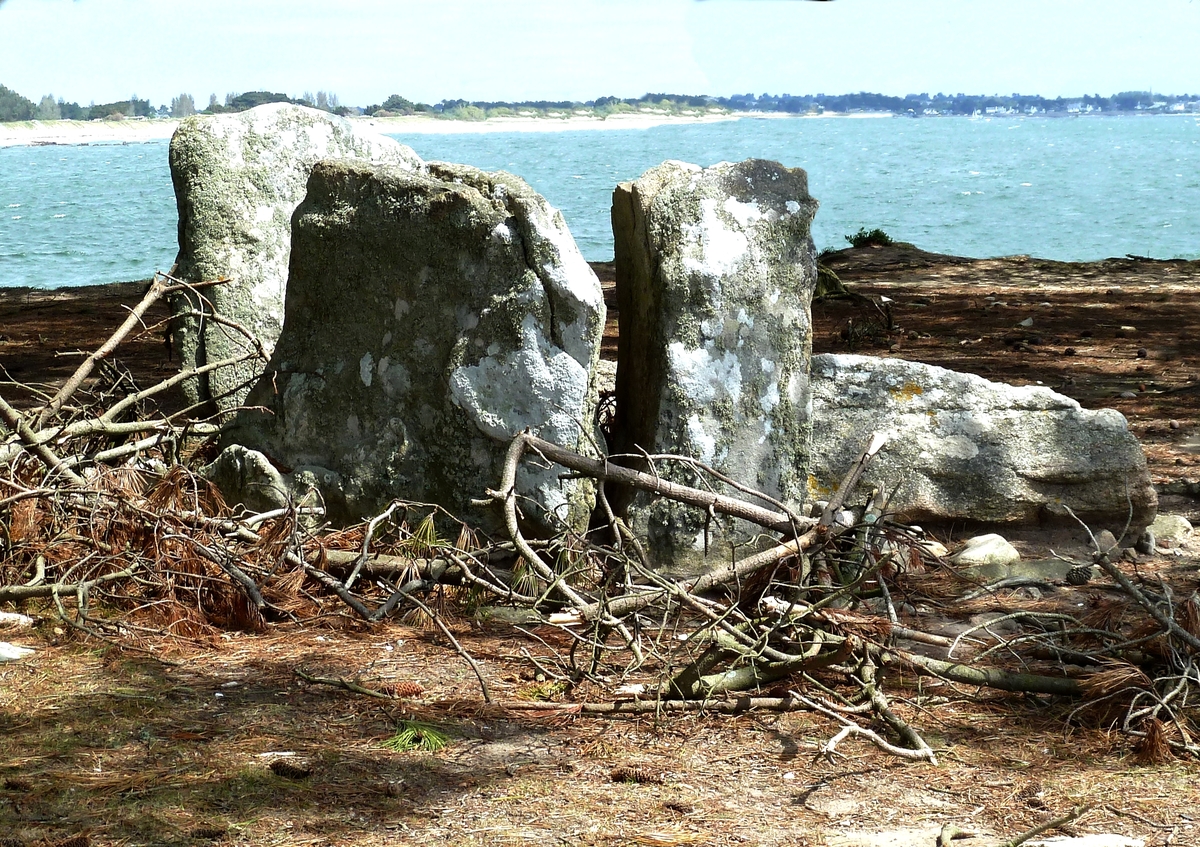
This observation is part of a long-running scientific debate on the origin and diffusion of megaliths in Europe. For a long time, it was assumed that the idea of building in great stones might have arisen in a single region before spreading through contacts and migrationsMigrationsLong-distance movements of populations; a major driver of human history (the exit from Africa, the peopling of continents, Neolithic and steppe expansions).→ along the Atlantic coasts. The work carried out within the NEOSEA project, by establishing a fine and early chronology for the Morbihan, provides weighty arguments for the hypothesis of a major Atlantic centre, from which the phenomenon may have radiated towards other regions.
The Neolithic landscape of the bay was not limited to rows of standing stones. It combined funerary spaces, commemorative monuments and gathering places, in a coherent whole that testifies to a society capable of ambitious collective projects. Dolmens and passage tombs, often covered by mounds, accompanied the alignments to compose a territory deeply marked by the presence of the dead and by the memory of ancestors.
Caution, nuance and debates to come
Spectacular as they are, these results call for a few precautions. First, Carnac cannot be reduced to a single phase of construction. The site brings together thousands of menhirs erected over a very long span, across several centuries or even millennia. The dating of 4600 to 4300 BC concerns a precise area, that of Le Plasker, and does not apply mechanically to the entirety of the alignments. Some of the stones visible today may be later.
Second, the phrase "the oldest megaliths in Europe" must be understood as "among the oldest". The research does not claim to close definitively the question of the very first megalithic monument on the continent, a task made difficult by the disappearance of many remains and by the uncertainties that persist elsewhere. It does establish, however, with new solidity, that the Morbihan stands in the front rank chronologically of the phenomenon4.
These nuances take nothing away from the importance of the study. By giving Carnac a precise temporal framework, it transforms a famous but chronologically vague site into a fundamental landmark for understanding the beginnings of monumental architecture. It also recalls the value of preventive archaeology, capable of revealing, beneath grounds destined for development, entire swathes of human history. The coming years, with new excavations and new dates, will no doubt refine still further the portrait of this bay which saw the birth, more than six thousand five hundred years ago, of one of the oldest monumental traditions in Europe.
C'est accessible mais pas simpliste. Parfait pour quelqu'un comme moi qui débute.
La taille du silex, la fabrication d'outils, les premières constructions... directement lié à mon métier.