Two violent deaths against the rampart of a vanished city
Roughly 2,200 years ago, in the final decades of a fortified town in central Spain, two men met brutal deaths and were then laid side by side against the defensive wall of their city, surrounded by six deer antlers. No pit, no urn, no grave goods, no funerary stele. None of what their people's custom prescribed for the dead. This silent deposit, uncovered in 2010 at the site of Cerro de las Cabezas near Valdepeñas, in the province of Ciudad Real, has just yielded its secrets to a team of anthropologists and isotope specialists whose study was published in 2026.1
What this funerary scene tells is anything but ordinary. In the Iberian world of the Iron AgeIron AgeThe last period of protohistory (from c. 1200 BC in Europe and the Near East), marked by iron metallurgy and the first kingdoms.→, the dead were not buried intact: they were burned. Cremation, followed by the deposit of the ashes in an urn within a necropolisNecropolisA large organised burial ground, a "city of the dead", often spanning several periods.→, had been the rule since the sixth century BCE. Yet these two men were not cremated. They were laid directly on the ground, in a carefully considered order, with antlers slid above and below them. One bore the mark of a fatal blow to the thigh; the other had been decapitated, his head placed forty centimetres from his body, resting on his own arm.
Archaeologists use an expression to describe this kind of anomalous funerary treatment: the "bad death"‘Bad death’An archaeological concept for the funerary treatment of those who die violently or outside social norms: denial of the usual rites, deposition apart from the community, sometimes as a warning.→. It covers those cases in which individuals who die violently, or who are seen as dangerous, undesirable or impure, are denied the rites granted to other members of the community. What Cerro de las Cabezas reveals may be one of the most elaborate stagings of this phenomenon ever documented in protohistoric Iberia. This article retraces the discovery, describes what the bones and teeth could say about these two interrupted lives, and attempts to place this enigmatic scene within the broad context of Iberian societies on the eve of their disappearance under the domination of Rome.
It must be stressed from the outset how much patience this reading required. The remains were uncovered as early as 2010, but it was only after long years of examination, cross-referencing anatomy, taphonomy (the study of what becomes of bodies after death) and geochemistry, that the team could propose a coherent scenario. Between the excavation and the 2026 publication, it was necessary to document the position of every bone, analyse the marks left on the bones by weapons, take samples of teeth and collagen, and confront all of this with the few available comparisons. It is this meticulous accumulation of clues, rather than any sudden revelation, that gives the Cerro de las Cabezas deposit its demonstrative force. Nothing in what follows belongs to novelistic reconstruction: every assertion rests on a material observation, and where the material falls silent, the study stops and the hypothesis begins, clearly signalled as such.
Cerro de las Cabezas, an Oretani town on the edge of the Meseta
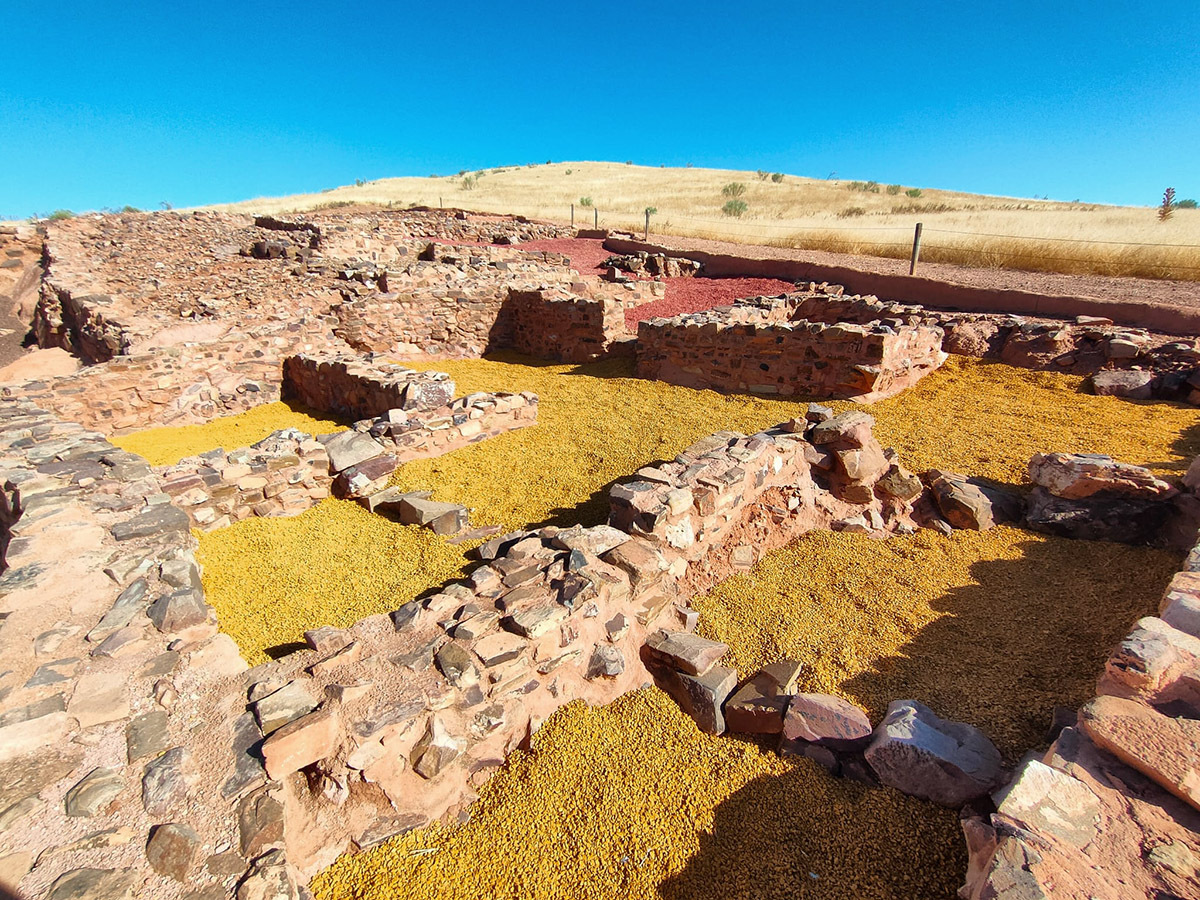
Before it was a two-thousand-year-old crime scene, Cerro de las Cabezas was a town. An oppidumOppidumA large fortified settlement of late Iron Age Celtic Europe, set on high ground and walled; the first form of town north of the Mediterranean.→, to use the term archaeologists borrow from Latin: a fortified, hilltop, densely built settlement, equipped with ramparts, streets, residential quarters and storage spaces. The site rises on a hill in the southern Meseta, the high central plateau of the Iberian Peninsula, some 185 kilometres south of Madrid, not far from present-day Valdepeñas. It was occupied for several centuries during the first millennium BCE and is today one of the best-preserved Iberian sites in the region.
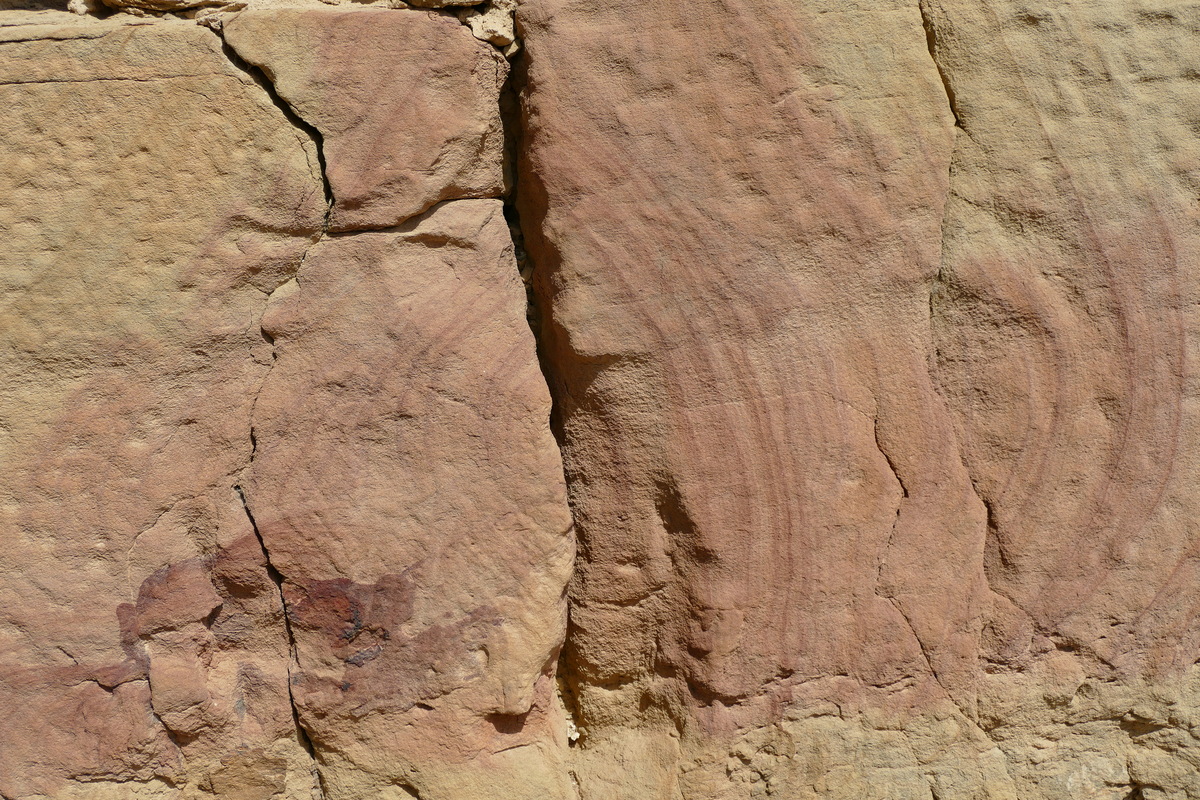
Its inhabitants belonged to the people of the OretaniOretaniAn Iberian Iron Age people occupying Oretania, in the southern Spanish Meseta (modern Ciudad Real and Jaén provinces), before the Roman conquest.→ (in Latin, Oretani), one of the groups that made up the mosaic of Iberian cultureIberian cultureA set of Iron Age cultures in southern and eastern Iberia (6th to 1st century BCE): fortified towns, writingWritingA system of conventional signs used to fix language or information durably; its appearance (c. 3300 BC) marks, by convention, the end of prehistory.→, sculpture and cremation burialBurialThe intentional deposition of a body, sometimes with offerings; a marker of symbolic behaviour.→.→. The Iberians did not form a unified nation but a set of kindred peoples sharing a language, a script, and artistic and religious traditions, spread across the entire east and south of the peninsula, from Catalonia to Andalusia. The Oretani occupied Oretania, a territory covering roughly the present province of Ciudad Real and its margins, rich in mineral resources and pastures. Their inland position made them a crossroads between the Mediterranean Iberian world and the Celtiberian cultures of the interior.
The town was protected by an imposing defensive system. It was precisely against the southeastern defensive wall of the settlement that the two bodies were laid, a detail that is surely not incidental. Ramparts, in protohistoric societies, were not only military works: they marked out an inside and an outside, a civilised and communal space set against a potentially hostile outer world. To place the dead against this boundary, rather than within a necropolis, is already to situate them symbolically on the frontier of the group, neither quite inside nor quite outside.
We know, from excavations carried out at the site over several decades, that Cerro de las Cabezas was far more than a mere fortified point. The town was organised into quarters, with domestic spaces, grain storage areas, workshops, and signs of a structured religious and communal life. Its defensive monumentality, with its walls and towers, testifies to a society capable of mobilising a substantial workforce and of thinking about urban space over the long term. The Oretani produced and exchanged ceramics here, worked metals, and took part in the trade networks that linked the interior of the peninsula to the Mediterranean coasts, where Greek, Phoenician and then Punic objects circulated. It was therefore not in an isolated hamlet that the funerary scene took place, but at the heart of an organised community, with its hierarchies, its rules and, no doubt, its tensions.
The dating of the deposit, established through the stratigraphic context, places it at the end of the third or the very beginning of the second century BCE, that is, in the last years of the site's occupation. This chronological precision carries weight: it places the scene at a pivotal moment in Iberian history, the one in which the peninsula tipped into the Roman orbit. We shall return to this, for this context of crisis and upheaval may illuminate, though never prove, the fate reserved for these two men.
How the dead were buried in Iron Age Iberia
To grasp how abnormal the Cerro de las Cabezas deposit is, one must first understand what an Iberian burial conforming to custom looked like. And here, precisely, the word "burial" fits poorly, for the Iberians did not bury their dead intact: they cremated them. From the sixth to the first century BCE, cremation was the dominant, almost exclusive, funerary rite across the whole Iberian area.2
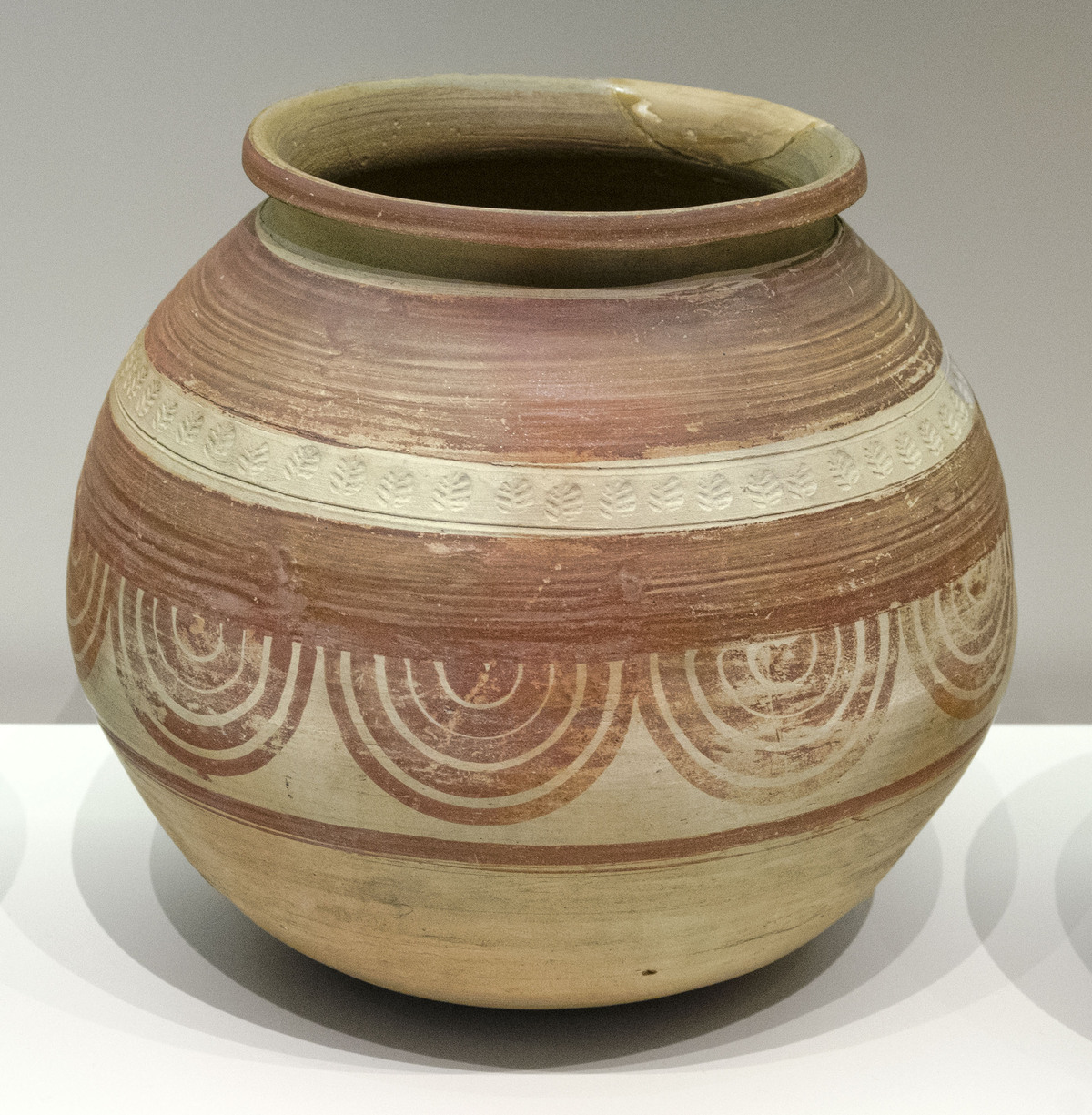
Its unfolding was relatively codified. The body of the deceased was burned on a pyre; the charred remains, bones and ashes, were then gathered, sometimes washed, and placed in a ceramic urn. This urn found its place in a necropolis, a funerary space distinct from the town of the living, often accompanied by grave goods: vessels, weapons, ornaments, everyday objects meant to accompany the deceased. Some elite tombs were topped with monuments, sculptures or stelae, as attested by the great Iberian funerary complexes of the southeast of the peninsula. Death, in this system, was a passage framed by precise gestures, intended to integrate the deceased into the memory and the order of the community.
None of this at Cerro de las Cabezas. The two men were not burned. They were not placed in an urn, nor in a tomb, nor in a necropolis. They were laid directly on the ground, without a pit dug to receive them, without a structure to protect them, without a single object meant to accompany them into the afterlife. Each of these omissions, taken alone, would already be remarkable; their accumulation composes an exceptional picture. These men did not receive the treatment reserved for ordinary members of the community. They were withdrawn from the common rite, and that refusal is in itself a crucial piece of information.
It is worth dwelling on what the Iberian funerary norm said about the society that practised it. Cremation was not merely a technique for treating the body: it was a language. The choice of urn, the richness or sobriety of the grave goods, the location of the burial within the necropolis, the presence or absence of a monument, all of this traced a social geography in which each person found their place according to rank, age, sex and merit. The great Iberian necropolises of the southeast, with their animal sculptures, their stelae and their monumental complexes, show aristocracies eager to display their power even in death. The funerary rite was thus a way of reproducing and perpetuating the order of the world of the living in that of the dead.
From then on, to take an individual out of this system is to take them out of order itself. Not to burn a body, not to give it an urn, not to admit it into the necropolis, is to refuse to count it among the ancestors, to refuse to grant it the place society reserved for its members. The gesture is all the weightier for being deliberate and costly: it would have been simpler to treat these men like the others. That someone took the trouble to treat them otherwise, and to stage that treatment with such care, indicates that their exclusion had a precise meaning for the community, a meaning we are still seeking to decipher.
For a deviant funerary treatment is never a matter of chance. In ancient societies, the way a corpse is disposed of reflects the status of the deceased, the nature of their death, and sometimes the way the living regarded them. To deprive someone of the normal rites is to perform a strong social act: it designates them as different, sets them apart, and possibly punishes them or guards against them. This is the whole stake of the notion of "bad death", which the Cerro de las Cabezas discovery illustrates in spectacular fashion.
Individual A: the survivor killed by a blow to the thigh
The first of the two men, designated by the researchers as "Individual A", was between thirty-five and forty-five years old at the time of his death. His skeleton tells a story of violence that did not play out in a single instant but was inscribed over time. Anthropological examination revealed that he had survived an earlier trauma: a violent blow to the forehead, a few weeks before his death. The cranial wound had begun to heal, a sign that the man had lived long enough after the shock for the bone to begin rebuilding itself.3
The cause of death, for its part, leaves little room for doubt. Individual A was killed by a powerful gash, delivered by a sharp weapon, to the right femur. The blow was deep enough to sever the large blood vessels that run along the thigh, causing massive and rapidly fatal haemorrhage. The most chilling detail is provided by the bone itself: the weapon lodged in the femur with such force that it left a clean notch there, before being withdrawn. Here we hold the gesture, frozen in bone matter, of a deliberate assault of extreme brutality.
What can be said of this man's life before his violent end? His bones bear marks evoking long, repeated walks, a muscular and articular strain compatible with a mobile way of life. The researchers advance, with due caution, the hypothesis that he may have been a herder or a shepherd, accustomed to covering long distances behind his flocks. This is only one possible reading of the skeletal evidence, not a certainty: the same marks could result from other ways of life. But the image of a man accustomed to roads, high pastures and transhumance rejoins, in a troubling way, the symbolism of the deer that accompanies him in death, that great animal of the wild spaces and the margins of the cultivated world.
The blow to the femur deserves a pause, for it says a great deal about the nature of the killing. To slash a man's thigh to the bone, deep enough to sever the femoral artery, is not the gesture of a confused brawl or an accident. It is a blow struck with force and, probably, with the intention to kill, or at least to inflict a wound known to be potentially fatal. The femoral artery, when opened, causes death by haemorrhage within minutes. That the weapon lodged in the bone before being wrenched out suggests an impact of great violence, perhaps repeated. One easily imagines the scene: a man pinned down or on the ground, struck on the leg by a heavy blade, bleeding out while no one could, or would, come to his aid.
The combination of these two traumas, one survived, the other fatal, sketches a destiny. Here is a man who, a few weeks before dying, had already faced violence and narrowly escaped it. The wound to the forehead could bear witness to a confrontation, a capture, an inflicted punishment, before death caught up with him through a blow to the leg. We know nothing of the link between these two episodes. But their succession suggests a tormented trajectory, that of a man caught in a spiral of violence whose outcome was his deposit at the foot of the rampart. Should we see in him a captive first beaten, then kept for a few weeks before being executed? A man condemned at the end of a judgment? A defeated and humiliated enemy? The bones say no more, and it would be imprudent to decide. But they impose one certainty: this man's death was violent, inflicted by another, and preceded by another act of violence whose mark he still bore.
Individual B: the head resting on the arm
The second man, "Individual B", was older: between forty and fifty-nine years. His case is, if possible, even more striking than that of his companion in misfortune, for it concerns the most meaning-laden gesture in the whole history of funerary rituals: decapitation. Individual B was decapitated, his head separated from the rest of the body by a violent intervention that occurred just before or just after death.
The anatomical evidence here is remarkably precise. At the time of burial, the skull, the jaw and the upper cervical vertebrae were still connected to one another by soft tissue: in other words, the head formed a coherent anatomical block, decapitated while the flesh still held the bones together. This head was placed about forty centimetres from the body, at the top of the deposit, resting on the deceased's left arm. A position of strange gentleness, almost that of a sleeper, for a man whose neck had just been cut.
This detail of position is decisive. The anthropologists who studied the deposit stress that no natural post-burial movement, no collapse of the tissues, no settling of the sediment could have brought a head to lie thus, at a distance from the trunk and set upon the arm. The only possible explanation is that of a deliberate gesture: someone detached the head and placed it there, intentionally, with care. We are not before an accident of preservation, but before a composition, a staging conceived by human hands.
The severed head is no trivial motif in Iron Age Iberia, nor, more broadly, in the protohistoric cultures of Western Europe. Among many Celtic and Iberian peoples, the head was regarded as the seat of vital force, of identity, even of the soul. Ancient sources and archaeology attest to practices of taking and displaying the heads of enemies, at once war trophies and objects charged with magical or apotropaic power. Without mechanically transposing these traditions to the specific case of Cerro de las Cabezas, this cultural background gives the decapitation of Individual B a particular resonance: it belongs to a mental universe in which the head carried considerable symbolic weight.
Ancient authors, notably when describing the Iberian and Celtic peoples, evoke warriors who brought back the heads of their vanquished adversaries, sometimes nailed them to the walls of their houses or displayed them during ceremonies. Iberian iconography itself, on certain painted ceramics and reliefs, offers glimpses of scenes in which the severed head occupies a place of honour. Whether this motif was purely martial, properly religious, or both at once, it makes the head a thing apart, charged with a power that had to be mastered, displayed or neutralised. In this frame, to place the head of Individual B at the top of the deposit, carefully set upon his arm, is no random gesture: it may be a way of controlling it, of putting it on show, or of warding off what it represented.
One question remains, to which the study cannot answer: was the decapitation the cause of death, or a gesture performed on a body already lifeless? The anatomical evidence situates the intervention just before or just after death, without allowing us to decide. If the head was cut off to kill, we are before a formal execution. If it was cut off after death, the decapitation then belongs to a post-mortem treatment, a manipulation of the corpse for ritual or demonstrative ends. In either case, the result is the same: a body deprived of its integrity, a head separated and then reunited with the deposit according to a logic that escapes our immediate understanding.
Six deer antlers: an enigma without equal
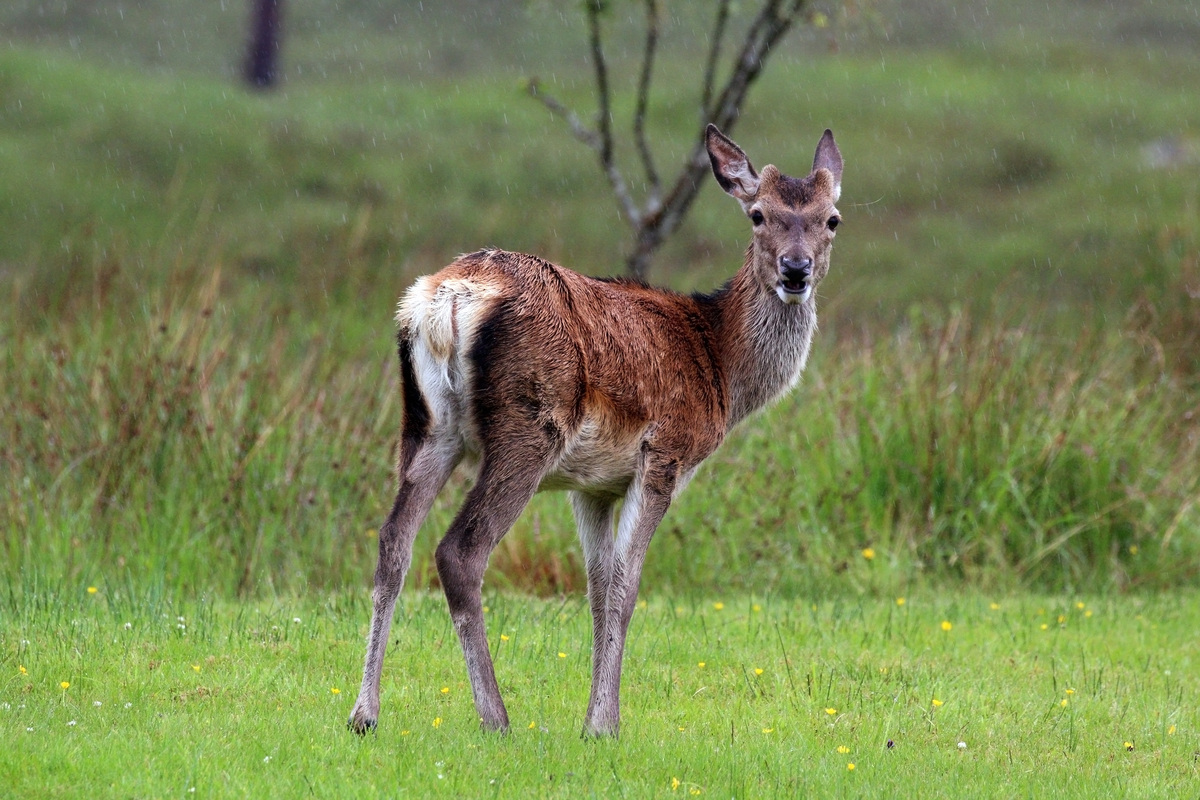
If the traumas of the two men tellTellAn artificial mound formed by the accumulation of successive layers of settlement remains at the same spot, typical of the Near East. Each destruction-rebuilding event adds a stratum.→ of the violence of their deaths, it is the deer antlers that make this deposit a genuine archaeological enigma. Six antlers of the red deerRed deer (Cervus elaphus)A large European deer whose males bear branching antlers renewed each year; the antlers, both raw material and symbol, feature in many proto-historic ritual deposits.→ (Cervus elaphus) accompanied the bodies, some exceeding a metre in length. They were not thrown in haphazardly: some are found above and others below the remains, integrated into the very structure of the deposit.4
The red deer was far more than mere game in protohistoric societies. Its antlers, which the animal sheds and renews each year, held a double value, both utilitarian and symbolic. Utilitarian first: antler is a hard, dense and easily worked material, from which tool handles, points, awls, harness elements and various objects were made. Symbolic next: through its majestic rack, which regrows cyclically, the deer embodied in many ancient cultures renewal, power, virility, sovereignty over the wild spaces. To possess or handle its antlers could be a matter of prestige as much as of practice.
Deposits of deer antlers are in fact known elsewhere, notably in Celtic and Celtiberian contexts, where they have been found buried beneath walls and buildings. Archaeologists generally see in them foundation or protection offerings: these meaning-laden elements were deposited at the moment a construction was raised, to place the edifice under a form of supernatural guard, or to sealSealA small engraved object (often steatite) used to stamp a mark in clay; the Indus seals, bearing animals and signs, attest to administration and trade, though their script remains undeciphered.→ a pact with the powers of the place. This parallel is valuable, for it shows that the association between deer antlers and protective ritual gestures did indeed exist in the protohistoric world of the peninsula and its margins.
The figure of the deer runs, moreover, through the whole imaginary of the ancient societies of Western Europe. An animal of forests and borderlands, it appears on coins, stelae and ornaments, associated now with the hunt, now with deities of the wild spaces. In certain traditions, the deer is an intermediary between worlds, a guide, a psychopomp capable of leading souls. Its rack, which falls and regrows with the seasons, made it a natural symbol of the cycle of death and rebirth. Nothing proves that the Oretani of Cerro de las Cabezas shared precisely these meanings, but the recurrence of the deer as a symbolically charged animal, over a vast geographical and cultural area, makes its emphatic presence around our two dead men all the more intriguing.
But, and here lies the exceptional character of Cerro de las Cabezas, no known Iberian parallel associates deer antlers with human bodies in this way. The antler deposits documented so far concern the foundations of buildings, not human remains. Here, the antlers literally envelop the two dead, taking part in an ensemble that mingles lethal violence, funerary exclusion and animal symbolism. This singularity forbids any overconfident interpretation: we are before a gesture to which we do not hold the key, an unprecedented combination that made sense to those who carried it out, but whose logic still largely escapes us.
Should we read the antlers as an offering meant to accompany the dead, as a protective device sealing the rampart, as a mark of infamy, or as all of these at once? The comparison with Celtiberian foundation deposits argues for the protective and apotropaic dimension: by burying these meaning-laden antlers against the wall, together with two violent deaths, the community may have sought to reinforce its defence symbolically, to turn a potentially harmful force into a benevolent guard. But the association with human remains, unprecedented, adds a layer of meaning that the parallels do not suffice to illuminate. It is precisely this absence of a model that makes Cerro de las Cabezas a textbook case: a deposit that forces researchers to reason without a net, to confront converging clues without being able to lean on an identical precedent.
The sequence of the deposit, gesture by gesture
One of the most valuable contributions of the anthropological study was to reconstruct, from the relative position of the bones and the antlers, the exact order in which the scene was composed. For this deposit was not improvised: it obeys a choreography, a succession of considered gestures that betrays an intention and a ritual know-how.
The sequence begins with the placing of several deer antlers, arranged at the bottom, forming a kind of bed or base. Onto this first foundation was then laid the body of Individual A, the man with the severed femur. Then came the body of Individual B, the decapitated man, arranged in such a way that it partly covered the first. This superposition is not neutral: it indicates that the two men were treated in the same moment, during one and the same event, and not in successive burials separated by time.
Once the two bodies were in place, further deer antlers were added on top, completing the animal envelope that surrounds the dead. Finally, as a last gesture, the head of Individual B was carefully positioned at the top of the deposit, forty centimetres from his body, resting on the left arm. This crowning of the scene with the severed head is in no way accidental: it constitutes the culmination of a ritual, the climax of a composition each element of which was placed by design.
This reconstruction radically transforms our reading of the discovery. We are not before two abandoned corpses, nor before an emergency pit dug in haste. We are before a planned act, carried out by people who knew what they were doing and why they were doing it. The care given to the arrangement, the alternation of bodies and antlers, the final disposition of the head: everything signals a strong ritual intention. It remains to understand which one. And it is here that the laboratory analyses come to provide, if not answers, at least precious clues.
What the isotopes say: two lives, two histories
To go beyond what the bones reveal to the naked eye, the team turned to the analysis of stable isotopesStable isotopesNon-radioactive forms of an element (carbon, nitrogen, oxygen) whose ratios in bone and teeth reveal an individual's diet, mobility and geographic origin.→, a method that exploits the minute chemical variations recorded by the tissues over the course of a life. Bones and teeth preserve the isotopic signature of the food and water consumed by an individual. By measuring the ratios of carbon (δ13C), nitrogen (δ15N) and oxygen (δ18O) in the remains of the two men, the researchers were able to open a window onto their diet and their geographical origin.
The results concerning diet sketch, for Individual A, the portrait of a man well nourished in animal protein. The carbon and nitrogen values indicate a diet rich in animal-derived products, and this signature remains stable from adolescence to adulthood. In other words, the man benefited throughout his life from a quality diet, which does not necessarily fit the image of an outcast or a starving captive. This datum accords, moreover, with the hypothesis of a way of life tied to herding, in which access to animal resources is direct and regular.
The oxygen analysis, for its part, opens a different and fascinating avenue. δ18O reflects the isotopic signature of the waters an individual has drunk, which varies according to geography, altitude and climateClimateThe long-term average atmospheric conditions of a region; its variations (glaciations, aridifications) shaped migrations, agriculture and the collapse of prehistoric societies.→. And the two men present distinct values: they did not drink, over the course of their childhood and their lives, waters of the same signature. This means that they lived different geographical histories, that they did not share the same life trajectory. Two strangers, perhaps, brought together in death by a common fate.
It is worth briefly explaining why these methods work. The carbon and nitrogen we ingest through our food end up, in the form of isotopes in varying proportions, in the collagen of our bones and the substance of our teeth. A diet rich in meat, fish or dairy leaves a high nitrogen signature; a plant-based diet leaves a lower one. As for the oxygen of the water we drink, its isotopic composition depends on the water cycle, which is itself tied to latitude, altitude and temperature: drinking from a mountain spring does not leave the same imprint as drinking from a coastal plain. By reading these signatures in the teeth, which form during childhood, and in the bones, which renew themselves in adulthood, one can reconstruct fragments of the dietary and geographical history of an individual dead for two thousand years.
One must, however, take care not to go too far in interpretation, and the study itself calls for caution. Although the oxygen signatures differ between the two men, both nonetheless remain within the range of local values. In other words, the isotopic analysis does not allow us to affirm that these men were foreigners come from distant lands. They could perfectly well have been from the region, while having grown up in microterritories with slightly different waters. The temptation to make of these two dead men enemies captured far away, or sacrificed travellers, here runs up against the rigour of the data: science invites us to retain the most measured conclusion, that of two distinct trajectories, without settling the question of origin.
This caution is exemplary of the scientific approach at work. It would have been tempting, and no doubt more spectacular, to conclude that the two men were foreigners, enemies come from elsewhere, sacrificed against the rampart of a town that was not their own. The data forbid this shortcut. They show only two distinct life histories, two men who did not grow up in exactly the same place, but who could just as well have belonged to the region, or even to the town. This restraint is precious, for it reminds us that the archaeology of violent death is not a detective novel in which everything is resolved on the last page: it is an art of nuance, in which certainties are counted and in which uncertainty, far from being a failure, is an integral part of the result.
The "bad death": to punish, to warn, to protect
How to tie together all these threads, the traumas, the exclusion from the necropolis, the deposit against the rampart, the deer antlers, the carefully arranged head? The authors of the study propose an interpretive framework that gathers these scattered elements under a single concept, that of the "bad death", the mala muerte of Hispanists, the bad death of English-speaking anthropologists.
This notion covers a fact observed in many cultures across the world: not all deaths are equal, and not all confer the right to the same rites. Certain circumstances, violent death, death outside social norms, the death of persons judged dangerous, criminal, impure or accursed, entail a specific funerary treatment, marked by the deprivation of the usual honours. The "bad" dead person is not integrated into the community of ancestors; they are set apart, sometimes neutralised by gestures intended to prevent their return or to contain their harmful power. The refusal of the normal rite is not an oversight: it is a positive act of distancing.
Violent deaths, exclusion from the communal necropolis, deposit against the rampart, symbolic antlers: each of these traits, gathered into a single gesture, signals what archaeologists call a "bad death", in which the dead who fall outside the norms are deprived of the rites granted to others.
Applied to Cerro de las Cabezas, this reading illuminates the whole scene. The two men died violently, one killed by a blow to the thigh after surviving an earlier trauma, the other decapitated. They were excluded from the necropolis and deprived of cremation, those gestures that made a deceased person a full member of the community of the dead. They were laid at the edge of the town, against the rampart, in that frontier-space between inside and outside. And they were surrounded by deer antlers, those objects charged with a ritual value attested in foundation and protection deposits. Everything conspires to make this deposit a unique and planned event, radically distinct from an ordinary burial.
Two functions, not mutually exclusive, may be envisaged for such a deposit. The first is that of public warning. To place these mutilated bodies in a visible spot, against the wall of the town, could deliver a message to the living: this is the fate of those who transgress, of those who threaten, of those who are vanquished. The second function is that of ritual protection. By sealing against the rampart two violent deaths wrapped in symbolic antlers, the community may have sought to ward off a danger, to place the town under a supernatural guard, to turn the violence suffered or inflicted into a protective force. These two readings do not oppose one another; they might even complement each other, the warning addressed to men reinforcing the protection sought from the invisible powers.
An enigmatic scene on the eve of Rome
It remains to situate this event in its time. The dating of the deposit, to the end of the third or the beginning of the second century BCE, coincides with one of the most violent moments in the history of the Iberian Peninsula: the Second Punic War and the beginning of the Roman conquest of Hispania. Between Carthage and Rome, the Iberian peoples were caught in a whirlwind of alliances, betrayals, military campaigns and destruction. It was in these decades that many oppida were abandoned, destroyed or subjugated, and Cerro de las Cabezas, whose deposit belongs to the last years of occupation, is no exception.
A word about this period clarifies the stakes. From 218 BCE onward, the Second Punic War turned the Iberian Peninsula into a battlefield between Rome and Carthage. The Iberian peoples, Oretani included, found themselves caught between two powers that recruited, taxed, requisitioned, punished defections and rewarded those who rallied to their side. The Roman victory then opened two centuries of gradual conquest, made of campaigns, sieges, crushed revolts and towns destroyed or subjugated. Many Iberian oppida did not survive this upheaval: they were abandoned, burned, or emptied of their populations in favour of new foundations. Cerro de las Cabezas fades out precisely within this chronological window, and its anomalous funerary deposit belongs to its final years of existence.
This context of crisis proves nothing as to the precise fate of the two men, but it constitutes its probable backdrop. In a town threatened, besieged, or already on the way to abandonment, internal and external tensions could exacerbate violence, multiply captives, presumed traitors, scapegoats. A protection ritual intended to save the city, or an exemplary punishment addressed to enemies or transgressors, takes on particular relief in such a climate of insecurity. The "bad death" of Cerro de las Cabezas could thus be a symptom of this troubled era, though nothing allows us to affirm it.
For it must be said again, and forcefully: the essential remains uncertain. We do not know who these two men were. Were they inhabitants of the town, punished for a crime or a betrayal? Enemies captured in a confrontation? Prisoners, hostages, sacrificial victims? The isotopic analyses, as we have seen, do not allow us to call them foreigners with certainty, but do not exclude it either. The exact circumstances of their execution, the precise ritual to which they were subjected, the beliefs that motivated it: all of this remains, for the most part, beyond our reach.
What Cerro de las Cabezas offers us is not a closed answer but a window thrown wide open onto the complexity of the relations that protohistoric societies maintained with death, violence and the sacred. Two men killed, excluded, wrapped in deer antlers and sealed against a wall, at the dawn of the disappearance of their world: the scene has the power of a dark poem and the mystery of a riddle from which we shall always be missing a few lines. As the methods of archaeology and biochemistry are refined, further discoveries may come to illuminate these enigmatic gestures. In the meantime, the two men of Cerro de las Cabezas continue to speak to us, from the foot of their rampart, of a time when death knew how to be a terribly serious affair.
Passionnant. J'avais jamais vraiment creusé ce sujet. Maintenant je veux aller plus loin.
Parfait pour mes élèves de 5e. Je garde cet article en favori pour ma séquence préhistoire.