Between 3,300 and 800 BCE, humanity crossed several decisive thresholds that radically transformed the social, economic and symbolic organisation of human societies: the mastery of metals, the invention of writingWritingA system of conventional signs used to fix language or information durably; its appearance (c. 3300 BC) marks, by convention, the end of prehistory.→, the emergence of the first cities and states, and the establishment of transcontinental trade networks. This period -- conventionally divided into the ChalcolithicChalcolithicThe "Copper Age": a transition between the Neolithic and the Bronze Age, marked by the first copper objects (Ötzi's era).→ (Copper Age, approximately 3,500 to 2,300 BCE), Early (approximately 3,300 to 2,000), Middle (approximately 2,000 to 1,550) and Late Bronze AgeLate Bronze AgeThe final phase of the Bronze Age in the Near East (c. 1550 to 1200 BCE), an age of great empires and international diplomacy, ended by a general collapse.→ (approximately 1,550 to 1,200), then the transition to the Iron AgeIron AgeThe last period of protohistory (from c. 1200 BC in Europe and the Near East), marked by iron metallurgy and the first kingdoms.→ (approximately 1,200 to 800 BCE) -- saw the birth of the great historical civilisations of Sumer, Egypt, Crete, Mycenae, the Indus Valley and China. Their brutal collapse around 1,200 BCE remains one of archaeology's great mysteries.1
The Chalcolithic: the first copper metallurgies
Copper was the first metal to be systematically worked by humans. Its smelting, from oxide ores (malachite, azurite) or sulphides, requires temperatures of approximately 1,085°C and blowing techniques to reach this heat in rudimentary furnaces. The earliest traces of copper metallurgyMetallurgyThe techniques of extracting and working metals (copper, bronze, gold); its rise in the Eneolithic and Bronze Age transformed tools, weapons and social hierarchies.→ date to approximately 6,000 BCE in the Balkans (Vinca and Rudna Glava sites in Serbia) and the Near EastNear EastA region of western Asia (Levant, Mesopotamia, Anatolia, Iran), cradle of the Neolithic revolution, agriculture, the first cities and writing.→ (Çatalhöyük, Turkey). But it is in the 5th millennium that copper metallurgy established itself as a major factor of social differentiation.2
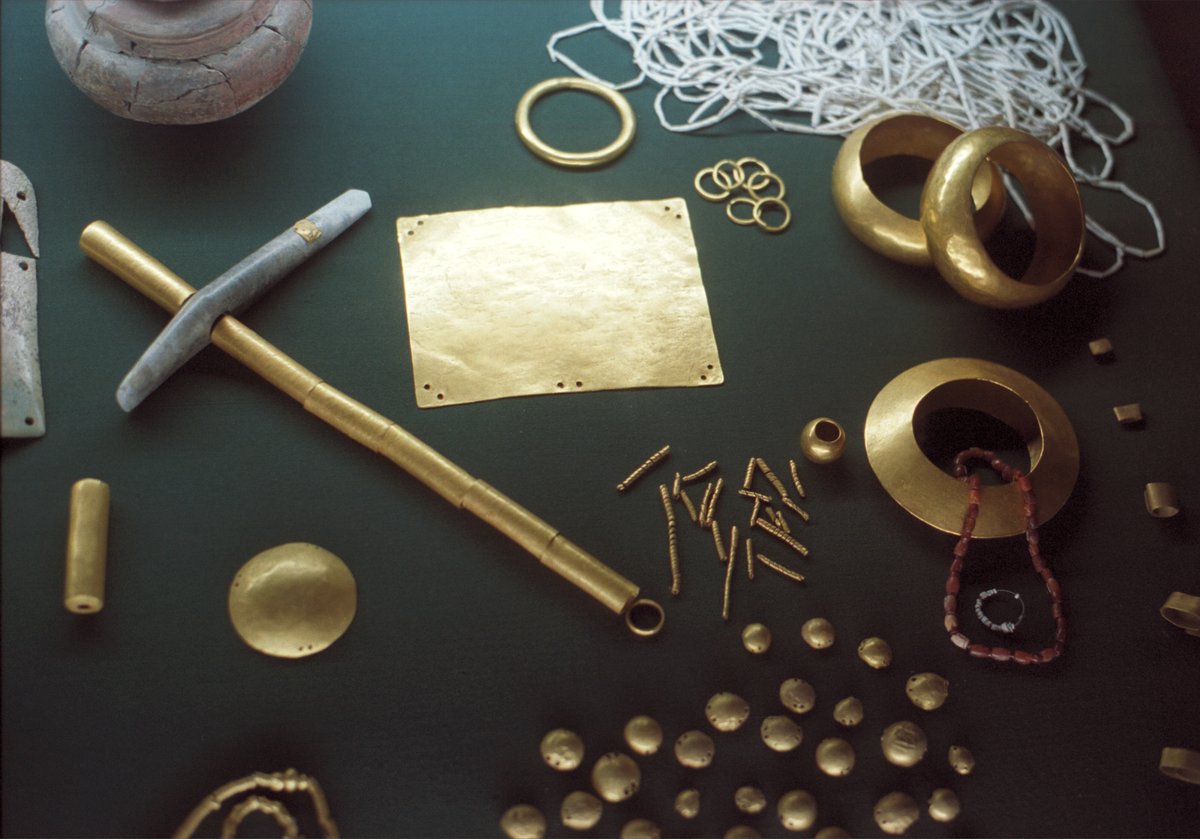
The Varna necropolisNecropolisA large organised burial ground, a "city of the dead", often spanning several periods.→ (Bulgaria, approximately 4,600 to 4,200 BCE), excavated from 1972, constitutes one of the most spectacular discoveries of the world Chalcolithic. Among the 294 explored tombs, some contained stunning quantities of gold objects: grave 43, belonging to a high-status male individual, contained more than 990 gold objects totalling 1.5 kilograms -- the largest known concentration of gold of this era in the world. This concentration of wealth in individual burials is evidence of already advanced social stratification, in which possession of precious metals conferred hereditarily transmissible status. Varna's gold probably came from alluvial deposits in what is now Romania or southern Bulgaria.3
Ötzi, the Iceman discovered in 1991 in the Austrian Alps on the Italian border, is one of the most precious witnesses to European Chalcolithic. Dead around 3,300 BCE, this man of approximately 45 years carried an axe with a blade of arsenical copper, fashioned by cold-hammering -- a technique that hardens metal through work-hardening. His complete equipment reveals sophisticated craft mastery: an unfinished yew bow, a deerskin quiver containing 14 arrows with flintFlintA hard, brittle siliceous rock, knapped by prehistoric people to produce blades, points and sharp tools.→ points, shoes of cork and fur, clothes of deer, chamois and bear hide. Genomic analyses (Keller et al., Nature Communications 2012) reveal that Ötzi was of recent Anatolian origin, with light eyes, dark skin and blood group O+. His death was violent: a flint arrowhead, discovered in his left shoulder in 2001, caused fatal haemorrhage.4
The bronze revolution: alloy, tin and exchange networks
Bronze is an alloy of copper (generally 90%) and tin (approximately 10%), whose mechanical properties are markedly superior to pure copper: harder, less brittle, with a lower melting point (approximately 950°C versus 1,085°C), it is easier to cast in moulds. The difficulty is that copper and tin are rarely found in the same place: tin is only available in a few dispersed geological zones (Devon and Cornwall in England, Erzgebirge in Saxony-Bohemia, Asturias in Spain, Afghanistan, Thailand). This geographic disjunction has two major consequences: it requires long-distance exchange networks, and it confers a considerable strategic advantage on societies that control the tin routes.5
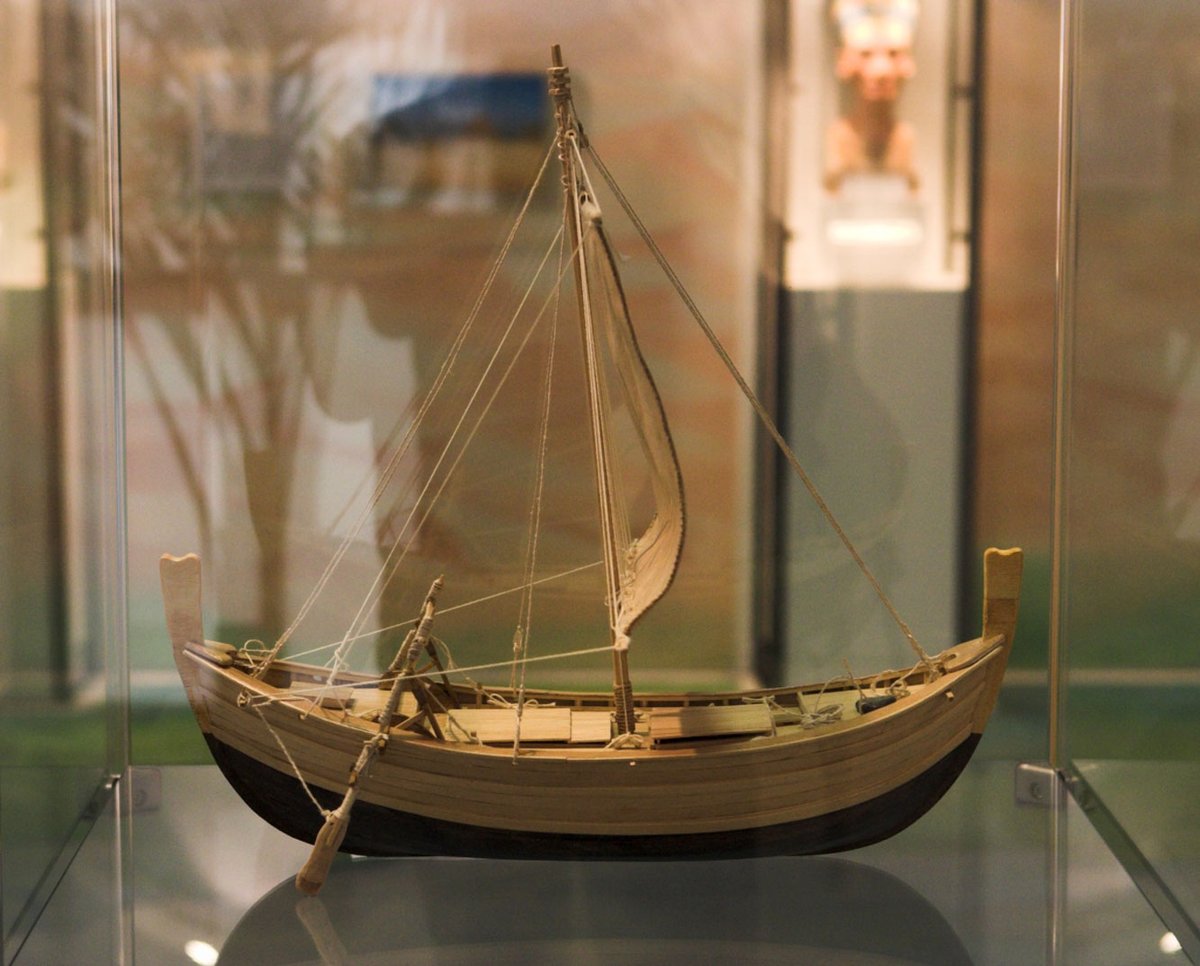
The Uluburun shipwreck (Turkey, Lycian coast), discovered in 1982 and excavated between 1984 and 1994 by Cemal Pulak, offers the most extraordinary window on Late Bronze Age trade (approximately 1,300 BCE). This 15-metre vessel sunk in rough weather carried a cargo of stunning diversity: 10 tonnes of oxhide copper ingots (354 pieces), one tonne of tin ingots, 150 cobalt glass cylinders (provenance: Egypt or Mesopotamia), African ebony, Baltic amber, Greek yew wood, Levantine terebinth resin, hippopotamus tusks, ostrich eggs, elephant and hippopotamus ivory, a hinged wooden writing board with ivory hinge (the oldest known "book"), and Cypriot, Canaanite, Mycenaean, Egyptian and Nubian pottery. The cargo alone summarises the commercial integration of the Mediterranean world in the 14th century BCE.6
The invention of writing: Sumer, Egypt, Crete
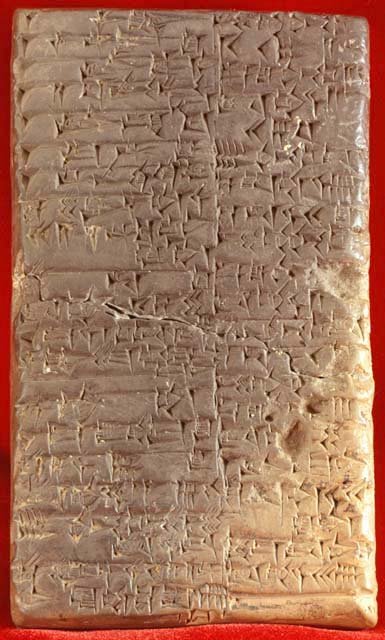
Writing was invented independently in several locations: in Mesopotamia around 3,200 BCE (Sumerian cuneiform writing), in Egypt around 3,100 BCE (hieroglyphics), possibly also in the Indus Valley civilisation around 2,600 BCE (Indus scriptIndus scriptA system of about 400 signs engraved on Harappan seals, tablets and pottery, undeciphered to date for lack of a bilingual text.→, still undeciphered), and in China around 1,250 BCE (oracle bone script). In every case, the first documented uses of writing are economic and administrative: it arises from the necessity of keeping accounts in societies whose complexity exceeds the capacity of human memory.7
Sumerian cuneiform originated at Uruk (present-day Iraq), the world's first great city with an estimated population of 40,000 to 80,000 inhabitants around 3,100 BCE. The first tablets discovered (Uruk layer IVa) contain pictograms recording barley rations distributed to workers identified by their function. Over a few centuries, the system evolved from pictograms to ideograms, then to phonetic signs representing syllables -- an evolution that can be followed step by step in the thousands of tablets discovered at Uruk, Nippur, Lagash and other Sumerian cities. By around 2,500 BCE, cuneiform was capable of expressing the full complexity of the Akkadian language, and the first literary works appeared -- including the Epic of Gilgamesh, the oldest known literary text.8
Linear B, deciphered in 1952 by Michael Ventris (an architect with no linguistic training), is the syllabic script of the Mycenaean palaces of mainland Greece (Mycenae, Tiryns, Pylos) and Crete (Knossos) between 1,450 and 1,200 BCE. The unbaked clay tablets, preserved thanks to the fires that accidentally baked them, record exclusively administrative inventories: herds, oil, wool, slaves, offerings to the gods. Mycenaean writing is palatial bureaucracy, not literary culture. Linear A, its Minoan (Cretan) ancestor, remains undeciphered to this day despite 60 years of effort.9
The early and middle Bronze AgeBronze AgeA protohistoric period following the Neolithic, defined by bronze metallurgy (a copper-tin alloy) and the rise of the first cities and states; in Egypt it corresponds to the age of the first pyramids.→ civilisations: Sumer, Akkad, Egypt
The Early Bronze Age in the Near East saw the emergence of the first Sumerian city-states, then their unification under Sargon of Akkad (approximately 2,334 to 2,279 BCE), founder of the first known historical empire. The Akkadian Empire extended from the Zagros mountains to the Persian Gulf and the Mediterranean, controlling trade routes for tin, copper and lapis lazuli. Its collapse around 2,200 BCE coincides with a prolonged drought documented by sediment cores (Harvey Weiss, Yale), raising the question of the role of climateClimateThe long-term average atmospheric conditions of a region; its variations (glaciations, aridifications) shaped migrations, agriculture and the collapse of prehistoric societies.→ change in civilisational collapse.10
In Egypt, the Bronze Age saw the construction of the Giza pyramids (approximately 2,560 to 2,510 BCE), the expansion of the New Kingdom into Nubia and the LevantLevantA region of the eastern Mediterranean Near East (Israel, Lebanon, Syria, Jordan), a major crossroads of the first human migrations out of Africa.→, and the first documented battles in history (Megiddo, approximately 1,457 BCE, described on the walls of the temple of Karnak by Thutmose III). Bronze played a decisive military role: war chariots with spoked wheels, whose technology spread from the Eurasian steppes around 2,000 BCE, constituted the dominant weapon of the Late Bronze Age, and their effectiveness depended directly on the availability of tin to make bronze axles and armour.11
Minoan Crete and the Aegean Bronze Age
The Minoan civilisation (approximately 3,000 to 1,450 BCE), established on the island of Crete and identified from Arthur Evans' excavations at Knossos from 1900, constitutes the first great civilisation of Europe. The Minoan palaces (Knossos, Phaistos, Malia, Zakros) are vast multifunctional complexes organised around a central court, integrating storage spaces, craft production areas, administrative and cult spaces. Unlike Mycenaean palaces, Minoan cities do not appear to have been fortified, which led Arthur Evans to speak of a "Minoan peace" -- an interpretation since nuanced by the discovery of warrior representations and combat scenes.12
Minoan art is distinguished by an extraordinary naturalistic vitality: dolphin and monkey frescoes, leaping bulls (taurokathapsia), vase-juggling silhouettes, snake goddesses. Minoan religion is based on the cult of a nature goddess associated with horns of consecration, double axes (labrys) and bulls. The catastrophic eruption of the Santorini volcano (Thera) around 1,620 to 1,500 BCE (precise dating is debated between 1628 and 1500 BCE) appears to have devastated the northern coasts of Crete by tsunami and ash fall, weakening the Minoan civilisation which was subsequently absorbed by the Mycenaeans around 1,450 BCE.13
The Mycenaean civilisation (approximately 1,650 to 1,200 BCE), centred on fortified palatial cities of mainland Greece (Mycenae, Tiryns, Pylos, Thebes, Athens), was the first Hellenic civilisation. The "shaft graves" of circle A at Mycenae, excavated by Heinrich Schliemann in 1876, yielded gold funerary masks, gold- and silver-inlaid swords and exceptional gold cups. Schliemann, convinced he had found the tombs of the heroes of the Trojan War, exclaimed in a telegram to Athens: "I have gazed on the face of Agamemnon" -- a romantic identification now refuted by chronology: these tombs date to approximately 1,550 BCE, 400 years before the probable historical date of the Trojan War.14
The Bronze Age in Europe: Unetice, Nebra and tumuli
The European Bronze Age developed from approximately 2,300 BCE with the Unetice (Aunjetitz) culture, covering the present-day Czech Republic, central Germany and southern Poland. This culture is characterised by its bronze daggers and pins, gold torques, and ritual metal deposits ("hoards") carefully buried in the ground -- a practice running through the entire European Bronze Age that may reflect ritual practices of "hoarding" or gifts to the gods. The "Dieskau hoardHoardA set of deliberately buried objects: a metal reserve, hoarding or offering; common in the Bronze Age.→" (approximately 1,700 BCE), containing hundreds of bronze and gold objects, is one of the most spectacular deposits of this culture.15
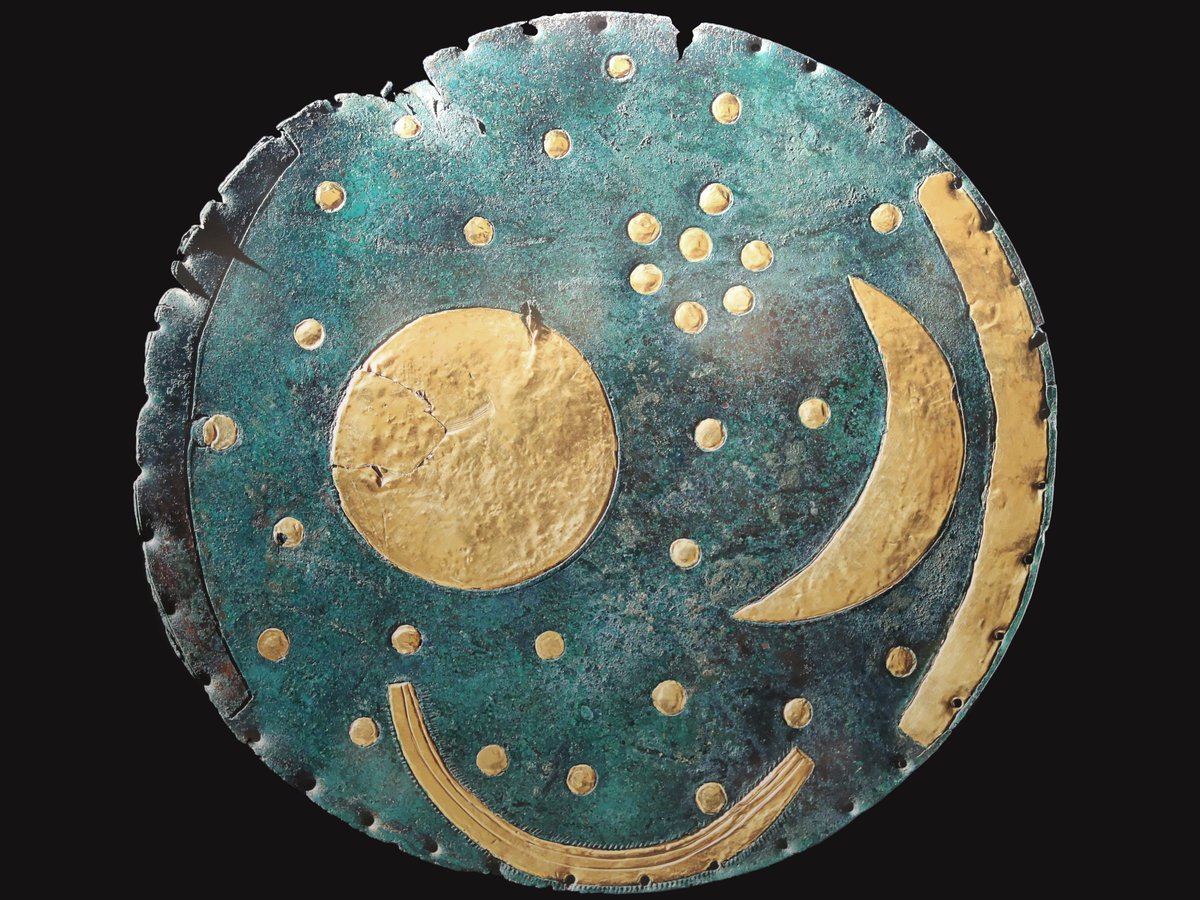
The Nebra sky disk (found clandestinely in 1999 on the Mittelberg, in Saxony-Anhalt, Germany, and authenticated after a judicial odyssey), dated to approximately 1,600 BCE, is the most extraordinary object of the European Bronze Age. This 32 cm bronze disk, inlaid with gold, represents the night sky: a crescent moon, the sun (or full moon), a cluster of stars identifiable as the Pleiades, two lateral golden arcs corresponding to the azimuths of sunset at the solstices at Nebra's latitude, and a dorsal "solar barque". It is the oldest known concrete representation of the night sky in the world. Its astronomical content suggests it was used to calculate lunar-solar intercalations to synchronise an agricultural-lunar calendar with the seasons -- a sophisticated mathematical problem.16
The Bronze Age worldwide: Shang China and the Indus civilisationIndus CivilisationA major Bronze Age urban civilisation (c. 2600-1900 BC) across present-day Pakistan and north-west India: planned cities (Harappa, Mohenjo-daro), standardised bricks, undeciphered script, no monumental palaces.→
Bronze metallurgy developed independently in China during the Shang period (approximately 1,600 to 1,046 BCE). Shang ritual bronzes -- tripod libation vessels (ding), cauldrons (fang ding), amphoras (lei) -- represent the world's ancient summit of piece-mould casting technique: their finely decorated surfaces of taotie motifs (zoomorphic masks) required multi-piece moulds assembled with millimetre precision. The largest known Shang bronze, the Houmuwu fang ding (National Museum of China), weighs 832 kilograms. These bronzes were used in ancestral sacrifice rituals and symbolised dynastic power: the possession of ritual cauldrons was synonymous with legitimacy.17
The Indus Valley civilisation (HarappaHarappaA major city of the Indus Civilization, in the Pakistani Punjab, the first site excavated and the one that gave the Harappan culture its name.→ and Mohenjo-daroMohenjo-daroOne of the largest cities of the Indus Civilization (Sindh, Pakistan), famed for its Great Bath and grid layout; a World Heritage site.→, approximately 2,600 to 1,900 BCE) is contemporary with the great Bronze Age civilisations of the Mediterranean but distinguishes itself by its remarkably "democratic" organisation: its planned cities with orthogonal streets, sophisticated sewage and drainage systems, public baths (probably for ritual use), and the absence of great palaces or monumental tombs of exceptional wealth. The Indus civilisation practised copper and bronze working (tools, ornaments), used a 400-sign script still undeciphered, and traded with Sumer (Indus sealSealA small engraved object (often steatite) used to stamp a mark in clay; the Indus seals, bearing animals and signs, attest to administration and trade, though their script remains undeciphered.→ stamps have been found in Mesopotamia). Its decline around 1,900 BCE is attributed to a combination of prolonged drought and modification of river courses (drying of the Ghaggar-Hakra river).18
Bronze Age trade routes: a globalised world
The Late Bronze Age (approximately 1,550 to 1,200 BCE) saw the emergence of an international exchange system that modern historians sometimes compare to an early globalisation. The el-AmarnaAmarnaA site in Middle Egypt (Tell el-Amarna), location of Akhetaten, the capital founded by Akhenaten and then abandoned; a major New Kingdom archaeological site.→ diplomatic correspondence (approximately 1,350 BCE), discovered in Egypt in 1887, reveals a network of sovereigns -- Egyptian pharaohs, Hittite kings of Anatolia, Assyrian kings of Mesopotamia, kings of Cyprus, Babylon and Mitanni -- exchanging gold, silver, lapis lazuli, horses, women and mercenaries while maintaining formalised diplomatic relations of "brotherhood". The letters, written in Akkadian on clay tablets, form the oldest known international diplomatic corpus.19
Archaeologists have reconstructed tin trade routes from isotopic analyses of ingots found in shipwrecks and terrestrial sites. Tin came primarily from Afghanistan (Kestel and Göltepe mines in Turkey, Tashkent mines), Cornwall (England) and Erzgebirge (Saxony). The eastern tin route (Afghanistan to Sumer) is documented in Assyrian merchant archives of the 19th century BCE discovered at Kültepe (Anatolia): merchants (tamkarum) from Assur financed donkey caravans transporting textiles to Anatolia and returning silver and gold -- a sophisticated commercial credit system with bills of exchange and clay tablet contracts.20
The Bronze Age collapse: a systemic catastrophe
Around 1,200 BCE, the international system of the Bronze Age collapsed within one or two generations in an unprecedented catastrophe: the great Mycenaean palatial cities of Greece (Mycenae, Tiryns, Pylos) were burned and abandoned; the Hittite EmpireHittite empireA great Anatolian power of the Late Bronze Age, centred on Hattusha; in the 13th century BCE its great kings arbitrated the affairs of their Syrian vassal kingdoms.→ of Anatolia collapsed; the cities of Canaanite Levant (UgaritUgaritA wealthy Bronze Age merchant city-kingdom on the Syrian coast (Ras Shamra); its cuneiform archives and alphabet make it a major source on the ancient Near East.→, Alalakh, Hazor) were destroyed; Egypt survived but suffered several waves of invasion and lost control of its Asian provinces; Cyprus was partially devastated. The complexity of the commercial networks, the specialisation of production and the interdependence of exchanges made this system particularly vulnerable to chain disruptions.21
The causes of this collapse are the subject of intense historiographical debate. Eric Cline (1177 B.C.: The Year Civilization Collapsed, 2014) argues it was a "systemic collapse" resulting from a combination of factors: prolonged drought (documented by marine sediment cores and pollen grains), internal unrest and social revolts, earthquakes (several destroyed cities show seismic traces), disruption of tin trade routes, and finally the famous "Sea Peoples" mentioned in the inscriptions of Ramesses III at Medinet Habu (approximately 1,175 BCE).22
The "Sea Peoples" -- identified in Egyptian texts under the names Peleset, Tjeker, Shekelesh, Denyen, Weshesh -- were groups of armed migrants who swept across the eastern Mediterranean and contributed to the destructions. The Peleset are generally identified with the Biblical Philistines who settled in Palestine. But their precise origin remains debated: Aegean (collapsed Mycenae?), western Anatolia, Sicily or Sardinia? Recent genomic analyses (Harney et al., 2018; Maeir et al., 2019) of Philistine skeletons from the city of Ashkelon show a strong southern European genetic component in the earliest generations, consistent with an Aegean or western Anatolian origin.23
The Dark Ages and the transition to the Iron Age
The collapse of 1,200 BCE plunged the eastern Mediterranean into a period of reduced complexity -- the "Dark Ages" (approximately 1,200 to 800 BCE) -- characterised by the disappearance of palaces, population decline, loss of writing in Greece (Linear B disappeared with the Mycenaean palaces), reduction of long-distance trade, and a return to dispersed settlement in small rural communities. This regression is comparable, in terms of lost complexity, to the collapse of the Western Roman Empire in the 5th century CE.24
The transition to the Iron Age began before the 1,200 collapse but accelerated thereafter. Iron is an abundant metal (the fourth element in the Earth's crust), but its smelting requires temperatures of approximately 1,540°C, far above those for bronze -- a mastery only achieved with improved bellows and forced-draught furnaces. Carburised iron (steel) is superior to bronze for weapons and agricultural tools, but its production in large quantities was slow to develop. The adoption of iron progressively transformed agricultural economies (iron tools enabled clearing of more resistant land), military tactics and social hierarchies: iron being abundant and accessible everywhere, it no longer conferred the exclusive strategic advantages that control of tin had provided.25
The legacy of the Bronze Age: cities, states, law, literature
The legacy of the Bronze Age is immense. It includes the first documented forms of state, monarchy, codified law (the Code of Hammurabi, approximately 1,754 BCE, is the most famous but not the oldest -- the Code of Ur-Nammu, approximately 2,100 BCE, precedes it), narrative literature (the Epic of Gilgamesh, the Egyptian Pyramid Texts, the Indian Rig-Veda), formalised diplomacy, commodity money (standard-weight metal ingots), standing armies, taxation and administrative bureaucracy.26
The mythologies and religions of classical antiquity -- Greek, Roman, Hebrew, Iranian -- are deeply rooted in Bronze Age traditions. The Greek pantheon inherits Mycenaean gods (Zeus, Poseidon, Hera identifiable in Linear B tablets). The Hebrew Bible reflects Late Bronze Age Levantine traditions. The Epic of Gilgamesh, the Sumerian Flood narrative, the myth of the Garden of Eden -- all stories whose parallels with later mythologies testify to the depth of the Bronze Age's cultural imprint on all subsequent history.27
Ancient genomics today sheds new light on Bronze Age migrationsMigrationsLong-distance movements of populations; a major driver of human history (the exit from Africa, the peopling of continents, Neolithic and steppe expansions).→ and population dynamics. The analyses of Olalde et al. (Nature 2018) and Mathieson et al. (Nature 2015) show that the European Bronze Age was marked by a massive replacement of populations descended from Anatolian NeolithicNeolithicThe "New Stone Age": a period marked by farming, herding, settlement and pottery, from around 10,000 BC.→ farmers by migrants from the Pontic steppeSteppeA vast semi-arid, treeless grassland of Eurasia, suited to nomadic herding and the horse; a corridor for the movement of peoples and technologies in later prehistory.→ (Yamnaya and derived cultures), who brought a dominant "steppic" genetic component to present-day Northern and Western European populations. This migration is associated with the spread of Indo-European languages, the traditions of the Corded Ware and Bell Beaker cultures, and the first horse breeders. The Bronze Age is thus not only a technological revolution, but also a demographic and linguistic one -- the crucible in which historical Europe was forged.28
No comments yet. Be the first.