In archaeology, the most remarkable discoveries sometimes occur at the least expected moment. At the end of the 2024 summer season, a team led by Professor Tomasz Gralak was preparing to leave the excavation site at Zorawina, in the Lower Silesia region of Poland. The work, devoted to studying burials from the Roman influence period some 1,600 years ago, seemed to have revealed all its secrets. It was then that biological anthropologist Pawel Dabrowski noticed a circular shape in the soil. A few trowel strokes later, the team found itself face to face with one of the most exceptional discoveries in Polish archaeology in recent years: the tomb of a NeolithicNeolithicThe "New Stone Age": a period marked by farming, herding, settlement and pottery, from around 10,000 BC.→ chieftain buried nearly 4,900 years ago, beneath a 4-metre diameter tumulusTumulusA mound of earth or stones covering one or more burials; it often capped a dolmen's chamber in the Neolithic.→, accompanied by a funeral necklace of 42 pierced teeth and two human skulls without bodies.
A 4-Metre Kurhan Hidden Beneath a Roman Cemetery
The Zorawina site, located about twenty kilometres south of Wroclaw, had been chosen for its surface archaeological interest: remains from the late Roman period, corresponding to contacts between local Germanic populations and the neighbouring Roman Empire. The excavations had progressed normally, yielding the types of materials typically associated with this period in the region: ceramics, bronze fibulae, bone remains. Nothing foreshadowed the presence of a much older structure.
It was careful observation of the soil during the final cleaning phase of the site that led to the discovery. "We were about to pack up our belongings when we discovered a circular shape in the ground and started digging," Dabrowski explained in a press release published by the Medical University of Wroclaw in September 2026. This shape was the contour of a kurhan -- the Polish term for a burialBurialThe intentional deposition of a body, sometimes with offerings; a marker of symbolic behaviour.→ mound -- compressed by the millennia but still perfectly discernible in stratigraphic cross-section.
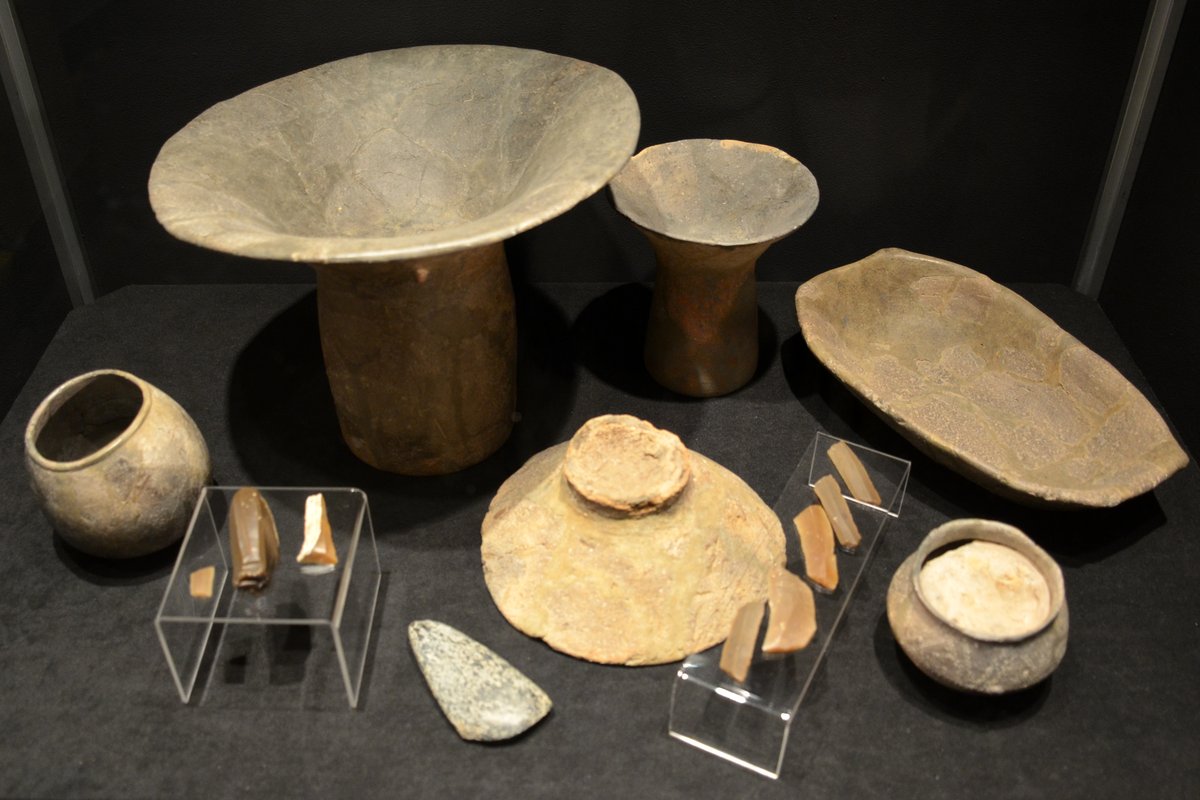
Excavation of the tumulus revealed the nearly complete skeleton of an adult man, in a flexed position -- typical of the funerary rites of the Corded Ware culture. Around him, a series of carefully arranged objects attested to a particularly high social status: amber beads, a carefully knapped flintFlintA hard, brittle siliceous rock, knapped by prehistoric people to produce blades, points and sharp tools.→ blade, and above all a combat axe in serpentinite, a metamorphic rock with a characteristic grey-green hue. It is precisely the typological form of this axe that allowed specialists to date the burial to around 2900 BCE, the peak of the Middle Neolithic in Poland.
The Necklace of 42 Teeth: Funeral Ornament of a Clan Chief
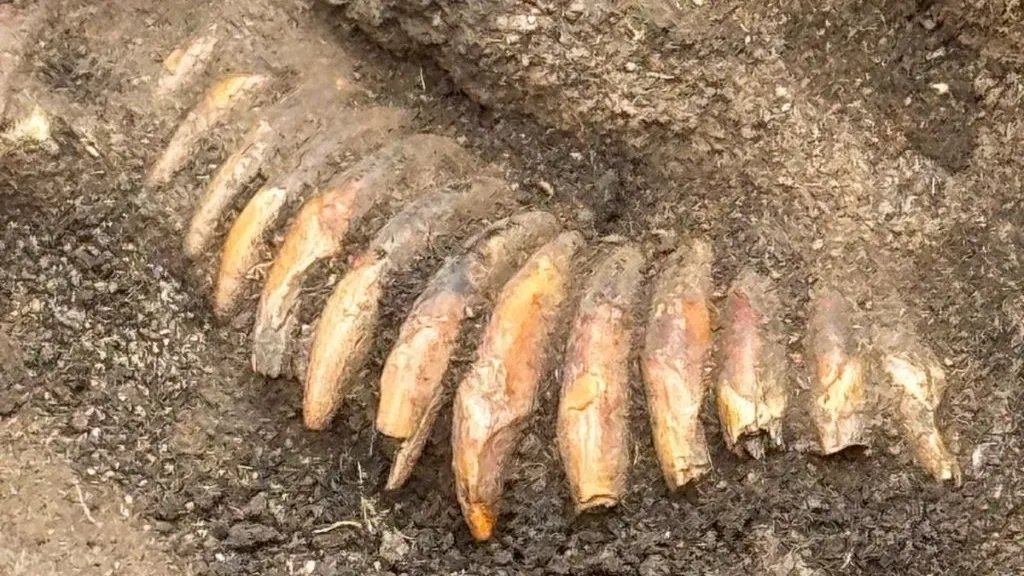
Among all the objects uncovered, it was the funeral necklace that most struck archaeologists and anthropologists. Arranged with a troubling regularity around the skeleton, 42 teeth pierced at their roots most likely formed an ornament designed to be worn suspended around the neck, even though the original cord -- made of organic material -- left no trace after nearly five millennia of burial.
Zoological analysis of the teeth revealed a remarkably diverse assemblage: incisors and canines of wolf (Canis lupus), red deer (Cervus elaphus)Red deer (Cervus elaphus)A large European deer whose males bear branching antlers renewed each year; the antlers, both raw material and symbol, feature in many proto-historic ritual deposits.→, and brown bear (Ursus arctos), three of the great predators and prey of Neolithic Europe. But it is the possible presence of human teeth among this assemblage that has generated the most speculation. Dabrowski remains cautious on this point: "A complementary analysis will need to confirm or refute the presence of human teeth," he specifies, noting that initial visual observations do not allow a definitive conclusion.
This type of animal-tooth necklace, while rare, is not unique in European Neolithic contexts. Several examples are known from contemporary cultures in Central and Northern Europe. But their systematic assemblage with a combat axe, amber beads, and other prestige objects is characteristic of "chieftain" burials as researchers define them in the context of the Corded Ware culture. "It is possible that we have discovered the tomb of a warrior or a hunter, but thanks to this necklace, we can suppose that this was someone important, for example the chief of a family clan," Dabrowski suggests.
The Serpentinite Combat Axe: A Symbol of Power
The serpentinite combat axe is the element that made it possible to date the burial with the greatest precision. This metamorphic rock, which forms under high pressure in oceanic subduction zones, was particularly valued during the Neolithic for its aesthetic qualities and hardness. Its grey-green hue, streaked with black and white filaments, gives it a decorative aspect that Neolithic craftsmen knew how to highlight through careful polishing.
Combat axes in polished stone, of which serpentinite is one of the most represented raw materials, are one of the most emblematic objects of the Corded Ware culture. They served not only as weapons: their presence in high-status funerary contexts suggests that they were above all insignia of power, prestige objects that signalled their owner's social status within the community. Their carefully regular shape, meticulously polished surface, and the quality of the raw material used indicate a considerable investment of time and artisanal skill.
The serpentinite used for the Zorawina axe does not come from Lower Silesia itself: the nearest deposits of this rock are in the Sudetes, the mountain range forming the border between present-day Poland and the Czech Republic. The presence of this object in the tomb implies either long-distance trade in raw materials, or the individual's own displacement during his lifetime. Neither hypothesis is mutually exclusive, and both testify to the mobility and extensive exchange networks of Corded Ware populations.
Two Skulls Without Bodies: Ritual Offering or Unresolved Mystery
The most enigmatic element of the Zorawina discovery remains the presence of two adult human skulls, found near the main skeleton but without any bodily remains to which they might have belonged. Their interpretation remains open to several hypotheses, which future analyses will need to help resolve.
The first hypothesis, and the one most commonly advanced by researchers, is that of funerary offerings: the two individuals to whom these skulls belonged may have been decapitated -- perhaps sacrificed during the funeral rites -- and their heads deposited in the tomb to accompany the deceased into the afterlife. This practice, though disturbing by modern sensibilities, is not without parallel in European Neolithic contexts. Sites from the same period in Central and Northern Europe have yielded similar deposits, suggesting the existence of elaborate funerary rites that could involve human victims.
A second hypothesis involves secondary manipulation: the two individuals may have been originally buried elsewhere, their skulls later retrieved and placed in the chieftain's tomb. This practice of secondary manipulation of human remains is also attested in several European Neolithic cultures and may respond to various logics: ancestor veneration, affirmation of a lineage relationship with the deceased, or symbolic appropriation of the identity of the individuals represented.
Ancient DNAAncient DNAGenetic material preserved in old remains, often degraded, sequenced with cutting-edge techniques.→ analysis will be essential to determine whether the three individuals -- the main deceased and the two owners of the skulls -- were biologically related. This data will be crucial for interpreting the meaning of the cranial deposits: if these were members of the same family or clan group, the ancestor veneration hypothesis will be reinforced. Conversely, if genetic analyses reveal that the three individuals were unrelated, the hypothesis of sacrifice or war trophy becomes more plausible.
The Corded Ware Culture: From the Steppes to Central Europe
To understand the significance of the Zorawina discovery, it must be placed within the context of the Corded Ware culture -- Schnurkeramik in German, kultura ceramiki sznurowej in Polish -- one of the most widespread and historically important Neolithic cultures in European prehistoryPrehistoryThe span of human history before the invention of writing, from the Palaeolithic to the Metal Ages, known mainly through material remains.→. This culture, which developed between approximately 2900 and 2350 BCE, covers an immense territory from the British Isles in the west to western Siberia in the east.
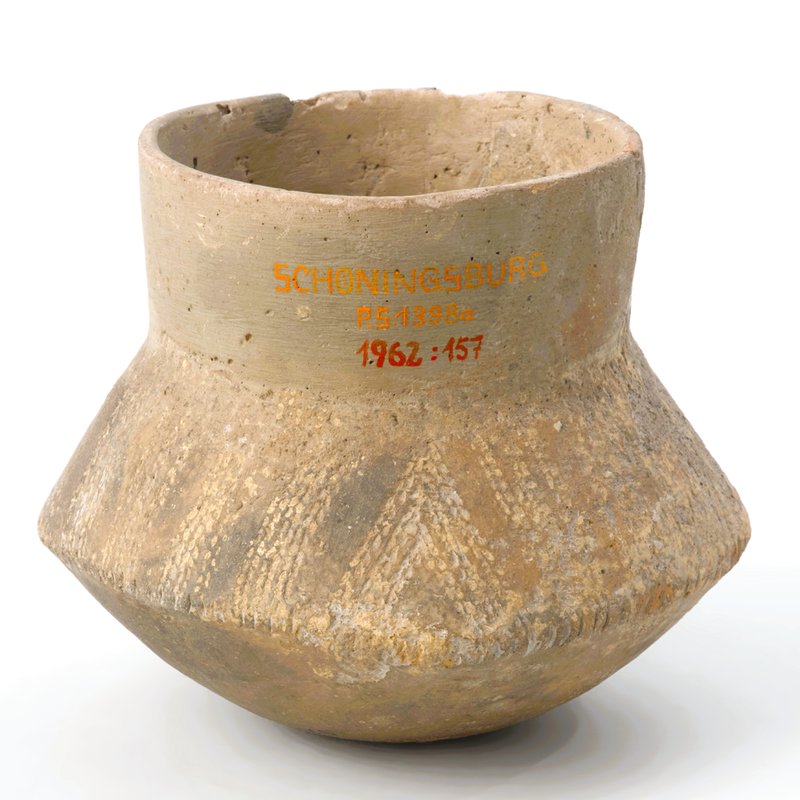
It takes its name from its characteristic ceramics, decorated with cord impressions printed into the still-fresh clay before firing. This simple but recognisable technique allows archaeologists to identify sites and artefacts associated with this culture, even in complex stratigraphic contexts. But beyond the ceramics, it is the entire funerary complex -- polished stone combat axes, amber beads, animal-tooth necklaces, specific burial positions -- that defines the cultural identity of these populations.
The origin of the Corded Ware culture is one of the most debated subjects in European prehistory. Modern genetic studies -- notably the major ancient DNA analyses published between 2015 and 2022 -- have confirmed that the bearers of this culture descended largely from populations from the Pontic-Caspian steppes, located between the Black Sea and the Caspian Sea, who migrated en masse into Central and Western Europe from the end of the Neolithic. This migratory wave is now closely associated with the spread of Proto-Indo-European languages across Eurasia, making the Corded Ware culture a central element in one of the greatest demographic and linguistic transformations in human history.
In Lower Silesia, the presence of this culture was already known from a few isolated sites, but the discovery of two major tumuli -- the one at Zorawina and another uncovered almost simultaneously at Iwiny, near Wroclaw, by a separate team -- suggests a more organised and perhaps denser presence than previous data had indicated. The two individuals found in these tumuli may represent members of the same community, or even the same dominant family lineage, which planned genetic analyses may help to verify.
Prospects: Ancient DNA, Isotopic Analysis, and Reconstruction
The archaeological richness of the Zorawina site opens an exceptionally broad field of investigation for the coming years. Several types of scientific analysis are planned by Dabrowski's team, with the first results expected before the end of 2026.
Ancient DNA analysis will be the absolute priority. Human remains from the Neolithic, though often fragmentary and degraded, can preserve exploitable DNADNAThe molecule carrying genetic information, used to reconstruct kinship between species.→ sequences thanks to modern high-throughput sequencingSequencingReading the order of the bases (A, T, G, C) of a DNA molecule; high-throughput sequencing reads millions of fragments in parallel.→ techniques. Mitochondrial DNA (transmitted by the mother) and Y-chromosome DNA (transmitted by the father) will make it possible to determine the genetic haplotype of the individuals, compare them with contemporary and ancient populations of Central Europe, and verify whether they were biologically related. These data will help clarify the migratory dynamics of the Corded Ware culture in the region.
Stable isotope analysis -- particularly oxygen (O-18/O-16) and strontium (Sr-87/Sr-86) contained in dental enamel -- will make it possible to reconstruct the geographical movements of individuals during their lifetime. These isotopes are incorporated into enamel at the moment of tooth formation (childhood and adolescence) and reflect the chemical composition of the water and food of the region where the individual lived at that time. If the Zorawina chieftain was a migrant from elsewhere -- as the distant origin of his serpentinite axe might suggest -- isotopic analyses may identify his region of origin.
From this almost-concluded site emerges a far broader narrative than anticipated: that of a Neolithic chieftain buried with his power attributes and two enigmatic heads, at the dawn of the great cultural transformation that would reshape the demographic and linguistic face of Europe. The analyses to come may one day give a face -- and a history -- to this man whom the millennia had so well preserved beneath his mound of Silesian earth.
No comments yet. Be the first.