The Oxus civilisation -- also known as the Bactria-Margiana Archaeological Complex (BMAC) -- was one of the great Bronze AgeBronze AgeA protohistoric period following the Neolithic, defined by bronze metallurgy (a copper-tin alloy) and the rise of the first cities and states; in Egypt it corresponds to the age of the first pyramids.→ cultures of Central Asia, flourishing between approximately 2300 and 1700 BCE across the alluvial plains of present-day Turkmenistan, Uzbekistan, Afghanistan and Tajikistan. Its monumental sites, sophisticated metal and ceramic art, and elaborate funerary practices make it one of the most advanced civilisations of the Eastern Hemisphere at that time. A study published in 20261 adds a striking new dimension to this portrait: surgeons of this culture were performing cranial operations on young children with remarkable precision.
Djarkutan, a metropolis of the Oxus civilisation
Djarkutan is one of the most important sites of the Oxus civilisation, located in the Surkhan Darya province of southeastern Uzbekistan. The site has been intensively excavated since the 1970s by Soviet and then Uzbek archaeologists. It covers tens of hectares and comprises a fortified urban centre, craft quarters, fire-altar temples and a vast necropolisNecropolisA large organised burial ground, a "city of the dead", often spanning several periods.→. Excavations of the necropolis have yielded thousands of individual and collective graves, enabling in-depth anthropological studies of the BMAC population.

It was within the funerary levels dated to approximately 2000-1800 BCE that anthropologists isolated a particular skull: that of a child estimated to be around five years old at death. The skull's preservation, though partial, was sufficient to identify an intentional modification -- a trepanation -- performed on the parietal bone. The shape and characteristics of the opening rule out any accidental traumatic cause or post-depositional taphonomic process.
Trepanation -- the surgical technique of deliberately opening the skull by scraping, drilling, sawing or incising -- is documented since the NeolithicNeolithicThe "New Stone Age": a period marked by farming, herding, settlement and pottery, from around 10,000 BC.→ in many parts of the world. Thousands of trepanned skulls have been recorded in Europe, South America, AfricaAfricaThe cradle of humankind: the continent where the first hominins appeared, then Homo sapiens around 300,000 years ago, before the expansion to the rest of the world.→ and Asia. However, examples involving such young individuals remain rare, and cases from the BMAC in Central Asia are virtually unprecedented.
A surgical intervention on a child
Analysis of the skull was conducted using scanning electron microscopy and micro-computed tomography (micro-CT). These methods allow examination of the perforation's morphology at millimetre resolution and detection of tool characteristics: parallel abrasion striations, rotation drill notches, or saw grooves.
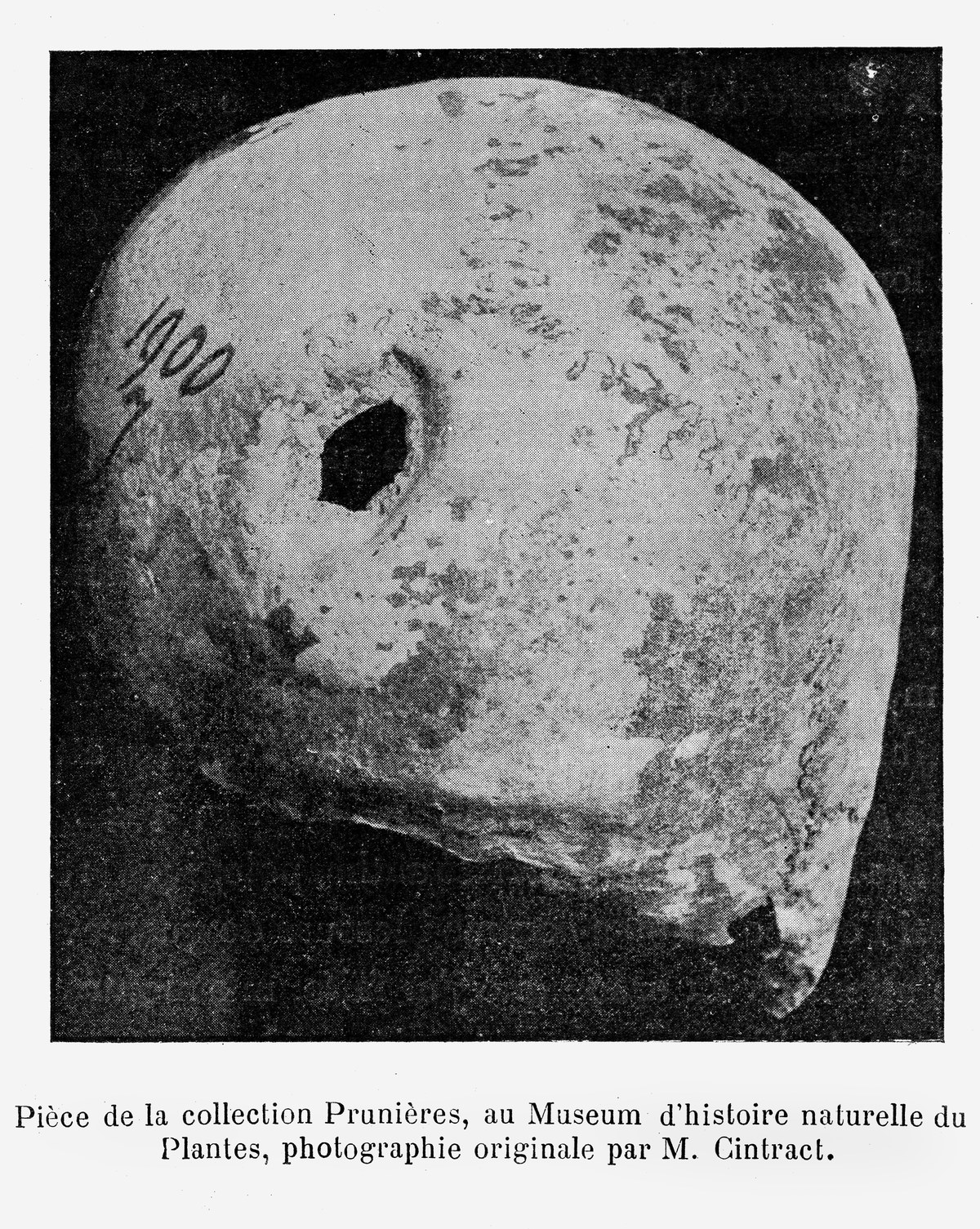
Results indicate the trepanation was performed by progressive scraping -- the most widespread technique in Neolithic and Bronze Age contexts. The margins of the orifice are regular and show no radial fractures, excluding violent impact. The size of the opening is consistent with a deliberate intervention aimed at reducing intracranial pressure or treating a tumour, meningitis or head injury.
A crucial finding: examination of the orifice margins shows no evidence of bone healing. When a patient survives a trepanation, the edges begin to remodel within weeks, producing a characteristic smooth rim. The absence of this remodelling at Djarkutan suggests the child died during the operation or in the days immediately following, without time to heal. This tragic outcome does not diminish the significance of the find: it proves that surgeons of the Oxus civilisation were attempting complex cranial interventions, even on very young patients.
Medicine and anatomical knowledge in the Oxus civilisation
The discovery fits within a growing body of evidence for medical sophistication among Central Asian Bronze Age cultures. The Oxus civilisation maintained commercial and cultural contacts with Mesopotamia, the Indus Valley civilisation and the Iranian plateau. These exchanges may have facilitated the diffusion of medical and surgical knowledge between these contemporary civilisations.
Several authors have noted that Mesopotamian medicine of the same period -- notably the Babylonian and Sumerian medical texts -- references cranial interventions, though their exact nature remains debated. The Djarkutan trepanation suggests similar practices existed in the steppeSteppeA vast semi-arid, treeless grassland of Eurasia, suited to nomadic herding and the horse; a corridor for the movement of peoples and technologies in later prehistory.→ and oasis cultures of Central Asia, independently of or in parallel with the Mesopotamian tradition.
The questions of anaesthesia and antisepsis inevitably arise. It is well documented that many prehistoric cultures used plants with analgesic properties (opium, cannabis, mandrake, henbane) and natural antiseptics (honey, plant resins, fermented alcohol). It is impossible to determine from the skull alone whether such substances were used at Djarkutan. However, the regularity of the intervention -- which testifies to a skilled hand and mastered technique -- suggests the Oxus surgeons were operating within an organised medical framework, with specific instruments and probably a minimal protocol for patient preparation.
The child in the BMAC funerary context
The trepanned child's burialBurialThe intentional deposition of a body, sometimes with offerings; a marker of symbolic behaviour.→ fits within the elaborate funerary practices of the Oxus civilisation. Djarkutan's graves reveal marked social stratification: some individuals are interred with abundant grave goods (ceramics, gold and silver jewellery, bronze weapons, stone seals), others with minimal accompaniment. The child's tomb unfortunately did not preserve its complete funerary context, making inferences about the family's social status difficult.
Nevertheless, the fact that such a young child received a technically demanding surgical intervention suggests that the attempt at treatment was not reserved for adults contributing economically to the group. Oxus medicine may have extended to all members of the social body, regardless of age -- an indicator of compassion and community solidarity that archaeologists generally associate with complex, hierarchised societies.
This discovery calls for systematic new research on skulls from the Djarkutan necropolis and neighbouring BMAC sites (Gonur Depe in Turkmenistan, Shortughai in Afghanistan, Sapalli Tepe in Uzbekistan). It is likely that other trepanation cases await identification in these collections, which have not all been analysed with modern imaging methods. The medicine of the Oxus civilisation may prove far more developed than was previously assumed.
No comments yet. Be the first.