When the first weapons of America change their age
For decades, the story of the first peopling of North America came down to a simple, reassuring formula. The first Americans were said to be the bearers of the ClovisClovisA Palaeoindian culture of North America (c. 13,000 years ago), recognizable by its fluted stone points; long believed the oldest on the continent, no longer so.→ culture, recognisable by their long, finely fluted stone points, arriving some thirteen thousand years ago through an ice free corridor. Anything that might seem older was met with suspicion, and people spoke readily of "Clovis first," the idea that these hunters had led the way and that no human population had preceded them. Excavations carried out at the Paisley Caves, in southern Oregon, have helped to dismantle that certainty. There, projectile points of an entirely different kind were brought to light, the so called "Western Stemmed" points, that is to say points fitted with a stemstemThe narrowed base of a point, used to haft it onto a shaft or handle.→, whose age is close to fourteen thousand years.
Yet these stemmed points prove to be contemporary with the fluted points of ClovisClovisA Palaeoindian culture of North America (c. 13,000 years ago), recognizable by its fluted stone points; long believed the oldest on the continent, no longer so.→, and perhaps even a little older. The chronology once thought to be linear becomes blurred, and with it the idea of a single founding technical tradition. Far from being mere late heirs of the fluted hunters, the Western Stemmed points may have followed their own trajectory, arising from a parallel and distinct history. This article revisits the facts established at the Paisley Caves, the complementary data coming from Idaho, and the caution demanded by the interpretation of remains as slight as isolated stone points1.
The Paisley Caves, a window onto the Great Basin
The Paisley Caves form a string of shelters hollowed into a cliff of volcanic rock, at the edge of a former lake now dried up, in the northern Great Basin. This vast set of closed basins, wedged between the Rocky Mountains and the Sierra Nevada, is marked by its arid expanses, its brackish lakes and its harsh winters. At the end of the last glacial period, however, the landscape was wetter and more welcoming, dotted with larger lakes and marshes that drew game and waterfowl. These caves offered human groups a dry shelter, oriented so as to capture light and warmth, an ideal vantage point over the resources of the surrounding basin.
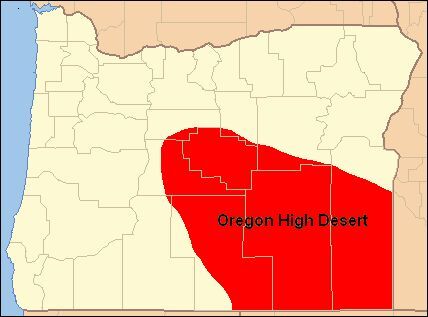
The great interest of these shelters lies in their exceptional conditions of preservation. The dryness of the climateClimateThe long-term average atmospheric conditions of a region; its variations (glaciations, aridifications) shaped migrations, agriculture and the collapse of prehistoric societies.→ has preserved organic materials that most sites allow to vanish, plant fibres, bones, and above all fossilised human excrement. This preservation makes the Paisley Caves a rare laboratory, where stone tools can be set against direct biological evidence of a human presence. The archaeological layers there are deep and stratified, which in principle allows each object to be tied to a precise position in time, provided one controls the many traps that dating holds in store.
The excavations, directed by Dennis Jenkins and the University of Oregon, spread over several field seasons and drew on a broad range of specialists. The aim was not only to gather artefacts, but to build a solid chronological framework by multiplying radiocarbon dates on varied materials. It is from this accumulation of measurements that the Paisley Caves derive their authority in the debate over the first peopling of the AmericasPeopling of the AmericasThe migration of the first modern humans into the Americas from Asia via Beringia, long dated to around 13,000 years ago (the "Clovis first" model) but pushed back beyond 20,000 years by sites such as White Sands.→Peopling of the AmericasThe migrationsMigrationsLong-distance movements of populations; a major driver of human history (the exit from Africa, the peopling of continents, Neolithic and steppe expansions).→ that led Homo sapiensHomo sapiensThe present-day human species, which emerged in Africa around 300,000 years ago, the only surviving human lineage after the extinction of Neanderthals and Denisovans.→ to occupy the American continent, from BeringiaBeringiaA vast land bridge emergent between Siberia and Alaska during the last glaciation, at the site of today's Bering Strait; a cold steppe through which the first Americans passed.→; its date and routes remain debated.→4.
The fluted Clovis point, a symbol turned standard
To grasp the significance of the discovery, one must first understand what a ClovisClovisA Palaeoindian culture of North America (c. 13,000 years ago), recognizable by its fluted stone points; long believed the oldest on the continent, no longer so.→ point is. First identified near the town of Clovis, in New Mexico, this technical tradition is distinguished by an elongated lithic piece, carefully shaped, whose base bears a flute. This flute is a longitudinal removal of material, a channel obtained by detaching a flake from the base toward the tip, which no doubt made it easier to haft the weapon onto a shaft. The fluted points equipped formidable spears, associated with the hunting of big game, including the mammoths and mastodons whose remains have been found alongside these weapons.
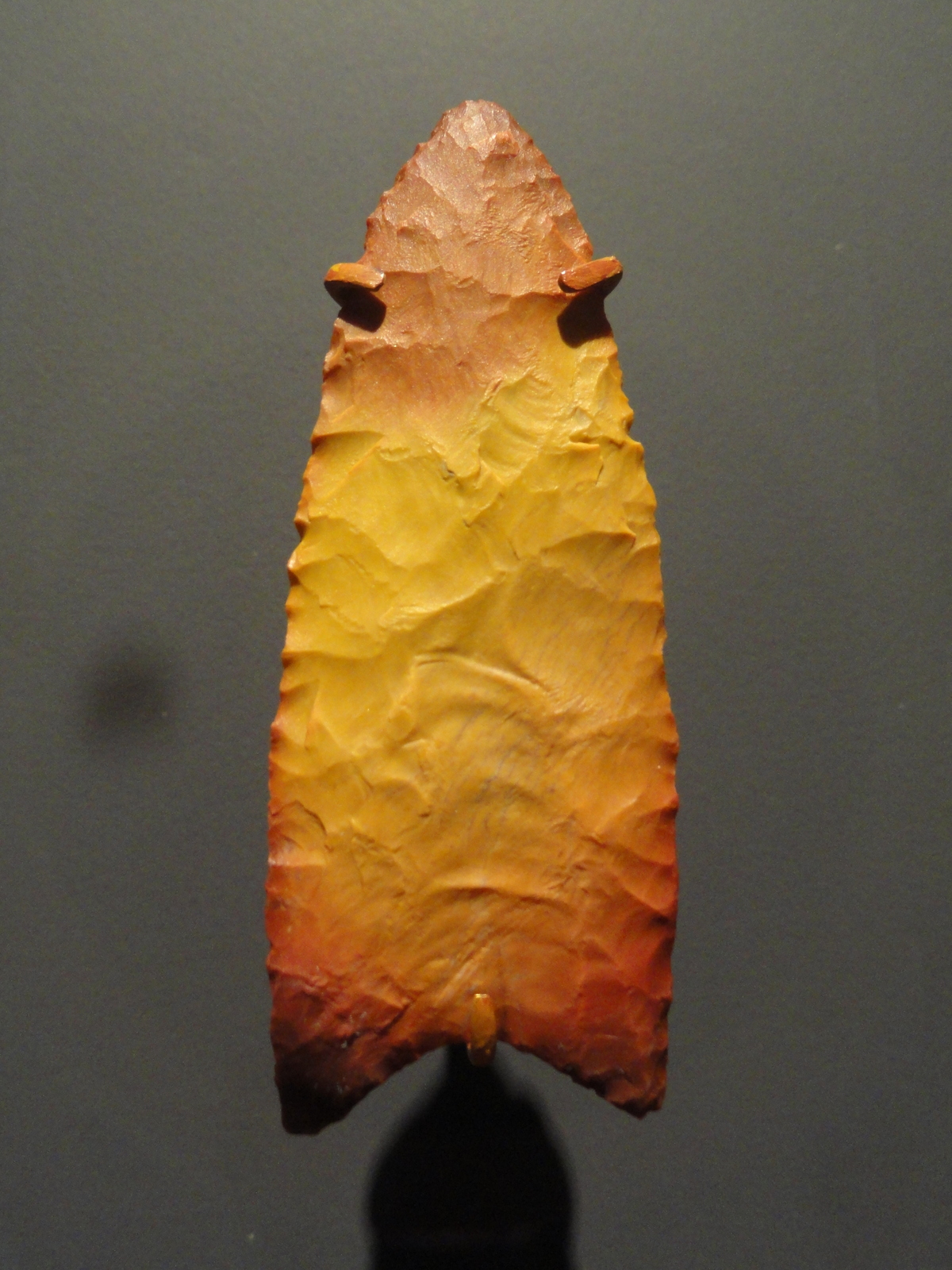
The Clovis culture long served as an absolute benchmark in American prehistoryPrehistoryThe span of human history before the invention of writing, from the Palaeolithic to the Metal Ages, known mainly through material remains.→, to the point of giving its name to an entire doctrine. Rigorous dating has tightened its span into a strikingly short window, between about thirteen thousand and fifty and twelve thousand seven hundred and fifty years before present. This very brevity is striking, for it signals the rapid spread of a highly standardised technique across a large part of the continent. For a long time, this homogeneity fed the idea of a single pioneering wave, that of the inventors of the fluted pointfluted pointA projectile point thinned at the base by the removal of a long axial flake, the flute, which eased hafting.→3.
It is this image of a single, well dated starting point that made the Clovis culture so convenient. It provided a marker, a founding moment to which everything else could be referred. But a marker only has value if nothing precedes or accompanies it. Yet the stemmed points of the Paisley Caves slip precisely into that window, if not before it, and call into question the role of absolute benchmark that had been ascribed to Clovis.
Stemmed points, a parallel tradition
The Western Stemmed points differ markedly from the fluted points. Instead of a channelled base, they present a stem, that is to say a narrowed tongue at the base, released by notches or a simple constriction, which served to fix the point to its shaft. This technical solution, just as effective but conceptually different, reflects another way of conceiving the weapon. One does not shape a flute in the same way that one releases a stem, and the two gestures imply distinct forms of know how, transmitted within separate traditions. It is this contrast that gives the contemporaneity of the two types its full significance.
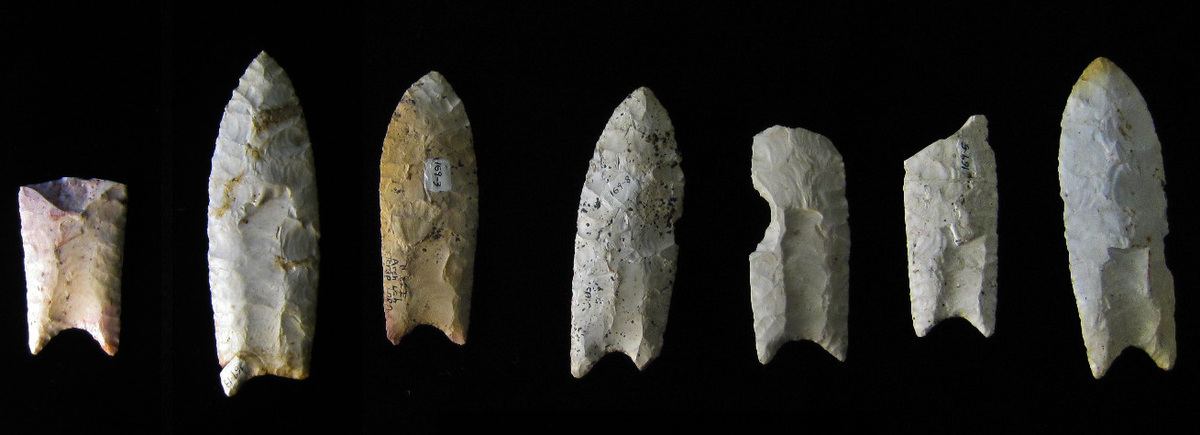
For a long time, it was assumed that stemmed points derived from fluted points, like a late branch springing from the Clovis trunk. This evolutionary scheme naturally placed the Western Stemmed after Clovis, in a tidy order. The dates from the Paisley Caves have overturned this assumption. The stemmed points appear there around fourteen thousand years ago, which makes them contemporary with the Clovis window and, according to some readings, a little older. Two distinct technical traditions would therefore have coexisted, without one necessarily descending from the other1.
This coexistence has profound consequences. It suggests that the North American continent sheltered, from the end of the Pleistocene, several PaleoindianPalaeoindianRefers to the earliest human cultures of the Americas at the end of the Pleistocene, big-game hunters, including Clovis and Folsom.→ groups carrying different technical solutions, adapted to varied environments and prey. The fluted hunters of the plains and the stemmed point makers of the West could have crossed paths, ignored one another or influenced each other, without either being the exclusive ancestor of the other. The story of a single origin gives way to that of a mosaic of traditions.
Cooper's Ferry, an even older milestone
The case is not confined to Oregon. Further north, at the Cooper's Ferry site, in Idaho, a team led by Loren Davis brought to light a rich assemblage of stone tools on the bank of the Salmon River. There they recovered several stemmed points related to the Western Stemmed type, associated with hearths, faunal remains and knappingknappingThe set of operations for fracturing a stone block to extract flakes or blades.→ debris, in carefully excavated layers. This context, fuller than that of isolated points, offers a more robust chronological anchor, for it rests on charcoal and bones dated in series rather than on a single object.
The ages obtained are striking. An assemblage comprising some fifteen stemmed points has been tied to a period close to sixteen thousand years ago, that is several millennia before the appearance of the fluted points of ClovisClovisA Palaeoindian culture of North America (c. 13,000 years ago), recognizable by its fluted stone points; long believed the oldest on the continent, no longer so.→. If these dates withstand scrutiny, they make the stemmed point makers occupants of the continent well before the fluted hunters, and not their successors. Cooper's Ferry thus extends backward the temporal depth sketched at the Paisley Caves, and reinforces the idea of a precedence of stemmed traditions in the American West2.
This site also brings a geographical argument. It lies inland, in a region that can be reached by the Pacific coast rather than by the interior ice free corridor, long presented as the only way in. An arrival along the shoreline, hugging the coasts and exploiting marine and riverine resources, fits better with such early dates, at a time when the interior corridor was not yet passable. The stemmed points of Idaho thus feed, indirectly, the hypothesis of an early coastal peopling.
Coprolites that speak of humans
At the Paisley Caves, the stone points are not the only witnesses of a human presence. The site has yielded coprolitesCoproliteA fossilized excrement; it can preserve DNADNAThe molecule carrying genetic information, used to reconstruct kinship between species.→ and food remains, valuable for dating and identifying its makers.→, that is to say fossilised excrement, some of which have preserved human DNA. A coprolite is a precious object for the archaeologist, for it informs at once on the biological identity of the one who deposited it, on their diet and, through its stratigraphic position, on its age. To find a human coproliteCoproliteA fossilized excrement; it can preserve DNA and food remains, valuable for dating and identifying its makers.→ in the same levels as the stemmed points amounts to having a clue of direct presence, independent of the tools themselves.
These remains were the object of meticulous examination, for contamination by recent DNA, human or animal, constitutes a permanent risk in this type of analysis. The researchers had to demonstrate that the genetic sequences were not modern intrusions, by cross checking the dates and verifying the consistency of the results. Some of the excrement did in fact prove to be of animal origin, which fuelled the discussion. But the whole converges toward an ancient human presence, contemporary with the first points, around fourteen thousand years ago4.
The interest of coprolites is to couple two registers usually kept apart, that of material culture and that of biology. A stone tool attests a technical gesture, but not necessarily the physical presence of a human body on the spot. A human coproliteCoproliteA fossilized excrement; it can preserve DNA and food remains, valuable for dating and identifying its makers.→, by contrast, makes that presence tangible in an irrefutable way. By associating the two in the same layers, the Paisley Caves offer a convergent demonstration, in which the testimony of the weapons is confirmed by that of the living.
The end of "Clovis first" and its cautions
The main lesson of this work is the obsolescence of the "Clovis first" doctrine. The idea that the fluted point hunters were the first inhabitants of the continent no longer withstands the accumulation of data. The contemporary or earlier stemmed points of the Paisley Caves, the early dates of Cooper's Ferry and the coprolitesCoproliteA fossilized excrement; it can preserve DNA and food remains, valuable for dating and identifying its makers.→ with human DNA sketch a far richer picture, in which several technical traditions coexist and in which the peopling of the AmericasPeopling of the AmericasThe migrations that led Homo sapiens to occupy the American continent, from Beringia; its date and routes remain debated.→ appears older and more diverse than was thought. The fluted point is no longer the starting point, but one of the expressions of a PaleoindianPalaeoindianRefers to the earliest human cultures of the Americas at the end of the Pleistocene, big-game hunters, including Clovis and Folsom.→ world already plural.
This revision nonetheless calls for measure. Dating isolated stone points is a delicate exercise, for the object itself does not carry its age, which must be deduced from its stratigraphic environment. An artefact can migrate within the sediments, be reworked by a rodent burrow or by runoff, become associated by accident with charcoal older or younger than itself. This is why researchers insist less on a precise date than on the chronological overlap between the two traditions. The essential point is not to claim that the stemmed points absolutely precede Clovis, but to observe that the two overlap in time.
Acknowledging this caution in no way diminishes the significance of the case, on the contrary. By giving up a single, tidy line of descent, research gains in fidelity to reality. The Paisley Caves and Cooper's Ferry do not provide a new certainty destined to replace the old one, but an invitation to think of the first peopling of the AmericasPeopling of the AmericasThe migrations that led Homo sapiens to occupy the American continent, from Beringia; its date and routes remain debated.→ as a complex, multiform and still largely open process. It is in this space of questions, more than in a definitive answer, that the true richness of these discoveries lies3.
Ces formes géométriques préhistoriques reviennent régulièrement dans mon travail graphique. Ce site les documente parfaitement.
C'est vertigineux de réaliser à quel point nos ancêtres étaient déjà pleinement humains.