In the spring of 1868, workers building the railway between Perigueux and Agen cut into a rock shelterRock shelterA shallow cavity at the foot of a cliff or under a rocky overhang, offering natural shelter; a favoured site of prehistoric habitation and rock art.→ at a spot called Cro-Magnon, at Les Eyzies-de-Tayac in the Dordogne. Beneath the rubble appeared human bones mixed with flintFlintA hard, brittle siliceous rock, knapped by prehistoric people to produce blades, points and sharp tools.→ tools and the remains of extinct animals. The geologist Louis Lartet, called to the site, recognised the first representatives of our species ever found in a clear archaeological context, that is, within an indisputably PalaeolithicPalaeolithicThe oldest and longest period of prehistory (c. 3.3 Ma–12,000 BC), defined by chipped stone tools and a hunter-gatherer way of life.→ sedimentary layer. That place name, Cro-Magnon (big hole in Occitan), would come to designate an entire humanity, that of the Cro-MagnonCro-MagnonName given to the first Homo sapiensHomo sapiensThe present-day human species, which emerged in Africa around 300,000 years ago, the only surviving human lineage after the extinction of Neanderthals and Denisovans.→ of the European Upper Palaeolithic, after the Cro-Magnon shelter at Les Eyzies (1868).→ people, the first artists in history. This dossier retraces their discovery, their culture, and the sudden birth of art on the cave walls of Europe.
1868: the discovery of the Cro-Magnon shelter
The excavation of the shelter yielded roughly one hundred and twenty human bones scattered at the back of the overhang: skulls, cranial fragments, hip bones and long bones. At least four adults were counted (two men, a woman, one indeterminate individual), together with three newborns and one older child.1 The most famous of these fossils, named Cro-Magnon 1, is the skull of an elderly man with a high forehead and a broad, low face, whose robustness contrasts with the finer build of people today. Its fame rests on a decisive fact: it was the first time Homo sapiens had been exhumed within a layer rich in worked tools and animal bones of the Upper PalaeolithicUpper PalaeolithicThe final phase of the Palaeolithic (c. 45,000 to 10,000 years ago), marked by Homo sapiens in Europe, art, ornaments and a succession of cultures (Aurignacian, GravettianGravettianAn Upper Palaeolithic culture (c. 33,000–21,000 BC) spanning from the Atlantic to Siberia, famous for its ivory female figurines ("Venuses") and, at Dolní Věstonice, the oldest fired ceramics.→, Solutrean, Magdalenian).→, thereby confirming the great antiquity of our species.2
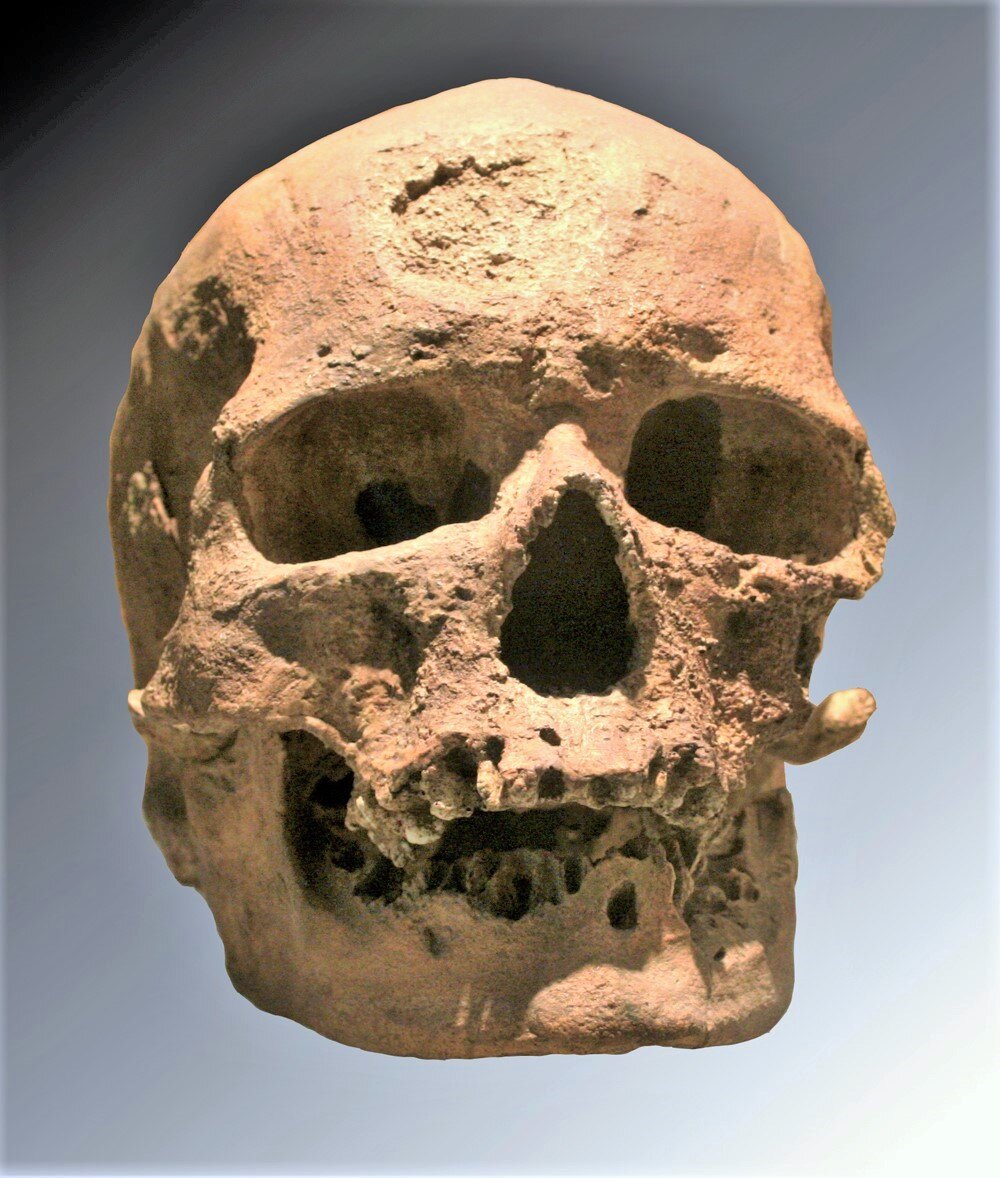
The flints spread across several archaeological levels are attributed to the Aurignacian, now dated to a broad range within the Upper Palaeolithic. The discovery caused a sensation in a scholarly Europe still debating the age of humankind. Soon the late nineteenth century extended the term Cro-Magnon to all Homo sapiens present in Europe between roughly 45,000 and 12,000 years before present. Les Eyzies became the world capital of prehistoryPrehistoryThe span of human history before the invention of writing, from the Palaeolithic to the Metal Ages, known mainly through material remains.→, as the National Museum of Prehistory at the foot of the cliff still attests today. The shelter itself, long neglected, has been the object since the 2000s of new research aimed at clarifying the stratigraphyStratigraphyThe study of the superimposed layers (strata) of an archaeological site; each layer corresponds to a phase of occupation and yields a relative chronology.→ and dating of a founding site.
Who were the Cro-Magnon people?
Anatomically, Cro-Magnon Man is a Homo sapiens identical to us in every essential respect, with a few details apart: a slightly heavier skeleton, a broad face, a stature often tall for the period. His brain, comparable in volume to ours, or even slightly larger according to some older measurements, does not fundamentally set him apart from present-day humans.3 These populations were the first modern humans attested in Europe and Siberia, occupying the continent continuously for perhaps more than 45,000 years, arriving at the end of a long expansion out of AfricaOut of AfricaThe dispersals of Homo sapiens out of Africa, including a major expansion c. 70,000 to 60,000 years ago and earlier exits.→.
Genetics has greatly enriched this portrait. DNADNAThe molecule carrying genetic information, used to reconstruct kinship between species.→ sequencingSequencingReading the order of the bases (A, T, G, C) of a DNA molecule; high-throughput sequencing reads millions of fragments in parallel.→ has shown that the Cro-Magnons lived alongside, and partly replaced, the native NeanderthalsNeanderthalsA fossil humanity of Eurasia, robust and cold-adapted, extinct around 40,000 years before present.→, who died out roughly 35,000 to 40,000 years ago. Above all, the two humanities interbred: present-day populations of European and Asian descent retain close to 2 percent of Neanderthal genes in their genome, a legacy of encounters in the Near EastNear EastA region of western Asia (Levant, Mesopotamia, Anatolia, Iran), cradle of the Neolithic revolution, agriculture, the first cities and writing.→ and Europe.3 Far from a brutal and total replacement, recent prehistory reveals a mosaic of biological and cultural exchange.
As for their way of life, the Cro-Magnons were nomadic hunter-gatherersHunter-gatherersA way of life based on hunting, fishing and gathering wild resources, without farming or herding; it dominated almost the whole of human history.→, dependent on the great herds of reindeer, horses, bison and mammoth that roamed the glacial steppes. They mastered sophisticated projectile weapons (spears tipped with bone or flint points, spear-throwers), made eyed needles to sew fitted clothing, laid out structured camps and sometimes buried their dead with ornaments. It is against this backdrop of growing social complexity that an unprecedented symbolic explosion emerges, abruptly on the scale of prehistoric time.
Aurignacian, Gravettian, Solutrean, Magdalenian: the major cultures
The European Upper Palaeolithic is divided into several successive cultures, defined by their stone and bone industries. From oldest to most recent, one classically distinguishes the Chatelperronian, the AurignacianAurignacianThe earliest culture of the European Upper Palaeolithic (c. 43,000–33,000 BC), tied to the arrival of Homo sapiens and the first artworks.→, the GravettianGravettianAn Upper Palaeolithic culture (c. 33,000–21,000 BC) famous for its female figurines, the "Venuses".→, the SolutreanSolutreanA European Upper Palaeolithic culture (c. 22,000–17,000 BC), remarkable for its leaf-shaped lithic points worked with flat retouch. Contemporary with the second art phase of Cosquer Cave.→ and the MagdalenianMagdalenianThe last great Upper Palaeolithic culture (c. 17,000–12,000 BC), the peak of cave art (Lascaux).→.4 This framework, established in the late nineteenth century and refined ever since, provides the chronological scaffold within which the whole artistic adventure unfolds.
The Aurignacian, between about 43,000 and 26,000 years ago, marks the full arrival of Homo sapiens. To it we owe the first figurative sculptures, the first bone flutes and, as we shall see, the oldest known cave paintings. The Gravettian, extending roughly from 28,000 to 18,000 years ago, is characterised by straight backed points and by the flowering of the famous female statuettes known as Venuses. The Solutrean, confined between 21,000 and 18,000 years ago to the Atlantic regions of France and Spain, stands out for a mastery of flint knappingknappingThe set of operations for fracturing a stone block to extract flakes or blades.→ without equal, whose laurel-leaf points are the emblem.
The Magdalenian, finally, unfolds from about 20,000 to 12,000 years ago the full flowering of Palaeolithic culture. It is the golden age of cave art, that of Lascaux and Altamira, but also of an explosion of portable artPortable artTransportable art objects (figurines, engravings on bone or ivory), such as the Palaeolithic Venuses.→ engraved on bone, reindeer antlerantlerThe mass of solid bony material that male deer grow on their heads and renew each year, a sought-after raw material for tools and weapons.→ and stone. These cultures do not all succeed one another in a straight line: some are contemporary but concern distinct regions, others follow one another in time with or without direct filiation. Together they span more than thirty millennia of continuous inventiveness.
Dating these works remains one of the great challenges of the discipline. Radiocarbon, applied to black pigments containing charcoal, allows a direct measurement of certain paintings, but it requires sampling a minute quantity of matter and runs up against contamination and the limit of about 50,000 years. For ochreOchreA red or yellow mineral pigment (iron oxides), used from prehistory for adornment, funerary rites and art.→ figures, which lack carbon, prehistorians turn to indirect methods: dating the associated archaeological layer, analysing the calcitecalciteCrystalline form of calcium carbonate that makes up cave concretions (stalactites, stalagmites, flowstone).→ concretions covering the paintings by the uranium-thorium method, or stylistic comparisons. The convergence of these approaches, long debated, has gradually built a reliable chronology, not without surprises such as the extreme antiquity of Chauvet.
Chauvet: cave art at its origins
For a long time, prehistorians believed that art was born slowly, moving from the schematic toward the refined. The discovery of Chauvet cave, on 18 December 1994 in the gorges of the Ardeche, overturned this scheme. Its walls bear hundreds of figures of astonishing mastery: cave lions on the hunt, confronting woolly rhinoceroses, horses with quivering nostrils, mammoths, bears and aurochs, rendered with a sense of movement, relief and perspective.5
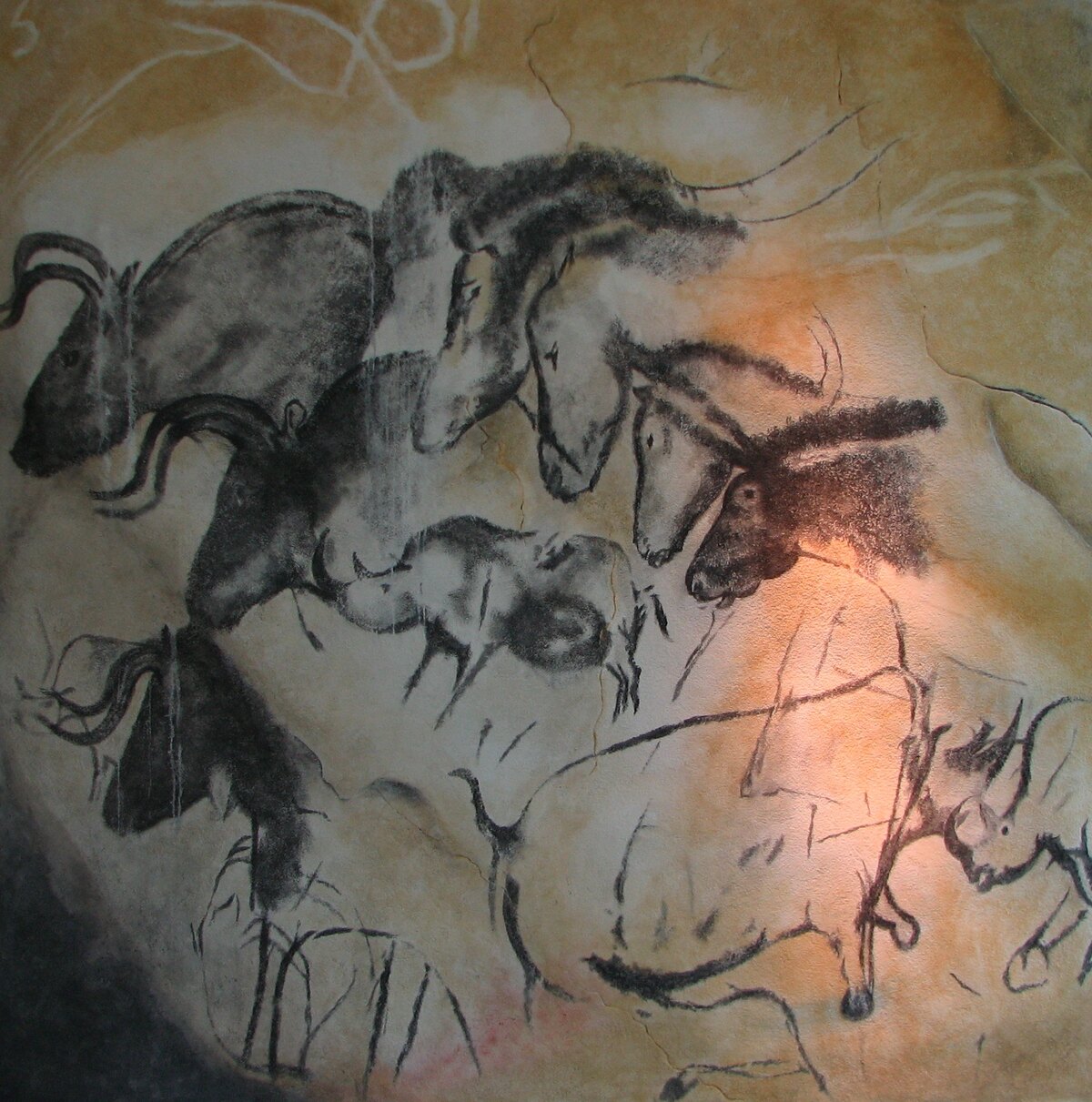
Yet the dating revealed a staggering age. Carried out by radiocarbon, uranium-thorium and chlorine 36 on more than two hundred samples, it places the decoration in the Aurignacian, between about 36,000 and 29,000 years ago, with a first phase between 37,000 and 34,000 years and a later occupation. The masterpieces of Chauvet are thus the oldest in France, some fifteen thousand years older than those of Lascaux.5 This antiquity proves that art had no faltering infancy: from the very oldest cave artCave (parietal) artArt made on the walls of caves and shelters (paintings, engravings), as opposed to portable art.→, artists already commanded the full range of techniques, from shading to outline, from scraping the wall to staging its relief. Chauvet imposes the idea of a fully constituted art at the very dawn of Cro-Magnon presence in Europe.
Lascaux, the Sistine Chapel of prehistory
On 12 September 1940, four teenagers, led by Marcel Ravidat who had spotted a hole a few days earlier, entered an unknown cavity near Montignac in the Dordogne. They discovered Lascaux, whose walls burst with colour: the famous Hall of the Bulls, seventeen metres long, lines up four immense aurochs painted in black, one of which exceeds five metres, surrounded by horses and deer.6
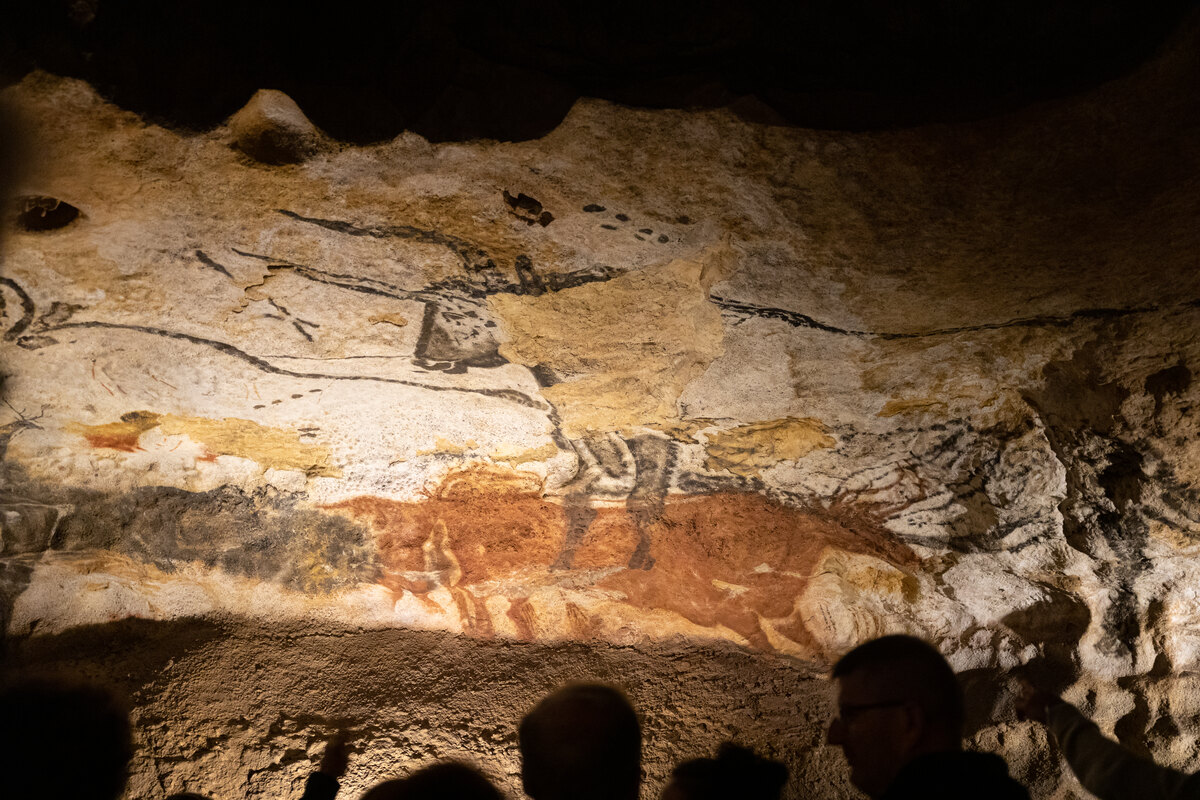
The dating of Lascaux has shifted over time. Abbe Breuil, a pioneer of the discipline, first assigned it to the Perigordian. Later studies of the objects, pigment analyses, radiocarbon and stylistic comparisons finally placed these frescoes in the Magdalenian, around 17,000 to 20,000 years before our era.6 Lascaux astonishes by the richness of its bestiary (horses, aurochs, deer, bison, a bear, a feline, a rhinoceros) and by enigmatic scenes, such as the one in the Shaft where a bird-headed man seems to fall before a disembowelled bison. Closed to the public in 1963 to protect paintings threatened by the flood of visitors, the cave is today reproduced by strikingly faithful replicas, from Lascaux II to Lascaux IV, which allow the wider public to approach this summit of Palaeolithic art.
Altamira, Cueva de las Manos (Patagonie) and Franco-Cantabrian art
The recognition of cave art came late and painfully. In 1879, at Altamira, near Santander in Spanish Cantabria, Marcelino Sanz de Sautuola was digging the floor of the cave when his eight-year-old daughter Maria looked up and cried out that she could see toros (bulls) on the ceiling.7 Sautuola had just brought to light one of the most sumptuous painted ceilings in prehistory, where sixteen polychrome bison hug the contours of the rock. Accused of forgery, he died without seeing his honour restored: the authenticity of Altamira was accepted only after similar discoveries multiplied elsewhere in Europe.
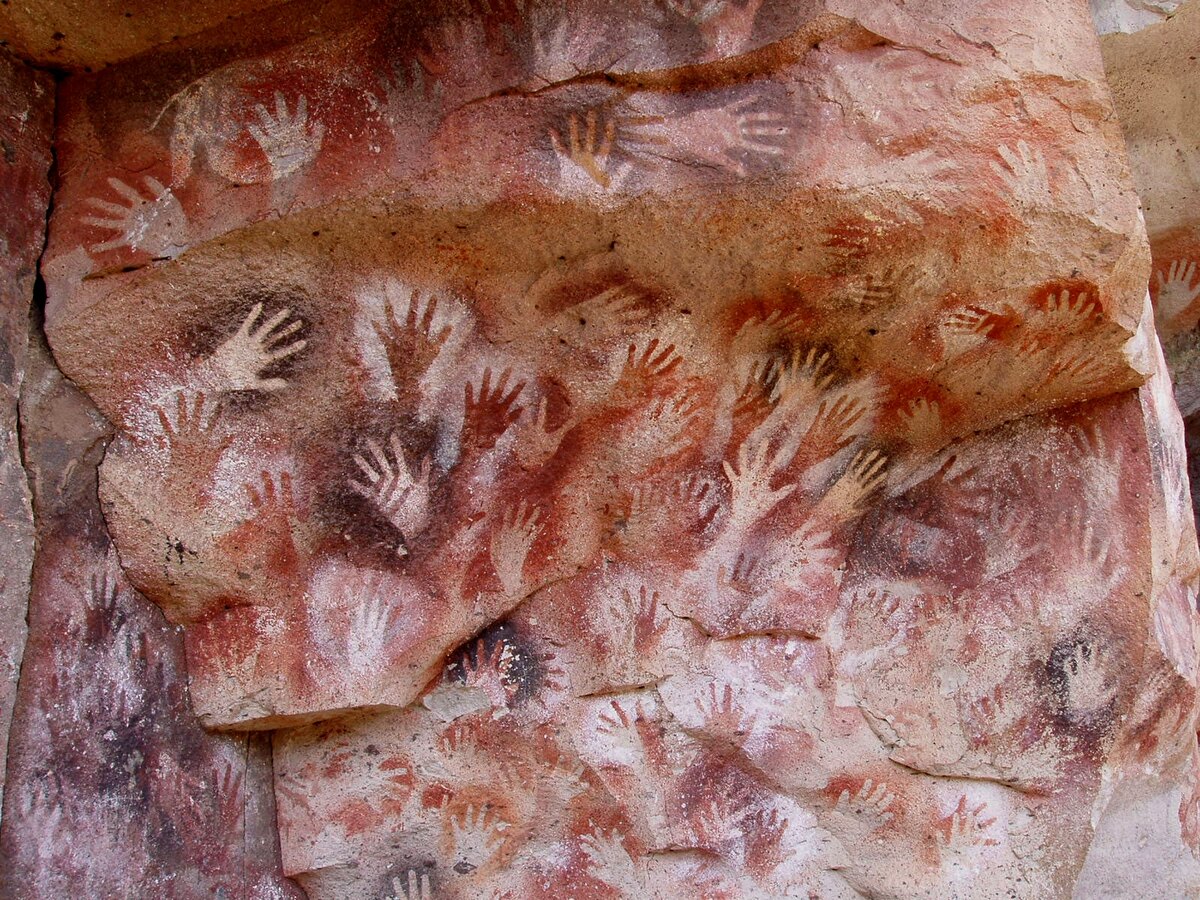
The Altamira bison, of striking realism and power, date to the Lower Magdalenian, between roughly 15,500 and 13,500 years before present. They embody what is called Franco-Cantabrian art, characterised by animal realism and the exploitation of the wall's relief. Further north, in the Lot, the cave of Cueva de las Manos (Patagonie) offers one of the most fascinating panels of the Palaeolithic: on a block 3.6 metres wide, two back-to-back horses spread out amid 252 dots, six black hand stencilshand stencilsHandprints made by blowing pigment around a hand pressed against the wall.→ and red thumb prints. The dating of one horse yielded about 24,600 years before present, that is the late Gravettian.8 The composition, playing on symmetry, alternation and the natural accidents of the wall (the outline of the rock forming a horse's head), reveals a plastic intention of disconcerting sophistication.
The techniques of the first painters
To understand cave art is first to grasp its material methods. The Palaeolithic palette rests on two registers: black and ochre. The black comes either from charcoal (juniper, pine) or, more rarely, burnt bone, or from manganese oxide. The ochres are clays laden with iron oxides, whose tint ranges from yellow to red-brown depending on the proportion of haematite or limonite, and which heating could alter.9
Application drew on a surprisingly varied set of tools. Artists used ochre crayons, charcoal sticks, their fingers, brushes of plant fibre or hair, moss pads and stencils. The blowing technique, doubtless the most spectacular, consisted of spraying chewed or diluted pigment directly onto the wall, sometimes with tubes of bone or reed. Applied over a hand pressed against the rock, it produced the famous hand stencils, true signatures of presence across the millennia. Engraving, finally, incised the outlines with flint, alone or combined with paint. Prehistorians have also demonstrated the use of grease lamps and torches, indispensable for working in the total darkness of the caves, as well as a deliberate choice of surfaces, the artist integrating cracks, bulges and concretions into the composition. Far from the image of instinctive daubing, these works testify to a transmitted, planned and deeply intentional skill.
Hunting, shamanism, symbolism: what do these images mean?
Why did these people decorate walls that were often inaccessible, plunged in darkness, far from living quarters? The question has haunted prehistory for a century and a half, and the answers have varied greatly. The first great hypothesis, that of hunting magic, saw in the painted animals a way of acting on the game, of capturing it through the image before killing it, or of ensuring its fertility. Attractive though it was, it ran up against the statistics: Andre Leroi-Gourhan showed that the proportion of animals bearing signs suggesting wounds or weapons remained minute, and that the depicted species did not always match those actually hunted.10
Leroi-Gourhan, precisely, proposed a structuralist reading in the 1960s. Analysing statistically the position of the motifs, he postulated an overall organisation of the cave, a genuine scenography in which the figures were distributed in a recurring order, with central and peripheral animals, entrance and rear species. In it he read a dualist system of thought, opposing and associating symbolic values. From the late 1990s, Jean Clottes and David Lewis-Williams renewed the debate by linking cave art to shamanismShamanismA set of beliefs and ritual practices based on communication between the living and a spirit world, mediated by a practitioner (the shaman) entering a trance state. The shamanic hypothesis has been proposed to interpret part of Palaeolithic parietal art.→. In this view, the caves would be places of contact with the spirit world, and certain figures, notably the geometric signs and the composite half-human, half-animal beings, would reflect visions experienced during altered states of consciousness, from light daydreaming to deep trance.10 None of these theories commands unanimous agreement today. Most researchers agree only on one point: these images were not mere decoration, but the expression of a complex symbolic system, doubtless bound up with the sacred, cosmology and group identity.
Portable art and the legacy of Cro-Magnon
Cave art is only the most monumental face of a creativity that also invested objects. As early as the Aurignacian, a portable art of extraordinary precocity appears. The Lion-Man statuette, discovered in 1939 in the Hohlenstein-Stadel cave in Germany and carved from mammoth ivoryMammoth ivoryMammoth tusk worked by Palaeolithic craftspeople to carve figurines, beads, points and ornaments.→, depicts a composite being with a human body and a lion's head: this therianthrope, about 40,000 years old, ranks among the oldest figurative sculptures in the world and suggests the existence, from the very beginning, of mythological thought.11
The Gravettian then saw the multiplication of the female statuettes known as Palaeolithic Venuses, such as the Venus of Willendorf or that of Lespugue, discovered in 1922 and carved from ivory. Measuring from a few centimetres to around twenty, in ivory, soft stone or terracottaTerracottaClay shaped and then hardened by firing; the material of pottery, bricks and figurines, ubiquitous since the Neolithic.→, these figures with accentuated forms have been interpreted, without certainty, as symbols of fertility, idealised representations of woman or ritual figures. Their wide distribution across Europe, from the Pyrenees to Siberia, points to shared conventions and perhaps to exchanges of ideas over vast distances, a sign that these hunter-gatherer bands were bound by networks far broader than a single valley. The Magdalenian, finally, covered bone, reindeer antler and pebbles with engravings of remarkable delicacy, from sculpted spear-throwers to decorated plaquettes. From the discovery of 1868 to the staggering dates of Chauvet, the story of the Cro-Magnon people is that of the irruption of the symbol into the world. In thirty millennia, these hunter-gatherers invented painting, sculpture, ornament and, most likely, narrative. Their hands pressed on the rock, their bison and their horses still speak to us, crossing the abyss of time to remind us that the need to create images is as old as modern humanity itself.
No comments yet. Be the first.