In March 1868, workers digging a railway cutting near Les Eyzies-de-Tayac in the Dordogne region of France uncovered a small natural cavity beneath a rocky overhang. Inside: five human skeletons, perforated shells, stone tools. Geologist Louis Lartet, called to the scene, identified the remains of Homo sapiensHomo sapiensThe present-day human species, which emerged in Africa around 300,000 years ago, the only surviving human lineage after the extinction of Neanderthals and Denisovans.→ dating to around 28,000 years ago. The Cro-Magnon man had just entered the history of science , and with him, a question that has never ceased to fascinate us: where does our irrepressible urge to leave traces, to draw, to paint, to depict the world on cave walls, come from?
Who Was Cro-Magnon?
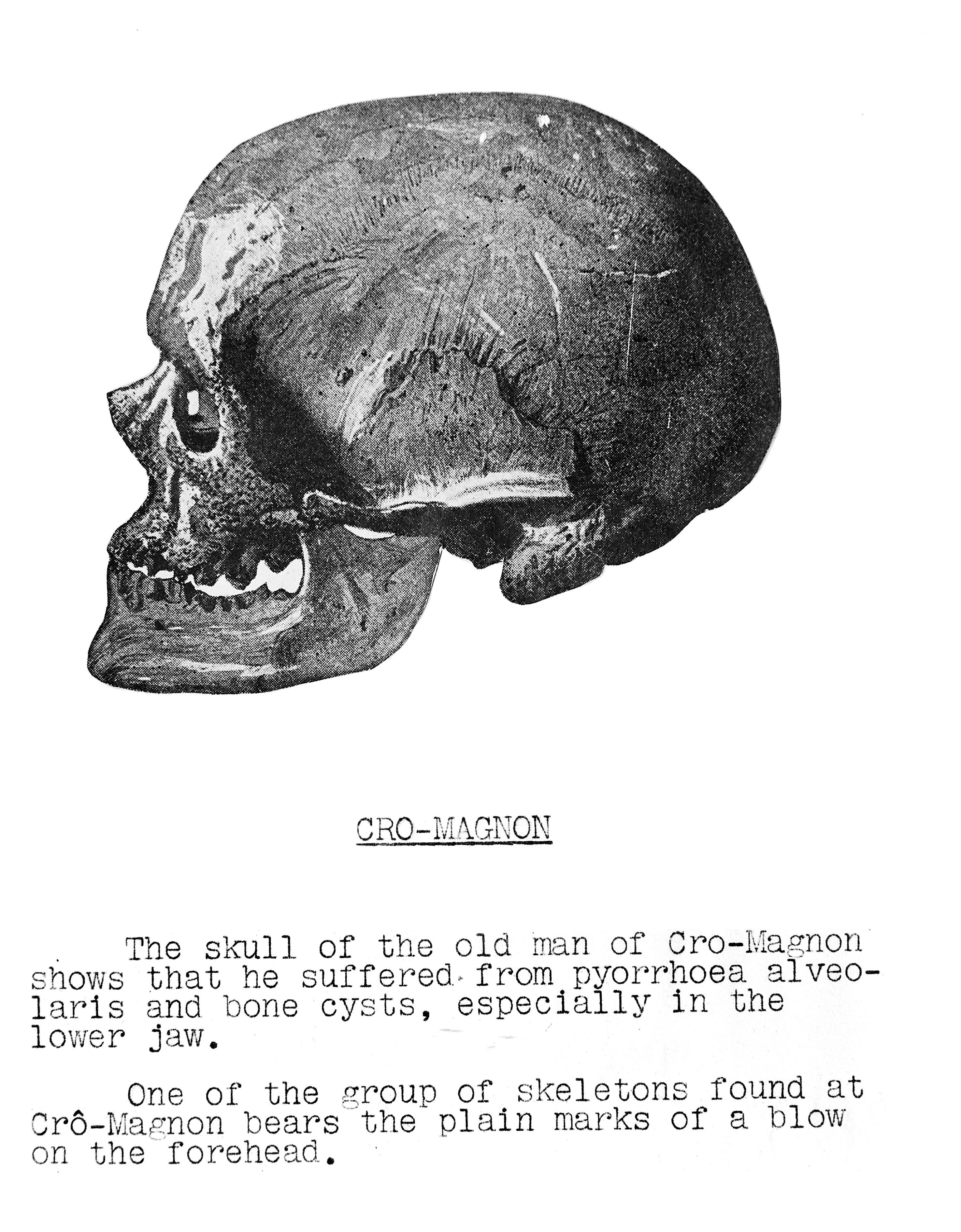
The expression "Cro-Magnon man" now designates, by extension, all Homo sapiens of the European Upper PalaeolithicUpper PalaeolithicThe final phase of the Palaeolithic (c. 45,000 to 10,000 years ago), marked by Homo sapiens in Europe, art, ornaments and a succession of cultures (Aurignacian, Gravettian, Solutrean, Magdalenian).→, between roughly 45,000 and 10,000 years ago. This is not a distinct species: biologically, Cro-Magnon is us. Same brain, same cranial capacity, same post-cranial skeleton morphology. If you dressed the "Old Man of Cro-Magnon" in modern clothing and passed him on the street, you would notice nothing unusual.
What distinguishes these men and women from their predecessors is therefore less biology than behaviour. They bury their dead with offerings. They adorn themselves with necklaces of shells and ivory beads. They make musical instruments , bone flutes found in Germany dating to 42,000 years ago. They engrave, sculpt, paint. And, above all, they venture deep into the earth, carrying animal-fat lamps, to cover the walls of inaccessible caves with animal figures.
The Arrival in Europe: 45,000 Years Ago
The presence of Homo sapiens in Europe dates to around 45,000 years ago, during what prehistorians call the AurignacianAurignacianThe earliest culture of the European Upper Palaeolithic (c. 43,000–33,000 BC), tied to the arrival of Homo sapiens and the first artworks.→ , named after a village in the Aveyron where this culture was first identified. These Sapiens came from the Near EastNear EastA region of western Asia (Levant, Mesopotamia, Anatolia, Iran), cradle of the Neolithic revolution, agriculture, the first cities and writing.→, themselves carriers of an older migration out of East AfricaAfricaThe cradle of humankind: the continent where the first hominins appeared, then Homo sapiens around 300,000 years ago, before the expansion to the rest of the world.→. They did not find Europe empty: NeanderthalsNeanderthalsA fossil humanity of Eurasia, robust and cold-adapted, extinct around 40,000 years before present.→ had lived there for at least 400,000 years.
Coexistence lasted between 2,600 and 5,400 years depending on the region , long enough for exchanges to have taken place, including genetic ones. Non-African modern humans carry between 1 and 4% Neanderthal DNADNAThe molecule carrying genetic information, used to reconstruct kinship between species.→ today. Then Neanderthals disappear, around 40,000 years ago. The causes remain debated: resource competition, epidemics, demographic pressure, perhaps also the inability to adapt to rapid climateClimateThe long-term average atmospheric conditions of a region; its variations (glaciations, aridifications) shaped migrations, agriculture and the collapse of prehistoric societies.→ change. What is certain is that the Cro-Magnons did not stop painting.
The Symbolic Revolution: When Humanity Invented Art
The emergence of art is neither sudden nor exclusively European. Abstract engravings on ochreOchreA red or yellow mineral pigment (iron oxides), used from prehistory for adornment, funerary rites and art.→ found at Blombos Cave in South Africa date to 77,000 years ago. Perforated shell ornaments appear in the Maghreb around 130,000 years ago. But it is in Europe, from the Aurignacian onwards, that art reaches a density, sophistication, and continuity unparalleled elsewhere in the world: over 400 decorated caves, spread from Cantabrian Spain to the Russian Urals, over a period of 30,000 years.
What triggers this creative explosion? Hypotheses abound. Some researchers evoke a neurological mutation enabling complex symbolic thought. Others defend the idea of a demographic threshold , enough people, close enough together, for cultural innovations to spread and accumulate. Still others point to the adaptive pressure of the Last Glacial MaximumLast Glacial MaximumThe peak of the last glaciation (c. 26,000 to 19,000 years ago), with ice sheets at their greatest extent; it pushed populations towards southern refuges.→: in a world of tundra and glaciers, art may have served to cement group identity, map hunting territories, and transmit survival knowledge.
Font-de-Gaume: The Last Painted Sanctuary Still Open to the Public
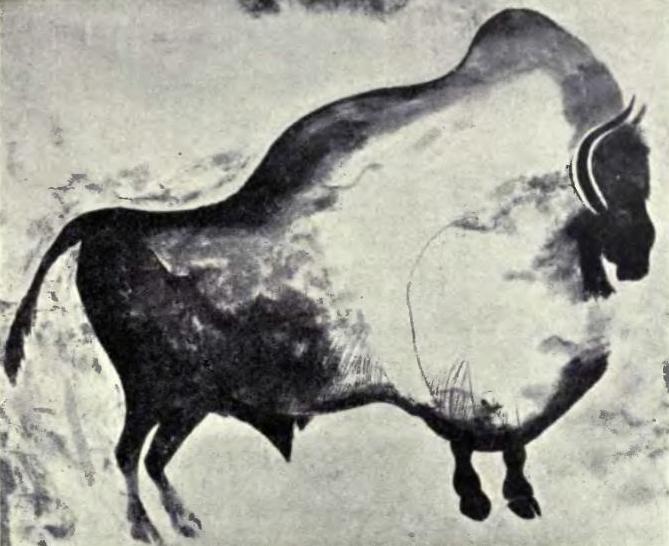
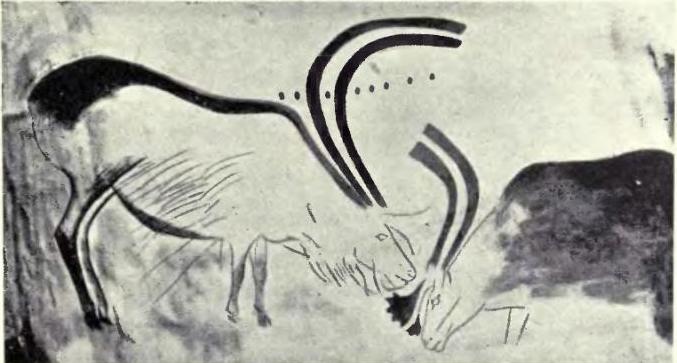
Two kilometres from Les Eyzies, in a wooded limestone gorge, the cave of Font-de-Gaume preserves one of the most remarkable ensembles of polychrome cave art ever discovered. Rediscovered in 1901 by schoolteacher Denis Peyrony, it contains over 230 painted and engraved figures , bison, mammoths, reindeer, woolly rhinoceroses, cave bears , some fifty of them in colour. It is, to date, the only decorated MagdalenianMagdalenianThe last great Upper Palaeolithic culture (c. 17,000–12,000 BC), the peak of cave art (Lascaux).→ cave still accessible to the public in France.
What strikes immediately is the modernity of the gesture. The artists of Font-de-Gaume did not merely trace outlines: they modelled volumes by exploiting the natural reliefs of the rock, used multiple pigments (red and yellow ochre, black manganese, white kaolin), blended colours, and depicted movement. The bison frieze, several metres long, shows animals galloping, charging, lying down. One is rendered in perfect perspective, facing us. We are contemplating a work of art in its own right, born 17,000 years ago.
Altamira: The "Sistine Chapel" of PrehistoryPrehistoryThe span of human history before the invention of writing, from the Palaeolithic to the Metal Ages, known mainly through material remains.→
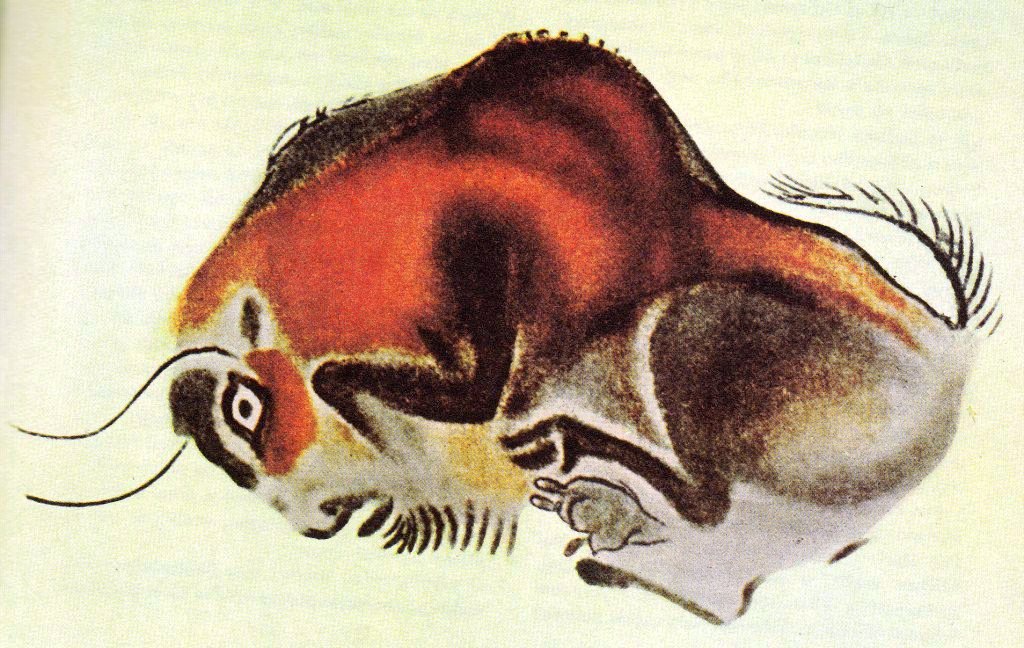
In 1879, Marcelino Sanz de Sautuola explored a cave on his land in Cantabria, Spain. His eight-year-old daughter María looked up at the ceiling and exclaimed: "Mira, papá, bueyes pintados!" (Look, papa, painted bulls!). Her father saw polychrome bison of breathtaking perfection. He published his discovery in 1880. The scientific community's reaction was unanimous: it was a forgery. No "primitive" could have produced such masterpieces.
It would take until 1902 and the discovery of several other indisputable decorated caves for Altamira's prehistoric authorship to be recognised. Sautuola had died in 1888, never rehabilitated. The "Sistine Chapel of prehistory" , the phrase is Abbé Breuil's , now contains some 150 figures, including about fifty remarkably well-preserved bison. The Magdalenian artists exploited the dips and bumps of the limestone ceiling to give relief to the animals' bodies: some appear genuinely three-dimensional, as if sculpted from the rock.
Lascaux and the Question of Meaning
Discovered in 1940 by four teenagers and their dog Robot, the cave of Lascaux has yielded nearly 2,000 figures along some 100 metres of galleries. Horses, aurochs, deer, bison, rhinoceroses, bears , and, in the shaft, this scene unique in prehistoric art: a man knocked down by a disembowelled bison, with a rhinoceros walking away nearby. The only known narrative scene from the Upper Palaeolithic.
The question of the meaning of all this art remains one of prehistory's most debated. Interpretations have succeeded one another for a century and a half. The hypothesis of art for art's sake is now largely abandoned: the decorated caves are too deep, too difficult to access to be mere leisure studios. The theory of hunting magic, long defended by Abbé Breuil , painting an animal is symbolically capturing it , runs into the problem that depicted species do not always match hunted ones. The shamanismShamanismA set of beliefs and ritual practices based on communication between the living and a spirit world, mediated by a practitioner (the shaman) entering a trance state. The shamanic hypothesis has been proposed to interpret part of Palaeolithic parietal art.→ hypothesis, popularised by David Lewis-Williams, suggests the artists were shamans reproducing hallucinations from altered states of consciousness. Leroi-Gourhan's structuralist theory sees the caves as temples organised according to a symbolic grammar reflecting a prehistoric cosmology.
The mystery of the negative hands: in over a hundred caves worldwide, prehistoric artists placed their hand on the wall and blew pigment around it. These "negative hands" are humanity's earliest signatures. Some show folded or missing fingers , possibly ritual amputations, possibly a symbolic convention. They appear in France, Spain, Argentina, and Indonesia, over a span of 40,000 years. It is the most universal and most persistent gesture of our species.
The Technique: Accomplished Artists
PalaeolithicPalaeolithicThe oldest and longest period of prehistory (c. 3.3 Ma–12,000 BC), defined by chipped stone tools and a hunter-gatherer way of life.→ cave art is not the work of fumbling beginners. Recent analyses reveal artists mastering an elaborate technical repertoire. Pigments , ochres (red and yellow iron oxides), manganese (black), kaolin (white) , were ground, mixed with animal fat or water, sometimes heated to alter their hue. They were applied with fingers, pads of moss or hide, blown through hollow bones , the first airbrushes in history.
Lighting posed a major challenge. Working in the total darkness of deep caves required fat lamps , small stone cups containing marrow or animal fat, with a wick of moss or plant fibres. Dozens of these lamps have been found in Palaeolithic deposits. Some bear engravings themselves, as if the lighting object also participated in the symbolic world.
Cro-Magnon's Legacy: A Continuous Presence
Contrary to popular belief, Cro-Magnon did not "disappear." The Upper Palaeolithic European populations are the direct ancestors , among others , of today's Europeans. Genetic analyses published since 2014 show genomic continuity between Cro-Magnons and the MesolithicMesolithicThe period between the Palaeolithic and the Neolithic (c. 10,000–6,000 BC in Europe), still based on hunting and gathering.→, then NeolithicNeolithicThe "New Stone Age": a period marked by farming, herding, settlement and pottery, from around 10,000 BC.→, then modern populations of Western Europe. We are their descendants.
What we have inherited from them is difficult to measure. Perhaps the taste for narrative. Perhaps the obsession with depicting the living. Perhaps simply this gesture , placing a hand on a surface and leaving a mark , that every child repeats spontaneously, everywhere in the world, as if re-enacting something as old as our species itself.
J'ai visité ce type de site l'année dernière. Cet article met parfaitement en contexte ce que j'avais observé.
La façon dont vous reliez l'objet à son contexte humain est exactement ce qu'on cherche en médiation.
L'art pariétal de Cro-Magnon représente un saut cognitif extraordinaire dans l'histoire de notre espèce. La capacité à représenter le monde visible sur une surface plane, à utiliser la perspective et le mouvement, implique des capacités d'abstraction et de symbolisation comparables aux notres. Ce bond créatif reste l'un des grands mystères de la paléoanthropologie.
Le terme Cro-Magnon est encore largement utilisé dans la vulgarisation mais il tend à disparaitre de la littérature scientifique au profit d'Homo sapiens à anatomie moderne. L'abri de Cro-Magnon en Dordogne reste néanmoins un site de référence historique pour la définition morphologique de ces premiers Européens. Les peintures qu'ils ont laissées témoignent d'une pensée symbolique pleinement développée.