Between the fifth and the fourth millennium BC, across a vast arc of land that today covers eastern Romania, the Republic of Moldova and central Ukraine, communities of farmers built one of the most striking civilisations of European prehistoryPrehistoryThe span of human history before the invention of writingWritingA system of conventional signs used to fix language or information durably; its appearance (c. 3300 BC) marks, by convention, the end of prehistory.→, from the PalaeolithicPalaeolithicThe oldest and longest period of prehistory (c. 3.3 Ma–12,000 BC), defined by chipped stone tools and a hunter-gatherer way of life.→ to the Metal Ages, known mainly through material remains.→. It is known by a double name, Cucuteni-TrypilliaCucuteni-TrypilliaA vast Eneolithic culture of south-eastern Europe (c. 5000–3000 BC), spread across Romania, Moldova and Ukraine. Famous for its spiral-painted pottery, its figurines and its huge settlements of several thousand inhabitants, sometimes cyclically burned and rebuilt.→, because archaeologists first identified it in two neighbouring countries, under two different labels, before realising it was a single shared world. This EneolithicEneolithicThe "Stone-and-Copper Age": a transition between the Neolithic and the Bronze AgeBronze AgeA protohistoric period following the Neolithic, defined by bronze metallurgy (a copper-tin alloy) and the rise of the first cities and states; in Egypt it corresponds to the age of the first pyramids.→ (c. 5000–3000 BC in south-eastern Europe), marked by the first copper objects, large farming settlements and, in places, the rise of fortified sites. Broadly synonymous with ChalcolithicChalcolithicThe "Copper Age": a transition between the Neolithic and the Bronze Age, marked by the first copper objects (Ötzi's era).→.→ culture produced painted pottery of almost abstract elegance, thousands of clay figurines, and above all settlements of a scale that defies imagination: sites of several hundred hectares, perhaps home to ten thousand people or more, over a thousand years before the first cities of Mesopotamia. These "megasites" lie at the heart of a fascinating debate today: were they cities? And if so, what does that change about our story of the origins of urbanism?1
For a long time the history of the first cities seemed simple. Their birth was placed in Mesopotamia around 3500 BC, around centres such as Uruk: densely built, dominated by temples and palaces, ruled by kings and priests, equipped with writing to keep accounts. The Trypillian megasites, older and just as populous, resemble none of this. They were vast yet open, with no palace and no obvious monumental temple, no princely tombs, no writing. They force us to ask whether the city, from its very origin, necessarily took the hierarchical form we know, or whether other paths towards large human settlement existed, and then vanished.
The Eneolithic world north of the Black Sea
To understand Cucuteni-Trypillia, one must first picture the world in which this culture flourished. We are in the EneolithicEneolithicThe "Stone-and-Copper Age": a transition between the Neolithic and the Bronze Age (c. 5000–3000 BC in south-eastern Europe), marked by the first copper objects, large farming settlements and, in places, the rise of fortified sites. Broadly synonymous with Chalcolithic.→, sometimes called Chalcolithic or "Copper Age": a long transitional period between the fully agricultural NeolithicNeolithicThe "New Stone Age": a period marked by farming, herding, settlement and pottery, from around 10,000 BC.→ and the Bronze Age, when the first copper objects appear without yet replacing stone. In south-eastern Europe this period stretches roughly from 5000 to 3000 BC. The societies that inhabit it are already accomplished farming communities: they grow cereals, raise herds, live in permanent villages and make pottery of great sophistication.
The land north of the Black Sea was a crossroads. To the west lay the Carpathians and the Danube; to the east, the immense Pontic steppes stretching to the Volga and beyond; to the south, the sea and, past its shores, the first civilisations of Anatolia and the Near EastNear EastA region of western Asia (Levant, Mesopotamia, Anatolia, Iran), cradle of the Neolithic revolution, agriculture, the first cities and writing.→. It was a contact zone between very different worlds: that of the settled farmers of the forest-steppeSteppeA vast semi-arid, treeless grassland of Eurasia, suited to nomadic herding and the horse; a corridor for the movement of peoples and technologies in later prehistory.→, rich in exceptionally fertile black soils, and that of the mobile herders of the open steppe, whose descendants, the peoples of the Yamnaya culture, would later play a decisive role in the history of Europe.
The climateClimateThe long-term average atmospheric conditions of a region; its variations (glaciations, aridifications) shaped migrations, agriculture and the collapse of prehistoric societies.→ of the time, warmer and wetter than today during the HoloceneHoloceneThe current geological epoch, begun about 11,700 years ago at the end of the last ice age; the setting of all post-glacial history.→ climatic optimum, favoured agricultureAgricultureThe cultivation of plants and production of food by working the soil, which emerged in the Neolithic in the Near East and independently elsewhere; it radically transformed human societies.→ on these loess lands. Trypillian communities settled by preference in the forest-steppe, that mosaic landscape where groves alternate with meadows. Wood was abundant, water accessible, soils easy to work. It was this generous ecological setting that ultimately made possible the concentration of vast populations in a single place, where poorer lands could never have fed such crowds.
But the Eneolithic north of the Black Sea was no isolated world. Analyses reveal exchange networks circulating Balkan copper, fine flintFlintA hard, brittle siliceous rock, knapped by prehistoric people to produce blades, points and sharp tools.→, salt and marine shells. Cucuteni-Trypillia belongs to a vast constellation of related south-east European cultures, including Gumelnița, Vinča and Karanovo, sharing a common Balkan Neolithic background. It was on this shared foundation that the Trypillian culture developed its most original features, until, through its scale and its giant sites, it became a phenomenon with no real equivalent.
Discovery and the reach of the culture
The history of research explains the culture's double name. In 1884 the Romanian archaeologist Teodor Burada noticed sherds of painted pottery near the village of Cucuteni, in Romanian Moldavia, not far from Iași. The excavations that followed revealed pottery of unexpected quality, and the village name gave its label to the culture on the Romanian side. A few years later, in 1893, the Czech-born archaeologist Vikentiy Khvoyka uncovered very similar remains near the village of Trypillia, south of Kyiv. On the Ukrainian and Russian side, the culture would therefore be called Trypillia, or Tripolye.
Across this vast culture stretched a duration that is exceptional in itself. More than two thousand years separate the first Pre-Cucuteni villages from the final dissolution of the culture: a span longer than the one that separates us from the Roman Empire. Throughout these centuries a single technical and symbolic tradition was maintained, transmitted and reinvented across a territory the size of several modern European states. This continuity, in a world without writing, points to remarkably robust cultural mechanisms, capable of transmitting complex skills and precise aesthetic codes across dozens of generations.
It would take time to understand that Cucuteni and Trypillia were not two distinct cultures but two faces of a single whole, divided by a modern political border that obviously meant nothing in the Eneolithic. Today scholars speak of a Cucuteni-Trypillia cultural complex, or CTC, spread over some 350,000 square kilometres, from the eastern foothills of the Carpathians to the Dnieper. It is one of the largest cultural areas of prehistoric Europe.
Researchers classically distinguish three broad phases. The early phase, sometimes labelled Pre-Cucuteni or Trypillia A, runs roughly from 5050 to 4500 BC; this is the time of the culture's formation, with still modest villages. The middle phase, Cucuteni A-B and Trypillia B, sees the culture reach full maturity and maximum extent between 4500 and 3900 BC; it is also the time of the largest sites. The late phase, Trypillia C, leads down to around 3000 BC through a slow transformation and the gradual dissolution of the phenomenon.
Across this huge territory several thousand sites have been recorded, from hamlets of a few houses to giant settlements. The density of occupation at certain phases is remarkable: the forest-steppe between the Southern Bug and the Dnieper is literally studded with settlements. It is in this zone, in the heart of present-day central Ukraine, in the Cherkasy and Kirovohrad oblasts, that the famous megasites are found, the ones that made the culture famous and fuelled the debate over early urbanism.
Nor should these populations be imagined as frozen isolates. The Trypillians lived in a world of movement, contact and exchange, where ideas travelled with objects. The remarkably uniform diffusion of ceramic styles, the sharing of almost identical urban plans from one site to another, the circulation of distant raw materials, all point to active communication networks, the movement of people, perhaps periodic festivals and gatherings that cemented belonging to a single cultural world across the scattering of villages.
Painted pottery and figurines
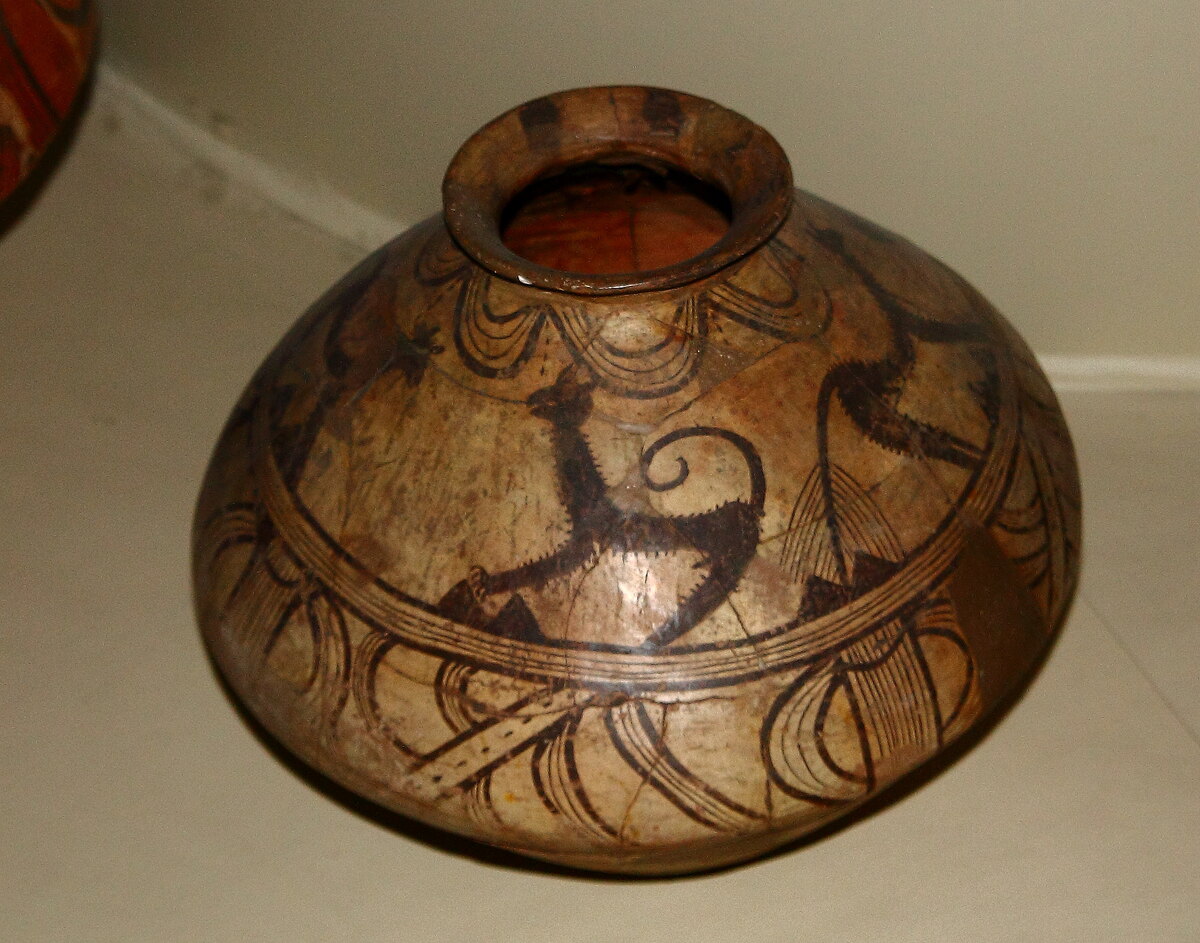
If one thing sums up Cucuteni-Trypillia for the general public, it is its pottery. Trypillian potters produced, without the wheel, by hand, vessels of astonishing variety: large storage jars, bowls, beakers, binocular vases, openwork stands. But it is the decoration that strikes. On a pale slip ground, the craftsmen drew, before firing, motifs painted in brown, red and black: coiled spirals, chained curved bands, meanders, sometimes stylised animal or human figures. The effect is rarely dynamic, as if the surface of the vessel were in perpetual motion.
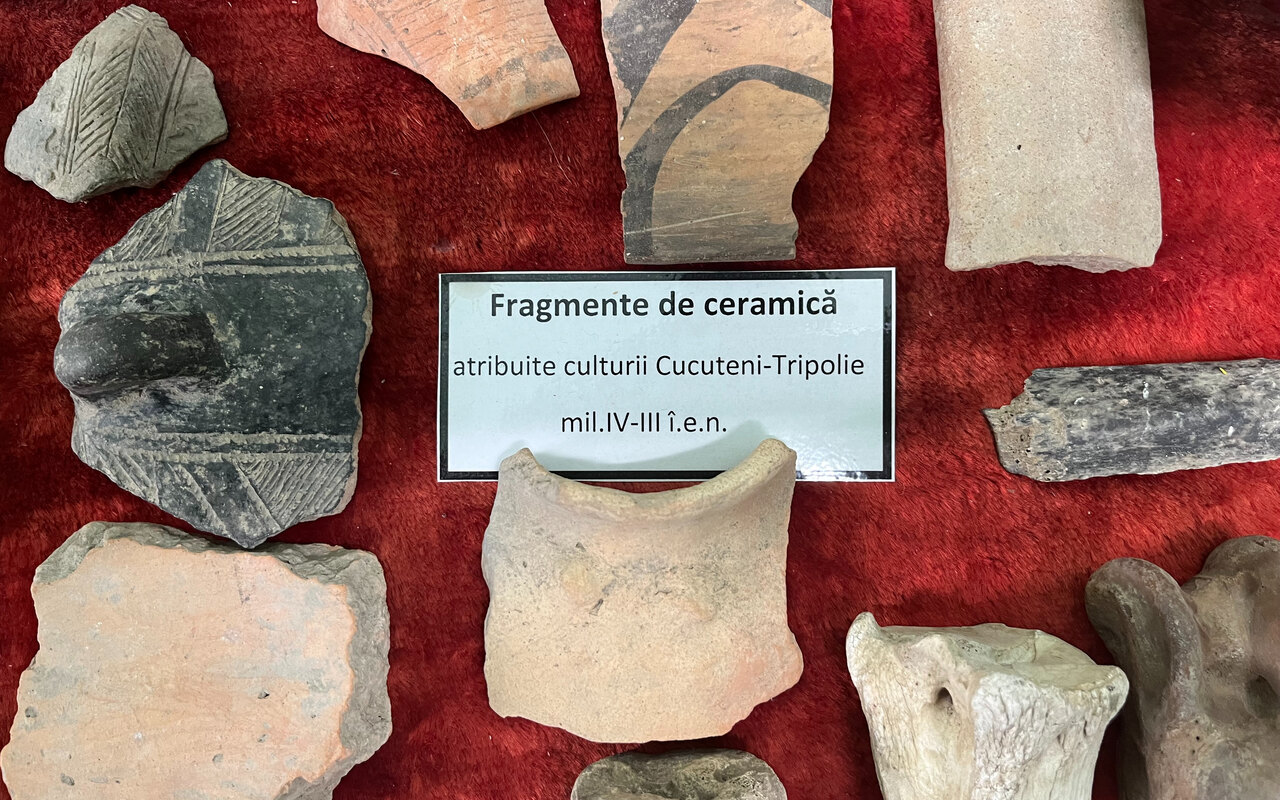
This pottery is more than ornament. Its manufacture implies a fine knowledge of clays, slips and kilns capable of reaching high, steady temperatures. Some vessels, by their size and delicacy, must have required specialised skill. The consistency of decorative repertoires over great distances suggests a genuine shared visual grammar, passed down from generation to generation, perhaps charged with symbolic meanings we can no longer read. Spirals and meanders often evoke, in modern interpretations, cycles, water and fertility, though this can never be proven with certainty.
The internal organisation of these settlements also raises the question of the long term. The megasites did not appear overnight: they often resulted from a process of aggregation in which previously dispersed communities gathered in a single place, perhaps for reasons of security, agricultural opportunity or ritual cohesion. Understanding how families used to village autonomy agreed to live side by side by the thousand, following a common plan, is one of the most stimulating questions these sites raise. It implies forms of social coordination of which we perceive only the material traces.
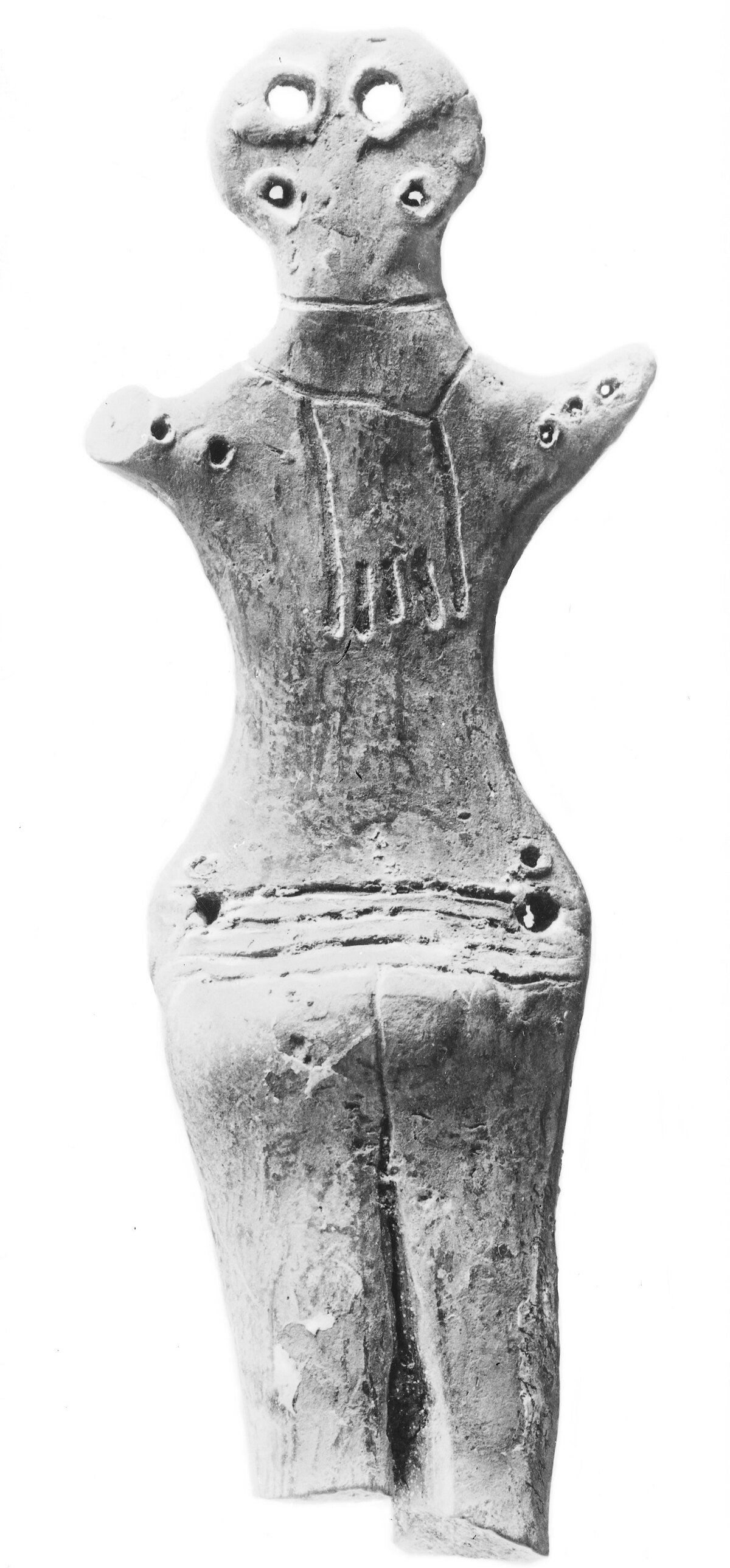
Alongside the vessels, Trypillian sites yield clay figurines by the thousand. Most depict stylised female silhouettes, with marked hips, sometimes seated, often incised with geometric motifs echoing those of the pottery. Following certain interpretations, these were long read as expressions of a "mother goddess" and fertility cult, in the lineage of the Neolithic idolsIdolA figurine, often of clay, depicting a figure (frequently female) or a deity; abundant in Neolithic and Eneolithic cultures such as Cucuteni-Trypillia.→ of south-eastern Europe. Archaeologists today are more cautious: these figurines could serve very diverse functions, ritual, educational, playful or domestic, and it would be simplistic to reduce them all to a single religion.
There are also scale models of houses, furniture and ovens, as well as male figurines, animal representations and miniature objects. This world of small terracottaTerracottaClay shaped and then hardened by firing; the material of pottery, bricks and figurines, ubiquitous since the Neolithic.→ things opens a precious window onto the imagination and daily life of the Trypillians. The house models in particular provide valuable clues about the actual architecture, of which archaeological remains often yield only the foundations and burnt debris. They show buildings with upper floors, gabled roofs and elaborate interior fittings.
The figurines, too, invite reflection on the role of ritual in everyday life. They turn up in houses, in pits, in special deposits, in contexts that suggest they were handled, displayed and eventually set aside or discarded according to rules we can only guess at. Some scholars stress that their abundance, their relative standardisation and their links with the ornament of the pottery point to a shared symbolic system rather than to individual artistic whim. Whatever their precise meaning, they embody a dense imaginative world that accompanied the Trypillians through the rhythms of birth, household life and renewal.
The megasites: Talianki, Maidanetske, Nebelivka
The real shock, for anyone discovering Cucuteni-Trypillia, comes from the megasites. From the 1970s onwards, aerial and geophysical surveys conducted in Soviet Ukraine, notably by Mykhailo Videiko and Volodymyr Kruts, revealed the existence of settlements of a truly staggering scale. At TaliankiMegasiteA very large prehistoric settlement of several hundred hectares and thousands of inhabitants, such as the Trypillian sites of Talianki or Maidanetske, organised in concentric rings of houses.→, in Cherkasy oblast, the site covers about 320 to 340 hectares, with estimates reaching nearly two thousand houses. At neighbouring Maidanetske, hundreds of buildings stand on some 200 hectares. At Nebelivka, finally, recent research has mapped close to 1,500 structures.2
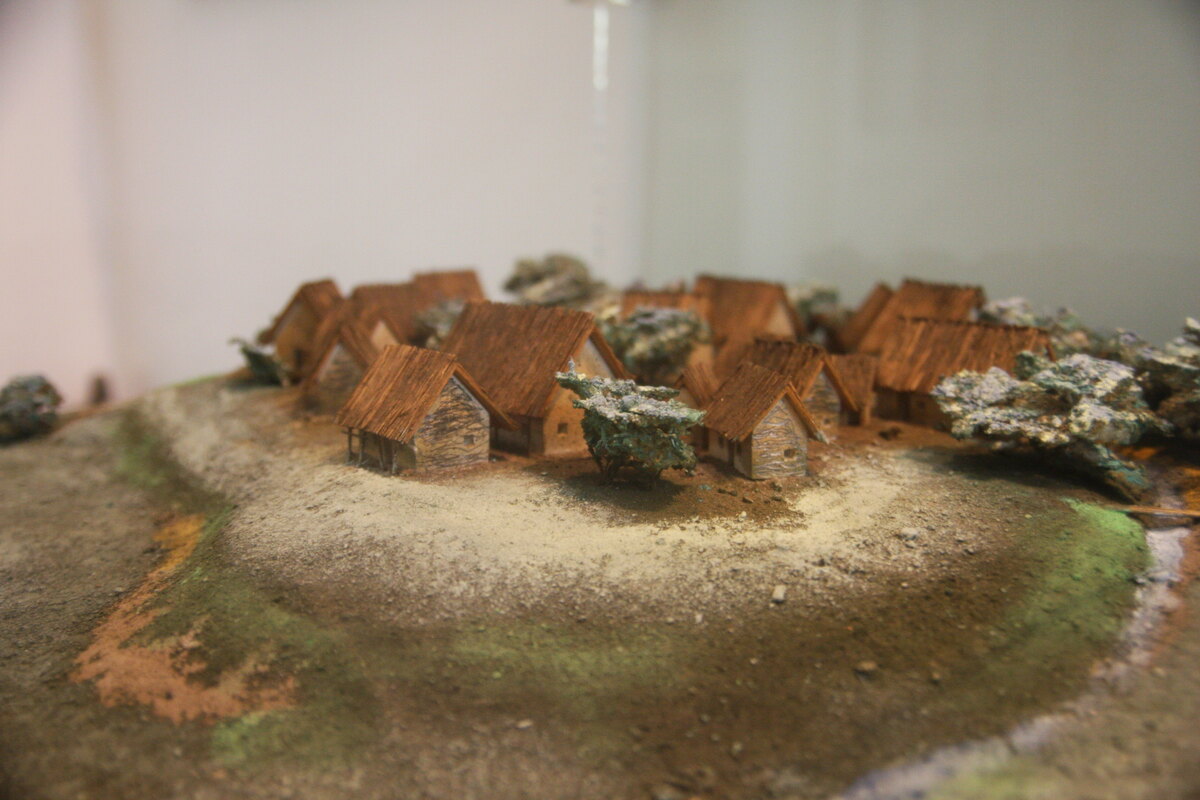
What makes these sites unique is not only their extent but their plan. Far from the disorder one might imagine, the Trypillian megasites display a strikingly regular organisation, revealed above all by magnetic survey, which detects beneath the surface the anomalies left by burnt houses. The buildings unfold in concentric circles, sometimes ten rings or more, around a large empty central space. Streets run between the rings, and larger buildings, perhaps communal, punctuate the whole at regular intervals.
The scale of planning this implies is considerable. Tracing concentric rings several kilometres in circumference, arranging streets and passages, reserving a central space, distributing special buildings: all of this implies a collective intention and an overall design. These curved cities are not the product of anarchic growth, house after house, but seem to obey a shared model, reproduced from one site to the next over great distances. This is one of the most baffling aspects of the phenomenon: sophisticated urban planningUrban planningThe planned organisation of urban space (streets, districts, water and drainage networks, public buildings); the Indus Civilisation offers an early and remarkable example.→ without the political hierarchy usually associated with such projects.
One should add that the meaning of these objects has shifted greatly in scholarship. The first generations of researchers, shaped by theories of fertility religions, readily projected onto the figurines and ceramic motifs a coherent, global religious system. Contemporary research is wary of these seductive but unverifiable reconstructions. It prefers to describe what it observes, the repetition of motifs, the contexts of discovery, the gestures of manufacture, and to acknowledge honestly the limits of our access to meaning. This caution in no way diminishes the richness of the material: it merely urges us not to fill the silences of the record with imagination.
Population estimates vary enormously according to methods and assumptions. The highest figures, inherited from Soviet archaeology, spoke of twenty thousand or even forty thousand inhabitants for the largest sites. More recent approaches, which account for the fact that not all houses were probably occupied at the same time, propose more cautious ranges, often of a few thousand to around ten thousand people at any one moment. Even at the low end, these are settlements without equivalent in Europe for the period, and among the most populous in the world of their time.
Proto-cities or not: the debate
The question is on everyone's lips: can these megasites be called cities? It all depends on what one means by the word. The British archaeologists Bisserka Gaydarska and John Chapman, who led major research at Nebelivka, argue for recognising these sites as fully urban, or at least "proto-urbanProto-urbanRefers to a large agglomerated centre with urban features (density, craft, communal functions) without being a city in the classical sense.→". Their argument rests on criteria of size, density, planning and function: by their scale, their spatial organisation and the concentration of activities they imply, the megasites meet, in their view, the conditions of a proto-cityProto-cityA very large settlement predating true cities, lacking certain urban features (state, writing, high density), whose status as a 'city' is debated, such as the Trypillian megasites.→.2
The method of magnetic survey deserves a pause, for it has literally revolutionised the study of these sites. By measuring the tiny variations in Earth's magnetic field caused by burnt soils, magnetometers allow a detailed plan of buried structures over hundreds of hectares to be drawn up without any excavation. It is thanks to this technology that the true scale of the megasites emerged: no longer a few houses dug here and there, but complete plans, ring after ring, showing hundreds or even thousands of organised buildings. This overall picture changed everything and made the very debate over their urban character possible.
Other researchers are more reserved. The classic definition of the city, inherited notably from work on Mesopotamia, stresses density of building, the presence of centralised institutions, an administration, public monuments and marked social stratification. Yet the Trypillian megasites, despite their size, are relatively low in density: the houses are spaced out, leaving room for gardens and yards, and scholars have spoken of "low-density urbanism", a phrase that brings these sites closer to very different phenomena, such as the vast settlements of ancient Amazonia or sub-Saharan AfricaSub-Saharan AfricaThe part of Africa south of the Sahara; cradle of Homo sapiens, long thought hostile to ancient-DNA preservation because of heat.→.
The heart of the debate concerns the apparent absence of hierarchy. On the megasites there are no palaces, no dominant monumental temple, no princely tombs heavy with riches, no clear sign of centralised power. The houses closely resemble one another; disparities of wealth, if they exist, remain discreet. For Gaydarska and Chapman this suggests a form of egalitarian urbanity, a great settlement that governed itself, by assembly and consensus, without king or bureaucracy. A city without a state, in short, opening dizzying perspectives on the diversity of political forms possible at the origins of human complexity.
The excavations, for their part, supply the flesh that geophysics cannot give. At Nebelivka as at Maidanetske, decades of fieldwork have clarified the nature of the buildings, the chronology of occupations and domestic practices. Among the structures detected by magnetometer, it has been possible to distinguish dwelling houses from larger buildings, and to attempt to estimate how many were occupied at the same time. This dialogue between large-scale survey and targeted excavation lies at the heart of the modern method, and it underpins the refined population estimates.
Sceptics object that the absence of evidence for hierarchy is not proof of its absence, and that organising and maintaining such a settlement over several centuries must have required decision-making mechanisms whose exact nature escapes us. The debate is therefore not settled. But it has already had a major effect: it has shattered the idea that the first form of large human settlement was necessarily the hierarchical city-state of the Near East. Cucuteni-Trypillia shows that, at least once, another path existed.
The riddle of the burnt houses
Among all the mysteries of this culture, the most striking is surely that of the burnt houses. On the great majority of Trypillian sites, the houses ended up burned. And everything indicates that, in many cases, this fire was not accidental but deliberate. The practice is so systematic that archaeologists speak of "burned houses", and it has become a diagnostic trait of the culture. Understanding why people would deliberately burn their own homes, sometimes their entire village, is one of the great open questions of European prehistory.
The signs of intentional burning are numerous. Trypillian houses were built of wood and wattle-and-daub, that is, of clay-coated wickerwork. For such a structure to burn hot enough to vitrify the clay and fire the walls like pottery requires intense, prolonged heat, which an ordinary accidental fire cannot produce. Fuel had to be added, wood piled inside, the blaze kept going. In many cases the houses seem to have been burned while still containing furniture, vessels, sometimes grain stores, as if a complete and functioning household had been knowingly given to the flames.
Yet any definition is partly conventional. Deciding whether the megasites "deserve" the name of city sometimes amounts to a debate about vocabulary. The real, deeper issue lies elsewhere: it is about understanding how very large populations were able to coexist over time, how they organised, fed and governed themselves, and what this teaches us about the capacities of human societies. Whether one opts for "city", "proto-city" or "large low-density settlement", what matters is the intellectual challenge posed by the very existence of these places, and the need to widen our categories to think about them.
Interpretations abound. Some see a rite linked to the life cycle of the household: at the death of a head of family, or at the end of a generation, the house might have been "killed" by burning, as one buries the dead. Others invoke a logic of periodic renewal of the community, a great fresh start punctuating collective life every two or three generations. Still others offer more prosaic explanations: clearing infested buildings, deliberately producing platforms of fired daub to rebuild upon, or simply managing ageing structures. No hypothesis commands unanimity, and several motives may have coexisted.
Whatever the reason, this cyclical burning has a major consequence for archaeology. Fired daub, turned into a kind of shapeless brick, resists time far better than raw clay, and leaves a strong magnetic signature in the soil. It is precisely this that allows the megasites to be mapped house by house today using geophysical surveyGeophysical surveyTechniques (magnetometry, radar) detecting buried structures underground without digging, by measuring physical anomalies.→, without even digging. Paradoxically, then, it is the systematic destruction of Trypillian houses that allows us to find them again and to measure the staggering scale of their settlements.
The very rhythm of construction and destruction shaped the landscape over time. Where houses were burnt and rebuilt on the same spots, layers of fired daub accumulated, raising the ground and leaving lasting marks. Over generations, the cumulative effect of building, burning and rebuilding turned these places into palimpsests of human activity, each new settlement inscribed upon the traces of the last. This deep stratification of habitation is itself a form of memory, a way in which the community recorded its own continuity in the very substance of the soil it lived upon.
Economy, agriculture, society
How were thousands of people gathered in one place fed? The Trypillian economy rested on cereal agriculture, mainly emmer wheat, barley and various legumes such as peas and lentils. Herding held an important place: cattle, sheep, goats and pigs, with cattle no doubt also serving as draught animals. Hunting and gathering supplemented the diet, but most resources came from the fields and herds worked around each settlement.
One must also weigh what burning represents as effort and as sacrifice. To burn a full house, with its stores and furniture, is to destroy considerable value, the fruit of months of labour. That a society would accept doing so repeatedly, over generations, says much about the place of the symbolic in its collective life. It suggests that the Trypillian house was not merely a shelter but an entity charged with meaning, tied to the cycle of the family that inhabited it, whose end had to be marked by a powerful act. In this sense, the riddle of the burnt houses opens a door onto the spiritual life of a people without writing.
The concentration of population on the megasites posed formidable logistical challenges. Feeding such a crowd meant cultivating vast, sometimes distant, lands and bringing the harvests to the site. Some researchers have suggested that the inhabitants combined agriculture, extensive herding and perhaps the grazing of flocks over large surrounding areas. Recent isotopic and archaeobotanical analyses gradually refine this picture, showing farming systems capable of sustaining, at least for a time, human densities exceptional for the period.
Modern archaeological experiments, which involve rebuilding full-scale Trypillian houses and then burning them under controlled conditions, have brought decisive elements to this debate. They have shown that an ordinary accidental fire does not suffice to produce the effects observed on the remains, and that a deliberate input of fuel is needed to reach the required temperatures. These reconstructions confirm the intentional character of the practice while illustrating the scale of resources mobilised, and they remind us that archaeology can, through experiment, test its own hypotheses.
Socially, the picture that emerges is of a society of relatively autonomous household units. The house, with its family, seems to have been the basic cell, at once a place of residence, production and storage. Each household had its oven, its stores, its tools. The large buildings spread through the concentric rings may have served as meeting places, sanctuaries or communal spaces, without being recognisable as the seats of centralised power. This weakly hierarchical structure is, as we have seen, at the heart of the debate over the urban status of the megasites.
Copper metallurgyMetallurgyThe techniques of extracting and working metals (copper, bronze, gold); its rise in the Eneolithic and Bronze Age transformed tools, weapons and social hierarchies.→, the marker of the Eneolithic, was present but relatively discreet. The Trypillians worked copper for ornaments and small objects, partly imported from the Balkans. Chipped and polished stone nevertheless remained the dominant toolkit. Long-distance trade, attested by salt, flint and shells, testifies to integration in extensive exchange networks, but the bulk of economic life remained local, founded on the self-sufficiency of households and communities.
It is worth dwelling on the experimental dimension of recent research. Reconstructing a Trypillian dwelling at full scale, with authentic materials and techniques, then observing how it behaves, ages and burns, allows hypotheses to be tested against physical reality rather than left to speculation. Such projects have clarified how the houses were built, how long they might have stood, how much labour they demanded and what conditions were needed to reduce them to the fired rubble found in the ground. They embody a wider trend in archaeology towards experiment and replication, which turns the discipline from a purely descriptive enterprise into one that can actively probe the past.
Decline and legacy
Like all great human adventures, the megasite phenomenon came to an end. Around 3500 to 3000 BC, during the late phase, the very large sites cease to be built, settlements fragment into smaller and more scattered establishments, the fine painted pottery grows rare and simplifies. The Cucuteni-Trypillia culture, in its classic form, gradually dissolves. The causes of this decline are debated, and several factors probably combined.
Waste management, water supply and nuisance control in settlements of this size raise questions still poorly resolved. How were the refuse of several thousand people removed? How were rings of dwellings that could extend over more than a kilometre in diameter supplied with water? The open spaces left between houses, the yards and gardens, no doubt played a role in this balance, limiting crowding and offering surfaces for immediate production. This "greened urbanism", in which the city remains porous to the countryside, may be one of the keys to the viability, at least temporary, of these extraordinary ensembles.
Ecological pressures are often invoked: the possible exhaustion of soils and timber resources around settlements grown too large, climatic changes making agriculture less reliable, perhaps episodes of drought. To this is added the growing pressure of steppe populations, the mobile herders of the Yamnaya sphere, whose westward expansion deeply marks this period. Contacts between Trypillians and steppe peoples may have been at times peaceful, at times conflictual; in any case, the old balance north of the Black Sea was overturned.
The central space, that great void around which the rings of houses coil, particularly intrigues researchers. Free of dense building, it was not a dwelling quarter. It has been seen as a gathering place, a space given over to herds, a market or ceremonial area, or several of these functions at once. This open heart, common to all, may have materialised the unity of the community, the reference point of the whole settlement. Its systematic presence from one site to the next reinforces the idea of a genuine shared urban model, consciously conceived and reproduced.
This period was also one of great genetic movements, now documented by ancient DNAAncient DNAGenetic material preserved in old remains, often degraded, sequenced with cutting-edge techniques.→, which saw steppe ancestrySteppe ancestryA genetic component derived from the pastoralists of the Pontic steppes (Yamnaya and related cultures) spreading across Europe and Asia in the Bronze Age; its absence in the Harappan individual from Rakhigarhi reopened debates on South Asian peopling.→ spread widely towards Europe. Trypillian populations did not vanish abruptly: they transformed, mingled and redistributed in a landscape under recomposition. The dissolution of the megasites was therefore not an apocalyptic collapse but rather the end of a particular way of inhabiting the world, replaced by other forms of social life, more mobile and more dispersed.
The legacy of Cucuteni-Trypillia is manifold today. For science it is an exceptional laboratory for thinking about alternative forms of large human settlement. For the nations that share its area, Romania, Moldova and above all Ukraine, it is a powerful heritage of identity, celebrated in museums and popular culture. Since the Russian invasion, the megasites and their study have taken on an added symbolic dimension, as testimony to a historical depth rooted in these lands.
What it changes for the history of urbanism
Ultimately, the interest of Cucuteni-Trypillia far exceeds regional scholarship. These megasites compel us to rethink a narrative once thought well established: that of the origins of the city. The dominant model, forged on the Mesopotamian example, made the city an invention inseparable from the state, social hierarchy, writing and centralised power. The giant settlements north of the Black Sea, older, show that large human concentrations could exist without these attributes, or at least without their being archaeologically visible.
This observation joins a current of thought that, in recent years, has challenged simple evolutionist schemes. Researchers have shown, on every continent, that large settlement took very diverse forms, that societies experimented with egalitarian ways of living together at scale, and that the trajectory "village, city, state, empire" is no universal law. The Trypillian megasites have become, in this debate, a prime example: proof that another path towards urban complexity existed, at least for a time, before fading away.
The concept of "low-density urbanism" is central here. It designates these vast, airy settlements, where buildings are scattered amid gardens and open spaces, covering large surfaces without reaching the crushing density of classic cities. It is found in contexts as far apart as the Khmer garden-cities of Angkor, the settlements of pre-Columbian Amazonia and certain ancient African cities. Cucuteni-Trypillia offers one of the oldest and most spectacular examples, and nourishes a very living reflection on what, at bottom, a city can be.
Recognising this diversity does not mean denying differences. The Trypillian megasites had no writing, no monuments comparable to ziggurats, no administration like that of Near Eastern cities, and they did not last as long. But they remind us that human history is made of multiple paths, many of which did not lead to where we are. Studying these abandoned routes is to widen our imagination of the possible, and to understand that the forms of our world were in no way written in advance.
Conclusion
The Cucuteni-Trypillia culture remains one of the most fascinating riddles of European prehistory. In the space of two millennia, farmers of the forest-steppe created sublime pottery, peopled their houses with thousands of figurines, and built settlements whose size and regularity still defy our understanding. They organised cities of several thousand inhabitants in concentric rings, with no visible king and no dominant temple, then seem to have periodically given their houses to the flames, in a gesture whose meaning still escapes us.
The contribution of ancient DNA, finally, profoundly transforms our understanding of this pivotal period. Genetic studies show how, at the end of the Trypillian adventure, the ancestry of steppe herders spread massively towards Europe, helping to shape the genetic heritage of present-day European populations. The dissolution of the megasites is thus part of a far wider shift, which saw the old world of settled farmers of south-eastern Europe recompose in contact with the mobile worlds of the east. To understand the end of Cucuteni-Trypillia is therefore also to illuminate one of the great demographic turning points of continental prehistory.
These advances remind us how far research on this culture is today an interdisciplinary and international undertaking. Field archaeologists, geophysicists, archaeobotanists, geneticists and specialists in experiment collaborate to reconstruct a world of which no text speaks. Every survey campaign, every excavation, every laboratory analysis adds a piece to the puzzle. And the clearer the picture becomes, the more it appears that these curved cities north of the Black Sea were not an anomaly without sequel, but the expression of a social creativity from which we have everything to learn.
Far from being a marginal curiosity, this culture now occupies a central place in reflection on the origins of urbanism and on the diversity of complex human societies. Whether one calls them megasites, proto-cities or simply very large settlements, the sites of Talianki, Maidanetske and Nebelivka prove that, at the edges of Eneolithic Europe, there existed a way of living together at scale that we are only beginning to understand. That is the whole stake of ongoing research: to give voice again to these curved cities north of the Black Sea, and through them, to a forgotten part of our common history.3
Fascinant. Je travaille justement sur ce thème pour mon mémoire et cet article m'apporte un éclairage nouveau.
On a passé toute une soirée à parler de ça en famille. Merci pour ce moment !