Some 4,500 years ago, in the city of Hama in what is now central Syria, Bronze AgeBronze AgeA protohistoric period following the Neolithic, defined by bronze metallurgy (a copper-tin alloy) and the rise of the first cities and states; in Egypt it corresponds to the age of the first pyramids.→ cooks were already displaying a remarkable degree of culinary sophistication. A team of Danish researchers has analysed pottery sherds from this major Near Eastern archaeological site and made a striking discovery: at this remote period, people did not cook everything in the same pot. Certain vessels were reserved for goat or sheep meat, others for gazelle hunted in the surrounding plains, and still others for cereals. This specialisation reveals a culinary know-how far more elaborate than previously imagined.1
Hama: an ancient city on the Orontes
The modern city of Hama stretches along the Orontes River in central Syria. But long before the medieval era that brought it fame through its great water wheels -- the norias -- this site was already a crossroads of Levantine civilisation. The earliest human occupation dates to the sixth millennium BCE, and during the Bronze Age -- roughly 3,300 to 1,200 BCE -- Hama (known in antiquity as Hamath) was a thriving urban centre connected to the main trade routes crossing the Fertile CrescentFertile CrescentAn arc-shaped region of the Near East (Levant, Mesopotamia) where farming and herding first emerged.→.2
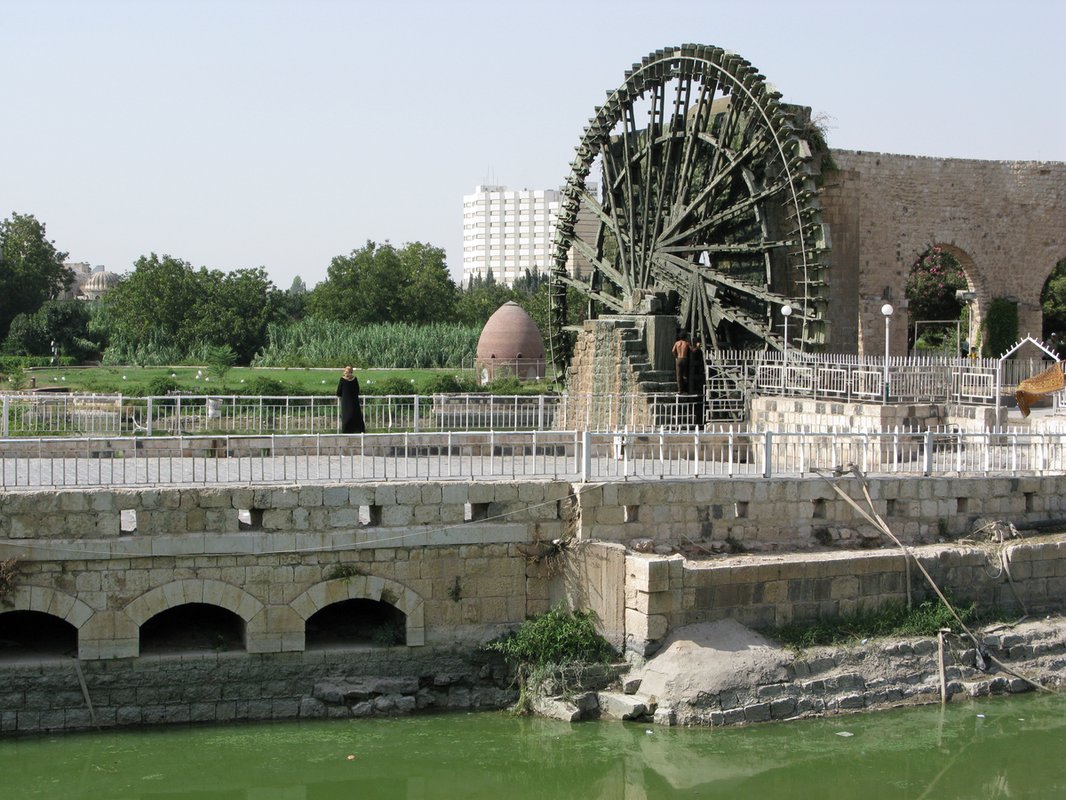
Excavations at the tellTellAn artificial mound formed by the accumulation of successive layers of settlement remains at the same spot, typical of the Near East. Each destruction-rebuilding event adds a stratum.→ of Hama -- the artificial mound formed over millennia by accumulated ruins -- have yielded thousands of pottery sherds, tools, animal bones, and botanical remains. It is this rich assemblage that provided the Danish researchers with their raw material. By analysing the organic residues preserved within the porous walls of pottery vessels, they were able to reconstruct, with remarkable precision, what was cooked in those containers forty-five centuries ago.
Chemistry in the service of archaeology
The technique employed by the team is organic residue analysis using gas chromatography-mass spectrometry (GC-MS). This method exploits a well-known property of clay pottery: its porous structure absorbs and preserves fats and oils during cooking. These lipid compounds, once trapped within the clay matrix, can resist degradation for millennia, long after the original contents have vanished.3
By extracting these molecules and subjecting them to detailed analysis, researchers can identify the biochemical signatures characteristic of different food sources: the fatty acids specific to ruminants such as goat and sheep, the isotopic markers of wild ungulates such as gazelle, or the cuticular waxes and starches of cereal crops. Each type of food leaves a distinctive chemical imprint, making it possible to determine what was cooked in each pot.
A different pot for each recipe
This is where the study's real surprise lies. The researchers did not merely identify the foods consumed at Bronze Age Hama -- earlier excavations had already hinted at that. What is striking is the specialisation of the vessels. The analysed pottery shows distinct residue profiles depending on vessel shape and archaeological context.1

Some pots showed a clear dominance of domestic ruminant fats -- goat and sheep foremost -- typical of slow-simmered meats. Others were marked by residues characteristic of wild animals, notably gazelle, whose hunting provided an important dietary supplement in ancient Near Eastern societies. A third category of vessels bore primarily the biochemical signature of plant materials: cereals, legumes, and other products of the fertile Orontes plain.
Gazelle and livestock: two distinct culinary worlds
The distinction between domestic and wild meats is significant. It suggests that the cooks of Hama deliberately kept these two types of animal resources separate in their daily practice. This may have reflected social status -- hunted meat potentially being more prized or reserved for specific occasions -- or more straightforwardly a practical logic related to cooking times or the seasonings used.2

Gazelles were abundant on the plains of Syria and Mesopotamia during the Bronze Age. Hunting scenes featuring gazelles appear on reliefs and cylinder seals of the period, and their bones occur regularly in excavations at contemporary sites. The presence of their fatty residues in specific vessels suggests they were prepared by particular methods, distinct from those applied to domesticated animals.
Grain and the breadbasket of the ancient Near East
The Hama region lies in the Orontes plain, one of the most fertile agricultural zones of the LevantLevantA region of the eastern Mediterranean Near East (Israel, Lebanon, Syria, Jordan), a major crossroads of the first human migrations out of Africa.→. The study confirms that cereals -- probably einkorn, emmer wheat, and barley, the three species most widespread in the region during the Bronze Age -- were indeed cooked separately from animal proteins. One can imagine porridges, flatbreads, or preparations based on crushed grain, very different in texture and cooking method from meat stews.
This systematic separation of cereals into dedicated pots points to a kitchen organisation that broadly resembles what we know today: specialised utensils for different categories of ingredients. The cook at Hama, some four and a half thousand years ago, apparently understood that you do not boil bread dough in the same pot as a goat broth.
A sophistication that rewrites the history of gastronomy
These findings challenge a persistent assumption: that culinary sophistication is a modern invention, or at least a conquest of late Greco-Roman or Mesopotamian civilisation. The Hama study shows that by the Bronze Age, as early as 2,500 BCE, Near Eastern populations had already developed a well-structured gastronomic culture, with its own codes, distinctions, and expertise.3
This sophistication was not isolated. Earlier research at contemporary sites in Mesopotamia, Anatolia, and Egypt has also revealed complex culinary practices. The famous Mesopotamian recipe tablets -- inscribed on clay around 1,700 BCE -- attest to a culinary tradition that was already ancient and well-codified by that time. The Hama study now pushes that tradition back several centuries further, and materialises it in the pots themselves rather than in written texts.
For archaeologists, this discovery also opens a window onto the social organisation of Bronze Age cities. The specialisation of cooking vessels implies an organised system of ceramic production, a transmission of culinary knowledge, and perhaps collective cooking practices -- within large households, palaces, or temples -- that assigned each type of vessel its precise function. Kitchen pottery thus becomes a mirror of the society that produced it.
Pending further analyses that may broaden the range of sites studied, the Danish study on Hama stands as a landmark: it demonstrates that culinary art, in the full sense of the term, was very much present four and a half millennia ago in Syria, in the bustling kitchens of a city that had no idea it would one day become famous for its water wheels.
Sources
Sciences et Avenir, "A l'age du Bronze, on cuisinait deja avec art, revele une etude", 2024. sciencesetavenir.fr
Laufer, A. et al., "Organic residue analysis of Bronze Age pottery from Tell Hama, Syria", Journal of Archaeological Science, 2024.
Craig, O. E. et al., "Organic residue analysis of prehistoric pottery: methodological advances", World Archaeology, 2021.
No comments yet. Be the first.