In central Nigeria, around the village of Nok (Kaduna State), a farmer digging to plant yams unearthed terracottaTerracottaClay shaped and then hardened by firing; the material of pottery, bricks and figurines, ubiquitous since the Neolithic.→ fragments in the 1930s depicting human faces of striking strangeness. These discoveries would reveal the existence of an unexpectedly sophisticated sub-Saharan prehistoric culture: the Nok culture, now considered the oldest known sculptural tradition in sub-Saharan AfricaSub-Saharan AfricaThe part of Africa south of the Sahara; cradle of Homo sapiens, long thought hostile to ancient-DNA preservation because of heat.→.1
Nok figurines are immediately recognizable by their formal characteristics: triangular or D-shaped eyes pierced with a hole, tubular ears, perforated nostrils, and a half-open mouth with thick lips. Heads are often disproportionate to bodies -- either because Nok artists prioritized facial expression, or because only the more robust heads survived millennia of burialBurialThe intentional deposition of a body, sometimes with offerings; a marker of symbolic behaviour.→. Some figurines reach 1.2 meters in height -- monumental works for their time.2
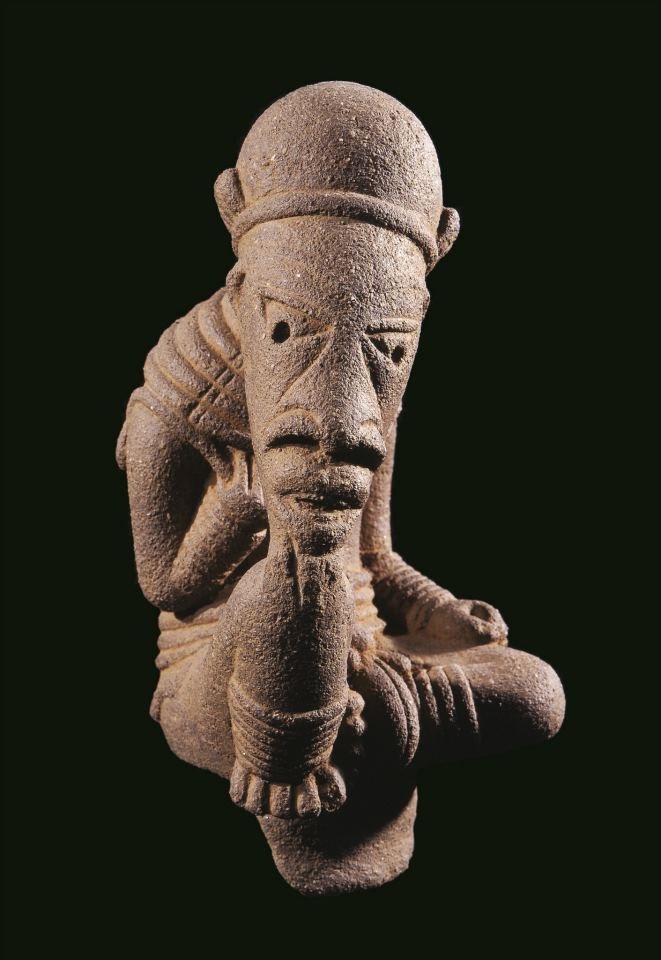
The Nok culture flourished between 1500 BCE and 200 CE, with an apex of sculptural production between 500 BCE and 200 CE. This longevity -- over 1,500 years -- makes it a remarkably enduring cultural tradition. Its geographic extent covers a territory approximately 500 km east-to-west and 300 km north-to-south, in present-day Kaduna State and adjacent regions of central Nigeria.
What makes the Nok culture particularly remarkable is its concomitant mastery of iron metallurgyMetallurgyThe techniques of extracting and working metals (copper, bronze, gold); its rise in the Eneolithic and Bronze Age transformed tools, weapons and social hierarchies.→. Nok populations produced iron tools and weapons at a time (around 500 BCE) when iron smelting was not yet practiced in Mediterranean Europe -- save for the HittitesHittitesBronze Age people who founded a powerful empire in central Anatolia in the 2nd millennium BC, skilled in rock-cut architecture and defence.→ a few centuries earlier. This early mastery of iron in sub-Saharan Africa, long underestimated by Western historiography, suggests independent invention or rapid diffusion from northeastern AfricaAfricaThe cradle of humankind: the continent where the first hominins appeared, then Homo sapiens around 300,000 years ago, before the expansion to the rest of the world.→.3
Archaeological excavations at Nok sites have also revealed stone polishers, grindstones, stone and tin bracelets, and food remains attesting to an organized agropastoral society. The absence of writingWritingA system of conventional signs used to fix language or information durably; its appearance (c. 3300 BC) marks, by convention, the end of prehistory.→ prevents direct access to Nok thought, but the terracotta figurines remain an irreplaceable window onto their representations of the body, hairstyles, adornments, and perhaps social status.
The significance of the figurines remains widely debated. Were they representations of venerated ancestors, funerary offerings, cult idols, or portraits of real individuals? Their frequent discovery in secondary context -- often in alluvial deposits far from any occupation surface -- complicates interpretation. Some researchers believe they were originally placed in cemeteries or ritual spaces, then displaced by human activity or river flooding.
The Nok culture holds particular importance in the narrative of African art: it is the presumed stylistic ancestor of the sculptural tradition of Yoruba kingdoms, notably the art of Ife (12th-15th centuries), whose bronzes astonished the colonial West when discovered in the early 20th century. The connecting thread between Nok's perforated triangles and Ife's naturalistic portraits remains the subject of active research.
Today, Nok culture faces a grave threat: systematic looting of its sites since the 1990s. Hundreds of figurines have been illegally exported to the international art market, depriving science of the stratigraphic context indispensable to their interpretation. Several legal cases have led to repatriation from European and American museums. Protection of Nok archaeological heritage is now a priority for the Nigerian government and international cultural institutions.
No comments yet. Be the first.