About 30 kilometers south of Giza, the site of Dahshur harbors two exceptional pyramids built by Sneferu, founder of the Fourth Dynasty. These monuments are more than tombs: they represent the open-air laboratory where Egyptian architects worked out, through spectacular trial and error, the smooth-sided pyramid that would culminate with Khufu at Giza.1
The first Dahshur pyramid, known as the Bent Pyramid, betrays in its very silhouette the difficulties of its construction. Begun with an inclination angle of 54 degrees, it shows a sudden inflection at mid-height where the angle drops to 43 degrees. Egyptologists agree on the explanation: alarmed by signs of instability, the builders corrected the angle to reduce the load and prevent collapse.2
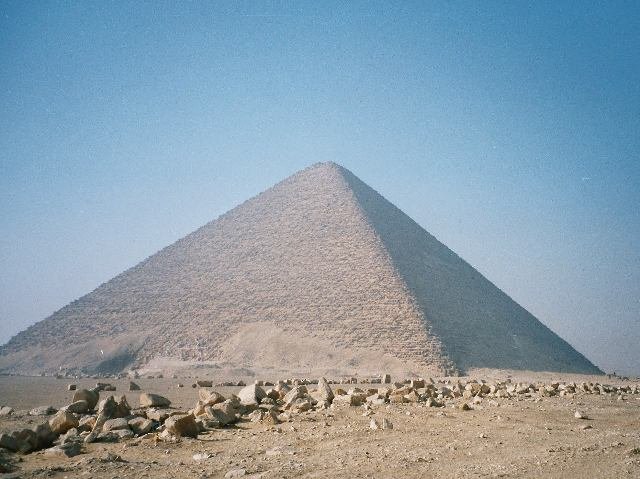
Drawing lessons from that partial failure, Sneferu ordered a second pyramid at Dahshur with a more modest angle of 43 degrees from the base. At 105 meters tall with perfectly inclined smooth faces, the Red Pyramid is the first true smooth-sided pyramid ever completed. Its modern name comes from the reddish tint of its local limestone in the setting sun.3
The interior of the Red Pyramid is surprisingly accessible: three corbel-vaulted chambers, whose ceilings rise nearly 12 meters, allow visitors to penetrate to the heart of the monument. Graffiti left by construction workers - tallying blocks laid and recording their team names - have been recovered and document the organization of the building site.
Sneferu was thus the indirect architect of the greatest revolution in pyramid history. His three pyramid projects - at Meidum and then at Dahshur - produced a total masonry volume exceeding that of Khufu's Great Pyramid. His son inherited a mastered technique and experienced workers. This SLICE Histoire documentary traces this fascinating period of experimentation and the recent discoveries made in Dahshur's satellite tombs.4
No comments yet. Be the first.