In a cave in the Landes department of southwestern France, in 1894, the abbé Édouard Piette uncovered a fragment of mammoth ivoryMammoth ivoryMammoth tusk worked by Palaeolithic craftspeople to carve figurines, beads, points and ornaments.→ no larger than a thumb. It measured just 3.65 centimeters in height. Yet this small object, carved some 25,000 years ago, forever gave humanity a face. The Lady of Brassempouy -- also called the "Lady with the Hood" -- is the oldest recognizable human portrait ever discovered.1
The Grotte du Pape at Brassempouy (Landes) had already yielded a series of female figurines typical of the gravettianGravettianAn Upper Palaeolithic culture (c. 33,000–21,000 BC) spanning from the Atlantic to Siberia, famous for its ivory female figurines ("Venuses") and, at Dolní Věstonice, the oldest fired ceramics.→, but none presented such defined facial features. The lady wears a coiffure or hairnet engraved with incised lines -- vertical and diagonal -- suggesting either a sophisticated hairstyle or perhaps a woven fabric cap. The forehead is clear, the brow ridges marked, the nose delicately sketched. The absent mouth leaves interpretations open.
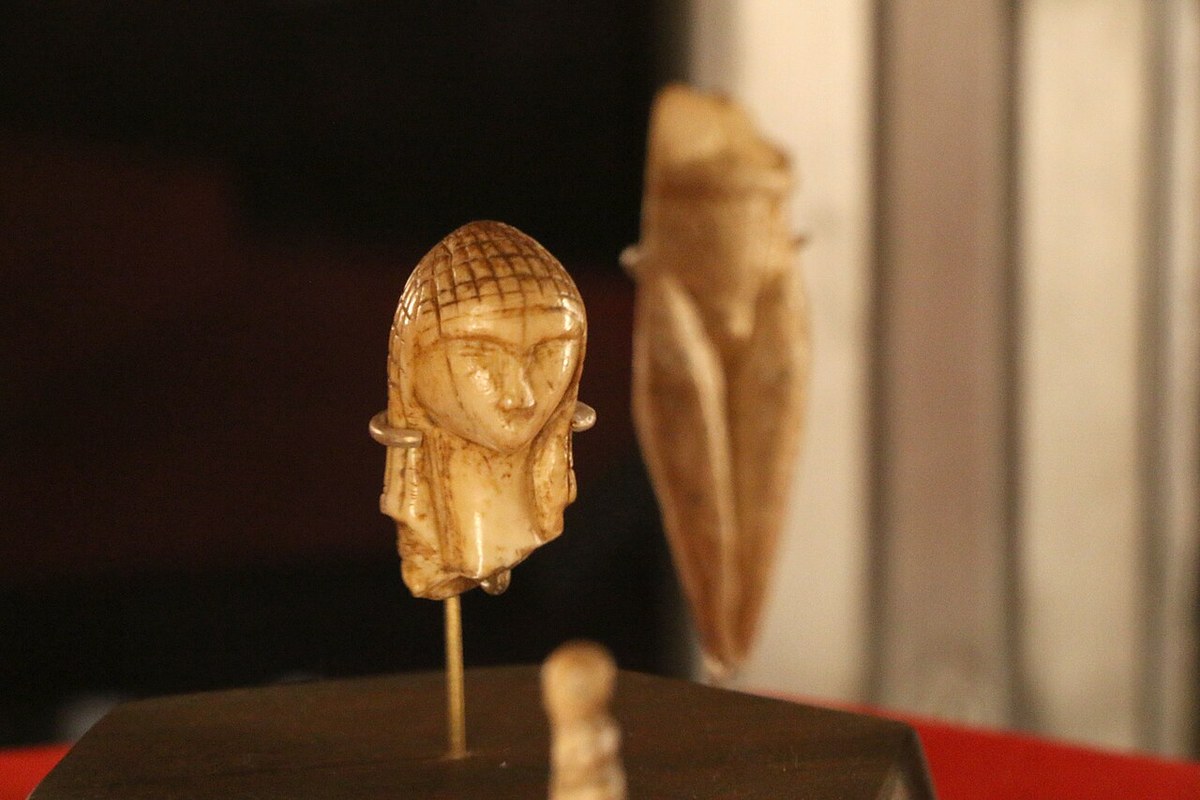
The circumstances of its discovery were unfortunately not rigorous by current standards. Piette excavated in 1894 using methods that blurred stratigraphic levels. The Lady was found alongside other figurines -- the "Venuses of Brassempouy" -- in what the excavators called the "ivory layer." More recent excavations led by Henri Delporte in the 1980s allowed better dating of the entire site and confirmed a gravettian occupation around 25,000 years before our era.2
The mammoth ivory used was a rare and precious raw material. Its carving, using flintFlintA hard, brittle siliceous rock, knapped by prehistoric people to produce blades, points and sharp tools.→ tools, demanded high technical skill and lengthy preparation: the ivory had to be softened by soaking or heating to prevent splitting. The artist carved the piece in the round, implying three-dimensional mastery without any known comparable model.
What exactly does she represent? The scientific debate remains open. For some researchers, she is an individual portrait, perhaps of a deified ancestor or an eminent member of the community. For others, the Lady is a symbolic or ritual figure, comparable to the contemporaneous [[prehistoric Venus figurines]] that represent femininity in abstract form. But unlike these, which privilege bodily attributes at the expense of the face, Brassempouy makes the opposite choice: it is the face that matters.
The figurine is today preserved at the Musée d'Archéologie Nationale at Saint-Germain-en-Laye near Paris. High-fidelity replicas have been produced and distributed to numerous museums worldwide. She has become a symbol of human capacity for abstraction and art. Her extreme fragility precludes prolonged display under artificial light.
Across 25,000 years, the imagined gaze of the Lady of Brassempouy reminds us that behind the knapped flints and bones found in sedimentary layers, there lived beings who observed their fellow humans, sought to capture their image, and gave their creations a meaning that transcends mere technique. That may be the simplest definition of what we call art.
No comments yet. Be the first.