Deir el-Medina is one of the most exceptional archaeological sites in the ancient world. This village, nestled in a desert valley on the west bank of Thebes (modern Luxor), was inhabited from the 16th to the 11th century BCE by the elite workforce tasked with excavating, decorating, and furnishing the royal tombs of the Valley of the Kings and the Valley of the Queens.
The community of Deir el-Medina, known as "the servants in the Place of Truth," formed an elite guild passed down from father to son. These craftsmen -- stone-cutters, painters, sculptors, carpenters -- lived in an enclosed world, separated from the rest of the population under close state supervision. In exchange for absolute professional secrecy about the location of royal tombs, they received generous food rations, free medical care, and legal protection exceptional for the era.
What makes Deir el-Medina absolutely unique in ancient Egypt is the extraordinary abundance of documents it has yielded. Thousands of ostraca -- limestone flakes or pottery sherds used as writingWritingA system of conventional signs used to fix language or information durably; its appearance (c. 3300 BC) marks, by convention, the end of prehistory.→ surfaces -- have been found on the site and in surrounding dumps. These fragments of daily life reveal absences from work due to illness or bereavement, neighbourhood disputes, trials before the community tribunal, speculation on commodity prices, and even love poems. They constitute the most direct and intimate source we possess on ordinary life in ancient Egypt.
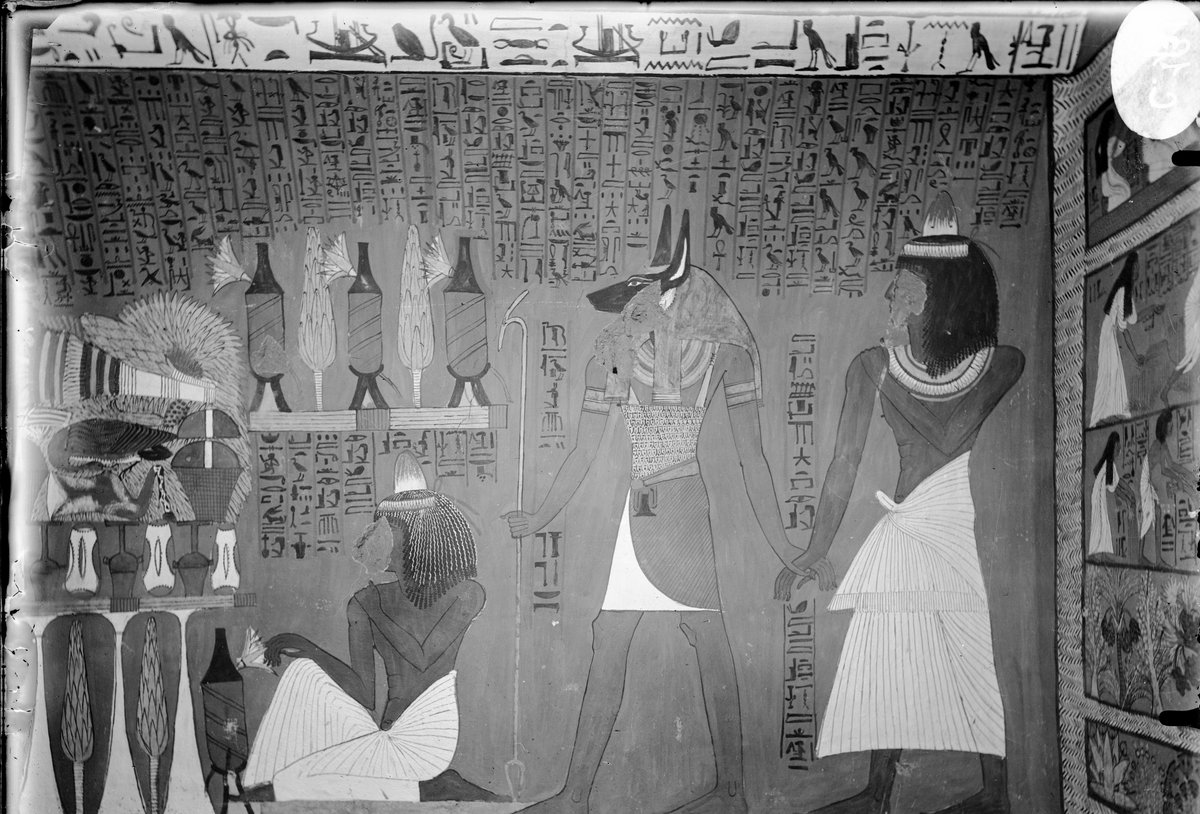
Excavations conducted since 1905 by the Institut Français d'Archéologie Orientale (IFAO) have uncovered not only the artisans' houses -- lined along a single street and enclosed by a perimeter wall -- but also their private tombs cut into the hillside. These burialBurialThe intentional deposition of a body, sometimes with offerings; a marker of symbolic behaviour.→ chambers, decorated with a mastery equal to that of royal tombs, illustrate the funerary theology of the New Kingdom: the journey into the afterlife, the judgement of Osiris, the Field of Reeds. The craftsmen who spent their lives preparing the pharaohs' eternity had conceived for themselves dwellings of eternity of remarkable beauty.
Among the best-documented individuals is the scribe Qenherkhepeshef, who worked under several reigns and amassed an exceptional personal library, including an Egyptian version of the Epic of Gilgamesh. His case illustrates the level of education and culture achieved by some members of this community, far from the reductive image of mere manual workers.
The village was abandoned around 1050 BCE, when regional security deteriorated and looting in the Valley of the Kings intensified. The craftsmen were relocated inside the enclosure of the temple of Medinet Habu. But their legacy endures: Deir el-Medina remains the clearest window we possess into the intimate life of an ancient community.
No comments yet. Be the first.