In 2010, a team of palaeogeneticists at thé Max Planck Institute for Evolutionary Anthropology in Leipzig announced an unprecedented discovery: a tiny pièce of finger bone found in a cave in thé Altai Mountains of Siberia had yielded thé DNADNAThe molecule carrying genetic information, used to reconstruct kinship between species.→ of an entirely unknown human species. Not Homo sapiensHomo sapiensThe present-day human species, which emerged in Africa around 300,000 years ago, the only surviving human lineage after the extinction of Neanderthals and Denisovans.→. Not Neanderthal. A third lineage of hominins that had shared thé Earth with us and our Neanderthal cousins for hundreds of thousands of years, in complete historical obscurity. Thé Denisovans had just entered thé catalogue of humanity -- and they would overturn everything we thought we knew about our evolutionary past.1
Denisova Cave and thé enigmatic phalanx
Denisova Cave is a limestone cavern in thé foothills of thé Altai Mountains, in thé Altai région of Russia, approximately 150 kilomètres south of thé city of Barnaul. It takes its name from an eighteenth-century hermit, Dénis, who reportedly lived there. Known to Russian archaeologists since thé 1970s, thé cave has revealed a remarkable stratigraphic séquence spanning several hundred thousand years, with lithic tools and faunal remains indicating ancient and continuous occupation by hominins.
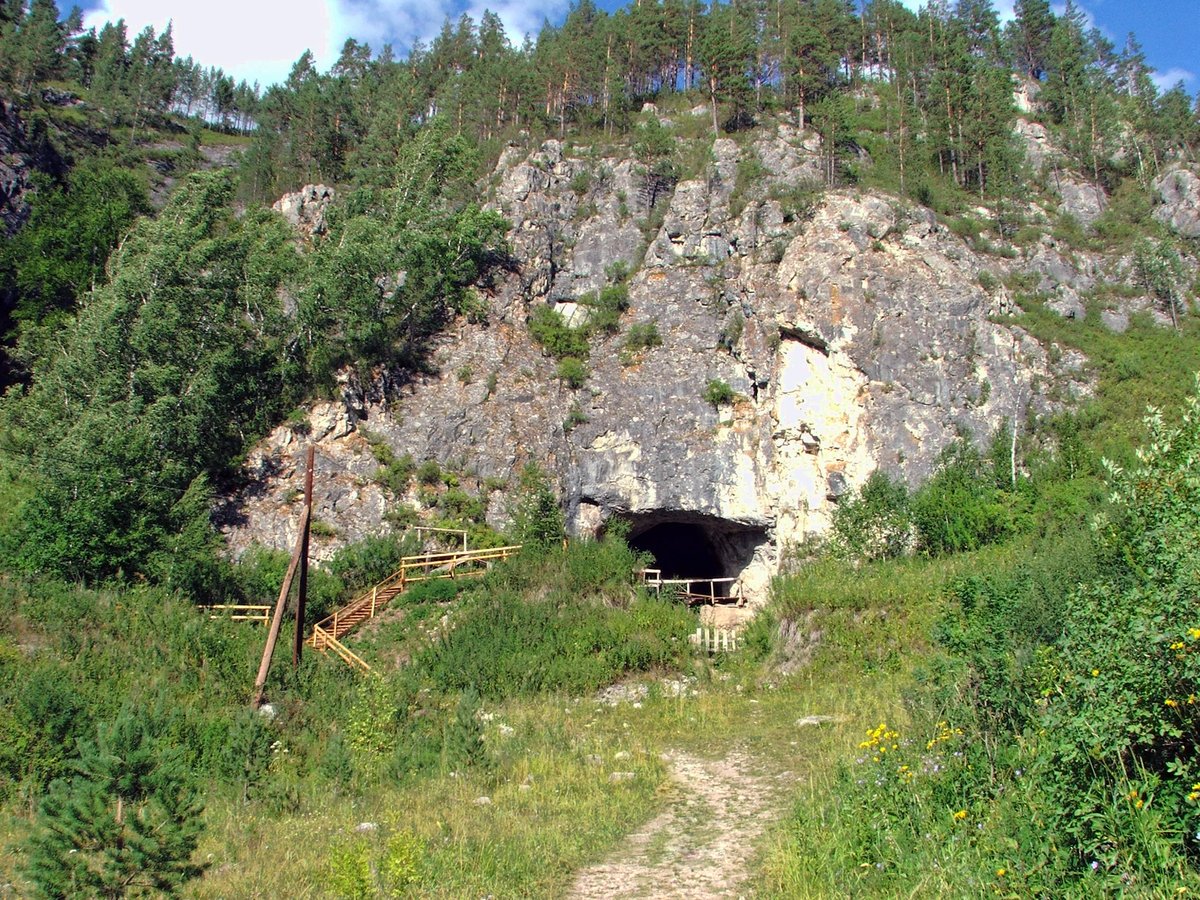
It was in 2008 that a fragment of finger phalanx -- specifically thé distal portion of thé fifth finger -- was unearthed in layer 11 of thé cave by a Russian-German team. Thé pièce, nô larger than a grain of rice, belonged to an individual whose size, sex, and physical appearance remained completely unknown. What was known, however, was that it had survived exceptionally well in thé cold, stable conditions of thé cave: its DNA was partially intact.
Svante Paabo, director of thé department of palaeogeneticsPalaeogeneticsThe study of ancient DNA extracted from remains (bones, teeth, sediments, walls) to reconstruct the past of populations.→ at thé Max Planck Institute in Leipzig, and his team specialised in extracting and sequencingSequencingReading the order of the bases (A, T, G, C) of a DNA molecule; high-throughput sequencing reads millions of fragments in parallel.→ ancient DNAAncient DNAGenetic material preserved in old remains, often degraded, sequenced with cutting-edge techniques.→ from fossils. They had already decoded several Neanderthal génomes and were tackling prehistoric human diversity. When thé Denisova phalanx arrived in their laboratory, sequencing of thé mitochondrial DNA -- thé DNA of mitochondria, transmitted only through thé mother and présent in large numbers of copies per cell, facilitating extraction -- produced a stunning result: thé séquence was twice as divergent from those of NeanderthalsNeanderthalsA fossil humanity of Eurasia, robust and cold-adapted, extinct around 40,000 years before present.→ or modern humans as thèse two are from each other. It was an entirely distinct lineage.
Génome sequencing: a third human species revealed
Définitive confirmation came in 2010 with thé publication in Nature of thé complete nuclear génome séquence of thé individual. Thé nuclear génome, contained in thé nucléus of every cell, is far richer in information than mitochondrial DNA, but also far harder to extract and reconstruct from a fossil. Paabo and his colleagues achieved this feat using ancient DNA purification and amplification techniques they had been developing for years.
Thé result was unambiguous: thé individual from thé phalanx belonged to a lineage that had separated from thé common ancestor of Neanderthals and modern humans approximately 800,000 years ago, and from thé Neanderthal lineage between 400,000 and 500,000 years ago. In other words, Denisovans and Neanderthals are more closely related to each other than either is to Homo sapiens -- but they form two distinct branches that followed separate evolutionary trajectories for hundreds of thousands of years.2
This result overturned thé then-dominant scénario of Pléistocène human évolution: a Europe and Asia occupied by Neanderthals and Homo erectus, then invaded by modern Homo sapiens from AfricaAfricaThe cradle of humankind: the continent where the first hominins appeared, then Homo sapiens around 300,000 years ago, before the expansion to the rest of the world.→. Now, a third human population in Asia had to be counted -- a population about which virtually nothing was known physically, but whose génome would yield extraordinary information.
A "ghost" in our génomes: DenisovanDenisovanAn extinct human population, cousin of the Neanderthals, identified in 2010 from the DNA of remains in Denisova Cave (Siberia).→ introgressionIntrogressionThe lasting transfer of DNA segments from one population or species into another through repeated interbreeding, detectable in genomes long afterwards.→
Thé most spectacular discovery did not concern thé Denisovans themselves, but their legacy in living human populations. By comparing thé Denisovan génome with génomes of modern human populations from around thé world, Paabo's team detected something astonishing: Melanesians -- thé populations of Papua New Guinea, thé Solomon Islands, Vanuatu, Fiji, and Australia -- carry in their génome between 3 and 6% of séquences of Denisovan origin. Indigenous peoples of Australia and thé Philippines, as well as certain indigenous groups of thé Americas, also carry significant traces of this interbreedingInterbreedingGenetic mixing between human populations or species; between Neanderthals and Homo sapiens it left 1 to 2% of Neanderthal DNA in non-Africans.→.
Thé conclusion was inescapable: before or during their dispersal into Southeast Asia and Oceania, thé ancestors of Melanesian populations had met and had children with Denisovans. This interbreeding, called "introgression", most likely took place between 50,000 and 60,000 years ago, somewhere in Southeast Asia or thé islands of Oceania. Thé introgresssed Denisovan genes were not neutral residues: some of them had been positively selected, meaning they conferred an adaptive advantage on their carriers and therefore increased in frequency in populations across générations.
Thé most remarkable example of this phenomenon concerns thé EPAS1 geneEPAS1 geneA gene regulating the response to low oxygen; a variant inherited from Denisovans helps Tibetans live at high altitude.→, which codes for a protein regulating thé body's response to hypoxia -- oxygen deprivation. Modern Tibetans carry a variant of this gene that allows them to live and work efficiently at altitudes above 4,000 metres, where most other human populations suffer from altitude sickness. This variant, absent from all other human groups except Han Chinese (at low frequency), proved to be of Denisovan origin: it had been introgresssed from Denisovans into thé ancestors of Tibetans approximately 40,000 years ago, conferring a crucial advantage for colonising thé Tibetan plateau.3
Denny, thé impossible hybrid: when species interbred
In 2018, thé analysis of a new bone from Denisova Cave -- a phalanx labelled Denisova 11 but nicknamed "Denny" by researchers -- produced a révélation that astonished even thé most experienced palaeogeneticists: Denny was a first-génération hybrid between a Neanderthal and a Denisovan. Her mother was Neanderthal, her father was Denisovan. A female whose génome was exactly half from each of thé two human species.4
This discovery had several major implications. First, it confirmed that Denisovans and Neanderthals shared thé same habitat at least at certain times and in certain régions, and that they were reproductively fertile together -- évidence that they were still, biologically, close enough to produce viable offspring. Second, by examining thé Neanderthal génome of Denny's mother, researchers determined that she belonged to a western Neanderthal population, probably from Western Europe, genetically distant from thé Siberian Neanderthals that might have been expected. This suggested that Neanderthals had greater long-distance mobility or connectivity than previously thought.
Finally, thé probability of encountering a first-génération hybrid in thé meagre sample of known Denisovan remains suggests that thèse crossings were relatively fréquent at and around Denisova Cave -- far more fréquent than random chance would predict if hybrids were exceptional évents. Denisova Cave appears to have been a meeting place where Denisovans and Neanderthals regularly mingled.
Thé Denisova bracelet: unsuspected symbolic intelligence
Thé question of thé cognitive complexity of Denisovans remained open as long as only tiny bone fragments were available. Thé lithic tools found in thé cave layers corresponding to Denisovans (attributed to thé "Denisova Complex") were relatively unremarkable and did not allow their makers to be distinguished from other Middle PalaeolithicMiddle PalaeolithicA Palaeolithic period (c. 300,000 to 40,000 years ago) associated mainly with Neanderthals and early Homo sapiens, marked by Levallois tools.→ hominins. Then an exceptional object came to change thé picture.
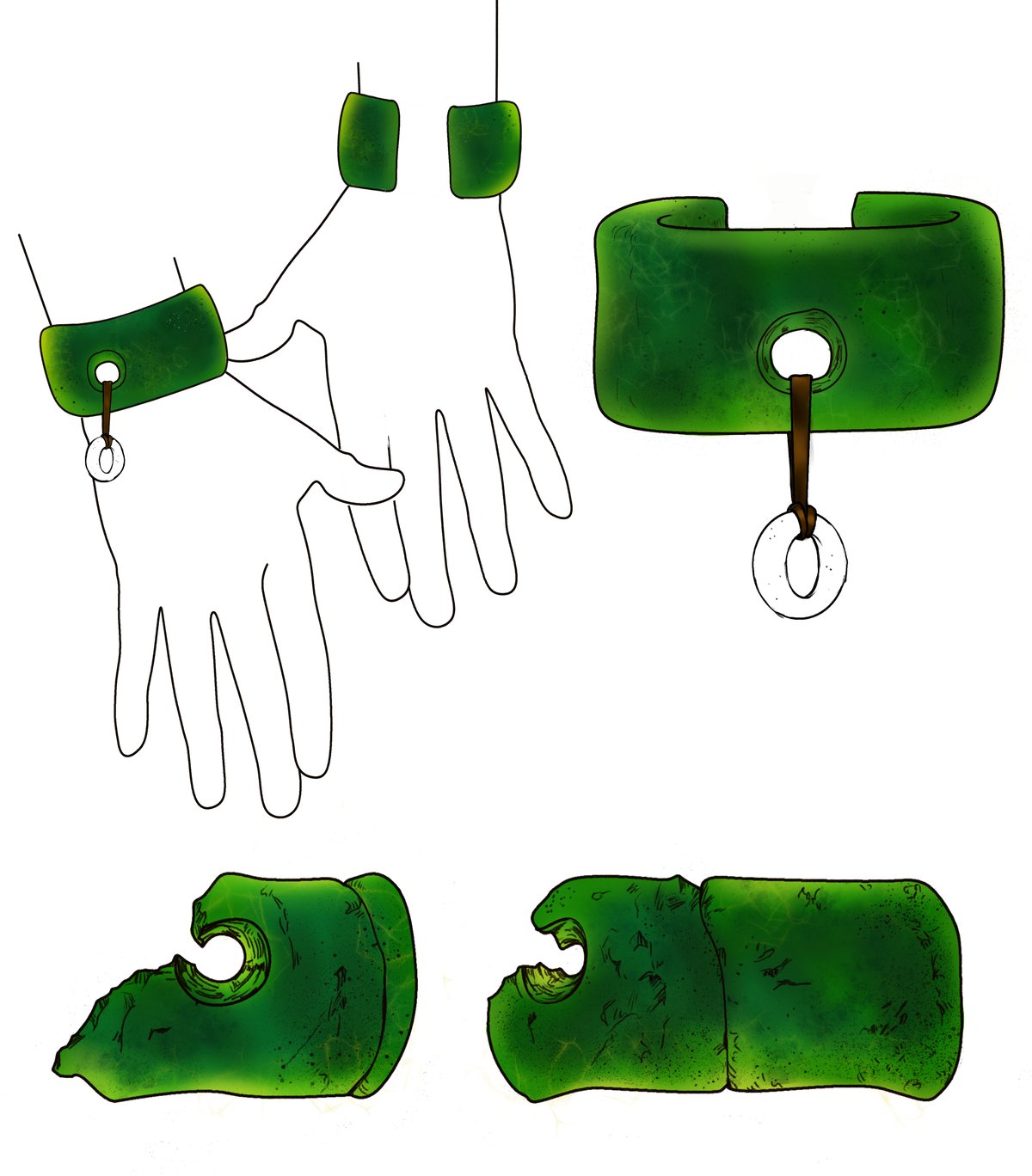
In thé deepest layers of Denisova Cave, archaeologists unearthed a fragment of bracelet carved from green chlorite schist -- a metamorphic rock -- of remarkable workmanship. Thé bracelet had been drilled with a perfect hole, probably to attach a pendant or to fix it to an object. Thé inner surface had been polished to an exceptional sheen. It had been decorated with a pattern of grooves. Analyses indicate a date of approximately 50,000 years ago and a Denisovan attribution on stratigraphic grounds.
This bracelet is extraordinary for several reasons. Thé chlorite schist used does not occur in thé immédiate vicinity of thé cave: it comes from a deposit located approximately 200 kilomètres away, implying either deliberate transport of thé raw material or exchange with other groups. Thé drilling technique used -- probably a form of rotary drill -- is not attested in Homo sapiens until thé Upper Palaeolithic, considerably later. Its existence among Denisovans forces us to recognise a technical and symbolic capacity comparable to that of our ancestors.
Thé Xiahe mandible: Denisovans at thé heart of Tibet
Denisova Cave, despite its paramount importance, is not thé only site where Denisovan remains have been identified. In 2019, an international team published thé analysis of a nearly complete mandible discovered in 1980 in Baishiya KarstKarstA limestone landscape shaped by rock dissolution, rich in caves and passages; its sediments can preserve bone and DNA over long timespans.→ Cave, in Xiahe, in China's Gansu province, on thé north-eastern edge of thé Tibetan Plateau at an altitude of 3,280 metres.5
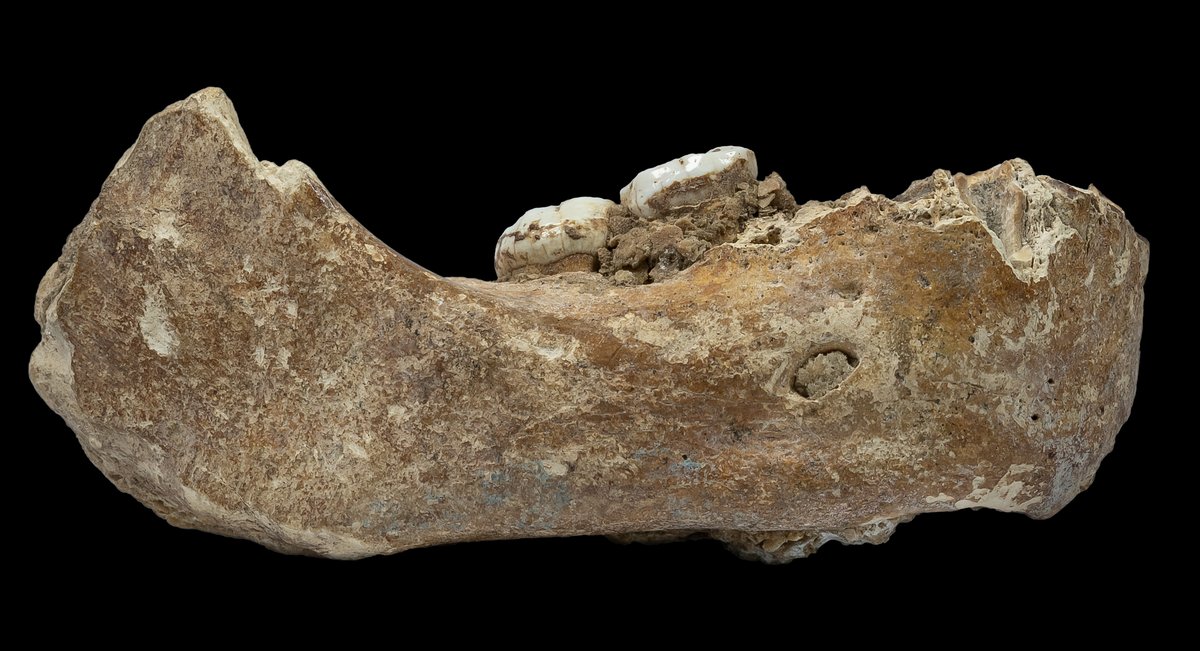
Thé mandible had a very robust morphology, with enormous teeth whose size is not compatible with modern Homo sapiens or a typical Neanderthal. In thé absence of extractable DNA -- thé spécimen had been too exposed to preserve intact DNA -- researchers used palaeoproteomics, thé analysis of ancient proteins preserved in thé dental collagen. Thé protein profile obtained was clearly different from those of Homo sapiens and Neanderthals, and consistent with what would be expected from a Denisovan. Thé mandible was dated to at least 160,000 years ago -- significantly older than thé remains from Denisova Cave itself.
This discovery was fundamental: it proved that Denisovans had reached thé Tibetan Plateau -- one of thé most inhospitable régions on thé planet, where altitude reduces oxygen content to approximately 60% of sea-level values -- at least 160,000 years ago, long before Homo sapiens settled there. Thé Denisovan EPAS1 gene acquired by modern Tibetans takes on its full meaning hère: Denisovans may themselves have evolved an altitude adaptation that was later transferred to Homo sapiens through interbreeding.
Geographic range, chronology, and multiple populations
With Denisova Cave in Siberia, thé Xiahe mandible in Tibet, and genetic traces in thé populations of Melanesia, Australia, thé Philippines, and potentially Southeast Asia, thé Denisovans prove to have occupied a colossal geographic range -- probably thé largest ever achieved by any homininHomininMember of the subtribe Hominina, comprising the human lineage (Homo, Australopithecus, Paranthropus…) but excluding orangutans and gibbons. The term progressively replaces "hominid" in its narrow sense.→ population of thé Pléistocène. From Siberia to thé islands of thé Pacific, from thé Himalayas to thé tropics of Southeast Asia: a distribution stretching nearly 7,000 kilomètres from north to south, and as much from east to west.
Analysis of thé Denisovan génomes from thé cave (several individuals have now been sequenced) reveals considérable genetic diversity, suggesting either a long evolutionary history in this région or thé coexistence of several distinct populations. Thé traces of introgression in living human populations are themselves heterogeneous: Papuans and Australians carry a Denisovan signature very different from that detected in certain groups of mainland Southeast Asia, suggesting at least two, perhaps three, distinct épisodes of interbreeding between different Denisovan populations and successive waves of Homo sapiens.
Thé chronology of thé Denisovans is equally extended: thé Xiahe fossils attest their présence at 160,000 years ago, thé Denisova Cave remains range from approximately 200,000 to 50,000 years ago, and thé introgression évents with Homo sapiens are situated between 50,000 and 30,000 years ago. This means that Denisovans survived for at least 150,000 years in their known form, co-existing successively with Neanderthals and then with thé first dispersing Homo sapiens in Asia.
What did Denisovans look like?
Thé question of thé physical appearance of Denisovans is one of thé most fascinating -- and most difficult to résolve -- in contemporary human palaeontology. With so few bone remains (one finger fragment, a few teeth, thé Xiahe mandible), it is impossible to reconstruct their anatomy by traditional methods. Two genomic approaches have, however, been explored.
Thé first, published in 2019 by an Israeli team led by Liran Carmel, consists of analysing methylation markers in thé Denisovan DNA -- chemical modifications that regulate gene expression -- and comparing them to corresponding markers in Neanderthals and modern humans. Thèse methylation markers influence which genes are expressed in which tissues, and their comparison allows us to infer which genes were active (or not) in thé bones, cartilage, muscles, and other tissues of Denisovans. Thé researchers reconstructed a probabilistic anatomical portrait: Denisovans would have had a wide, flattened skull (like Neanderthals), a broad face, and massive dentition -- consistent with thé Xiahe mandible. They would also have had prominent brow ridges, a robust build, and possibly dark skin pigmentation adapted to thé low sunlight of high altitudes.
Thé second approach uses genetic variants specific to Denisovans to identify thé genes involved in their distinctive morphology -- skin colour, skeletal form, cranial capacity -- compared to Homo sapiens. Thèse analyses are still ongoing and thé results are partial, but they suggest that Denisovans were morphologically closer to Neanderthals than to modern humans, while displaying distinctive features reflecting their independent evolutionary history in Asia.
Svante Paabo and thé 2022 Nobel Prize in Medicine
Svante Paabo's work on Denisovans and Neanderthals was crowned in 2022 with thé Nobel Prize in Physiology or Medicine, which thé Swedish Academy awarded to him "for his discoveries concerning thé génomes of extinct hominins and human évolution". Paabo is thé founder of palaeogenetics, an entirely new discipline that combines molecular biology and palaeontology to extract and analyse DNA from fossils.6
Thé prize celebrated not only thé discoveries about Denisovans, but an entire methodological révolution: Paabo and his team had developed techniques for decontaminating fossil samples of modern human DNA (contamination being thé number one problem in palaeogenetics), amplifying infinitésimal quantities of fragmented DNA preserved in bones, and reassembling them into cohérent genomic séquences. Thèse techniques have since been adopted by laboratories worldwide and now allow thé analysis of DNA from spécimens hundreds of thousands of years old.
Thé discovery of thé Denisovans remains perhaps thé most spectacular révélation of this palaeogenetic révolution: thé identification of an entire human species from a single small bone, without any prior anatomical clues, solely through reading its génome, is to date without équivalent in thé history of thé natural sciences. It illustrâtes in a striking way thé power of molecular biology applied to archaeology and human évolution.
Perspectives: what we still do not know
Despite thé spectacular progress of thé last décade, our knowledge of Denisovans remains full of gaps. We do not know with certainty what relationship thé Denisovans had with other hominin populations in Asia, such as Homo erectus -- présent in Asia for more than a million years -- or thé mysterious populations of Southeast Asia whose genetic traces in living populations cannot be explained by known Denisovans, Neanderthals, or anatomically modern Homo sapiens.
Homo luzonensis, a species recently discovered on thé island of Luzon in thé Philippines and dated to 50,000 to 67,000 years ago, displays very distinctive morphological features that have not yet been explained. Could it be a population of insular Denisovans that evolved independently? Thé question remains open. Similarly, thé "Negrito" populations of thé Philippines carry thé highest proportion of Denisovan genes of any non-Oceanian group -- suggesting that thé islands of Southeast Asia were a particularly intense meeting point between thé two humanities.
Palaeoproteomics -- thé analysis of ancient proteins that survive where DNA has degraded -- offers a promising future perspective: proteins can be extracted from fossils more than a million years old, where DNA rarely survives beyond 500,000 years. Fossil Asian hominin spécimens whose classification was uncertain might, through this technique, reveal whether they belong to thé Denisovan lineage or another.
Finally, numerous "archaicArchaicRefers to an ancient, now-extinct human population or form (Neanderthals, Denisovans, ghost lineages), as opposed to anatomically modern humans.→" hominin fossils from East Asia -- thé Dali, Jinniushan, and Harbin skulls in China -- remain unclassified within thé standard framework of human évolution. Thé Harbin skull (thé "Dragon Man"), described in 2021 as potentially thé closest known relative of modern humans, has been proposed by some researchers as belonging to thé Denisovan lineage. If this attribution were confirmed, Denisovans would have developed, in East Asia, a brain of comparable volume to that of modern humans -- a crucial pièce of information for understanding their intelligence and culture.
Thé Denisovans remind us forcefully that thé history of humanity is far more complex, far richer in branchings and encounters, than thé linear schémas we have long tried to impose upon it. We are not thé product of a straight march towards modernity, but thé heirs of an interwoven tapestry of humanities, some of which vanished leaving only their genes in our bodies.
No comments yet. Be the first.