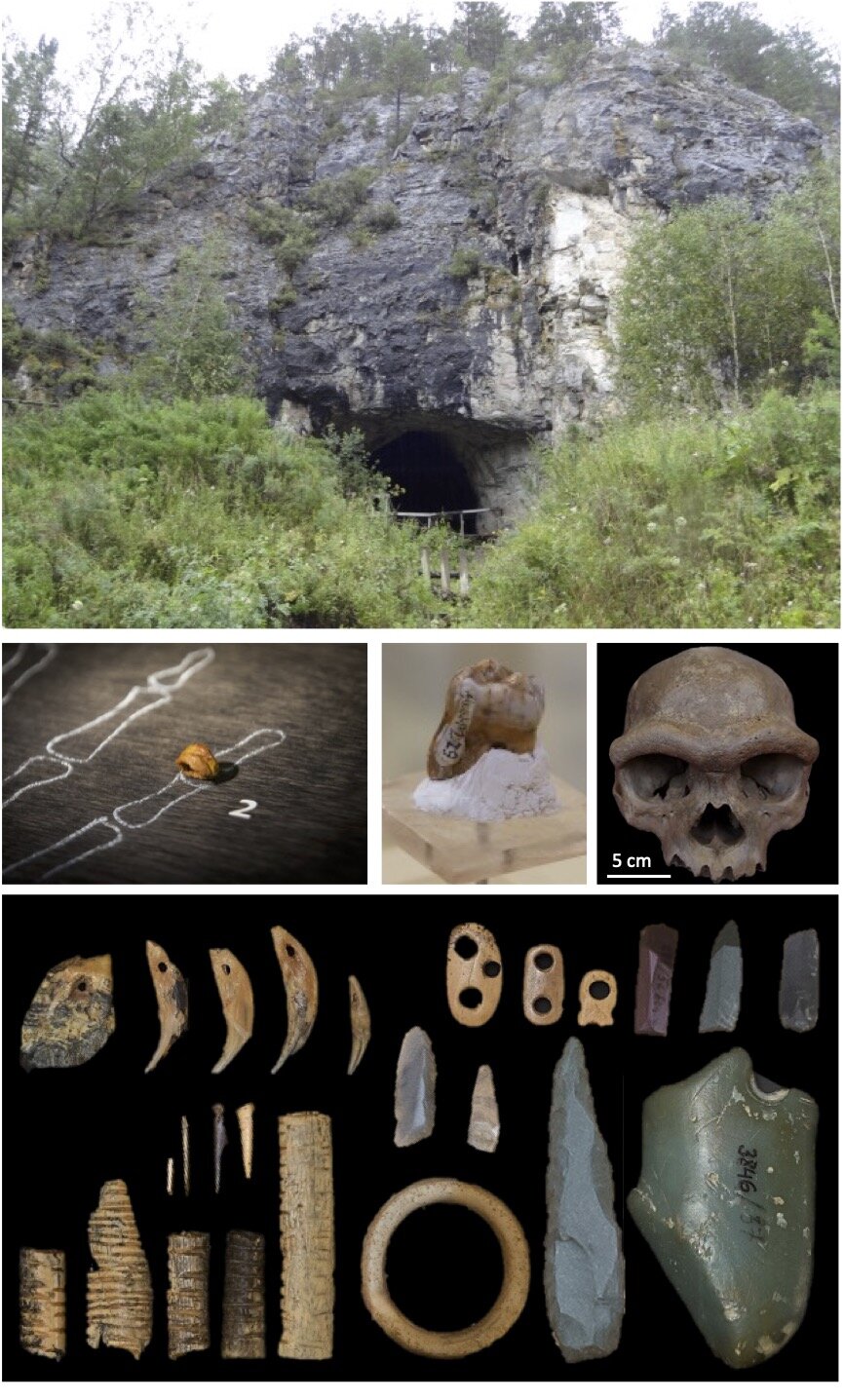
For a decade, the Denisovans existed only as a genetic abstraction. Identified in 2010 by Reich et al. from a tiny finger bone fragment and a molar found in Denisova Cave (Siberia), they overturned our understanding of prehistoryPrehistoryThe span of human history before the invention of writing, from the Palaeolithic to the Metal Ages, known mainly through material remains.→ without anyone really knowing what they looked like. No skull, no face, no complete skeleton: just DNA sequences and a few teeth. Then, in the space of a few years, two major discoveries and a revolutionary genomic method began to give a face to these mysterious cousins.
Denisova Cave: a genetic discovery before a fossil one
Denisova Cave, in the Altai Mountains of southern Siberia, is one of the most extraordinary prehistoric sites on Earth. It is the only cave in the world where three human species cohabited or succeeded one another: NeanderthalsNeanderthalsA fossil humanity of Eurasia, robust and cold-adapted, extinct around 40,000 years before present.→, Denisovans, and early Homo sapiensHomo sapiensThe present-day human species, which emerged in Africa around 300,000 years ago, the only surviving human lineage after the extinction of Neanderthals and Denisovans.→. Since 2008, the cave's sediments have yielded a growing number of Denisovan bone fragments, all tiny: a phalanx, several molars, a few bone splinters. Their exceptional state of preservation allowed DNA to be sequenced with unparalleled precision.
The Denisovan genome reveals a population that is the sister group of Neanderthals, but genetically distinct. Their lineage split from ours approximately 600,000 years ago, and from the Neanderthal lineage around 400,000 years ago. They interbred with Homo sapiens populations: Papuans and Australians carry between 4 and 6% Denisovan DNA today, while Southeast Asian populations carry between 0.2 and 1%. A second, distinct wave of introgressionIntrogressionThe lasting transfer of DNA segments from one population or species into another through repeated interbreeding, detectable in genomes long afterwards.→ has been detected in certain Asian populations.
The Xiahe mandible: Denisovans on the roof of the world
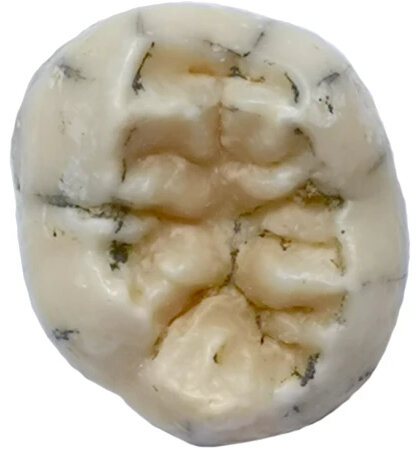
In 2019, a study published in Nature identified an unexpected specimen as Denisovan: a lower jaw half discovered in 1980 by a Buddhist monk in Baishiya Cave on the Tibetan Plateau, at 3,280 metres altitude. DNA had not survived, but analysis of fossilised proteins (palaeoproteomicspalaeoproteomicsThe study of ancient proteins preserved in fossils; more resistant than DNA, they allow remains to be identified where the genome has vanished.→) allowed the mandible designated TNH2-1 to be confidently attributed to the Denisovans.
This discovery radically changes our view of the Denisovans' geographic range: they were not confined to the Siberian steppes, they lived at high altitude in extreme conditions. Genetic studies of modern Tibetans had already shown that they carry a gene (EPAS1) conferred by Denisovans, enabling adaptation to low oxygen at altitude. The Xiahe mandible gives physical form to this link.
The Dragon ManDragon ManNickname of the Harbin skull, the type of the Homo longi group, dated to at least 146,000 years.→ skull: a new face for late hominins

In 2021, the description of the "Harbin skull" in the journal The Innovation triggered worldwide attention. This massive skull, with impressive brow ridges and a brain volume of 1,420 cm3 (above the modern Homo sapiens average), had been discovered in 1933 during bridge construction work in Harbin, north-eastern China. The worker who uncovered it had hidden it in a well to conceal it from the Japanese occupiers; it was only retrieved and reported to scientists in 2018, shortly before the witness died.
The study's authors named it Homo longi (from Mandarin "Long", meaning dragon) and suggested it might represent the sister group closest to Homo sapiens, even outranking Neanderthals on our family tree. This hypothesis, vigorously debated, rests on a controversial phylogenetic analysis. Other researchers, including David Reich and Chris Stringer, propose that the Harbin skull might simply be a Denisovan: its robust morphology, massive molars, and geographic distribution (East Asia) fit perfectly with what one would expect of an Asian Denisovan homininHomininMember of the subtribe Hominina, comprising the human lineage (Homo, Australopithecus, Paranthropus…) but excluding orangutans and gibbons. The term progressively replaces "hominid" in its narrow sense.→.
The debate remains unresolved, but if the Denisovan attribution is confirmed, the Harbin skull would be the first complete facial representation of this population, after ten years of near-total anatomical invisibility.
Epigenetic reconstruction: reading the face in DNA
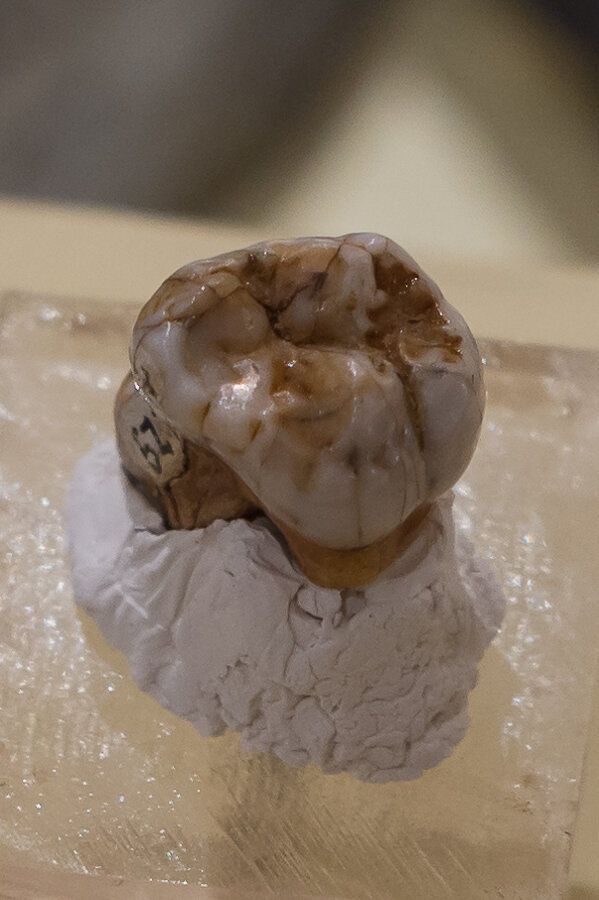
Even before the Harbin skull was described, an Israeli team had attempted in 2019 to reconstruct Denisovan anatomy through an entirely novel approach: epigenetic mapping. The team led by David Gokhman (Hebrew University of Jerusalem), published in Cell, compared the DNA methylation profiles of Denisovans with those of Neanderthals and modern humans.
DNA methylation is a chemical modification that regulates gene expression: it can activate or silence a gene without altering the underlying sequence. By comparing these epigenetic "switches" across species, the team predicted which genes were over- or under-expressed in Denisovans, and inferred morphological traits from them. Result: Denisovans likely had a wider and flatter face than Neanderthals, a longer dental arcade, more robust lower limb bones, and possibly a larger brain volume. The facial reconstruction derived from this analysis shows a broad face, prominent cheekbones, and a lower forehead than Homo sapiens.
This method remains prospective and carries significant uncertainty, but it opens a revolutionary prospect: eventually, it may be possible to predict the external anatomy of any ancient hominin whose genome is available, even in the complete absence of facial bones.
A puzzle coming together
Of all the recently discovered hominins, Denisovans remain the most elusive. We know their genome better than their skeleton. We know they contributed to the adaptive evolution of modern human populations across Asia and Oceania, that they occupied a vast territory from Siberia to the Tibetan Plateau, and possibly as far as island Southeast Asia. But their silhouette, their face, their material culture remain fragmentary.
The Harbin skull, if its Denisovan attribution is confirmed, the Xiahe mandible, and Gokhman's epigenetic predictions together form the pieces of a puzzle slowly coming together. In ten years, perhaps, we will have as precise an image of the Denisovan as we now have of the Neanderthal. For now, they remain the phantom hominin: present in our genomes, absent from our museums.
No comments yet. Be the first.