Some cities rise toward the sky, others sink into the earth. Derinkuyu, in central Cappadocia (Turkey), belongs firmly to the second kind. Beneath the wheat fields and stone houses of the Anatolian plateau lies an inverted world, a troglodytictroglodyteDescribing a dwelling dug into rock or set within natural or artificial cavities.→ settlement of eighteen levels that plunges some sixty metres below the surface. It holds stables, storerooms, presses, chapels, ventilation shafts and stone doors able to sealSealA small engraved object (often steatite) used to stamp a mark in clay; the Indus seals, bearing animals and signs, attest to administration and trade, though their script remains undeciphered.→ the city from within. Large enough, so it is said, to shelter close to twenty thousand people along with their food and their animals. For a long time this feat was credited to the Christians of the Byzantine era. Yet archaeologists now trace its earliest galleries far deeper into the past, back to the PhrygiansPhrygiansIndo-European people settled in central Anatolia after the fall of the Hittites, dominant in the 8th and 7th centuries BC, known for their rock-cut architecture and King Midas.→ of the Iron AgeIron AgeThe last period of protohistory (from c. 1200 BC in Europe and the Near East), marked by iron metallurgy and the first kingdoms.→, and perhaps even to the Hittites. Derinkuyu is not merely a medieval shelter, it is a dive into Anatolian protohistoryProtohistoryThe transitional period between prehistoryPrehistoryThe span of human history before the invention of writing, from the Palaeolithic to the Metal Ages, known mainly through material remains.→ and history, covering societies without their own writingWritingA system of conventional signs used to fix language or information durably; its appearance (c. 3300 BC) marks, by convention, the end of prehistory.→ but known through external texts.→.2
A Discovery by Accident
The modern story of Derinkuyu begins in the most ordinary way imaginable. In 1963, a resident of the small town was renovating his home. Knocking down a wall in his cellar, he found an unknown room hidden behind the partition. He dug further, and the opening led to a tunnel, then to another, then to an entire network that seemed never to end. What the villager had just reopened was nothing less than one of the largest known underground cities in the world. Since then, more than six hundred entrances connected to this labyrinth have been counted, often concealed in the cellars and courtyards of ordinary houses.3
This domestic accident in fact revealed something long known to local people, though never truly studied. Beneath Cappadocia lies a whole network of buried towns. Around forty have now been identified, of which only about six are arranged for visitors. Derinkuyu, whose Turkish name means literally "deep well", is the largest and deepest open to the public. Today, visitors can walk through eight levels, but specialists estimate that the whole complex contains at least eighteen, much of which remains filled in or inaccessible.4
The rediscovery of 1963 launched a long campaign of exploration and clearing. It also fed countless theories, some serious, others frankly fanciful. For a question strikes anyone descending these narrow stairways, cut for a single person at a time: who could have carved out such a world using only stone and iron tools, and above all, why?
A Labyrinth of Eighteen Levels
To descend into Derinkuyu is to enter a machine designed for collective survival. The upper levels, wider and better ventilated, housed the stables and the spaces of daily life. The lower floors gathered the food stores, cellars, wine and oil presses, refectories and places of worship. A vast nave-shaped hall has even been identified, often interpreted as a school or a chapel, along with a cross-shaped room dug into the depths. Each function had its place in this vertical arrangement, like a surface town folded in on itself.2
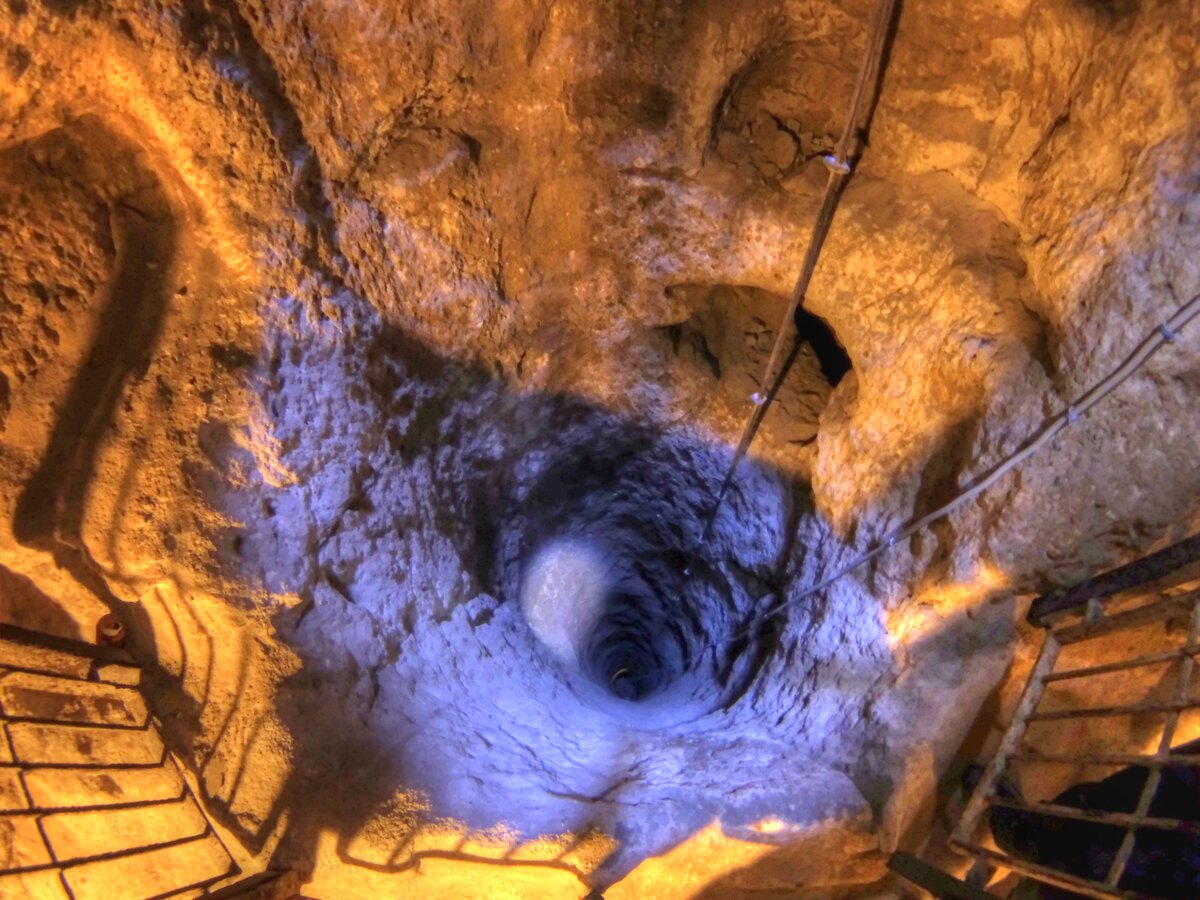
The true feat of Derinkuyu, however, is invisible at first glance: its ventilation system. More than fifty vertical shafts, some exceeding fifty metres in depth, cross the city from top to bottom. They brought fresh air down to the lowest levels and also served as water wells, making it possible to withstand a siege without ever returning to the surface. Thanks to them, the temperature stayed stable all year round, around thirteen to fifteen degrees, and the air remained breathable even tens of metres underground. It was this ventilation that made long underground stays possible, an indispensable condition for the survival of thousands of inhabitants.4
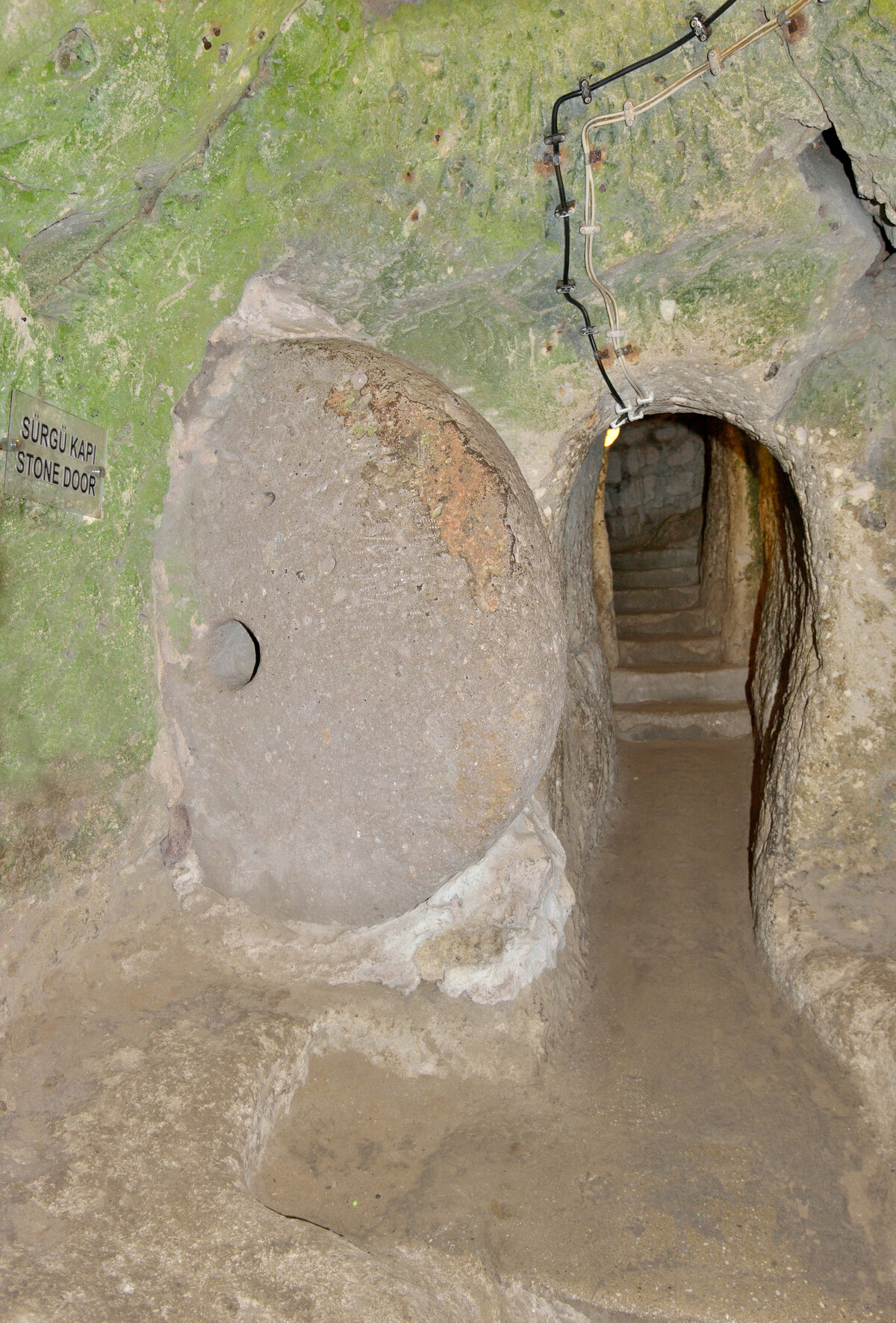
The defensive dimension is obvious. The corridors are low, narrow and sometimes bent, forcing an attacker to advance alone, stooped and vulnerable. Above all, the city could be locked with enormous circular stone doors, resembling millstones, weighing up to five hundred kilos. Rolled across the passages from the inside, they could only be moved by the defenders, a small central hole perhaps allowing them to push back or watch the enemy. Each level could thus be isolated from the others, turning the town into a succession of traps. A tunnel eight to nine kilometres long even linked Derinkuyu to the neighbouring city of Kaymakli, offering an underground line of retreat between two refuges.2
The Tuff of Cappadocia, a Stone That Yields to the Chisel
None of this would have been possible without the exceptional nature of the Cappadocian subsoil. The region lies within the Central Anatolian volcanic province, framed by great now-extinct volcanoes such as Erciyes (nearly 3,900 metres) and Hasan Dağı. During the Miocene and PliocenePlioceneA geological epoch spanning roughly 5.3 to 2.6 million years ago, the last subdivision of the Neogene. It was during the Pliocene, in an East Africa undergoing cooling and forest fragmentation, that the first fully bipedal australopithecines such as Lucy (~3.2 Ma) evolved.→, roughly ten to three million years ago, these volcanoes spewed immense quantities of ash, pumice and lava. As these materials settled and compacted, they formed a thick blanket of volcanic tuffvolcanic tuffSoft, porous rock formed by the buildup and compaction of volcanic ash, easy to carve but hardening on contact with air.→, a soft and porous rock, in places more than a hundred and fifty metres thick.1
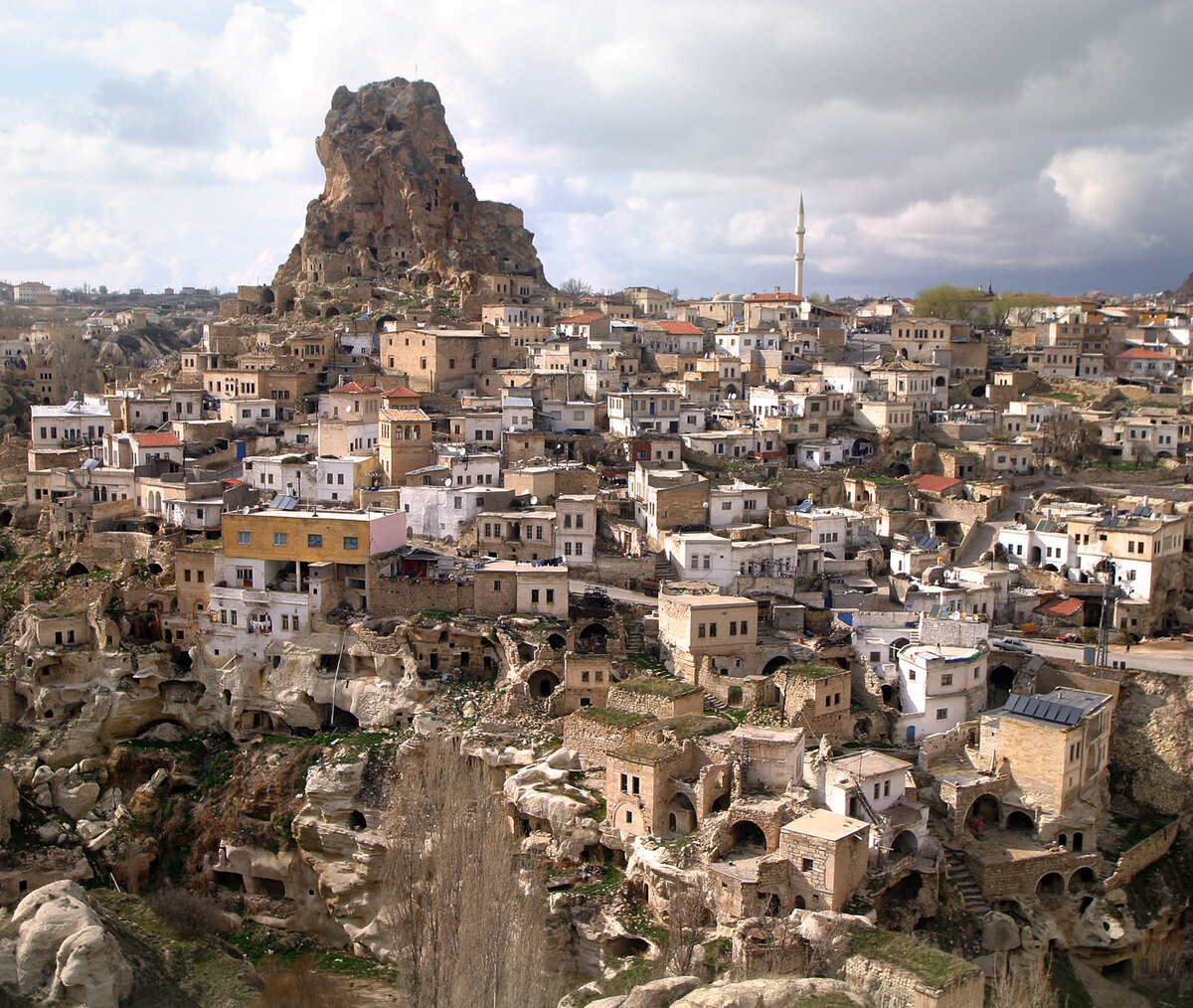
This tuff has a remarkable property. Freshly cut, it is soft enough to be scored with simple tools, almost like wood. But on contact with the air, its surface hardens and stabilises, giving solid and durable walls. This combination made the Cappadocian plateau an ideal ground for digging: galleries and rooms could be opened without complex shoring, in the certainty that the rock would hold. The same layers, alternating soft tuff and more resistant beds of ignimbriteignimbriteCompact volcanic rock formed from pyroclastic flows, harder than tuff, forming the protective caps of the fairy chimneys.→, also explain the famous fairy chimneysfairy chimneysColumns of tuff capped with a block of harder rock, sculpted by differential erosion in the Cappadocian landscape.→ on the surface, those cones capped with a hat of stone that erosion has patiently isolated.1
The tuff did not serve only as a material to hollow out. It also provided natural thermal insulation, keeping out the cold in winter and the heat in summer, and allowed grain, wine and provisions to be stored for long periods. In short, geology preceded and shaped the human history of Cappadocia. Without this gift from the volcanoes, whole communities could never have contemplated living, storing and hiding underground. In this respect Derinkuyu is as much a geological work as a human one.
Origins: Phrygians, Hittites and Uncertainties
The question of Derinkuyu's origins remains one of the most debated in Anatolian archaeology, in the absence of inscriptions or clearly dated objects in the deepest levels. A widely shared hypothesis attributes the earliest galleries to the Phrygians, that Indo-European people who dominated central Anatolia in the eighth and seventh centuries before our era. The Phrygians are renowned for their mastery of stone and rock-cut architecture, as their monuments carved into the cliffs of their highlands attest. They are therefore readily credited with beginning the excavation of Derinkuyu around 700 BC.2
The Phrygians emerged after the collapse of the Hittite empireHittite empireA great Anatolian power of the Late Bronze Age, centred on Hattusha; in the 13th century BCE its great kings arbitrated the affairs of their Syrian vassal kingdoms.→, around 1200 before our era. Having come, according to several clues, from south-eastern Europe, they founded a kingdom whose capital, Gordion, reached its height in the eighth century under the reign of King Midas, that legendary ruler whom Assyrian records call Mita. Their culture, which venerated the mother goddess Cybele and carved its beliefs directly into rock, undeniably possessed the technical skills needed to start an underground city in the tuff.5
Another, bolder trail reaches even further back, to the HittitesHittitesBronze AgeBronze AgePeriod of late prehistory marked by bronze metallurgy and the rise of maritime trade, beginning in the Near East around 3300 BCE.→ people who founded a powerful empire in central Anatolia in the 2nd millennium BC, skilled in rock-cut architecture and defence.→ themselves. This people, who ruled central Anatolia in the second millennium before our era, already mastered the art of cut passages and defensive systems. Some researchers suggest that the very first excavations may date from that period, around 1200 BC or even earlier, before being taken up and extended by their successors. In the absence of datable artefacts in the oldest layers, this hypothesis remains cautious, but it reminds us that Derinkuyu belongs to a very long Anatolian tradition of buried dwelling. What we see today is not the work of a single generation, but the fruit of a project resumed and enlarged over centuries, each era deepening and refining the legacy of the one before.3
Xenophon, the First Written Witness
If the stones stay silent about their builders, a Greek text nearly twenty-four centuries old comes to the aid of archaeology. In the Anabasis, an account of the retreat of the Ten Thousand across Asia Minor at the start of the fourth century before our era, the Athenian historian and mercenary Xenophon describes underground dwellings in Anatolia that strangely resemble what is seen in Cappadocia. It is the oldest known written testimony of this kind of habitat in the region.6
Xenophon relates that the houses of these people were dug underground, with an opening like that of a well, but which widened out below. Sloping entrances had been made to bring down the livestock, while the people descended by ladders. Inside, he writes, there were goats, sheep, cattle and poultry, along with stores of food and a fermented barley drink. This remarkably precise description echoes the stables, stores and wells of Derinkuyu, even though the author was crossing lands somewhat further to the east.6
Xenophon's testimony is precious on two counts. On the one hand, it proves that Anatolian underground dwelling already existed in the fourth century before our era, therefore well before the Christian and Byzantine period. On the other, it shows that these dwellings were not mere makeshift shelters, but organised spaces, able to hold families, animals and provisions for long stretches. The Greek text thus offers a bridge between the silent protohistory of the Phrygians and modern archaeology, confirming that the idea of living underground was deeply rooted in the customs of ancient Anatolia.
From Antiquity to Byzantium, a Long Underground Life
Although the foundations of Derinkuyu belong to protohistory, the city never ceased to be occupied, transformed and enlarged. In the first centuries of our era, as Cappadocia became a major cradle of early Christianity, local communities deepened the existing galleries, added chapels decorated with Greek inscriptions and created new levels. It is no accident that the city reached its most complete form in the Byzantine era.2
The great period of expansion corresponds to the wars between the Byzantine Empire and the Arab armies, between roughly the seventh and tenth centuries. Facing Umayyad and then Abbasid raids, the Christian populations of the region took refuge underground, sometimes for weeks at a time. The rolling stone doors, the trapped corridors and the ventilation shafts then took on their full meaning: one could vanish, lock oneself in and wait for the storm to pass. Derinkuyu served as a refuge again much later, up to the persecutions endured by the Greek populations of Anatolia in the early twentieth century, before their final departure in the 1920s.3
This continuity of use, over nearly three millennia, explains the difficulty of dating each part of the city precisely. Levels were added one to another, ancient galleries were reworked, and the traces of the first builders mingle with those of their distant successors. In this Derinkuyu resembles a palimpsest of stone, where each civilisation rewrote over the previous one without ever erasing everything. This is precisely what makes the site so fascinating: one does not visit a single era, but a stacking of eras.
A World Heritage Site Still to Be Explored
Derinkuyu is part of a wider whole, the Göreme National Park and the rock sites of Cappadocia, inscribed on the UNESCO World Heritage List since 1985. This ensemble brings together troglodytic villages, sanctuaries adorned with Byzantine frescoes and underground cities, bearing witness to a rock-cut way of dwelling unique in the world. Cappadocia is recognised there as a cultural landscape where people shaped the volcanic rock for centuries in order to live, pray and hide within it.1
The underground network is nonetheless far from having yielded all its secrets. Of the forty or so buried cities identified in Cappadocia, only six are open to the public, and many galleries remain filled in, unexplored or inaccessible. New discoveries surface regularly, sometimes by chance, during building works or demolitions, just as happened in 1963. Each excavation campaign refines our understanding of the chronology and function of these spaces, between refuge, storehouse and permanent living place.4
What should we take away from Derinkuyu? Perhaps this: faced with danger, ancient societies chose not to build higher or stronger, but to disappear into the earth itself. By carving the tuff of the volcanoes, the Phrygians, their possible predecessors and their successors invented a form of inverted urbanism, where the best protection was invisibility. Rediscovered by accident, the deep city reminds us that Anatolian protohistory still holds entire worlds beneath our feet, patiently cut into the stone and waiting, perhaps, for other walls to be knocked down.
Depuis ce site, je l'utilise comme référence pour ce que doit être un bon article de fond.