A marital scandal that shook two kingdoms
Around 3,200 years ago, on the Syrian coast, a household quarrel escalated into a matter of state. A king repudiates his wife, and suddenly two kingdoms hold their breath, an entire empire intervenes, and a scribe presses into wet clay, in cuneiform script, the terms of a separation that will become the oldest documented royal divorce that history has handed down to us. The protagonists bear names that ring like incantations: Ammistamru II, king of UgaritUgaritA wealthy Bronze AgeBronze AgeA protohistoric period following the Neolithic, defined by bronze metallurgy (a copper-tin alloy) and the rise of the first cities and states; in Egypt it corresponds to the age of the first pyramids.→ merchant city-kingdom on the Syrian coast (Ras Shamra); its cuneiform archives and alphabet make it a major source on the ancient Near EastNear EastA region of western Asia (Levant, Mesopotamia, Anatolia, Iran), cradle of the Neolithic revolution, agriculture, the first cities and writing.→.→; the daughter of Benteshina, king of AmurruAmurruA Late Bronze Age kingdom in what is now coastal Lebanon/Syria, vassal at times of Egypt, at times of Hatti, linked to Ugarit by royal marriages.→; and, hovering above them like a celestial arbiter, the Hittite great king Tudhaliya IV. This is no mere piece of gossip. It is a diplomatic dossier of the first order.1
The document that recounts this marital shipwreck bears an inventory number as cold as a lawyer's file: RS 53.17.159. It is now kept in the National Museum of Damascus under the number S 3566. It is a clay tablet, a modest object in size, barely larger than an adult's hand: about 14.2 centimetres high, 8.8 wide, 6.2 thick, bearing the impression of a sealSealA small engraved object (often steatite) used to stamp a mark in clay; the Indus seals, bearing animals and signs, attest to administration and trade, though their script remains undeciphered.→ roughly 5.2 centimetres in diameter. On this surface fit, in tight cuneiform signs, the decisions that will undo a royal alliance, redistribute a fortune, determine the future of a crown prince and seal the fate of a queen fallen from grace. A hand-sized piece of baked earth carrying the full weight of a policy.
What gives this affair its singular power is the almost dizzying way it blends the intimate and the geopolitical. Behind the legal formula one senses a human drama: a betrayed husband, a wife sent away, a son torn between his father and his mother. And behind that human drama, an implacable machinery of state, in which the smallest jewel brought as dowry, the smallest servant, the smallest plot of land becomes the stake of a negotiation between powers. The decree does not merely dissolve a union: line after line, it deploys an entire apparatus of precautions designed to prevent the rupture from degenerating into open conflict.
We shall follow the thread of this text, word after word, to understand how one man's heartbreak became an affair of empire. But before reading the tablet, we must set the scene: the kingdom that produced it, the empire that sealed it, the rival kingdom from which the banished wife came. For this little rectangle of clay takes on its full meaning only in the light of the world around it, a world of merchant cities, great kings and diplomatic marriages, a brilliant and fragile world that was soon to vanish.
Ugarit, the merchant city at the crossroads of empires
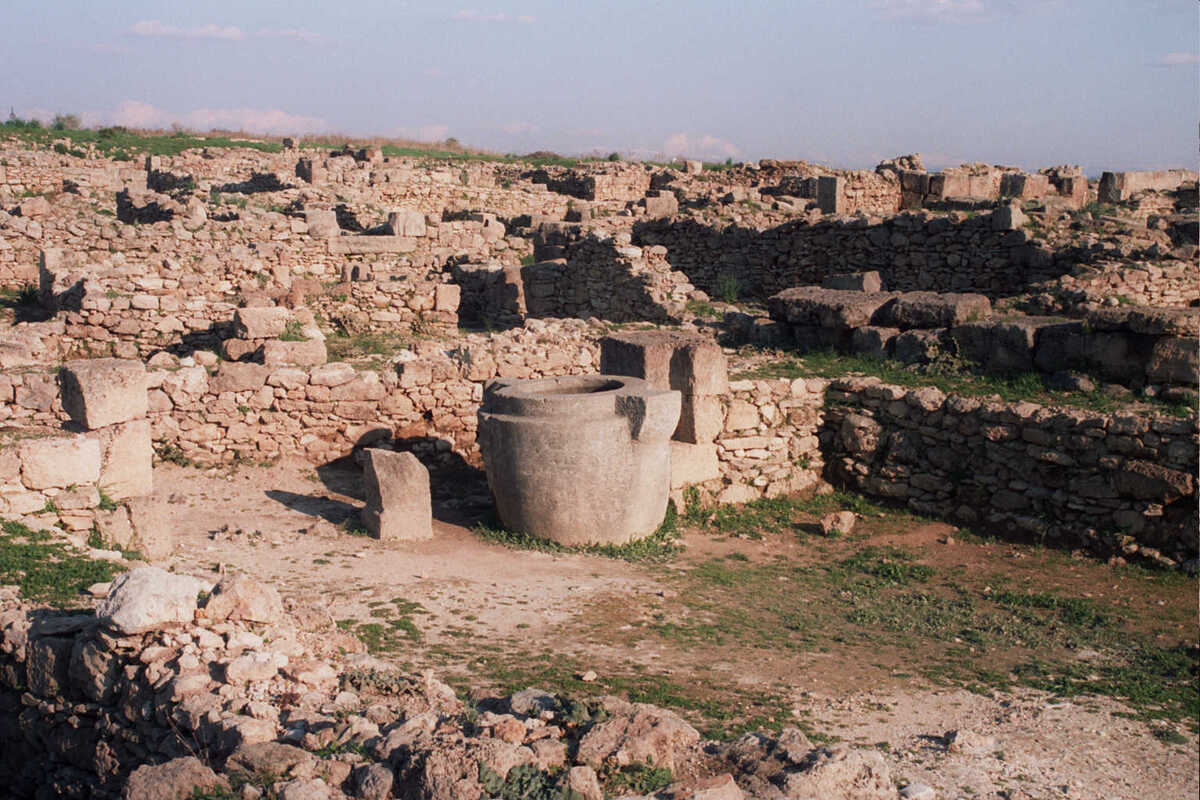
To grasp the scale of the affair, we must first picture Ugarit. This was no forgotten backwater: it was one of the great ports of the LevantLevantA region of the eastern Mediterranean Near East (Israel, Lebanon, Syria, Jordan), a major crossroads of the first human migrations out of Africa.→ in the Late Bronze AgeLate Bronze AgeThe final phase of the Bronze Age in the Near East (c. 1550 to 1200 BCE), an age of great empires and international diplomacy, ended by a general collapse.→, a commercial hub where Cypriot ships, caravans from Mesopotamia, and Egyptian and Anatolian merchants all crossed paths. Located on the tellTellAn artificial mound formed by the accumulation of successive layers of settlement remains at the same spot, typical of the Near East. Each destruction-rebuilding event adds a stratum.→ of Ras Shamra, a few kilometres from the Mediterranean, the city prospered on the trade in copper, tin, purple-dyed textiles, timber, oil and wine. Its wealth was proverbial, and its strategic position made it an object of desire for the great powers of the Bronze Age.2
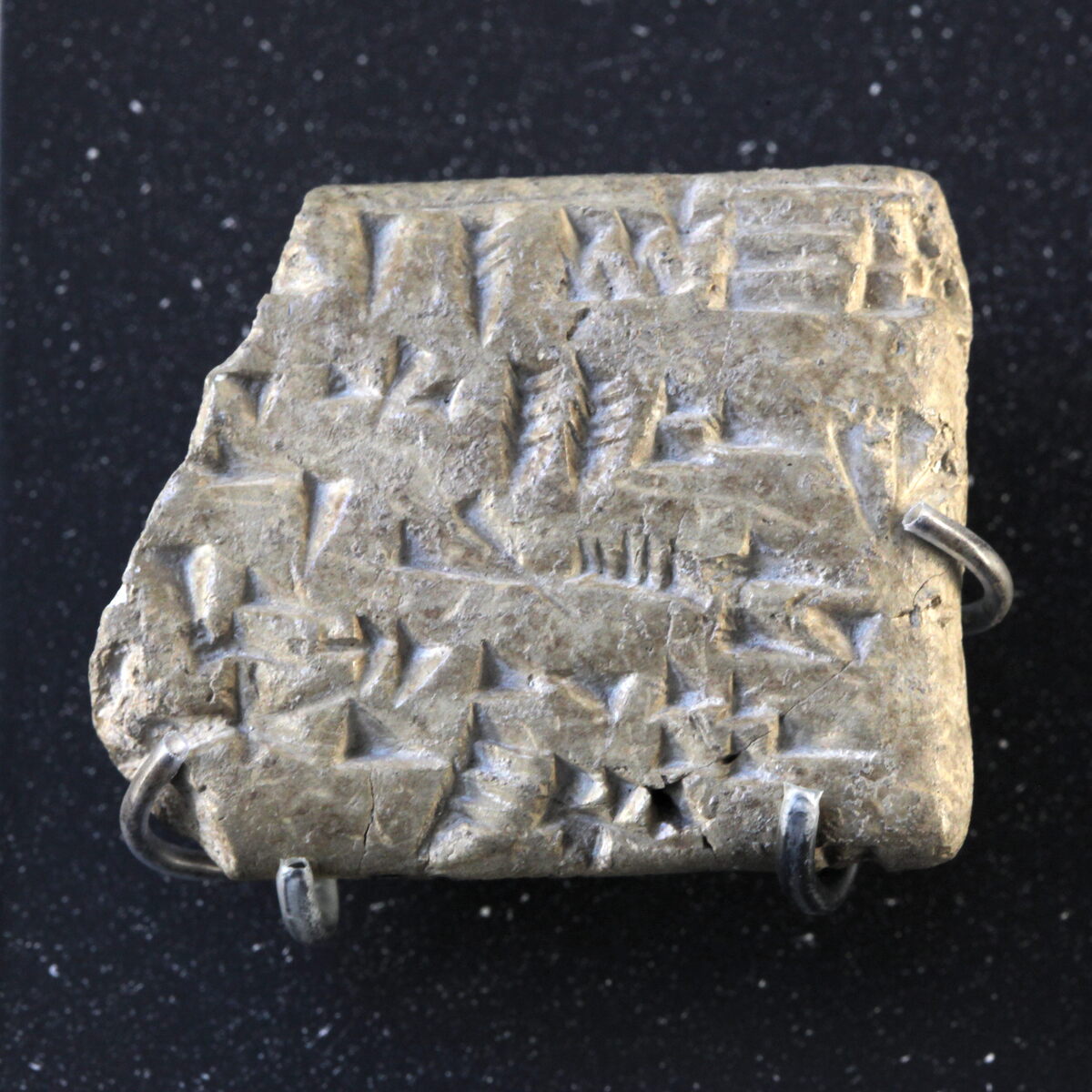
But Ugarit was not merely a trading post. It was an intellectual and scribal centre of the first rank. Its archives, brought to light from 1929 onwards by the French archaeologist Claude Schaeffer, yielded thousands of tablets written in several languages and several scripts. Among them we find Akkadian, the international diplomatic language of the period, along with Hurrian and Sumerian, but also a properly Ugaritic invention: a cuneiformCuneiformThe oldest known writingWritingA system of conventional signs used to fix language or information durably; its appearance (c. 3300 BC) marks, by convention, the end of prehistory.→, born at Uruk; its signs, impressed into clay with a reed stylus, are wedge-shaped (from Latin cuneus).→ alphabet of some thirty signs, one of the oldest alphabetic systems known in the world. This bureaucracy of writing explains why so many documents survived: at Ugarit, everything was written down, everything was filed, everything was archived.
The deciphermentDeciphermentThe reconstruction of the meaning and value of the signs of an unknown script, often from bilingual texts, repeated proper names or statistical regularities.→ of the Ugaritic alphabet, from the 1930s onward, was one of the great feats of modern epigraphy. Unlike the Mesopotamian syllabic systems, which counted hundreds of signs, Ugaritic rested on a handful of characters each representing a sound, distantly prefiguring the principle of our own alphabets. This invention testifies to the intellectual vitality of a city where the needs of commerce and administration pushed toward simplification, rationalisation, and making writing more accessible. The same scribes who recorded cargoes of copper and deliveries of purple could just as readily copy myths or draft legal acts such as our divorce decree.
The royal palace, with its dozens of rooms, its inner courtyards and its archives scattered across several locations (central archive, and east, west and south archives), functioned as the administrative brain of the kingdom. It is from the south archive that our divorce tablet comes. The kings of Ugarit kept there treaties, correspondence, contracts, inventories and legal acts, including this decree that would travel three thousand two hundred years to reach us. In outline, these documents paint the portrait of a society in which the written word had the force of law, in which a marriage could be undone by a sealed text, in which the sovereign's word was fixed in clay for eternity.
The Ugaritic society revealed by these texts was complex and hierarchical. At its summit sat the king, surrounded by a court, dignitaries and a sprawling administration. Below him were ranged the merchants, some of whom rivalled the nobility in fortune, the craftsmen of bronze and purple, the scribes, the peasants, the slaves. This commercial wealth nourished a refined art, a remarkable mythological literature (the famous Baal cycle is its high point) and a teeming religion. It was in this polished and opulent setting that a king could marry a foreign princess, then repudiate her, with all the legal and diplomatic consequences that entailed.
Ugarit, finally, was not independent in the full sense of the word. In the thirteenth century before our era, it belonged to the Hittite sphere of influence, as a vassal kingdomVassal kingdomA state bound by treaty to a great king, owing him tribute and military loyalty while keeping its own dynasty; Ugarit and Amurru were vassals of Hatti.→. This dependence, far from being a mere formality, structured its entire political life. A king of Ugarit could not conduct his foreign policy as he pleased, nor even settle certain family matters, without taking his Anatolian overlord into account. He owed tribute, loyalty, and on occasion a military contingent. The divorce of Ammistamru II is the most striking illustration of this: an affair of the heart carried all the way up to the imperial throne.
This vassal status should not, however, conjure up an image of a humiliated or impoverished Ugarit. Quite the contrary: Hittite protection guaranteed the safety of the routes and the stability of trade, two vital conditions for a city that lived by commerce. The tribute paid to the great king was the price of a peace worth far more, in return, to the kingdom's coffers. Ugarit therefore had every interest in remaining a loyal vassal, and its kings carefully cultivated this relationship, down to the most personal of affairs. Asking Tudhaliya to arbitrate a divorce was not a submission endured, but the normal use of a system in which the overlord was also the supreme guarantor of the law.
The Hittite empire and its tutelary shadow
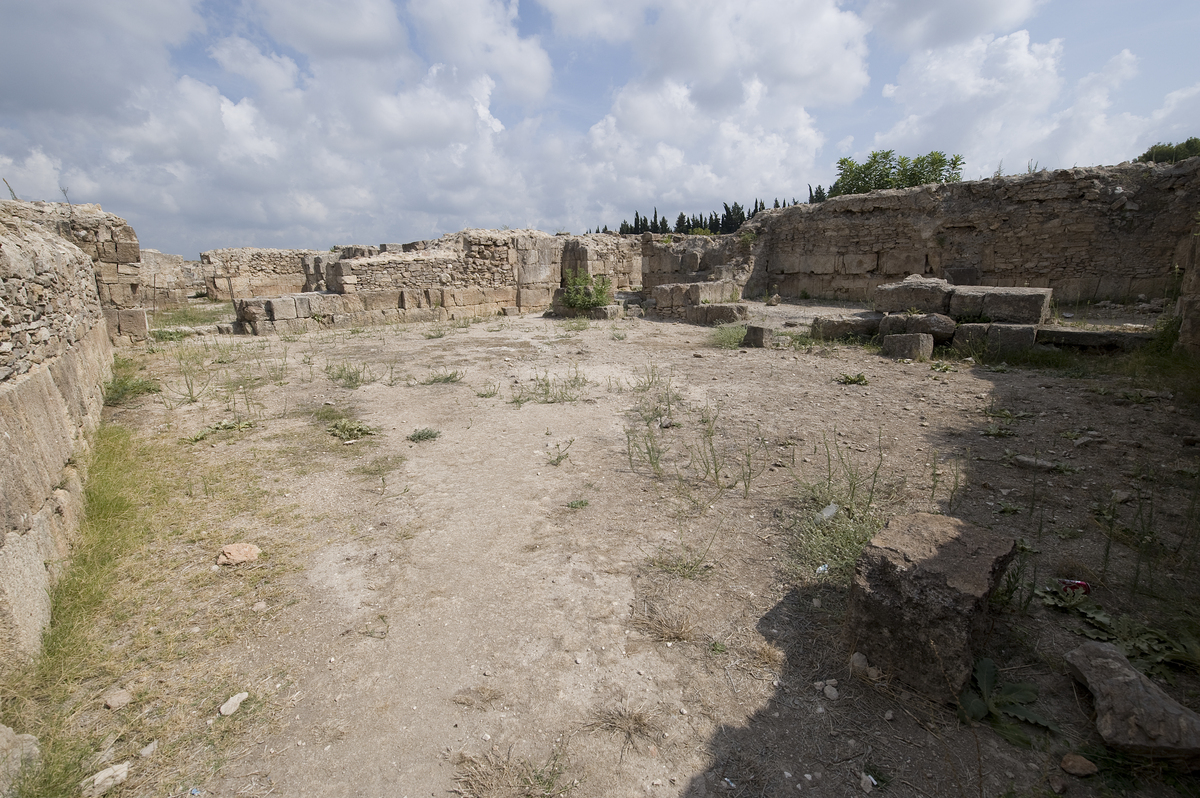
At the moment the affair unfolds, the Hittite empireHittite empireA great Anatolian power of the Late Bronze Age, centred on Hattusha; in the 13th century BCE its great kings arbitrated the affairs of their Syrian vassal kingdoms.→ is one of the three or four superpowers of the ancient Near East, alongside pharaonic Egypt, rising Assyria and Babylonia. From its capital Hattusa, at the heart of Anatolia, the Hittite dynasty dominates a vast network of territories and vassal kingdoms stretching from the Aegean Sea to the marches of northern Syria. Ugarit and Amurru are among these vassals, bound by treaties that tie them personally to the great king.3
The dynasty then reigning descended from Suppiluliuma I, the conqueror who had built the empire in the previous century. In the thirteenth century, the outstanding figure is Hattushili III, a king who had come to the throne after ousting his nephew, and whose wife, the great queen Puduhepa, played a political role of the very first order. Trained as a priestess and a formidable diplomat, Puduhepa corresponded directly with foreign courts, affixed her seal to treaties, and wielded an authority few queens of antiquity ever matched. It was from this powerful couple that Tudhaliya IV was born, the man whose seal closes the divorce tablet.
Tudhaliya IV, whose lineage reaches back to Mursili II and Suppiluliuma, inherited an empire still prestigious but already crossed by tensions. In the west, Anatolian unrest multiplied; in the east, Assyria pushed its pawns and even inflicted severe reverses on the Hittite army; and everywhere, the balance among vassals demanded constant vigilance. Arbitrating the quarrels of his client kingdoms was an integral part of his craft as sovereign. A divorce between two reigning houses of Syria was, for him, no minor matter: it was a test of his authority and a risk to the stability of his southern frontier.
One must picture the scene in all its gravity. When the Hittite great king settles a dispute between Ugarit and Amurru, he does not act as a justice of the peace resolving a neighbourhood squabble. He performs an act of imperial sovereignty. His decision, engraved and sealed, has the force of law for his vassals. The tablet RS 53.17.159 is therefore at once a divorce judgment and a demonstration of power: through this text, the overlord reminds everyone that nothing of importance is decided within his empire without his consent. The king of Ugarit, however rich and proud, is in the end only a vassal who comes to seek from his master the sanction of a decision he cannot impose alone.
This imperial hierarchy also had intermediate tiers. To administer Syria, the Hittite great kings relied on a viceroy installed at Karkemish, on the Euphrates, a member of the royal family charged with overseeing the vassals, settling their disputes and referring important matters up to Hattusa. In the file of Ammistamru's divorce, several texts show the involvement of this court at Karkemish. The rupture of a royal marriage thus circulated from office to office, from seal to seal, through the entire administrative chain of the empire, proof that nothing, in this world, was truly private.
It would be wrong to imagine this empire as a monolithic bloc governed by force alone. Its cohesion rested as much on oaths, treaties and personal bonds as on arms. Each vassal swore an oath of loyalty to the great king, swore by the gods of both parties, pledged to have the same friends and the same enemies as his overlord. To break this bond was to expose oneself to divine wrath as much as to royal vengeance. It is within this logic of sworn fidelity that the arbitration of the divorce belongs: in ruling, Tudhaliya does not merely render justice, he reminds his vassals of the sacred hierarchy that binds them to him.
Amurru, the other vassal kingdom at stake
The other party to this affair is the kingdom of Amurru, from which the repudiated wife came. Located in the mountainous and coastal region roughly corresponding to present-day Lebanon and its Syrian borderlands, Amurru was likewise a vassal kingdom, caught like Ugarit in the meshes of the Hittite imperial network. Its position, on the hinge between the Egyptian and Hittite spheres of influence, had for generations made it both a prize and a tipping ground between the two great powers.
The king of Amurru involved in our affair is Benteshina, whose name also appears in the form Henteshina in certain transcriptions. His dynasty had known turbulent times: in the previous generation, Amurru had swung to the Egyptian side before returning to the Hittite fold, which had cost its rulers many vicissitudes, including periods of exile and restoration. Marrying a princess of Amurru to a king of Ugarit followed a classic political logic of the Late Bronze Age: through marriage, alliances between reigning houses were forged or consolidated, a web of reciprocal solidarities and obligations was woven. The daughter of Benteshina had therefore not come to Ugarit as a mere bride: she was a living bridge between two kingdoms.
This is precisely what made her fall from favour so explosive. To repudiate the daughter of Benteshina was not simply to send a woman home: it was to break the pact that this marriage embodied, to humiliate an allied royal house, and to reopen all the questions the union had sealed. Should the dowry she had brought leave with her? Should the goods Ammistamru had squandered be compensated? To whom did the children born of the marriage now belong? Each of these questions engaged the honour, the fortune and the security of the two kingdoms. Without the arbitration of a higher authority, the affair could degenerate into open conflict between two vassals of the same empire.
The file of this affair, as the archives have preserved it for us, in fact contains several texts that reveal a negotiation spread over time and a complex settlement. We know, for instance, that the matter was brought before several tiers of the imperial hierarchy, including the viceroy of Karkemish and the great king himself. Some documents mention considerable payments intended to settle the accounts between the royal houses. Everything indicates that Ammistamru's divorce was not dispatched in a few words, but was the object of a meticulous arbitration, commensurate with the interests at stake.
What this negotiated slowness reveals is the very nature of matrimonial alliances in the Late Bronze Age. They were political instruments, almost treaties embodied in a person. Undoing them was costly, demanded guarantees, mobilised the highest authorities. The marital thread, in breaking, dragged behind it the whole fabric of regional diplomacy. It is this fabric that Tudhaliya's decree, in a few dozen lines, strives to mend and to fix for ever.
The decree: what the tablet actually says
Let us come to the heart of the document, to what the text states in black and white, or rather in signs on clay. The decree opens by recalling the marital fact: Ammistamru, king of Ugarit, had married the daughter of Benteshina, king of Amurru. Then comes the accusation, brief and cutting: she had, toward him, nothing but malice in mind. Because of this malice, Ammistamru repudiates her. And the text insists on a terrible word: for ever. The rupture is definitive, with no possible return, engraved in the permanence of baked clay.
Ammistamru had married the daughter of Benteshina, king of Amurru. But she had nothing but malice in mind toward him. And so Ammistamru repudiated her, for ever.
The decree then settles the question of property, which occupies a central place. The repudiated wife must take back everything she had brought into the house of Ammistamru and depart with it. This is the legal logic of the ancient Near East: the dowryDowryThe property a bride brings into a marriage; in the ancient Near East its return upon divorce was governed by precise clauses, here between two royal houses.→ belongs to the woman and to her family of origin; divorce requires its restitution. But the text foresees a delicate case. If Ammistamru has lost, squandered or sold part of these goods, then the people of Amurru may claim their value, and the king of Ugarit will have to indemnify them. In other words, one does not merely send the woman away: the accounts of the undone union are settled in full, down to the last missing object.
Then comes the clause with the heaviest consequences, the one touching the succession to the throne. The crown prince is named Utri-Sharruma, also transcribed Utrisharruma. The decree provides for his case with chilling precision. If he declares: I wish to follow my mother, then he must renounce power. The text uses a striking image: he must leave the royal robe upon a stool and depart. The robe laid on the empty seat is the abandoned throne, the inheritance surrendered, royal dignity set down like a garment cast off. In that case, Ammistamru will choose another of his sons to succeed him. And the clause goes further still: if Utri-Sharruma, after the death of his father, were to attempt to restore his mother to her dignity as queen mother, he would suffer the same fate and lose the crown.
This dynastic clause is perhaps the most revealing of the whole decree. It shows that the true stake is not merely to punish a wife, but to secure the future of the lineage. The bond between the heir and his fallen mother is severed, any posthumous rehabilitation is forbidden in advance, the crown is made conditional on renouncing the mother. Beneath the legal coldness one glimpses the political calculation: it must never happen that one day, out of filial piety, the future king reopens the file and restores to the banished queen, and thus to the house of Amurru, an influence over the crown of Ugarit.
Finally, the decree locks down the future. Henceforth, the daughter of Benteshina may assert no right over her sons, her daughters or her sons-in-law: they all belong to the king of Ugarit. Should she or her kin ever formulate a claim, this very tablet would be produced against them, brandished as irrefutable proof. The document thus conceives of itself as a legal weapon meant to endure, to settle any future dispute in advance. It does not merely record a decision: it arms it for eternity. In this it is troublingly modern, like those contracts that meticulously provide for every case of rupture even before the union is tied.
One must pause to measure what such legal foresight represents. The scribe who drafts this text does not merely record a present situation: he anticipates future scenarios, envisages the heir's possible reactions, provides for the potential claims of the house of Amurru, and arms the king of Ugarit with proof that can be produced against anyone who would contest it. This capacity to conceive of law as a device turned toward the future, to write not for the moment but for generations, is one of the great achievements of the literate civilisations of the ancient Near East. The divorce tablet is a remarkable distillation of it.
The fault: adultery or reason of state?
The decree speaks of malice, but on the exact nature of the fault it remains discreet in a thoroughly official way. What precisely was the wife of Ammistamru reproached with? The text of the divorce itself does not say so bluntly. One must cross-reference the sources and the scholarship to try to see more clearly, while bearing in mind that part of the affair will always escape us.
According to the interpretation most widespread among historians, Ammistamru is thought to have discovered, after his wife's return to her native land, that she had committed against him a grave fault, a great sin in the phrasing of the texts. This expression, in the legal and moral vocabulary of the ancient Near East, most often refers to adultery. This is the hypothesis most specialists adopt to explain the exceptional severity of the decree and the relentlessness in permanently barring the queen from any rehabilitation. It is nonetheless proper to remain cautious: this is an interpretation, the most common one certainly, but not an absolute certainty demonstrated by the text itself.
What is striking, in any case, is the apparent disproportion between the sober formula of the decree and the violence of the measures taken. She is not merely repudiated: she is exiled for ever, stripped of all rights over her own children, and her son is threatened with being dispossessed of the throne if he so much as dares to remain loyal to her. Such rigour suggests a fault judged to be infamous, touching the king's honour and the legitimacy of his lineage. The adultery of a queen, in a society where royal descent had to be beyond all suspicion, was precisely the kind of fault capable of justifying so implacable a reaction.
One must also gauge what such a fall meant for a queen. Once a sovereign, the living embodiment of an alliance between two crowns, she found herself sent back to her country, dispossessed, separated from her children, condemned to vanish from the official memory of the court where she had reigned. The decree, moreover, never troubles to name her otherwise than by her filiation: she is the daughter of Benteshina, never a person endowed with a name of her own. This onomastic effacement, in a text otherwise so precise, speaks volumes about the intent to erase her memory.
Finally, one may read the affair on another level, that of reason of state. A queen repudiated for a grave fault was a queen whose house of origin lost, at least momentarily, its ascendancy at the court of Ugarit. The marriage had made Amurru a privileged partner; the divorce reshuffled the cards. Without reducing the drama to cold calculation, one must keep in mind that, in these monarchies, the intimate and the political were inextricably intertwined. The wife's fault, real or constructed, also served interests that far exceeded her, and history has left us only one voice to tell it: that of the king who accused her.
The seal of Tudhaliya: when the gods validate a divorce
A royal decree is worth only as much as what authenticates it. On the divorce tablet appears a seal about 5.2 centimetres in diameter, and this seal is not that of Ammistamru nor of some Ugaritic official: it is that of the Hittite great king himself. It is this impression that transforms a local decision into an imperial act. It proclaims that the authority guaranteeing this divorce is not merely that of the wronged husband, but that of the overlord of an entire world, whose word is law from the Aegean to the Euphrates.
The seal bears, in Luwian hieroglyphic script, the titulature of the sovereign. Around a winged sun disk one reads the invocation: My Sun Tudhaliya, Labarna, the great king. The term Labarna is an ancient Hittite royal title, a kind of honorific dynastic name that one might compare, in another culture, to the title of Caesar: it designates the sovereign function in all its majesty. The winged sun disk, for its part, expresses the quasi-divine nature of the monarch, the Sun of his people. Around these signs runs the genealogy: Tudhaliya, the hero, son of Hattushili and of the great queen Puduhepa, grandson of Mursili. In a few signs, the entire prestige of the dynasty is summoned to support the judgment.
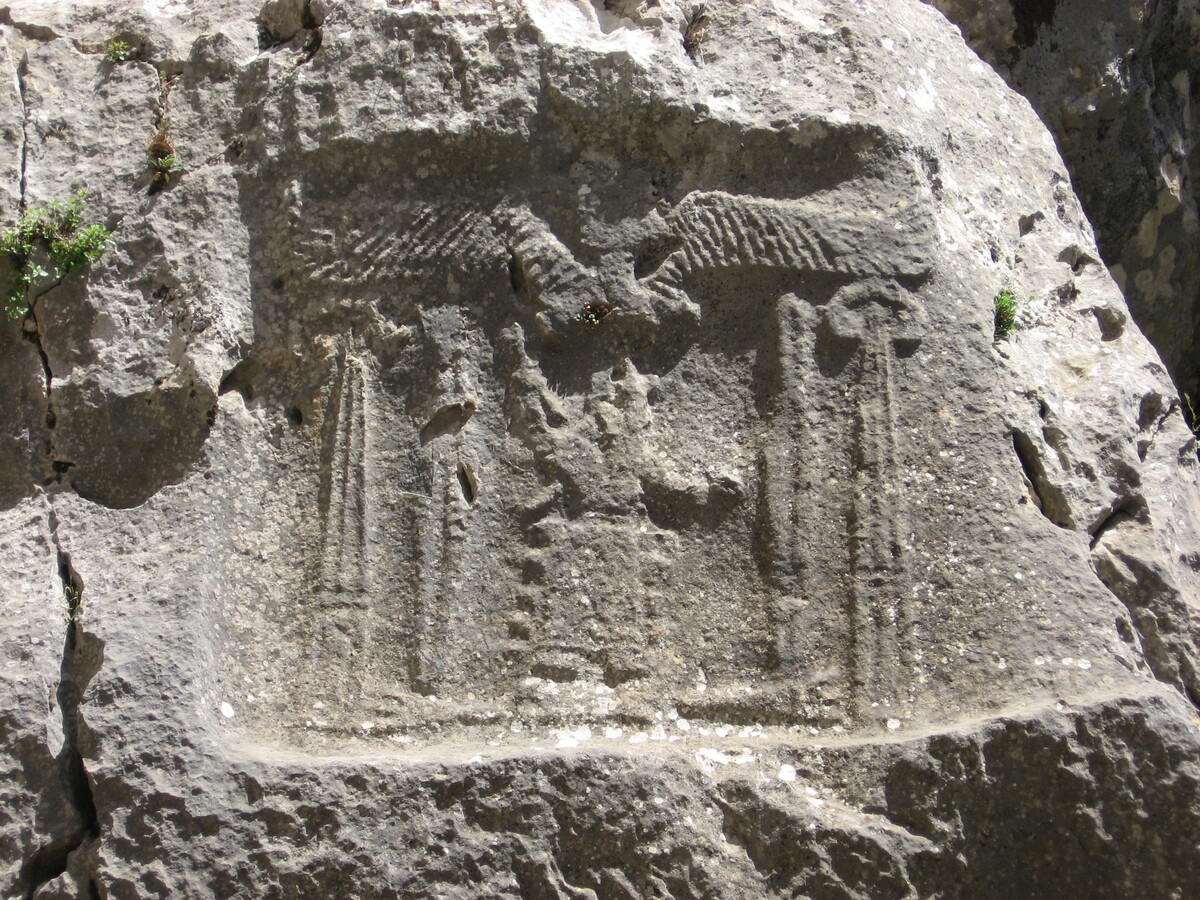
The scene engraved at the centre of the seal deserves our attention, for it says much about the theology of Hittite power. In it the king appears, clad in a short robe, in the act of embracing a deity: the storm god, who holds a mace, symbol of martial might. Facing this group stands a goddess in a long robe, holding a standard adorned with solar signs. This is the sun goddess of Arinna, the highest deity of the Hittite pantheon, the appointed protector of kingship. The king is therefore not depicted alone: he appears under the guardianship and in the intimacy of the gods, as their chosen one and their lieutenant on earth.
The symbolic reach is immense. In affixing this seal to the divorce decree, one does not merely validate a legal act: one places the decision under the gaze of the empire's sovereign deities. Ammistamru's divorce ceases to be a matter of men and becomes a provision that the gods themselves, through their earthly king, are meant to guarantee. Nothing could better deter a future challenge than this celestial surety pressed into the clay. To contest the decree would have been to defy not only Tudhaliya, but the storm god and the sun goddess of Arinna themselves.
This marriage of writing and image, of legal text and divine scene, is characteristic of Late Bronze Age diplomacy. The seal was not a mere administrative stamp: it was a profession of faith and a declaration of power. In pressing it into the still-soft clay, the scribe imprinted at once a signature and a theology. The divorce tablet, in this respect, is also a religious document: it shows us how, in these kingdoms, the gods were brought down even into the marital quarrels of kings.
Diplomatic marriages and law in the Late Bronze Age
So as not to isolate this affair, we must set it back within the diplomatic practice of its time. In the Late Bronze Age, the great courts of the Near East united themselves through marriage as one signs treaties today. The famous AmarnaAmarnaA site in Middle Egypt (Tell el-Amarna), location of Akhetaten, the capital founded by Akhenaten and then abandoned; a major New Kingdom archaeological site.→ letters, that diplomatic correspondence found in Egypt, teem with negotiations over princesses exchanged between pharaohs and the kings of Babylon, Mitanni or Hatti. A king's daughter setting out to marry a foreign sovereign carried with her a considerable dowry and sealed, through her own person, an alliance between two crowns.4
These unions obeyed a sophisticated matrimonial law, whose contracts have reached us by the hundreds. Within it several key notions can be distinguished. The dowry, brought by the woman, remained attached to her and to her family: hence the obligation, in the event of divorce, to restore it, which we see applied in our decree. Conversely, the terhatu designated the payment made by the future husband or his family to the bride's family, a kind of matrimonial compensation that sealed the agreement. Marriage, dowry, repudiation, succession: all of this was codified, quantified, recorded. Ammistamru's divorce applies this ordinary law, but on a royal scale where every clause carries political weight.
The place of queens in this system deserves a pause. Far from being mere pawns, some sovereigns of the Late Bronze Age wielded considerable influence. Puduhepa, the mother of Tudhaliya, is the shining example: she dealt as an equal with foreign courts, co-signed treaties and weighed on the policy of the empire. The contrast is striking with the fate reserved for the daughter of Benteshina, cast down from the dignity of queen to that of repudiated wife, stripped of all rights over her children. This contrast reminds us that a queen's status hung by a thread: as long as she embodied the alliance, she was untouchable; her disgrace tipped her into a legal void.
The great model of this diplomacy on clay, the one that dominates the whole century, remains the peace treaty between the Egypt of Ramesses II and the Hatti of Hattushili III, concluded after the battle of Kadesh. This treaty, of which we possess both the Egyptian and Hittite versions, was likewise sealed, archived, guaranteed by the gods of the two countries, and even consolidated by a marriage between a Hittite princess and the pharaohPharaohThe title of the ruler of ancient Egypt, regarded as a living god guaranteeing cosmic order (Maat), supreme head of state, army and worship.→. One version is known displayed in an Egyptian temple and another on a clay tablet, found at Hattusa: two faces of the same act, engraved in two different materials, for two different audiences.
The Ugarit divorce belongs to this same legal and diplomatic culture: that of a world where sealed clay made peace as it unmade marriages. Alongside the great treaties between equal powers, these more modest acts, these marriage contracts and divorce decrees between vassals, sketch in outline an international system of astonishing density. Nothing in it was left to chance or to spoken word alone: everything had to be written, sealed, archived, to serve as proof and to bind the generations to come. The tablet RS 53.17.159 is one of the intimate links in this immense diplomatic machine.
We then measure how far our modern categories, which sharply separate the private affair from the public one, sentiment from politics, struggle to account for this world. For a king of the Late Bronze Age, to marry was an act of state; to divorce was just as much one. The very body of the wife, her fidelity, her fertility, her loyalty to her husband's house, engaged the balance between entire kingdoms. This is what gives this decree, beyond its anecdotal interest, the value of an exceptional document: it opens a rare window onto the way these societies articulated desire and power, law and faith, the individual and the empire.
A divorce, last reflection of a world about to sink
There is something poignant in contemplating this tablet while knowing what will follow. Around 1200 before our era, barely two or three generations after Ammistamru's divorce, the world of the Late Bronze Age collapses. Within a few decades, the great empires totter, cities burn, trade networks break apart. The causes of this collapse remain debated: movements of peoples, including the famous Sea Peoples, droughts and famines, earthquakes, internal crises and the domino effect of a system too interdependent. The outcome, however, is beyond appeal.
Ugarit, the brilliant merchant city, does not survive the storm. It is destroyed at the beginning of the twelfth century and will never rise again. Extraordinarily, it is its final hours that have bequeathed us some of its most moving texts: letters in which the king calls for help, reports enemy ships offshore, describes a defence overwhelmed while his own troops and ships were far away. Then silence. The city buries itself beneath its own rubble, and with it its archives, including the divorce tablet, which will wait three thousand years for an archaeologist's pick to bring them back to the light of day.
This burialBurialThe intentional deposition of a body, sometimes with offerings; a marker of symbolic behaviour.→, paradoxically, was a stroke of luck for history. Because Ugarit was destroyed and abandoned all at once, its archives were neither methodically looted nor recycled, but sealed beneath the debris. Clay, a humble and seemingly perishable material, proved extraordinarily resistant: baked by fires or simply hardened by the centuries, it crossed the millennia when parchment and papyrus would long since have disintegrated. The oldest documented royal divorce has reached us only thanks, in a sense, to the catastrophe that swallowed the city that produced it.
What became of the protagonists of our story? Ammistamru II reigned a while longer over his prosperous kingdom, then left the throne to a successor, in a Ugarit living out its last decades of splendour. Of the daughter of Benteshina, history says nothing more after her banishment: she vanishes from the archives as the decree intended, effaced down to her very name, the victim of an oblivion organised by the very text that had condemned her. As for Tudhaliya IV, he strove to the end to hold together his threatened empire, without being able to prevent the slow unravelling that would carry off the Hittite world soon after him.
There remains, in the end, the troubling power of this document. Beneath the dryness of the legal clauses throbs a universal story: a couple breaking apart, a child divided between his parents, a woman judged and banished, families settling their accounts. Three thousand two hundred years separate us from Ammistamru and the daughter of Benteshina, yet the human tremor that surfaces beneath the cuneiform is strangely familiar to us. This is perhaps the finest lesson of this tablet: empires pass, cities collapse, but the passions and the heartbreaks of men resemble one another from one end of history to the other.
Les objets rituels et les premières représentations humaines sont ma spécialité. Cet article est parfait.
Je prépare une sortie avec l'association des retraités. Votre dossier sera notre guide de lecture.