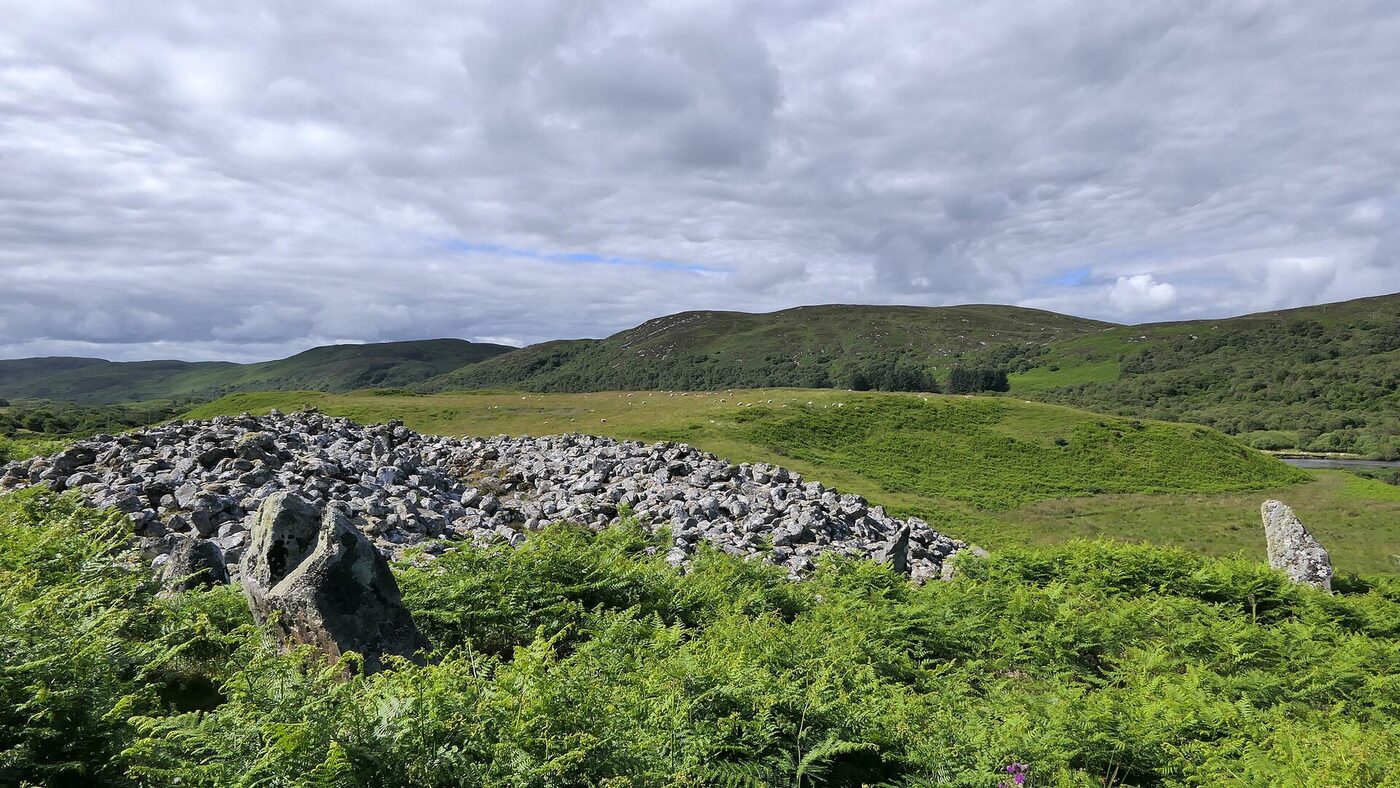
In the far north of Scotland, where the Highlands break into dark lochs and peatPeatA waterlogged organic soil formed by accumulated plants; it seals and remarkably preserves wood and ancient remains.→ bogs that the wind never stills, a small heap of collapsed stones overlooks the waters of Loch Borralie, in Sutherland. At first glance, nothing sets this mound apart from the countless piles of stones scattered across these moors. And yet, inside what archaeologists call a cairnCairnA human-made mound of stones, often raised over a burial chamber (chambered cairn) or used as a marker; common across the British Isles from the NeolithicNeolithicThe "New Stone Age": a period marked by farming, herding, settlement and pottery, from around 10,000 BC.→ to the Iron Age.→, human remains from the Iron AgeIron AgeThe last period of protohistoryProtohistoryThe transitional period between prehistory and history, covering societies without their own writing but known through external texts.→ (from c. 1200 BC in Europe and the Near EastNear EastA region of western Asia (Levant, Mesopotamia, Anatolia, Iran), cradle of the Neolithic revolution, agriculture, the first cities and writing.→), marked by iron metallurgyMetallurgyThe techniques of extracting and working metals (copper, bronze, gold); its rise in the Eneolithic and Bronze Age transformed tools, weapons and social hierarchies.→ and the first kingdoms.→ have yielded, through patient re-examination, one of the most unsettling files in the whole of British funerary archaeology. Long bones had been taken from the dead, fashioned into sharp tools and a point, then, in a gesture that defies our modern intuition, carefully put back in their anatomical place, as though to return to the skeleton what had been borrowed from it. To this is added an even more chilling clue: the trace of a post-mortem extraction of the brain. These are not the remains of ordinary violence, but the signature of a relationship with the dead whose complexity we are only beginning to glimpse1.
To grasp what the Loch Borralie cairn tells us, we must agree to set aside our certainties. In our societies, the body of the deceased is an object of almost untouchable respect: we bury it, we cremate it, we mourn it, but we do not dismantle it, and the idea of turning it into a working tool borders on sacrilege. Yet in the protohistory of the British Isles, the boundary between the dead and matter, between the ancestor and the object, seems to have been porous, negotiable, crossed by practices that neither horror nor fascination suffices to explain. It is this otherness that this article sets out to explore2.
The Scottish Iron Age: a world of stone and silence
Before turning to the site itself, we must set the scene. The British Iron AgeIron AgeThe last period of protohistory (from c. 1200 BC in Europe and the Near East), marked by iron metallurgy and the first kingdoms.→ runs roughly from the last third of the first millennium BC until the arrival of Rome, which never truly reached the far Caledonian north. In Scotland, and above all in its northern regions, Sutherland, Caithness, Orkney, Shetland and the Hebrides, this period left no text written by the local populations. These societies knew no writingWritingA system of conventional signs used to fix language or information durably; its appearance (c. 3300 BC) marks, by convention, the end of prehistory.→; we know them only through their stones, their bones and the rare, often distorted mentions made of them by Greek and Roman authors2.
Yet these stones are eloquent. The Scottish Iron Age is the age of great dry-stone architecture: promontory forts, roundhouses, underground passages dug beneath dwellings, and above all the brochs, those tall round towers that form one of the most spectacular architectural signatures of all protohistoric Europe. To raise such structures without mortar, by stacking thousands of dry-fitted blocks, demanded remarkable technical mastery and collective organisation. This world was neither poor nor archaicArchaicRefers to an ancient, now-extinct human population or form (Neanderthals, Denisovans, ghost lineages), as opposed to anatomically modern humans.→: it was a mosaic of farming and pastoral communities, hierarchical, capable of mobilising considerable labour, and deeply attached to the land of their ancestors3.
The relationship of these communities with their dead was, however, anything but simple. Unlike what is seen on the continent at the same time, where great cremation or inhumation cemeteries multiply, the British Iron Age is, in large part, archaeologically "without dead". Formal, identifiable, complete burials are surprisingly rare. For a long time, this was taken to mean that these populations practised "invisible" funerary rites: exposure of the body to the elements, abandonment in the open, immersion in water, scattering of ashes. But recent discoveries, of which Loch Borralie is a landmark, show that the reality was far more active. The dead were not merely set aside; they were handled, fragmented, kept, reused. Their absence from cemeteries does not mean they were forgotten, but on the contrary points to a diffuse, insistent presence at the very heart of the life of the living1.
Cairns and brochs: monuments of the long term
One should not, moreover, imagine the Scottish Iron Age as a closed world, folded in upon its moors. The communities of the far north took part in vast exchange networks linking the islands to one another and, by sea, to the rest of Atlantic Europe. Metal, ornaments and ideas circulated along the wind-beaten coasts. This maritime openness makes the singularity of local funerary practices all the more remarkable: these are not the rites of an isolate cut off from the world, but those of a connected society that made its own choices in its relationship with the dead. Regional diversity, moreover, was great: what held in Sutherland did not necessarily hold in the Hebrides or Orkney, and each community composed its own variations from a shared fund of beliefs. Loch Borralie is therefore not the spokesman for a uniform Iron Age, but the witness to one of these many local ways of inhabiting death2.
The word cairnCairnA human-made mound of stones, often raised over a burial chamber (chambered cairn) or used as a marker; common across the British Isles from the Neolithic to the Iron Age.→, passed from Scottish Gaelic into international scientific usage, denotes a mound of stones raised by human hands. Some are merely markers, landmarks set on a ridge. Others, the oldest and most imposing, cover one or more burial chambers: these are the chambered cairns, megalithicMegalithA large stone raised or assembled by humans (menhirMenhirA stone erected vertically by humans, standing alone or in rows (alignments), emblem of the Breton Neolithic megalithic tradition. From Breton men (stone) and hir (long).→, dolmenDolmenA megalithic funerary structure made of one or more capstones resting on vertical uprights, often topped by an earth tumulus. From Breton dol (table) and men (stone).→, stone circleStone circleA Neolithic or Bronze Age monument of standing stones set in a ring, often ritual or astronomical in purpose.→), typical of the Neolithic and Bronze AgeBronze AgeA protohistoric period following the Neolithic, defined by bronze metallurgy (a copper-tin alloy) and the rise of the first cities and states; in Egypt it corresponds to the age of the first pyramids.→.→ monuments whose earliest Scottish examples date back to the Neolithic, nearly three millennia before the Iron Age. In the far north, these Neolithic cairns still punctuate the landscape today, relics of a time when the islands' first farmers placed their dead in accessible collective chambers, to which they returned, generation after generation, to add new bones and move old ones3.
This long memory of stone is essential to understanding Loch Borralie. For the people of the Iron Age did not raise all their monuments from scratch: at times they reinvested ancient structures, inherited from their Neolithic or Bronze Age predecessors. A cairn already two thousand years old could become again, for a community of the first millennium BC, a place charged with meaning, a threshold between the world of the living and that of the ancestors, a fixed point in a landscape inhabited by the dead. To place a body, or fragments of a body, in such a monument was to bind them to an immemorial genealogy, real or imagined2.
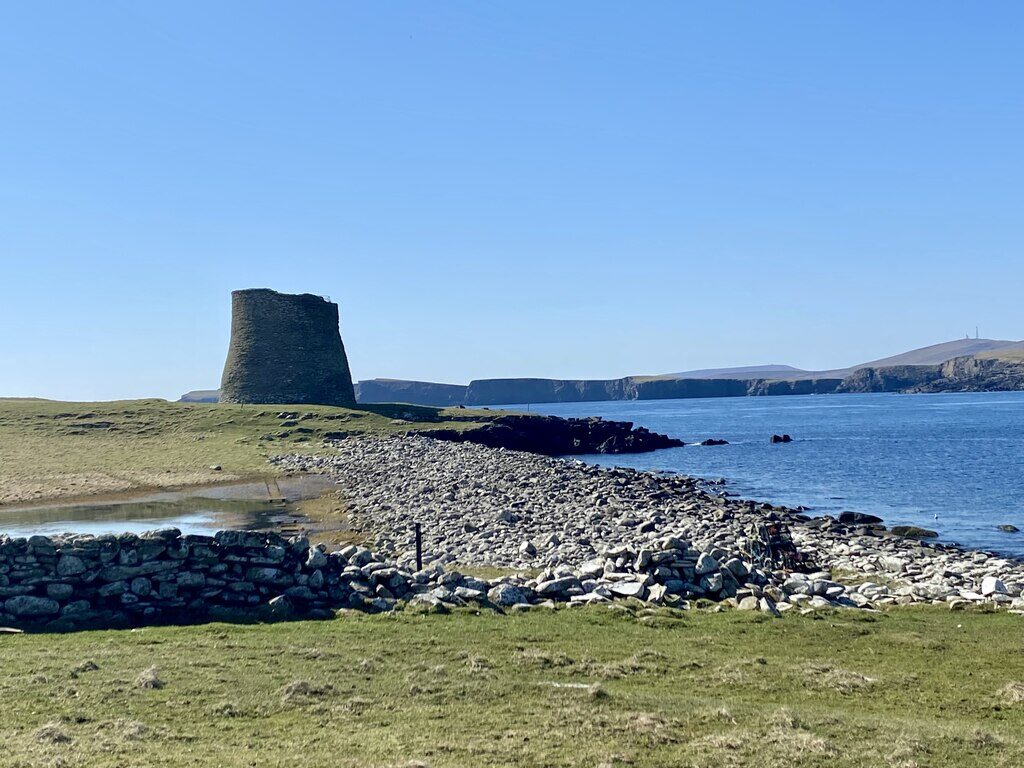
The broch, for its part, belongs properly to the Iron Age. These circular towers, built in dry stone on the principle of the double wall linked by internal galleries and stairs, rank among the most accomplished structures of European prehistoryPrehistoryThe span of human history before the invention of writing, from the Palaeolithic to the Metal Ages, known mainly through material remains.→. The most famous, that of Mousa in Shetland, still raises its thirteen metres of intact walls towards the North Sea. Their function has long been debated: defensive fortresses, prestige dwellings, fortified farms, status symbols? Doubtless something of all of these at once. What matters here is that these communities, capable of such technical masterpieces, simultaneously maintained, with the bodies of their dead, a relationship that we would today judge strangely brutal. Architectural sophistication and the handling of corpses were not, for them, contradictory: they belonged to one and the same mental universe, coherent, whose key still partly escapes us3.
Loch Borralie: the discovery and the re-examination
The site of Loch Borralie was excavated around the turn of the 2000s, as part of research into Iron Age occupation in the far north-west of Scotland. The cairn yielded human remains that, at first sight, seemed unexceptional: scattered, mingled, incomplete bones, like so many funerary deposits of this period. But archaeology does not have the last word at the moment of excavation. It is often the re-examinations, years later, in the light of new questions and new methods, that reveal what the first analysis had overlooked1.
That is precisely what happened. Taking up the bone material again with the tools of modern taphonomy, the discipline that reconstructs everything that befalls a body from the moment of death to its discovery, the researchers saw appear what no one had suspected. On certain bones, regular, intentional marks bore witness not to mere decomposition or to the action of scavengers, but to a deliberate working of the bone by the human hand. Four long bones in particular bore the stigmata of transformation into tools. And, in a truly astonishing detail, these modified bones had been reintegrated within the skeletons, placed back where anatomy expected them1.
The re-examination, in short, tipped Loch Borralie from a commonplace file towards an exceptional one. Where only a disordered deposit had been seen, a sequence of gestures could now be read: death, decomposition or defleshing, the removal of specific bones, their shaping into instruments, perhaps their use, then their restoration to the original body. A funerary choreography in several movements, which implies that the community returned several times to its dead, that it kept the memory of their identity, and that it obeyed rules whose code we do not possess2.
Bones transformed into tools
Let us dwell on the heart of the discovery: those four long bones, femurs, tibias or humeri, the great bones of the limbs, fashioned into tools. Human bone, it must be recalled, is a first-rate material for those who know how to work it. Dense, hard, elastic, it can be cut, polished, given an edge. Since the dawn of prehistory, animal bone has served to make awls, needles, burnishers, points and handles. That bone should have been turned into a tool in the Iron Age is in itself unsurprising: it is a universal skill. What is startling is that the bone used here was human, taken from dead people whose identity was probably known1.
The analyses showed that these bones had been retouched to produce cutting edges and, on at least one of them, a point. In other words, genuine functional tools, capable of cutting, piercing, scraping. We do not know the exact use for which they were intended: hide-working, woodworking, fibre preparation, ritual gestures? Archaeology does not decide. But the question of use is almost secondary to the dizzying one of meaning. Why draw the raw material of a tool from the bodies of the dead, when animal bone was abundant? Why mobilise, to fashion an instrument, the very bone of a relative, an ancestor, a member of the community3?
The choice of the long bone is surely not incidental. Femurs, tibias and humeri are the most voluminous, the most solid, the most symbolically charged bones of the skeleton: it is they that hold the body upright, that embody the strength and stature of the living individual. In many traditions, these great limb bones concentrate a particular value, as though they condensed something of the identity or power of the deceased. In selecting precisely these pieces for transformation, the craftsmen of Loch Borralie were not taking any ordinary material: they were drawing from the very core of what, in the body, signified most. The technical gesture is thus doubled by a gesture of meaning, the shaping of the tool being inseparable from the choice of the material. It is this entanglement of the functional and the symbolic that makes these objects so hard to interpret through our modern categories alone, in which the tool is pure instrument and bone pure waste3.
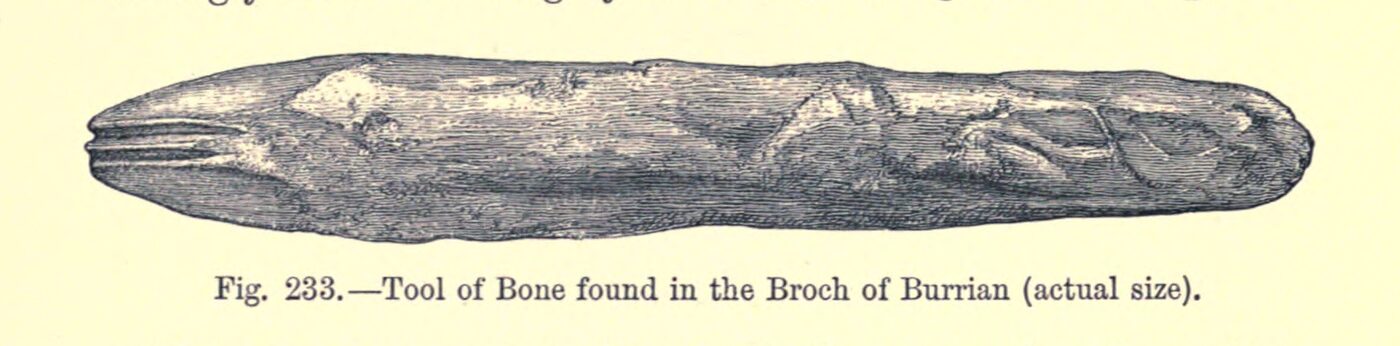
Several hypotheses present themselves, and none is exclusive. The first is that of the relic: a tool drawn from the bone of an ancestor would retain, by contact, part of their power, protection, authority. To wield such an instrument would be to bind oneself to the presence of the deceased, to make the dead work for the benefit of the living. The second hypothesis concerns social status: to possess a tool fashioned from the bone of a prestigious relative might mark belonging, legitimacy, a displayed genealogical link. The third, darker, evokes a relationship of domination or conflicted memory: the bone of an enemy, of a defeated foe, turned into a utilitarian tool, would signal appropriation, a lasting subjugation of the adversary. The Loch Borralie material does not allow us to decide between these readings; it permits them all, and it is this very openness that makes it so rich2.
Anatomical replacement: a gesture that defies intuition
If the transformation of bone into a tool intrigues, it is the following gesture that astounds: the anatomical replacement. The long bones fashioned into instruments were not kept apart, in a chest or a sanctuary, nor discarded once worn out. They were returned to the skeleton, placed back at the precise spot where anatomy located them, the tibia where the tibia should be, the femur in its place as femur. As if, after borrowing them, transforming them, perhaps using them, care had been taken to reconstitute the integrity of the dead body, to give back what had been taken from it1.
This gesture directly defies our logic. For us, to make a tool from a bone is to divert it definitively from its original function; the idea of "putting it back" in the skeleton has no utilitarian sense. It is precisely here that the symbolic depth of the rite lies. The anatomical replacement suggests that, in the thinking of these communities, the body of the dead did not cease to be a body when it was dismantled. To remove a bone, work it, then return it, was perhaps a complete cycle: the dead gives, the living receive and use, then restore, and the body becomes whole again, ready for another stage of its post-mortem existence. We glimpse a conception of the corpse not as waste to be disposed of, but as a sacred resource that one borrows and gives back2.
Another, complementary reading stresses the dimension of repair or reintegration. By replacing the bones, the community perhaps affirmed that the deceased, despite the removals, remained a person, a unit, an identifiable ancestor. Dismemberment was not destruction, but a reversible stage. This idea of a body that can be undone and remade, opened and reconstituted, is foreign to our culture, but it sheds new light on the whole of British Iron Age funerary practice, where one finds, at other sites, disarticulated then rearticulated bodies, skeletons recomposed from several individuals, bones that circulate before finding a grave3.
The post-mortem extraction of the brain
To this first series of gestures is added another, independent but convergent: the extraction of the brain after death. The marks noted on the cranial remains of Loch Borralie indicate that the brain was removed from the skull of one or more of the dead, not in a context of immediate violence but after death, as part of a post-mortem treatment of the body. Here again, this is not an act of predation or gratuitous cruelty, but a codified gesture, integrated into a funerary sequence1.
The extraction of the brain is, in protohistoric archaeology, no isolated fact. The most famous case is that of the Heslington skull, in Yorkshire, where an Iron Age brain was found remarkably preserved inside an isolated skull, proof that, under certain conditions, brain matter could survive for millennia, and a clue that the head was the object of particular treatment. At Loch Borralie, it is not preservation but extraction that is attested: the skull was emptied. Why? The hypotheses meet those of the transformed bones. The brain, the supposed seat of something essential, life, thought, force, identity, could be removed for ritual, conservatory or symbolic reasons. Emptying the skull might also prepare the head for later use: keeping, display, separate deposition2.
The head, in the Celtic world and more broadly in the protohistory of Atlantic Europe, held a singular place. Ancient authors report the importance that the peoples of the north-west attached to heads, kept, displayed, sometimes honoured as trophies or relics. Archaeology confirms, at many sites, a specific treatment of skulls, often separated from the rest of the body, sometimes pierced, suspended, deposited in significant places. The brain extraction at Loch Borralie belongs to this vast set of practices centred on the head, that privileged seat of the person and of power3.
A complex relationship with the dead in protohistoric Britain
Loch Borralie is no isolated anomaly: it is an exceptional point of light on a general phenomenon. The protohistory of the British Isles was the stage for a relationship with the dead of a richness and complexity that recent excavations continue to reveal. Far from simple burial followed by oblivion, these societies maintained with their dead an active, prolonged, negotiated relationship, in which the dead body remained, for years or even generations, an actor in social life2.
Archaeologists refer to this phenomenon by the term curation of human remains, that is, the keeping, the maintenance, the circulation of bones after death. At many British sites of the Bronze and Iron Ages, human bones have been found which, judging by their degree of alteration and by dating, had been kept long after death before being finally deposited. Bones that had lain in the open, been handled, polished by hands, passed on. Fragments of bodies kept as one keeps a precious object, perhaps within the houses, among the living. The dead were not banished from the world: they remained present in it, in the form of bones that were kept, shown, made to work1.
This practice casts new light on the famous "absence of the dead" in the British Iron Age. If formal cemeteries are lacking, it is not that these societies neglected their dead; it is that they treated them otherwise, by ways that leave none of the traces to which we are accustomed. The body did not go in one piece into a sealed burialBurialThe intentional deposition of a body, sometimes with offerings; a marker of symbolic behaviourSymbolic behaviourA set of practices (adornment, pigments, art, burial) reflecting symbolic thought; long ascribed to Homo sapiens alone, now attested for Neanderthals too.→.→, but followed a winding path: exposure, defleshing, removal, keeping, circulation, fragmentation, and finally, sometimes, deposition in a cairn, a ditch, a domestic pit, a river. At each stage, choices were made, some bones retained, others set aside. The dead became a social material, mobilised by the living to assert ties, statuses, belongings, memories3.
At the heart of all this stands the figure of the ancestor. In a society without writing, without archives, without title deeds, it is the dead who ground the legitimacy of the living. To possess the bones of a forebear, to keep them, display them, reuse them, was to assert a continuity, to anchor a group in a lineage, to justify the possession of land or a herd by the link with those who had held it before. The body of the ancestor was at once a title of nobility, a notarised deed and a protective relic. The bones of Loch Borralie, transformed into tools then returned to the skeleton, partake of this logic: they made of the dead a permanent partner of the living, present in everyday gestures as in the most solemn rites2.
This prolonged presence of the dead also had a properly political function. In societies where power rested on no state apparatus, no bureaucracy, no written law, authority was founded on prestige, ancestry, the memory of great deeds. To control the remains of the ancestors was to control the very source of legitimacy. One understands, then, why bones could become stakes: objects of transmission, of claim, sometimes of conflict. The bone of the founding forebear was worth more than a mere sentimental relic; it was the pledge of a right, the instrument of a domination, the cement of a community around its lineage. The practices of Loch Borralie, by making the dead work among the living, gave this logic its most tangible form: the ancestor was not only honoured in thought, but present in the hand, in the tool, in the daily gesture1.
The methods: taphonomy and cut-marks
How, in concrete terms, do archaeologists reconstruct such scenarios from a few bones? The answer lies in one word: taphonomy. This discipline studies all the processes that affect a body from the moment of death to its discovery by the excavator. Decomposition, the action of animals, transport by water, trampling, burial, human gestures: each leaves on the bone a recognisable signature. To read these signatures is to rewind the film of events, to distinguish what belongs to nature from what betrays the hand of man1.
The cut-marks play a decisive role here. A knife, a blade, a tool of metal or stone leaves, on cutting fresh bone, fine, straight striations with a characteristic V-shaped profile, distinguishable from the marks of carnivore teeth (broader, rounded), from desiccation cracks or from post-mortem fractures. Their location is eloquent: striations near muscle insertions signal defleshing, the detachment of the flesh; marks at the joints betray disarticulation; incisions on the cranial vault may indicate the opening of the head. At Loch Borralie, it is the conjunction of these clues, the regular shaping of the long bones, traces of extraction on the skulls, anatomical replacement, that made it possible to reconstruct the sequence of gestures3.
To these observations are added, at well-studied sites, complementary analyses: radiocarbonRadiocarbon (carbon-14)A dating method based on the decay of carbon-14, usable back to about 50,000 years.→ dating to place in time the death and any reuse, comparison of the degrees of alteration between the bones of a single deposit to spot the pieces kept longer, microscopic examination of surfaces to distinguish a use-polish from simple natural wear. It is the accumulation and convergence of these clues, rather than a single proof, that ground the interpretation. Funerary archaeology proceeds by bundles: no bone speaks alone, but their whole, patiently questioned, ends up yielding a coherent narrative2.
It is worth stressing the caution this approach demands. The researchers do not claim to have pierced the exact meaning of the rites of Loch Borralie; they establish material facts, a bone was carved, a skull was emptied, pieces were replaced, and propose interpretations they know to be provisional. This methodological rigour is the price of all serious archaeology. Faced with practices so distant from our own, the temptation is great to project our categories, our emotions, our fascination with the macabre. Taphonomy, by sticking first to the traces, offers a safeguard against such drifts1.
Understanding societies without writing
The case of Loch Borralie poses, in acute form, the fundamental problem of all archaeology of protohistoryIron AgeThe last period of protohistory (from c. 1200 BC in Europe and the Near East), marked by iron metallurgy and the first kingdoms.→: how to understand a society that has left us no word? The populations of the Scottish Iron Age speak to us only through their material remains. We have neither their stories, nor their names, nor their beliefs expressed in their own terms. All that we know of their relationship with the dead we deduce from carved bones, deposits, the arrangement of stones. It is knowledge by traces, indirect, fragmentary, always threatened by over-interpretation2.
This situation calls for a particular humility. It would be easy, and false, to call these practices "barbaric" or "savage". The dismemberment of bodies, their reuse, the extraction of the brain shock us because they collide with our norms; but our norms are not universal. Many cultures, across the world and through history, have maintained with their dead relationships we would judge strange: bones kept in the houses, painted and displayed skulls, defleshed bodies buried in several stages, relics circulating among the living. Far from being a monstrous exception, the treatment of the dead at Loch Borralie belongs to the vast range of human ways of living with those who are no more3.
Ethnography offers, in this respect, precious points of comparison. In many writing-less societies observed in modern times, death is not an instant but a process, spread over months or years, marked by successive rites that accompany the slow transformation of the deceased into an ancestor. The famous "secondary funerals", in which the defleshed body is exhumed to be treated a second time, illustrate this long temporality. Without mechanically imposing these models on Iron Age Scotland, we find in them a grid of reading: what if the gestures of Loch Borralie too belonged to a long funerary journey, of which the carved and replaced bones are but one stage among others1?
To understand these societies is therefore to accept a double requirement: rigour in establishing the facts, and openness in their interpretation. To assert nothing that the bones do not allow us to assert; but to forbid ourselves nothing of what comparative anthropology makes thinkable. Between the narrow positivism that confines itself to describing the striations, and the unbridled imagination that invents whole religions, protohistoric archaeology seeks its path. Loch Borralie, by its richness and its strangeness, is an excellent ground for this exercise in balance2.
Comparisons: Loch Borralie among other sites
To measure the significance of Loch Borralie, it must be placed within the network of British sites which, together, sketch the picture of funerary practice in insular protohistory. The most spectacular is doubtless Cladh Hallan, in the Outer Hebrides, where, beneath the remains of Bronze Age houses, artificially mummified bodies were discovered, and, more astonishing still, composite "skeletons" assembled from the bones of several distinct individuals, sometimes separated by centuries. At Cladh Hallan, the body laid to rest was not a single person, but a recomposition, a body rebuilt piece by piece. This practice echoes, across the centuries, the dismantling and reassembly observed at Loch Borralie: in both cases, the body is treated as a modular assemblage, something that can be undone and remade2.
The Heslington skull, already mentioned, brings further light. This isolated Iron Age skull, found in Yorkshire with its brain preserved, attests both to the separate treatment of heads and to the possibility, under certain conditions of burial, of an exceptional preservation of brain matter. It reminds us that the head was, throughout protohistoric Britain, the object of particular attention, which the brain extraction of Loch Borralie confirms from the opposite angle, that of removal rather than preservation3.
Other sites complete this panorama. In the caves of Alveston or the Somerset region, Iron Age human remains bear cut-marks and traces of handling that have prompted long debate, ritual defleshing, cannibalism, or simple funerary treatment? The ditches and enclosures of southern England, such as those of Wessex, have yielded scattered human bones mixed with domestic refuse, witnesses to a circulation of remains at the very heart of the settlement. Everywhere the same observation imposes itself: the British Iron Age dead were not a body to be buried and left, but a presence to be prolonged, fragmented, moved, kept. Loch Borralie, with its carved and replaced bones, offers one of the most accomplished and disconcerting expressions of this1.
These comparisons are precious for another reason: they forbid reducing Loch Borralie to a macabre curiosity. Taken alone, a cairn of carved bones might pass for a local eccentricity, the work of a deviant group. Placed within the series, it appears on the contrary as a particularly clear case of a widespread, shared, structured behaviour. Therein lies the whole value of the comparative approach: it transforms the anecdote into a phenomenon, the anomaly into a norm, and allows us to think, behind the diversity of gestures, the unity of a certain protohistoric way of inhabiting the world of the dead3.
Beyond the British Isles, protohistoric Europe as a whole offers echoes of these behaviours. On the continent, the Celtic sanctuaries of the second Iron Age, such as those of Gaul, have yielded deposits of human bones treated, displayed, handled, in which heads occupy a place of choice. The ancient sources, for their part, describe, not without exaggeration or misunderstanding, northern peoples keeping the skulls of their enemies or their ancestors. While we must beware of pouring all these cases into one mould, their convergence is striking: from one end of Iron Age Europe to the other, the dead body, and singularly the head, was the object of active treatment, blending ritual, politics and symbol. Loch Borralie, at the northern tip of this vast world, constitutes one of its most northerly and most accomplished testimonies2.
What Loch Borralie teaches us
At the end of this journey, what should we retain of the Loch Borralie cairn? First a material fact, firmly established: in Iron Age Scotland, human bones were taken from the dead, transformed into sharp tools and a point, then put back in their anatomical place within the skeletons, while the brain of at least one skull was extracted after death. These are not conjectures, but taphonomic observations, legible in the cut-marks and the arrangement of the pieces. Loch Borralie hands us, engraved in bone, the concrete trace of a complex funerary practice1.
Next, a lesson in method. It was a re-examination, and not the initial excavation, that revealed the exceptional. Remains do not yield their meaning all at once; they await the questions one will know how to put to them, the tools of analysis one will know how to apply. Archaeology is not only a science of discovery, but a science of re-reading, in which each generation of researchers questions anew the material inherited from the previous one. Loch Borralie, a commonplace file become a major one, is the perfect illustration of this2.
Finally, an invitation to broaden our view of death. The societies of the British Iron Age hold up to us a distorting mirror in which, by contrast, the narrowness of our own certainties is reflected. Where we see a body to be buried once and for all, they saw a living material of social relations, a resource to be kept, fragmented, reused, returned. The dead were there no absentee, but a partner; the ancestor, no abstract memory but a presence of bone and stone, mingled with the gestures of the living. In putting the carved bone back in its place in the skeleton, these men and women of the far Scottish north said, in their own way, that the bond with the dead is never quite broken, that it is transformed, negotiated, prolonged, beyond the decay of the flesh and the collapse of the cairns3.
The small mound of stones that watches over the waters of Loch Borralie has not finished instructing us. Modest among the monuments of prehistoric Scotland, lacking the majesty of the great brochs and the splendour of the Neolithic cairns, it nonetheless carries one of the most striking lessons in otherness that British protohistory has bequeathed to us. In its carved and restored bones can be read all the distance that separates us from the writing-less societies of the first millennium BC, and, in the extreme care taken to return to the dead what had been borrowed from them, perhaps also an unexpected nearness: that of a respect for the dead which, under forms we no longer recognise, has surely never ceased to dwell in the human heart1.
Je voyage beaucoup sur les sites archéologiques. Ce site est de loin le meilleur pour les préparer.
Les fouilles en contexte humide comme certains sites écossais conservent des matériaux organiques habituellement disparus : os, bois, textiles. Ces conditions de conservation exceptionnelles permettent des analyses qui sont impossibles sur les sites ordinaires. Les nouvelles méthodes d'analyse des résidus lipidiques sur les céramiques ont révolutionné notre connaissance de l'alimentation préhistorique.
Les découvertes préhistoriques en Ecosse sont souvent éclipsées par les monuments mégalithiques des Orcades, mais les sites paléolithiques et mésolithiques écossais sont tout aussi importants. Les restes humains retrouvés dans des contextes funéraires néolithiques en Ecosse témoignent de pratiques rituelles complexes. L'Ecosse mégalithique mérite vraiment une plus grande visibilité.